The 1977 Notre Dame Fighting Irish football team wasn’t supposed to win the national championship. Coming off a 9–3 season the year prior and still in the shadows of Ara Parseghian’s legendary tenure, head coach
Dan Devine
faced intense pressure from fans and media alike. After a rocky start and a humiliating early-season loss to Ole Miss, the Irish seemed destined for another “good but not great” season.
But fate, bold decision-making, and the clutch brilliance of Joe Montana flipped the script. By season’s end, the Irish had not only stunned top-ranked Texas in the Cotton Bowl but had reclaimed their status as college football’s most storied program. The journey there was turbulent, colorful, and unforgettable.
Preseason and Pressure on Dan Devine
Dan Devine inherited the program from Ara Parseghian in 1975 and was met with sky-high expectations. After going 8–3 in 1975 and 9–3 in 1976 (including a loss to USC that left fans bitter), Devine entered 1977 with growing skepticism surrounding his leadership. Notre Dame football was more than wins — it was legacy, tradition, and national pride. Devine needed a breakthrough.
The team returned a talented roster headlined by future NFL stars and All-Americans:
Ross Browner, a dominant defensive end and 1976 Outland Trophy winner.
Ken MacAfee, a future College Football Hall of Fame tight end.
Luther Bradley, a veteran cornerback with a nose for the ball.
And most importantly,
Joe Montana, a poised but relatively unknown quarterback who had yet to prove himself on the national stage.
Early Season: A Shaky Start and Montana’s Emergence
Week 1: @ Pittsburgh (W 19–9)
Notre Dame opened the season against defending national champion Pitt. It was a hard-fought win on the road. The Irish defense, led by Browner and Willie Fry, smothered the Panthers, giving Notre Dame a critical early-season confidence boost.
Week 2: vs. Purdue (W 31–24)
This game marked the beginning of Joe Montana’s legend. After falling behind, Montana came off the bench to lead a comeback, cementing his status as the team’s emotional and strategic leader. It was clear the Irish had a different swagger with him under center.
Week 3: @ Ole Miss (L 13–20)
This was the season’s low point. In the brutal Southern heat and humidity, Notre Dame looked uninspired. Ole Miss controlled the tempo, and the Irish were outplayed. Critics howled. Calls for Devine’s firing grew louder. National championship hopes appeared dashed.
Turning Point
Following the loss, Devine committed fully to Joe Montana as the starter — a move that would ultimately change the course of Notre Dame history.
Midseason Dominance and the Birth of a Legend
Week 4: vs. Michigan State (W 16–6)
Back in South Bend, the Irish rebounded with a methodical win. The defense was dominant, and Montana showed calm in the pocket.
Week 5: vs. Army (W 24–0)
A traditional opponent, Notre Dame shut them out with a swarming defense that forced multiple turnovers. Ross Browner was unblock able.
The Green Jersey Game: A Bold Stroke of Psychology
Week 6: vs. #5 USC (W 49–19)
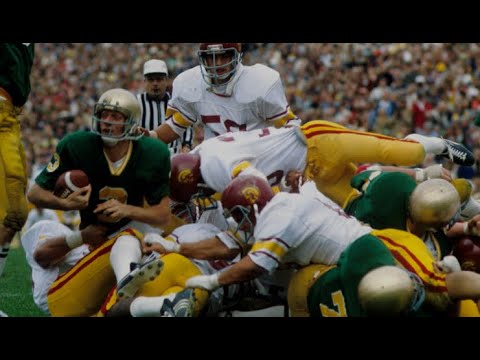
Dan Devine staged one of the most dramatic psychological ploys in college football history. Moments before kickoff, the Irish surprised their fans, USC, and the national television audience by taking the field in bright green jerseys — a direct callback to the 1940s when Frank Leahy’s Irish wore green in big games.
The move electrified the crowd and stunned USC. Notre Dame fed off the energy and delivered a demolition of their archrival. Montana was brilliant, throwing for two touchdowns and running for another. The defense overwhelmed USC quarterback Rob Hertel.
It was more than a win — it was a statement. Notre Dame was back.
The game became so iconic that Notre Dame kept wearing the green jerseys in future years in special games.
1977 #5 USC at #11 Notre Dame 1 of 1
Late Season Climb to Contention
Week 7: vs. Georgia Tech (W 69–14)
Montana engineered a nearly flawless offensive performance. The Irish racked up 600+ total yards. Ken MacAfee caught multiple touchdowns and continued to solidify his place as the nation’s top tight end.
Week 8: @ Clemson (W 21–17)
Played in the hostile environment of
Death Valley, this was a gutsy win. Clemson would rise to national prominence in the coming years, and this young Tigers team gave Notre Dame all it could handle. Montana again led a second-half comeback, further burnishing his legend.
Week 9: vs. Air Force (W 49–0)
An absolute blowout. Notre Dame scored early and often. Montana threw three touchdowns. The defense was stifling, allowing under 100 total yards.
Week 10: @ Miami (W 48–10)
Though Miami wasn’t yet a national powerhouse, this road win was another demonstration of Notre Dame’s focus and intensity. It set the stage for a shot at the national title.
The 1978 Cotton Bowl: A National Championship Statement
Opponent: #1 Texas Longhorns
Record: 11–0
Led by: Heisman winner Earl Campbell, QB Randy McEachern
Head Coach: Fred Akers
Texas was heavily favored.
They were unbeaten, had the best running back in the country, and boasted a swarming defense. Most pundits picked them to cruise to the national championship.
But Notre Dame had other plans.
Game Recap:
The Irish defense forced five turnovers, including two fumble recoveries and three interceptions.
Joe Montana was calm and surgical, throwing for 163 yards and a touchdown.
Vagas Ferguson and Jerome Heavens combined for 229 yards rushing.
Ross Browner and the defensive line neutralized Earl Campbell, who was limited to modest gains and was hit constantly.
Notre Dame dominated every phase of the game, winning 38–10. The polls responded:
Jumped from No. 5 to No. 1 in the final AP and Coaches polls.
Won the consensus national championship.
Awards and Honors
Ross Browner: Lombardi Award, Maxwell Trophy, UPI Lineman of the Year, All-American
Ken MacAfee: Walter Camp Award, Unanimous All-American, 3rd in Heisman voting
Joe Montana: Team MVP, future College and Pro Football Hall of Famer
Dan Devine: National Coach of the Year (Sporting News)
Key Players in Detail
Joe Montana (QB)
Stats: 1,604 yards, 11 TDs, 8 INTs
Nickname: “The Comeback Kid”
Known for his poise, timing, and ability to lead game-winning drives.
This season launched his legend and showed glimpses of the four-time Super Bowl champion he’d become.
Ross Browner (DE)
6’3″, 255 lbs — explosive, relentless, and technically perfect.
Finished his Notre Dame career with 77 tackles for loss and 340 total tackles.
Arguably the greatest defensive lineman in school history.
Ken MacAfee (TE)
54 receptions, 797 yards, 6 TDs — unheard of numbers for a tight end in the ’70s.
Combined size, athleticism, and sure hands.
Inducted into the College Football Hall of Fame in 1997.
Luther Bradley (CB)
A shutdown corner who helped erase opposing receivers.
Finished his Notre Dame career with 17 interceptions.
Legacy of the 1977 Fighting Irish
The 1977 title was Notre Dame’s 10th national championship.
It silenced Devine’s critics for a couple of years, but his tenure ended after the 1980 Sugar Bowl loss to Georgia.
It ushered in the legend of Joe Montana, whose heroics would only grow.
The Green Jersey Game became one of the most iconic moments in school history.
Notre Dame’s 38–10 destruction of Texas in the Cotton Bowl is still one of the most dominating performances in a title game.
Conclusion
The
1977 Notre Dame Fighting Irish
weren’t the preseason darlings. They weren’t perfect. But they had heart, leadership, grit — and when it counted most — dominance. From the depths of despair in Oxford, Mississippi, to the heights of glory in Dallas, this team captured the imagination of the college football world.
More than four decades later, the 1977 Irish remain a blueprint for resilience, belief, and boldness — a team that returned Notre Dame to glory.
Up To $1500 in Bonus Bets Paid Back if your First Bet Does Not Win
T&Cs apply
4.5/5
Gambling problem? Call 1-800-GAMBLER or 1-800-MY-RESET (Available in the US) 877-8-HOPENY or text HOPENY (467369) (NY) 1-800-327-5050 (MA), 1-800-BETS-OFF (IA), 1-800-981-0023 (PR). 21+ only. Please Gamble Responsibly. See BetMGM.com for Terms. First Bet Offer for new customers only (if applicable). Subject to eligibility requirements. Bonus bets are non-withdrawable. In partnership with Kansas Crossing Casino and Hotel. Promotional offers not available in Mississippi, Massachusetts, New York, Ontario, or Puerto Rico.
New DraftKings Customers: Spend $5+ Get $150 in Bonuses
T&Cs apply
4.5/5
GAMBLING PROBLEM? CALL 1-800-GAMBLER or 1-800-MY-RESET, (800) 327-5050 or visit gamblinghelplinema.org (MA). Please Gamble Responsibly. 888-789-7777/visit ccpg.org (CT), or visit www.mdgamblinghelp.org (MD), 1-800-981-0023 (PR). 21+ and present in most states. (18+ DC/NH/PR/WY). Void in CAN. Eligibility restrictions apply. On behalf of Boot Hill Casino (KS). Pass-thru of per wager tax may apply in IL. 1 per new DraftKings customer. $5+ first-time bet req. Max. $150 issued as non-withdrawable Bonus Bets. Stake removed from payout. Reward issued as $50 in Bonus Bets every 7 days via click-to-claim for 14 days. Bonus Bets and click-to-claims expire 7 days (168hrs) after issuance. Terms: sportsbook.draftkings.com/promos. Ends 10/11/26 at 11:59 PM ET. Sponsored by DK.
Must be 21+. GAMBLING PROBLEM? CALL 1-800-GAMBLER OR CALL 1-800-MY-RESET, www.mdgamblinghelp.org (MD), (800)-327-5050 or gamblinghelplinema.org (MA), Call (877)8-HOPENY or text HOPENY (467369) (NY), (888) 789-7777 or ccpg.org (CT), morethanagame.nc.gov (NC), 1800gambler.net (WV)
Bet $1 and get double the winnings up to $25 for your next 10 bets
T&Cs apply
4.4/5
21+ New users only. Must register using eligible promo code. First bet after registration must qualify. Max. Bonus Bet: $1,000. Bonus Bet expires 14 days after receipt. Void where prohibited. See Caesars.com/promos for full terms. Gambling Problem? 1-800-GAMBLER (1-800-426-2537)
21+ and present in OH. Gambling Problem? Call 1-800-GAMBLER.
This site is using
Cloudflare
and adheres to the
Google Safe Browsing Program. We adapted
Google's Privacy Guidelines
to keep your data safe at all times.
Close
Ready to Win Big? Join the Elite with Our Sports Betting Deals!
FanDuel Promo
New Users – Get $250 in Bonus Bets when you wager $5 for 5 days
Up To $1500 in Bonus Bets Paid Back if your First Bet Does Not Win
Best Slots
T&Cs and 21+ apply
Gambling problem? Call 1-800-GAMBLER or 1-800-MY-RESET (Available in the US) 877-8-HOPENY or text HOPENY (467369) (NY) 1-800-327-5050 (MA), 1-800-BETS-OFF (IA), 1-800-981-0023 (PR). 21+ only. Please Gamble Responsibly. See BetMGM.com for Terms. First Bet Offer for new customers only (if applicable). Subject to eligibility requirements. Bonus bets are non-withdrawable. In partnership with Kansas Crossing Casino and Hotel. Promotional offers not available in Mississippi, Massachusetts, New York, Ontario, or Puerto Rico.
Code:
Open BetMGM
Get Bonus
DraftKings Promo
New DraftKings Customers: Spend $5+ Get $150 in Bonuses
Newcomer
T&Cs and 21+ apply
GAMBLING PROBLEM? CALL 1-800-GAMBLER or 1-800-MY-RESET, (800) 327-5050 or visit gamblinghelplinema.org (MA). Please Gamble Responsibly. 888-789-7777/visit ccpg.org (CT), or visit www.mdgamblinghelp.org (MD), 1-800-981-0023 (PR). 21+ and present in most states. (18+ DC/NH/PR/WY). Void in CAN. Eligibility restrictions apply. On behalf of Boot Hill Casino (KS). Pass-thru of per wager tax may apply in IL. 1 per new DraftKings customer. $5+ first-time bet req. Max. $150 issued as non-withdrawable Bonus Bets. Stake removed from payout. Reward issued as $50 in Bonus Bets every 7 days via click-to-claim for 14 days. Bonus Bets and click-to-claims expire 7 days (168hrs) after issuance. Terms: sportsbook.draftkings.com/promos. Ends 10/11/26 at 11:59 PM ET. Sponsored by DK.
Code:
Open DraftKings
Get Bonus
Find out what the legends have to say about sports this week....