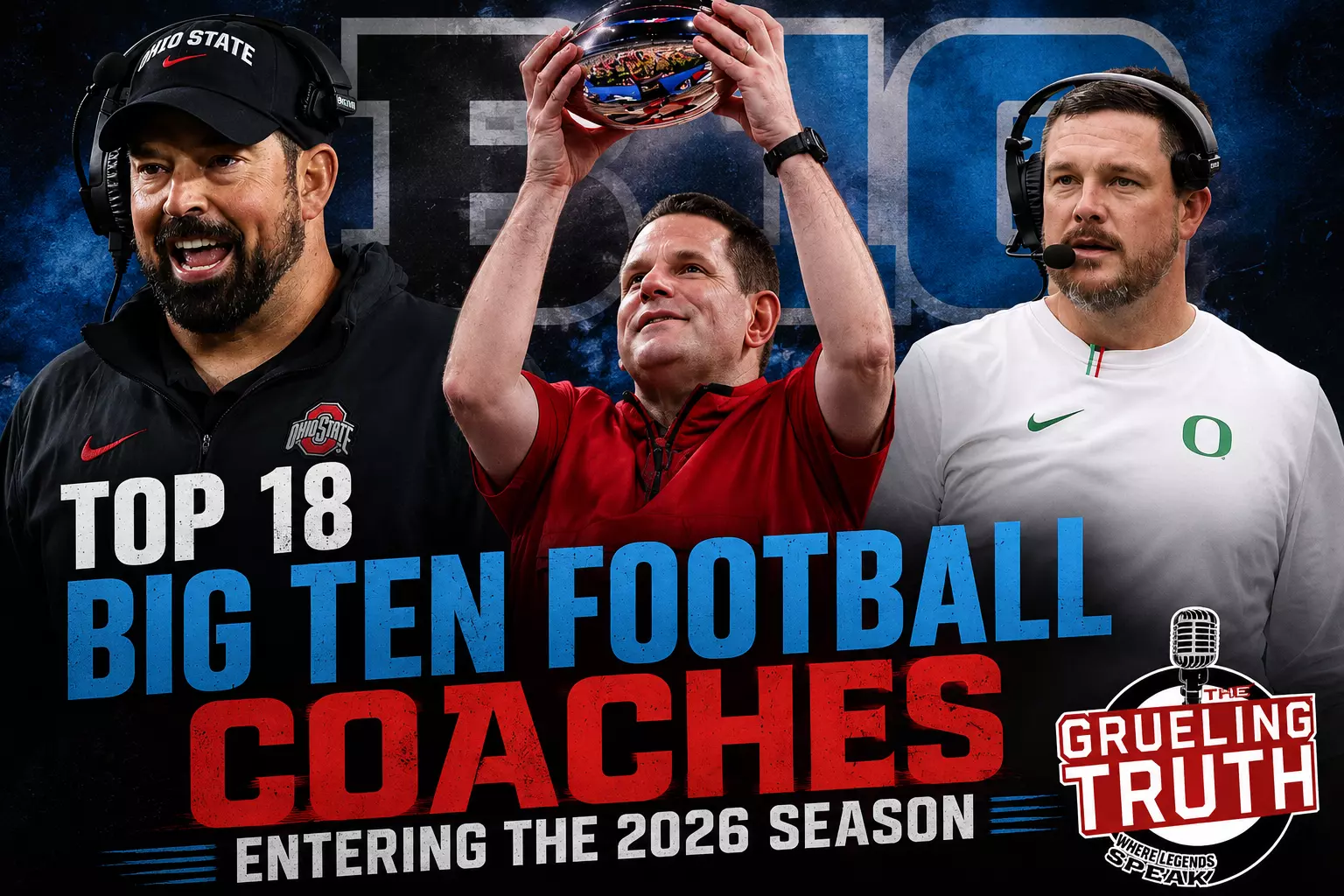
The Big Ten has never been deeper from a coaching standpoint. Curt Cignetti, Ryan Day, Dan Lanning, and Kyle Whittingham.
The Big Ten may now be the deepest coaching conference in college football. With established national championship winners, rising stars, and several high-profile coaching changes, ranking all 18 coaches is no easy task. This ranking is based on one question:
If I were starting a program today, which coach would I hire first?
Career accomplishments, program building, recruiting, player development, and current trajectory all factor into these rankings.
18. Mike Locksley — Maryland
Locksley deserves credit for improving recruiting at Maryland and bringing talent into College Park. However, the Terrapins have struggled to turn recruiting wins into consistent success on the field. Maryland remains stuck in the middle of the Big Ten with only occasional flashes of competitiveness against elite opponents. Locksley has elevated the talent level, but the results have not matched expectations. Entering 2026, he faces significant pressure to prove Maryland can become more than a bowl-caliber program. Among Big Ten coaches, he has the most to prove heading into this season.
17. David Braun — Northwestern
Braun took over under difficult circumstances and stabilized
Northwestern
during one of the most turbulent periods in school history. The Wildcats have remained competitive despite recruiting challenges and limited resources. Braun has shown leadership and toughness, but Northwestern still faces an uphill climb in the expanded Big Ten. His future appears bright, but he lacks the track record of many coaches above him. Continued progress could move him up quickly over the next two seasons.
16. Luke Fickell — Wisconsin
Fickell arrived at Wisconsin with enormous expectations after leading Cincinnati to the College Football Playoff. The results have been mixed thus far, but his overall body of work remains impressive. Few coaches have proven they can build a program the way Fickell did at Cincinnati. Wisconsin remains a sleeping giant, and many believe Fickell can still unlock that potential. The pressure is mounting, however, after a disappointing start in Madison.
15. Greg Schiano — Rutgers
No coach means more to his program than Schiano means to Rutgers. He built the Scarlet Knights into a winner during his first tenure and has restored respectability since returning. However, Rutgers continues to struggle in conference play and has yet to emerge as a true Big Ten contender. Schiano’s leadership is unquestioned, but the ceiling appears limited. Still, his ability to maximize Rutgers’ resources deserves respect.
14. Barry Odom — Purdue
Odom has quietly built a reputation as one of college football’s better program builders. His success at UNLV helped earn him the Purdue job. The Boilermakers need stability after years of inconsistency, and Odom provides exactly that. He understands roster construction and player development. The challenge is competing in a conference loaded with elite coaches and deeper rosters. Purdue fans should feel optimistic, but Odom still has to prove himself in the Big Ten.
13. Bob Chesney — UCLA
Chesney built a strong reputation at the FCS level before arriving in Los Angeles. UCLA believes he can bring consistency and toughness to a program that has struggled to find a long-term identity. While his success at lower levels is impressive, he still must prove he can recruit and win consistently in the Big Ten. The transition from FCS power to major-conference football is significant. Until he demonstrates success against top competition, he starts near the bottom of these rankings. I do believe he will quickly climb these rankings.
12. PJ Fleck — Minnesota
Row the Boat has become one of college football’s most recognizable slogans. Fleck consistently fields disciplined, physical football teams that compete above their talent level. Minnesota rarely beats itself and regularly earns bowl bids. While the Golden Gophers have not broken through to championship contention, Fleck has established one of the conference’s most stable programs. His culture-building ability remains among the best in the country.
11. Matt Rhule — Nebraska
Rhule’s reputation as a program rebuilder is unmatched. He transformed Temple and Baylor into winners before taking on the Nebraska challenge. The Cornhuskers have improved steadily under his leadership and appear closer than ever to returning to national relevance. Rhule develops players, recruits effectively, and creates winning cultures. If Nebraska breaks through in 2026, he will climb even higher.
10. Jedd Fisch — Washington
Fisch engineered one of the best rebuilds in college football at Arizona and now faces a new challenge at Washington. He is an outstanding offensive coach and recruiter who understands how to build modern programs. Washington remains one of the Big Ten’s most intriguing teams because of Fisch’s leadership. If the Huskies take another step forward, he could quickly move into the top tier of conference coaches.
9. Pat Fitzgerald — Michigan State
Fitzgerald returns to the
Big Ten
after building Northwestern into one of the conference’s most respected programs. His ability to maximize limited resources is legendary. Michigan State hired him to restore toughness and accountability after several difficult seasons. While he has yet to coach a game for the Spartans, his proven track record makes him an immediate factor in the conference hierarchy.
8. Kirk Ferentz — Iowa
The dean of Big Ten coaches continues to prove doubters wrong. Ferentz has built one of the most consistent programs in America over the last two decades. Iowa routinely wins games despite recruiting disadvantages and limited resources. While the Hawkeyes may not generate national headlines, they remain one of the toughest teams in the conference every year. Ferentz’s longevity and consistency are remarkable.
7. Lincoln Riley — USC
Few offensive minds are more respected than Riley. He has produced Heisman Trophy winners, playoff appearances, and explosive offenses everywhere he has coached. While USC has experienced some inconsistency, Riley remains one of the game’s elite offensive architects. The Trojans possess the resources to compete for national championships, and Riley remains one of the most dangerous coaches in college football. This year he needs to live up to the hype.
6. Bret Bielema — Illinois
Bielema has quietly done an outstanding job at Illinois. The Illini have become one of the Big Ten’s most physical and disciplined teams. His extensive Big Ten experience allows him to understand exactly what it takes to win in the conference. Illinois is no longer an easy victory for anyone. Bielema deserves credit for transforming the program into a legitimate contender capable of upsetting conference powers.
5. Kyle Whittingham — Michigan
Whittingham’s move to Michigan immediately elevated the Wolverines’ coaching profile. Few coaches have accomplished more with less during the modern era. His Utah teams consistently exceeded expectations, won conference championships, and competed nationally. Whittingham brings toughness, discipline, and championship-level leadership to Ann Arbor. Even before coaching a game at Michigan, his résumé places him among the conference’s elite.
4. Matt Campbell — Penn State
Campbell’s success at Iowa State made him one of the hottest names in coaching. Now leading Penn State, he inherits one of the nation’s premier programs. Campbell’s teams are disciplined, fundamentally sound, and tough. His ability to develop players and create culture makes him a perfect fit in Happy Valley. Many expect Penn State to remain a national championship contender under his leadership.
3. Dan Lanning — Oregon
Lanning has rapidly transformed Oregon into one of the nation’s premier programs. Elite recruiting, aggressive coaching, and championship-level expectations define his tenure. The Ducks have thrived since joining the Big Ten and remain legitimate national title contenders. Lanning’s combination of youth, energy, and recruiting prowess makes him one of the most valuable coaches in the country.
2. Ryan Day — Ohio State
The numbers speak for themselves. Day has won at an extraordinary level, captured a national championship, and kept Ohio State among the sport’s elite. His winning percentage rivals any coach in the country, and the Buckeyes enter every season expecting championships. The only reason he is not No. 1 is because another coach has accomplished one of the greatest turnarounds in college football history.
1. Curt Cignetti — Indiana
No coach in America has done more to elevate his program than Curt Cignetti. Indiana went from Big Ten afterthought to
national power
under his leadership. His confidence, player development, recruiting, and culture-building have completely transformed the Hoosiers. Multiple national rankings now place him atop the Big Ten coaching hierarchy, and it is difficult to argue otherwise. Until someone proves they can accomplish more with less, Cignetti deserves the top spot.
Final Thoughts
The Big Ten has never been deeper from a coaching standpoint. Curt Cignetti, Ryan Day, Dan Lanning, and Kyle Whittingham give the conference four coaches capable of winning a national championship, while veterans like Kirk Ferentz and Bret Bielema continue to prove experience matters.
If I were hiring today, Curt Cignetti would be my first call.
Up To $1500 in Bonus Bets Paid Back if your First Bet Does Not Win
T&Cs apply
4.5/5
Gambling problem? Call 1-800-GAMBLER or 1-800-MY-RESET (Available in the US) 877-8-HOPENY or text HOPENY (467369) (NY) 1-800-327-5050 (MA), 1-800-BETS-OFF (IA), 1-800-981-0023 (PR). 21+ only. Please Gamble Responsibly. See BetMGM.com for Terms. First Bet Offer for new customers only (if applicable). Subject to eligibility requirements. Bonus bets are non-withdrawable. In partnership with Kansas Crossing Casino and Hotel. Promotional offers not available in Mississippi, Massachusetts, New York, Ontario, or Puerto Rico.
New DraftKings Customers: Spend $5+ Get $150 in Bonuses
T&Cs apply
4.5/5
GAMBLING PROBLEM? CALL 1-800-GAMBLER or 1-800-MY-RESET, (800) 327-5050 or visit gamblinghelplinema.org (MA). Please Gamble Responsibly. 888-789-7777/visit ccpg.org (CT), or visit www.mdgamblinghelp.org (MD), 1-800-981-0023 (PR). 21+ and present in most states. (18+ DC/NH/PR/WY). Void in CAN. Eligibility restrictions apply. On behalf of Boot Hill Casino (KS). Pass-thru of per wager tax may apply in IL. 1 per new DraftKings customer. $5+ first-time bet req. Max. $150 issued as non-withdrawable Bonus Bets. Stake removed from payout. Reward issued as $50 in Bonus Bets every 7 days via click-to-claim for 14 days. Bonus Bets and click-to-claims expire 7 days (168hrs) after issuance. Terms: sportsbook.draftkings.com/promos. Ends 10/11/26 at 11:59 PM ET. Sponsored by DK.
Must be 21+. GAMBLING PROBLEM? CALL 1-800-GAMBLER OR CALL 1-800-MY-RESET, www.mdgamblinghelp.org (MD), (800)-327-5050 or gamblinghelplinema.org (MA), Call (877)8-HOPENY or text HOPENY (467369) (NY), (888) 789-7777 or ccpg.org (CT), morethanagame.nc.gov (NC), 1800gambler.net (WV)
Bet $1 and get double the winnings up to $25 for your next 10 bets
T&Cs apply
4.4/5
21+ New users only. Must register using eligible promo code. First bet after registration must qualify. Max. Bonus Bet: $1,000. Bonus Bet expires 14 days after receipt. Void where prohibited. See Caesars.com/promos for full terms. Gambling Problem? 1-800-GAMBLER (1-800-426-2537)
21+ and present in OH. Gambling Problem? Call 1-800-GAMBLER.
This site is using
Cloudflare
and adheres to the
Google Safe Browsing Program. We adapted
Google's Privacy Guidelines
to keep your data safe at all times.
Close
Ready to Win Big? Join the Elite with Our Sports Betting Deals!
FanDuel Promo
New Users – Get $250 in Bonus Bets when you wager $5 for 5 days
Up To $1500 in Bonus Bets Paid Back if your First Bet Does Not Win
Best Slots
T&Cs and 21+ apply
Gambling problem? Call 1-800-GAMBLER or 1-800-MY-RESET (Available in the US) 877-8-HOPENY or text HOPENY (467369) (NY) 1-800-327-5050 (MA), 1-800-BETS-OFF (IA), 1-800-981-0023 (PR). 21+ only. Please Gamble Responsibly. See BetMGM.com for Terms. First Bet Offer for new customers only (if applicable). Subject to eligibility requirements. Bonus bets are non-withdrawable. In partnership with Kansas Crossing Casino and Hotel. Promotional offers not available in Mississippi, Massachusetts, New York, Ontario, or Puerto Rico.
Code:
Open BetMGM
Get Bonus
DraftKings Promo
New DraftKings Customers: Spend $5+ Get $150 in Bonuses
Newcomer
T&Cs and 21+ apply
GAMBLING PROBLEM? CALL 1-800-GAMBLER or 1-800-MY-RESET, (800) 327-5050 or visit gamblinghelplinema.org (MA). Please Gamble Responsibly. 888-789-7777/visit ccpg.org (CT), or visit www.mdgamblinghelp.org (MD), 1-800-981-0023 (PR). 21+ and present in most states. (18+ DC/NH/PR/WY). Void in CAN. Eligibility restrictions apply. On behalf of Boot Hill Casino (KS). Pass-thru of per wager tax may apply in IL. 1 per new DraftKings customer. $5+ first-time bet req. Max. $150 issued as non-withdrawable Bonus Bets. Stake removed from payout. Reward issued as $50 in Bonus Bets every 7 days via click-to-claim for 14 days. Bonus Bets and click-to-claims expire 7 days (168hrs) after issuance. Terms: sportsbook.draftkings.com/promos. Ends 10/11/26 at 11:59 PM ET. Sponsored by DK.
Code:
Open DraftKings
Get Bonus
Find out what the legends have to say about sports this week....