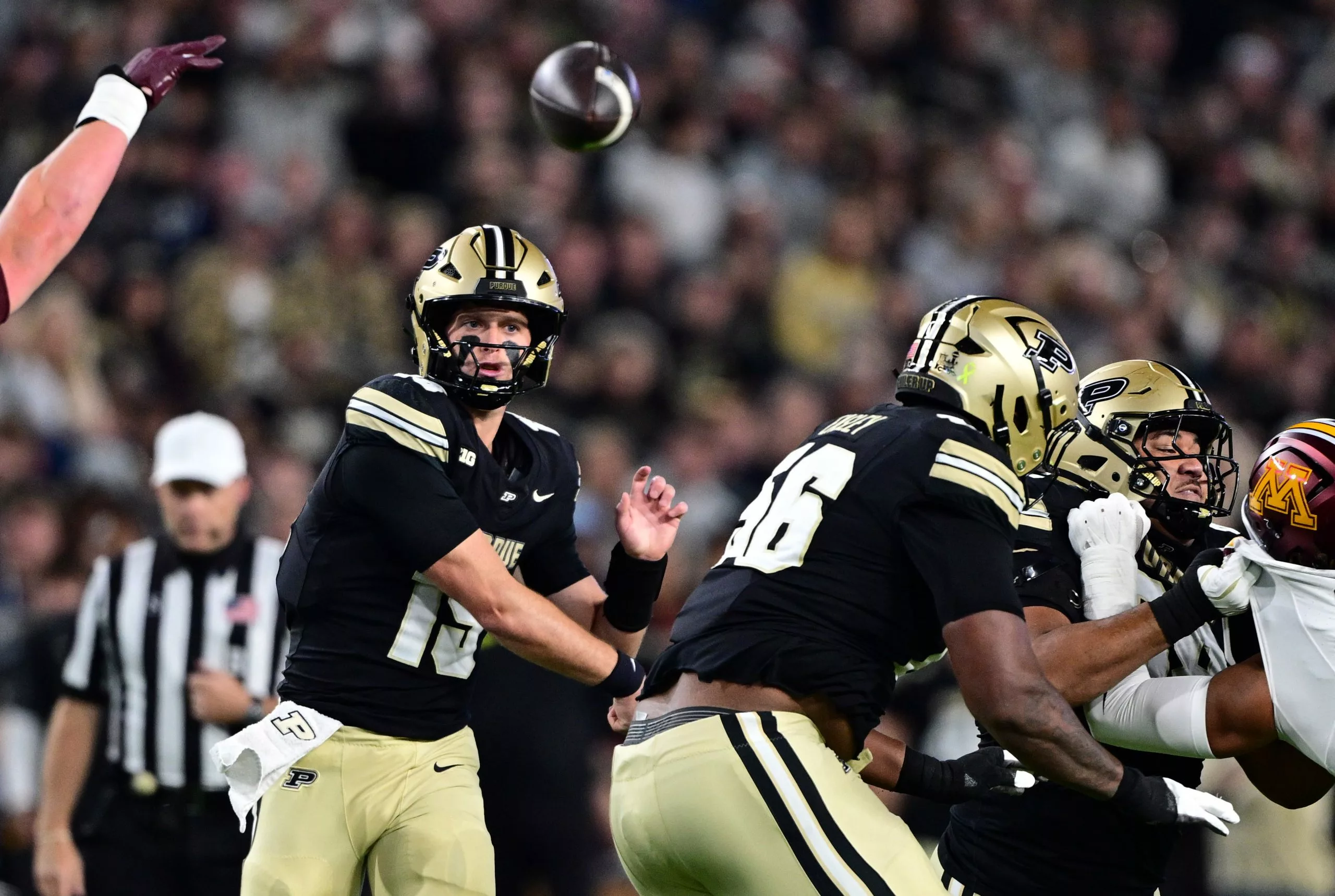
Oct 10, 2026; West Lafayette, Indiana, USA; Purdue Boilermakers quarterback Ryan Browne (15) throws a pass during the first quarter against the Minnesota Golden Gophers at Ross-Ade Stadium. Mandatory Credit: Marc Lebryk-Imagn Images
Purdue did more than beat Minnesota on Saturday night. It took control of the game in the area where the Gophers should have been prepared to compete.
The Boilermakers won 41–13, rushing for 305 yards while holding Minnesota to just 27. They also finished with a 25–10 advantage in first downs. Those numbers describe sustained control, not a victory built around one fortunate bounce.
For a Purdue program trying to establish credibility under Barry Odom, this was an important step. A week after winning at Illinois, the Boilermakers followed with a substantially more convincing performance.
For Minnesota, it was an uncomfortable reminder that progress can disappear quickly when a team loses control of the line of scrimmage.
Purdue has earned a reassessment. Minnesota has earned some difficult questions.
Two Different Victories Make the Improvement More Convincing
Purdue’s 24–17 victory
at Illinois required the Boilermakers to finish a competitive road game. Bringing home the Cannon Trophy gave the program a result it badly needed.
The Minnesota victory supplied something different: evidence that Purdue could take an opponent out of its preferred game and maintain control.
That distinction matters when evaluating a rebuilding team.
One close victory can come from a favorable matchup, a handful of timely plays or an opponent’s mistakes. Following it with a commanding performance makes the improvement harder to dismiss.
Purdue still has to prove that it can sustain this level. But consecutive conference wins give Odom’s players evidence that their preparation can produce results against familiar opponents.
Confidence becomes more useful when it is attached to something repeatable. Saturday’s physical performance gives the Boilermakers a foundation they can try to reproduce.
Fame Ijeboi Made His Former Team Pay
Fame Ijeboi was the central figure in Purdue’s victory.
The former Minnesota running back rushed for a career-high 195 yards and three touchdowns against the program he left.
The transfer connection makes the story more compelling. The performance itself is what makes it significant.
Purdue found a back capable of carrying substantial responsibility, and its blocking gave him opportunities to turn that responsibility into production. A running game working this effectively changes the demands placed on everyone else.
The quarterback can operate with more manageable situations. The defense gets opportunities to regroup. Coaches can call plays without every possession feeling like a rescue mission.
Ijeboi deserves the attention, but this should also be viewed as an offensive unit succeeding together. A back cannot consistently produce through defenders meeting him in the backfield.
Purdue gave its featured runner a chance to influence the game, and he delivered.
Ryan Browne Added Another Problem for Minnesota
A productive running back is difficult enough to contain. A quarterback who can punish a defense with his legs makes the assignment more complicated.
Ryan Browne provided a critical response after Minnesota cut the deficit to 27–13, scoring on a 12-yard run early in the fourth quarter.
That sequence matters because the Gophers still had an opportunity to make the finish uncomfortable.
Instead, Purdue answered.
For an improving team, those responses are revealing. Building a lead is one challenge; maintaining composure when the opponent begins pushing back is another.
Browne’s mobility also gives Purdue a useful way to stress defensive assignments. Opponents must account for more than the handoff, which can create hesitation and change how aggressively defenders pursue.
The task going forward is to maintain that balance without asking the quarterback to become the entire offense. Saturday showed the value of making him one part of a broader rushing threat.
Minnesota Lost the Physical Argument
The most concerning element for Minnesota was how sharply the matchup departed from expectations.
Entering Saturday, Purdue ranked last in the Big Ten in rushing offense, while Minnesota ranked fourth in rushing defense.
Those rankings did not decide the game. They make the outcome more difficult for the Gophers to explain.
When a supposed strength fails this dramatically against an opponent’s supposed weakness, the review must reach beyond general comments about effort.
Were defenders maintaining their assignments? Were they getting displaced at the point of attack? Were tackles being finished? Did the staff make effective adjustments when the original approach failed?
The final statistics cannot answer every technical question. They establish how urgently those questions need to be addressed.
P.J. Fleck’s team must determine whether this was a collection of correctable mistakes or evidence that its defensive performance had been overstated.
Minnesota’s Offense Could Not Provide Enough Relief
The Gophers’ offensive problems reinforced the defensive ones.
Without a dependable ground game, sustaining possessions becomes harder. A team falls into more predictable passing situations, and its opportunities to control the pace diminish.
That does not mean every rushing attempt should work. It means the offense needs enough efficiency to prevent the defense from being asked to repeatedly rescue the afternoon.
Minnesota briefly created some hope with a touchdown in the third quarter. Purdue’s subsequent response ended that momentum, and a muffed punt later gave the Boilermakers another short-field opportunity.
The special-teams mistake was costly. It was also part of a broader failure.
Minnesota cannot fix this game by concentrating on one play when its problems extended across possessions and phases.
Purdue Has Improved, but the Standard Must Keep Rising
The Boilermakers are now 3–3 overall and 2–1 in conference play. Earlier losses to Wake Forest, UCLA and Notre Dame remain part of their résumé.
That record calls for measured optimism.
Purdue has not suddenly become a championship contender because it won twice. It has demonstrated that its season does not need to follow the discouraging direction suggested by its early struggles.
The next question is consistency.
Can the offensive line keep creating movement? Can Ijeboi remain productive when opponents prioritize stopping him? Can Browne make the passing plays required when running lanes become harder to find?
Those are the tests that will distinguish an encouraging stretch from a meaningful change in the program’s direction.
Odom deserves credit for the recent results. Sustaining them is the next responsibility.
The Boilermakers Have Earned More Than a Dismissive Reaction
Purdue should not be treated as a team that merely benefited from Minnesota having a bad night.
The
Boilermakers
helped make it a bad night. They established a productive approach, defended effectively and answered when the Gophers threatened to regain momentum.
That is coaching and execution worth recognizing.
Minnesota, meanwhile, must resist the temptation to move on without confronting how thoroughly it was beaten. A loss this decisive should change the questions asked during preparation.
Purdue is showing credible signs of turning a corner. Whether that turn lasts depends on what comes next—but Saturday gave the Big Ten a reason to stop overlooking the Boilermakers.
Up To $1500 in Bonus Bets Paid Back if your First Bet Does Not Win
T&Cs apply
4.5/5
Gambling problem? Call 1-800-GAMBLER or 1-800-MY-RESET (Available in the US) 877-8-HOPENY or text HOPENY (467369) (NY) 1-800-327-5050 (MA), 1-800-BETS-OFF (IA), 1-800-981-0023 (PR). 21+ only. Please Gamble Responsibly. See BetMGM.com for Terms. First Bet Offer for new customers only (if applicable). Subject to eligibility requirements. Bonus bets are non-withdrawable. In partnership with Kansas Crossing Casino and Hotel. Promotional offers not available in Mississippi, Massachusetts, New York, Ontario, or Puerto Rico.
New DraftKings Customers: Spend $5+ Get $150 in Bonuses
T&Cs apply
4.5/5
GAMBLING PROBLEM? CALL 1-800-GAMBLER or 1-800-MY-RESET, (800) 327-5050 or visit gamblinghelplinema.org (MA). Please Gamble Responsibly. 888-789-7777/visit ccpg.org (CT), or visit www.mdgamblinghelp.org (MD), 1-800-981-0023 (PR). 21+ and present in most states. (18+ DC/NH/PR/WY). Void in CAN. Eligibility restrictions apply. On behalf of Boot Hill Casino (KS). Pass-thru of per wager tax may apply in IL. 1 per new DraftKings customer. $5+ first-time bet req. Max. $150 issued as non-withdrawable Bonus Bets. Stake removed from payout. Reward issued as $50 in Bonus Bets every 7 days via click-to-claim for 14 days. Bonus Bets and click-to-claims expire 7 days (168hrs) after issuance. Terms: sportsbook.draftkings.com/promos. Ends 10/11/26 at 11:59 PM ET. Sponsored by DK.
Must be 21+. GAMBLING PROBLEM? CALL 1-800-GAMBLER OR CALL 1-800-MY-RESET, www.mdgamblinghelp.org (MD), (800)-327-5050 or gamblinghelplinema.org (MA), Call (877)8-HOPENY or text HOPENY (467369) (NY), (888) 789-7777 or ccpg.org (CT), morethanagame.nc.gov (NC), 1800gambler.net (WV)
Bet $1 and get double the winnings up to $25 for your next 10 bets
T&Cs apply
4.4/5
21+ New users only. Must register using eligible promo code. First bet after registration must qualify. Max. Bonus Bet: $1,000. Bonus Bet expires 14 days after receipt. Void where prohibited. See Caesars.com/promos for full terms. Gambling Problem? 1-800-GAMBLER (1-800-426-2537)
21+ and present in OH. Gambling Problem? Call 1-800-GAMBLER.
This site is using
Cloudflare
and adheres to the
Google Safe Browsing Program. We adapted
Google's Privacy Guidelines
to keep your data safe at all times.
Close
Ready to Win Big? Join the Elite with Our Sports Betting Deals!
FanDuel Promo
New Users – Get $250 in Bonus Bets when you wager $5 for 5 days
Up To $1500 in Bonus Bets Paid Back if your First Bet Does Not Win
Best Slots
T&Cs and 21+ apply
Gambling problem? Call 1-800-GAMBLER or 1-800-MY-RESET (Available in the US) 877-8-HOPENY or text HOPENY (467369) (NY) 1-800-327-5050 (MA), 1-800-BETS-OFF (IA), 1-800-981-0023 (PR). 21+ only. Please Gamble Responsibly. See BetMGM.com for Terms. First Bet Offer for new customers only (if applicable). Subject to eligibility requirements. Bonus bets are non-withdrawable. In partnership with Kansas Crossing Casino and Hotel. Promotional offers not available in Mississippi, Massachusetts, New York, Ontario, or Puerto Rico.
Code:
Open BetMGM
Get Bonus
DraftKings Promo
New DraftKings Customers: Spend $5+ Get $150 in Bonuses
Newcomer
T&Cs and 21+ apply
GAMBLING PROBLEM? CALL 1-800-GAMBLER or 1-800-MY-RESET, (800) 327-5050 or visit gamblinghelplinema.org (MA). Please Gamble Responsibly. 888-789-7777/visit ccpg.org (CT), or visit www.mdgamblinghelp.org (MD), 1-800-981-0023 (PR). 21+ and present in most states. (18+ DC/NH/PR/WY). Void in CAN. Eligibility restrictions apply. On behalf of Boot Hill Casino (KS). Pass-thru of per wager tax may apply in IL. 1 per new DraftKings customer. $5+ first-time bet req. Max. $150 issued as non-withdrawable Bonus Bets. Stake removed from payout. Reward issued as $50 in Bonus Bets every 7 days via click-to-claim for 14 days. Bonus Bets and click-to-claims expire 7 days (168hrs) after issuance. Terms: sportsbook.draftkings.com/promos. Ends 10/11/26 at 11:59 PM ET. Sponsored by DK.
Code:
Open DraftKings
Get Bonus
Find out what the legends have to say about sports this week....