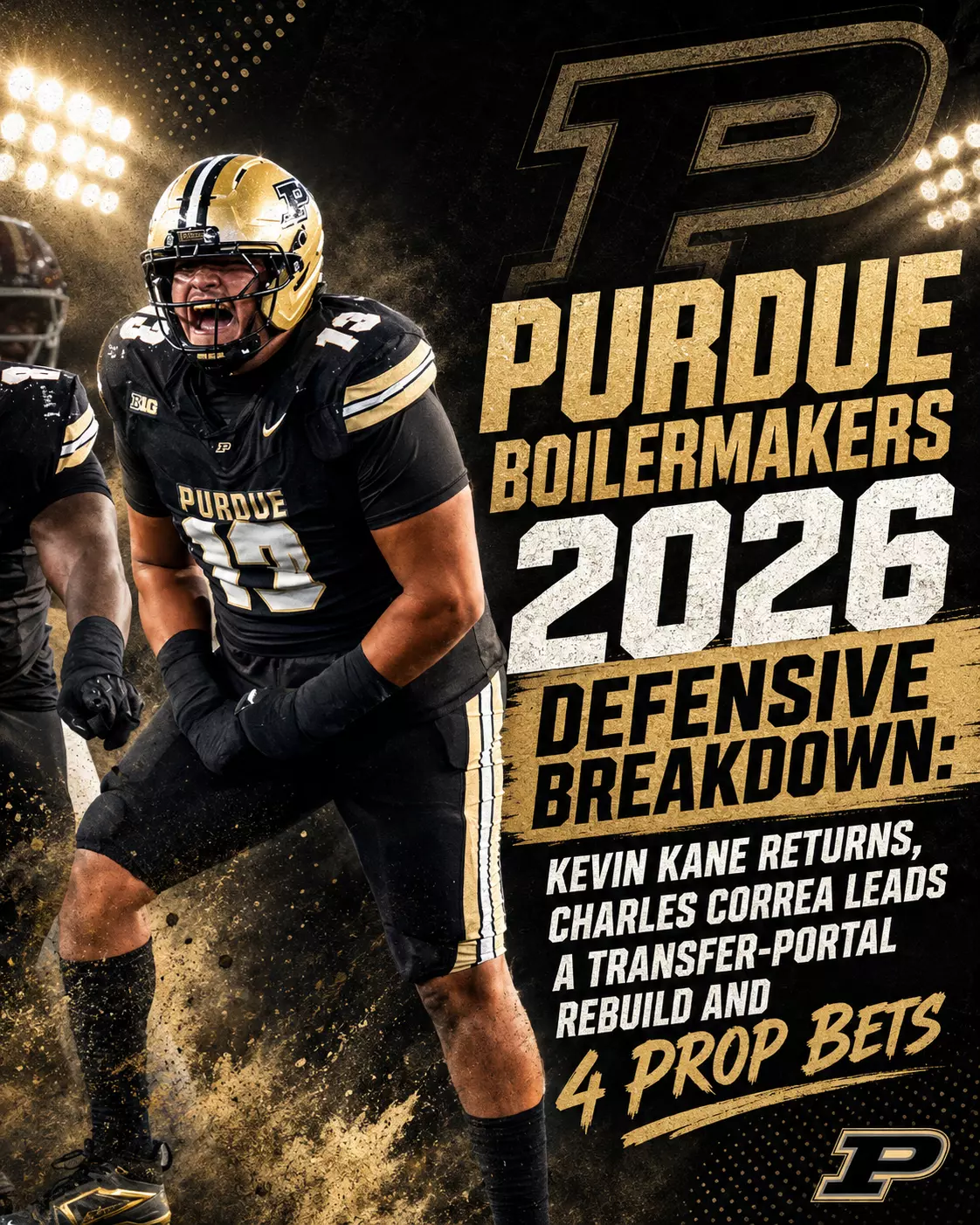
Purdue Boilermakers 2026 Defensive Breakdown: Kevin Kane Returns, Charles Correa Leads a Transfer-Portal Rebuild and 4 Prop Bets
The
Purdue Boilermakers enter the 2026 college football season hoping a familiar defensive coordinator and another aggressive transfer-portal rebuild can finally produce the defensive improvement Barry Odom needs in West Lafayette.
Purdue finished only
2-10 overall and 0-9 in Big Ten play in 2025. The defense allowed approximately
31.8 points and 423.5 total yards per game, including 181.8 rushing yards and 241.7 passing yards per contest. The Boilermakers finished with 24 sacks and 64 tackles for loss while generating only nine total takeaways.
Those numbers weren’t good enough.
But Purdue’s defense wasn’t completely without encouraging individual performances.
Charles Correa
emerged as one of the Big Ten’s most productive young linebackers, producing
96 tackles, 7.5 tackles for loss and three sacks
while earning honorable mention All-Big Ten recognition.
Hudauri Hines
became Purdue’s most productive returning cover defender, leading the team with nine passes defended.
Smiley Bradford
produced 30 tackles, five tackles for loss, seven passes defended and an interception.
Ian Jeffries
gained valuable experience along the interior.
And several younger defenders were forced into meaningful Big Ten snaps.
Now Odom has made one of the most important changes of his Purdue tenure.
Kevin Kane is back.
Kane returns as Purdue’s defensive coordinator and linebackers coach after spending 2025 at Minnesota. He previously coordinated Purdue’s defense in 2023 and 2024. During his first season in West Lafayette, the Boilermakers recorded
35 sacks — their most since 2004 and the third-most in program history. His Minnesota position group helped a defense that ranked second in the Big Ten in both sacks and tackles for loss last season.
The personnel has also changed dramatically.
Purdue assembled a transfer class ranked
24th nationally and fourth in the Big Ten by On3, with
17 defensive transfers, including seven defensive backs, four linebackers, three defensive ends and three defensive linemen.
That group includes:
Elo Modozie.
Jaden Mangham.
Jojo Hayden.
Anthony Speca.
Keyshawn Burgos.
Jeremy Lewis.
John Slaughter.
Don Saunders.
Curt Neal.
Rodney Lora.
And several other veteran additions.
Purdue isn’t rebuilding with freshmen alone.
Odom and Kane have assembled a defense filled with players who have spent time at Georgia, Michigan, Michigan State, Penn State, Illinois, Virginia Tech, Utah and several other major programs.
That doesn’t guarantee success.
But it gives Purdue a legitimate opportunity to make a substantial defensive improvement in Year 2.
Purdue Boilermakers 2026 Defensive Projections
Projected Record:
4-8
Projected Points Allowed Per Game:
27-29
Projected Total Defense:
370-390 yards per game
Projected Rushing Defense:
150-165 yards per game
Projected Passing Defense:
215-230 yards per game
Projected Team Sacks:
28-33
Projected Interceptions:
8-11
Projected Total Takeaways:
15-19
Projected Tackles for Loss:
70-78
Biggest Defensive Strength:
Linebacker Experience and Improved Edge Depth
Biggest Defensive Question:
Can a rebuilt secondary and defensive front eliminate the explosive plays that overwhelmed Purdue in 2025?
Kevin Kane Returns to Run the Purdue Defense
The most important offseason defensive acquisition may be the coordinator.
Kevin Kane knows Purdue.
He knows Barry Odom.
And he has a proven history of generating pressure.
Kane previously coordinated Purdue’s defense for two seasons before spending 2025 as Minnesota’s nickel and outside linebackers coach. Minnesota ranked second in the Big Ten in tackles for loss and sacks, while ranking 11th and 13th nationally in those categories.
His previous Purdue tenure showed what his system can accomplish.
The 2023 Boilermakers recorded
35 sacks.
Nic Scourton led the Big Ten with
10 sacks.
Scourton and Kydran Jenkins combined to become one of the conference’s most disruptive edge combinations.
That fits exactly what Purdue needs now.
The 2025 Boilermakers produced only
24 sacks
while allowing more than 420 yards per game.
Pressure and coverage are connected.
If quarterbacks have five seconds to throw, eventually somebody gets open.
If Kane can force quarterbacks to speed up their decisions, Purdue’s reconstructed secondary becomes considerably easier to protect.
His history extends beyond Purdue.
At SMU in 2019, Kane’s defense ranked
No. 1 nationally in sacks per game and No. 3 in tackles for loss. At Northern Illinois, his 2017 defense led the country in tackles for loss and ranked second in sacks.
That doesn’t mean Purdue suddenly produces 40 sacks.
But it demonstrates that pressure is part of Kane’s defensive identity.
And Purdue has given him considerably more pass-rushing options.
Purdue Defensive Line Breakdown
The interior defensive line is one of the biggest developmental areas on the roster.
Purdue allowed
181.8 rushing yards per game in 2025.
That number must improve.
Everything Kane wants to do becomes more difficult if Purdue cannot stop the run.
Third-and-3 doesn’t allow the same playbook as third-and-9.
The most intriguing returning interior player may be
TJ Lindsey.
Lindsey arrived from Auburn before the 2025 season but appeared in only three games because of injury.
He recorded five tackles and a tackle for loss before his season ended. At
6-foot-3 and 308 pounds, he gives Purdue legitimate size in the middle.
A healthy Lindsey could essentially function like another transfer addition.
Then there is
Ian Jeffries.
Jeffries appeared in all 12 games and made six starts last season, recording
20 tackles, three tackles for loss and one sack. He previously produced 41 tackles, 4.5 tackles for loss and 3.5 sacks at Arkansas State in 2024.
That previous production suggests there may still be another level available.
Purdue also added multiple interior transfers.
Curt Neal
comes from Illinois.
Rodney Lora
arrives from UCF.
Wisdom Simms
transfers from North Carolina Central.
Those three were part of Purdue’s 17-player defensive transfer haul.
The objective isn’t complicated.
Purdue needs to become more difficult to move.
The Boilermakers don’t need every defensive tackle collecting sacks.
They need interior linemen occupying blockers.
They need penetration.
They need second-and-9 instead of second-and-5.
And they need to keep offensive guards away from Correa.
If Purdue reduces its rushing allowance from approximately 182 yards per game to somewhere near 155, the entire defense becomes more functional.
Projected Purdue Rushing Defense: 150-165 yards per game
Purdue Edge-Rusher Breakdown
This is where Purdue’s offseason work becomes much more interesting.
There isn’t one obvious established Big Ten sack star.
There are
multiple players with pass-rushing evidence.
Start with
Elo Modozie.
Modozie spent the 2025 season at Georgia, appearing in 12 games and contributing to an SEC championship team.
But his 2024 season at Army is the reason Purdue fans should be interested.
Modozie started all 14 games and recorded
34 tackles, eight tackles for loss and 6.5 sacks, earning Third-Team All-American Athletic Conference recognition.
That is legitimate production.
The question is whether it translates into the Big Ten.
Modozie won’t be facing AAC offensive tackles anymore.
But he also won’t be asked to carry Purdue’s pass rush alone.
Then there is
Jeremy Lewis.
Lewis was one of the most productive junior-college pass rushers in the country last season.
He recorded
41 tackles, 15.5 tackles for loss and nine sacks
while helping Iowa Western win the NJCAA Division I national championship. He also forced three fumbles and recovered four.
His national championship performance was enormous.
Seven tackles.
2.5 sacks.
A forced fumble.
A fumble recovery.
Again, the competition level changes dramatically.
But nine sacks are nine sacks.
Lewis understands how to finish quarterbacks.
Keyshawn Burgos
brings another experienced option.
Burgos has played extensive football at Virginia Tech. His best season came in 2023 when he recorded
five tackles for loss and two sacks, and he followed that with 33 tackles in 2024.
Then there is returning captain
CJ Madden.
Madden started eight games last season and recorded
16 tackles and 2.5 tackles for loss. Purdue’s coaching staff has challenged him to turn his experience into more production during his senior season.
Breeon Ishmail
returns after recording 23 tackles and a sack.
Trey Smith
also returns after recording his first collegiate sack last season.
That gives Kane options.
Modozie.
Lewis.
Burgos.
Madden.
Ishmail.
Smith.
Purdue doesn’t need one player to record 12 sacks.
It needs several players who can consistently affect quarterbacks.
The coaching staff has emphasized rotational depth throughout August camp rather than identifying only two traditional starting defensive ends.
That could ultimately become an advantage.
Projected Purdue Team Sacks: 28-33
Charles Correa: Purdue’s Defensive Leader
Charles Correa enters 2026 as the player around whom Purdue can build its defense.
His first season in West Lafayette was outstanding.
Correa started every game and recorded:
96 tackles.
7.5 tackles for loss.
Three sacks.
Two passes defended.
He led Purdue in tackles for loss and finished third on the team in tackles.
Correa also earned honorable mention All-Big Ten recognition from both the coaches and media.
His consistency may have been even more impressive than the final statistics.
Correa recorded at least 10 tackles in five games.
He had 15 against Illinois.
He recorded 13 against Rutgers.
He produced tackles for loss against Ohio State.
He recorded sacks against Southern Illinois and USC.
And he accomplished all of that as a sophomore.
Now Kane becomes his position coach.
That relationship could become extremely important.
Kane is both defensive coordinator and linebackers coach, meaning Correa should become one of the primary communicators within the defense.
He needs to set fronts.
Recognize motion.
Communicate coverage checks.
Attack the run.
Cover.
And pressure the quarterback.
That is a significant responsibility.
But Purdue already knows he can produce.
The question is whether he goes from productive Big Ten linebacker to genuine All-Big Ten star.
Charles Correa Projection: 90-105 tackles, 8-11 tackles for loss, 3-5 sacks and multiple forced turnovers.
Purdue Linebacker Breakdown
Correa is the centerpiece.
The players around him make this group considerably deeper than it was one year ago.
One of the most important additions is
Jojo Hayden.
Hayden transfers from Illinois after appearing in 11 games last season and recording
26 tackles and 1.5 tackles for loss.
He also recovered a fumble against Purdue.
At 6-foot-2 and 245 pounds, Hayden gives the Boilermakers another physical inside option.
He also understands Big Ten football.
There is no adjustment to the league.
He has already played against many of Purdue’s opponents.
Hudson Miller
returns to West Lafayette after spending 2025 at Toledo.
Miller originally played three seasons at Purdue and started the final five games of the 2024 season, recording
42 tackles, a tackle for loss, half a sack and two pass breakups.
That familiarity is valuable.
He understands Purdue.
He understands the Big Ten.
He isn’t learning the environment from scratch.
Then there is
Anthony Speca.
Speca comes from Penn State after appearing in 17 games over two seasons. His college production has been limited, but he arrived at Penn State as one of the nation’s better linebacker prospects after setting Pittsburgh Central Catholic’s career tackles record with 326.
The opportunity at Purdue should be considerably larger.
The room also includes returning players such as Winston Berglund and several younger linebackers.
The depth gives Kane flexibility.
He can use heavier combinations against Wisconsin or Iowa.
He can use more athletic combinations against spread offenses.
He can blitz Correa.
Or Hayden.
Or disguise which linebacker is coming.
That is exactly what a pressure-oriented coordinator wants.
The biggest concern is replacing departed production.
Purdue lost
Mani Powell, who recorded 110 tackles, 12 tackles for loss and five sacks last season.
That is enormous production.
No individual player needs to replace all of it.
But somebody has to absorb the snaps.
Hayden, Miller and Speca were brought in to make sure Correa isn’t asked to do everything himself.
Purdue Secondary Breakdown
This may be the most completely rebuilt unit on Purdue’s defense.
The Boilermakers lost significant experience after the 2025 season.
So they attacked the portal aggressively.
Purdue added
eight transfer defensive backs
and entered August camp with what defensive passing-game coordinator Charles Clark described as one of the deepest groups he has coached, with six or seven players capable of playing multiple starting positions.
The returning foundation starts with
Hudauri Hines.
Hines appeared in every game and made 11 starts last season.
He recorded:
33 tackles.
Nine passes defended.
1.5 tackles for loss.
One interception.
Most importantly, Hines led Purdue in passes defended.
That makes him the most established returning cover defender.
Then there is
Smiley Bradford.
Bradford appeared in all 12 games and produced
30 tackles, five tackles for loss, seven passes defended and one interception.
The five tackles for loss jump out.
Bradford isn’t simply a deep coverage player.
He can attack the football near the line of scrimmage.
That gives Kane another movable piece.
The biggest transfer addition may be
Jaden Mangham.
Mangham brings
34 career appearances and 17 starts
from Michigan and Michigan State. He recorded 30 tackles in 2025 for Michigan and previously earned honorable mention All-Big Ten recognition at Michigan State after producing
53 tackles and four interceptions in 2023.
Four interceptions in a Big Ten season matter.
Mangham has already shown he can make plays on the football against this level of competition.
He also brings something Purdue desperately needs.
Experience.
Purdue’s secondary includes numerous new players.
Mangham has already spent years preparing for Big Ten offenses.
The Boilermakers also added
John Slaughter.
Slaughter spent 2025 at Colorado after previously appearing in 23 games over two seasons at Tennessee.
Don Saunders
arrives from Utah.
Justin Denson Jr.
comes from Michigan State.
Mister Clark
transfers from FIU.
Dee Newsome
arrives after recording five passes defended at Samford.
Dax Noles
joins the secondary after an outstanding junior-college season in which he produced
61 tackles and four interceptions
for national champion Iowa Western.
That is a lot of competition.
Purdue doesn’t need to find four competent defensive backs.
It may have eight or nine players competing for meaningful roles.
The challenge is turning depth into chemistry.
Secondary play requires communication.
One player can execute his assignment perfectly and still surrender a touchdown if another defender misreads the coverage.
That will be the critical August and September issue.
But the talent level appears substantially improved.
Projected Purdue Passing Defense: 215-230 yards per game
Projected Purdue Interceptions: 8-11
Hudauri Hines: Purdue’s Defensive Wild Card
Hudauri Hines has an opportunity to become one of Purdue’s most important defensive players in 2026.
His 2025 season established the foundation.
Thirty-three tackles.
Nine passes defended.
An interception.
Eleven starts.
Now his role changes.
Last season, Hines was one player in a veteran defensive-back room.
This season, he is one of the players providing continuity for numerous newcomers.
That matters.
Mangham has more career experience.
Slaughter has played at multiple major programs.
Other transfers bring impressive résumés.
But Hines knows Purdue’s current coaching staff.
He knows Charles Clark.
He knows the returning players.
That experience should allow him to play faster.
The statistical opportunity also exists.
Nine passes defended is already impressive.
If Purdue generates better quarterback pressure, Hines could receive even more opportunities to attack rushed throws.
The biggest question is whether opponents stop testing him.
If Hines develops into Purdue’s most reliable cover corner, quarterbacks may intentionally attack other members of the secondary.
That could reduce his numbers while making him more valuable.
Note:
Full-season college football defensive player and team props are not consistently offered by every sportsbook. The defensive statistical lines below should therefore be treated as
projection-based betting benchmarks, not claims that every sportsbook currently offers these exact markets.
Prop Bet #1: Purdue Over 25.5 Team Sacks
DraftKings
4.5/5
Tip: Purdue Over 25.5 Team Sacks
Kevin Kane Returns
Elo Modozie’s Proven Production
Deep Edge-Rusher Rotation
New DraftKings Customers: Bet $5, Get $200 + 3 Months of NBA League Pass!
Get bonus now
GAMBLING PROBLEM? CALL 1-800-GAMBLER or 1-800-MY-RESET, (800) 327-5050 or visit gamblinghelplinema.org (MA). Please Gamble Responsibly. 888-789-7777/visit ccpg.org (CT), or visit www.mdgamblinghelp.org (MD), 1-800-981-0023 (PR). 21+ and present in most states. (18+ DC/NH/PR/WY). Void in CAN. Eligibility restrictions apply. On behalf of Boot Hill Casino (KS). Pass-thru of per wager tax may apply in IL. 1 per new Sportsbook customer. $5+ first-time bet req. Max. $200 issued as non-withdrawable Bonus Bets. Stake removed from payout. Reward issued as $50 in Bonus Bets every 7 days via click-to-claim for 21 days. Bonus Bets and click-to-claims expire 7 days (168hrs) after issuance. Terms: dkng.co/offer. Get 1 promo code to redeem a 3-month NBA League Pass subscription, complimentary of DraftKings. Subscription auto-renews monthly at then-current price (currently $16.99/mo); cancel anytime. Terms, restrictions, and eligibility requirements apply. Redeem League Pass by 12/19/26 at 11:59 PM ET. Addt’l terms: support.watch.nba.com/hc/en-us/articles/9165532876183-League-Pass-Terms-of-Use_. Ends 11/29/26 at 11:59 PM ET. Sponsored by DK.
Why the Over Is a Good Bet
Purdue recorded only
24 sacks in 2025.
The Boilermakers need just two additional sacks to clear this benchmark.
The coordinator change is the biggest reason to expect improvement.
Kane’s first Purdue defense recorded
35 sacks in 2023.
His 2019 SMU defense led the country in sacks per game.
His 2017 Northern Illinois defense ranked second nationally in sacks.
Then consider the new personnel.
Modozie recorded
6.5 sacks at Army in 2024.
Lewis recorded
nine sacks at Iowa Western last season.
Burgos has previous ACC starting experience.
Correa already recorded three sacks from linebacker last year.
Purdue doesn’t need one player to become an All-American.
It needs more pressure from several positions.
Twenty-six sacks is a reasonable target.
Why the Under Is a Good Bet
Most of Purdue’s projected improvement remains theoretical.
Modozie’s 6.5-sack season came at Army in 2024.
He recorded only seven tackles during his season at Georgia.
Lewis dominated junior-college competition.
Now he has to rush Big Ten quarterbacks behind Big Ten offensive lines.
Madden produced only half a sack last year.
Burgos recorded limited statistics during his final season at Virginia Tech.
There are good options.
There isn’t yet a proven 2026 Big Ten sack leader.
Purdue’s schedule also includes strong offensive lines from Notre Dame, Penn State, Iowa, Wisconsin and Indiana.
Projection: 28-33 Team Sacks
Bet: Over 25.5 Team Sacks
Confidence: 8/10
Prop Bet #2: Charles Correa Over 89.5 Tackles
FanDuel
4.6/5
Tip: Charles Correa Over 89.5 Tackles
96 Tackles in 2025
Every-Down Linebacker
Kevin Kane Coaches the Position
New Users – Get $350 in Bonus Bets when you wager $5 for 7 days
Get bonus now
Gambling Problem? Call 1-800-GAMBLER or 1-800-MY-RESET. Call 1-888-789-7777 or visit ccpgg.org/chat (CT). Hope is here. GamblingHelpLineMA.org or call (800) 327-5050 for 24/7 support (MA). Visit www.mdgamblinghelp.org (MD). Call 1-877-8HOPE-NY or text HOPENY (NY). 21+ (18+ DC, WY) and present in select states (for KS, in affiliation with Kansas Star Casino). Find online real money wagering only. Min $5 wager required for 7 consecutive days. $5 free play credit. Bonus issued as non-withdrawable bonus with cash withdrawable bonus with cash withdrawable. Bonus bets which expire 7 days after receipt. Restrictions apply. See terms at sportsbook.fanduel.com. Call 1-877-770-7867 (LA).
Why the Over Is a Good Bet
Correa already surpassed this number.
He produced
96 tackles in 12 games last season.
That is eight tackles per contest.
He does not need a major statistical breakout.
He needs to remain healthy and maintain a similar role.
There is also no reason to expect Kane to take Correa off the field very often.
He is Purdue’s most proven returning linebacker.
He can tackle.
Blitz.
Cover.
And communicate.
The departure of Powell also leaves significant tackling production available.
Powell recorded 110 tackles last season.
Hayden, Miller and Speca will absorb some of those opportunities.
Correa should absorb others.
Why the Under Is a Good Bet
Purdue’s improved linebacker depth could actually hurt this Over.
Hayden had 26 tackles in a rotational role at Illinois.
Miller has already produced 42 tackles in a Purdue season.
Speca has the physical tools to earn meaningful snaps.
If Purdue’s defense improves overall, opponents may also run fewer offensive plays.
That means fewer tackle opportunities.
Correa also becomes a bigger pass-rushing weapon in Kane’s scheme.
If he spends more snaps attacking quarterbacks, some traditional tackle opportunities could move elsewhere.
Projection: 90-105 Tackles
Bet: Over 89.5 Tackles
Confidence: 8/10
Prop Bet #3: Hudauri Hines Over 7.5 Passes Defended
Caesars
4.4/5
Tip: Hudauri Hines Over 7.5 Passes Defended
Nine Passes Defended in 2025
Eleven Returning Starts
Improved Pass Rush
Bet $1 and get double the winnings up to $25 for your next 10 bets
–
21+ New users only. Must register using eligible promo code. First bet after registration must qualify. Max. Bonus Bet: $1,000. Bonus Bet expires 14 days after receipt. Void where prohibited. See Caesars.com/promos for full terms. Gambling Problem? 1-800-GAMBLER (1-800-426-2537)
Why the Over Is a Good Bet
Hines recorded
nine passes defended last season.
He doesn’t need improvement to cash this benchmark.
He needs to maintain approximately the same production.
The secondary should also be deeper.
Mangham brings Big Ten experience.
Bradford returns.
Slaughter, Saunders, Denson and several additional defensive backs increase the competition around him.
That should make it harder for offenses to simply locate Purdue’s weakest coverage defender every snap.
A better pass rush could also create more contested throws.
Hines has already demonstrated that he can get his hands on the football.
Why the Under Is a Good Bet
The counterargument is respect.
If Hines becomes Purdue’s clear No. 1 cover defender, quarterbacks may simply stop throwing toward him.
That can be frustrating for defensive-back prop bettors.
Excellent coverage doesn’t count as a pass defended if the quarterback never throws the ball.
Purdue’s depth could also lead to more rotation.
Clark has specifically discussed having six or seven defensive backs capable of playing starter-level snaps.
That is good for Purdue.
It could reduce individual snap volume.
Projection: 8-11 Passes Defended
Bet: Over 7.5 Passes Defended
Confidence: 7/10
Prop Bet #4: Purdue Under 30.5 Points Allowed Per Game
BetMGM
4.5/5
Tip: Purdue Under 30.5 Points Allowed Per Game
Kevin Kane’s Return
17 Defensive Portal Additions
More Experienced Secondary
Up To $1500 in Bonus Bets Paid Back if your First Bet Does Not Win
Get bonus now
Gambling problem? Call 1-800-GAMBLER or 1-800-MY-RESET (Available in the US) 877-8-HOPENY or text HOPENY (467369) (NY) 1-800-327-5050 (MA), 1-800-BETS-OFF (IA), 1-800-981-0023 (PR). 21+ only. Please Gamble Responsibly. See BetMGM.com for Terms. First Bet Offer for new customers only (if applicable). Subject to eligibility requirements. Bonus bets are non-withdrawable. In partnership with Kansas Crossing Casino and Hotel. Promotional offers not available in Mississippi, Massachusetts, New York, Ontario, or Puerto Rico.
Why the Under Is a Good Bet
Purdue allowed approximately
31.8 points per game last season.
The Boilermakers only need moderate improvement to fall below 30.5.
The coordinator change should help.
Kane has repeatedly coordinated or coached productive pressure defenses.
The roster should also be deeper.
Purdue added 17 defensive transfers.
Seven defensive backs.
Four linebackers.
Three defensive ends.
Three defensive linemen.
Correa returns.
Hines returns.
Bradford returns.
Jeffries returns.
And Purdue effectively gets Lindsey back after injury limited him to three games.
This doesn’t need to become a top-25 defense.
It needs to become a respectable Big Ten defense.
Why the Over Is a Good Bet
The schedule is extremely challenging.
Purdue hosts Notre Dame.
Travels to Penn State.
Travels to Iowa.
Hosts Washington and Wisconsin.
And closes the regular season at defending national champion Indiana.
There are several opportunities for 30-plus-point performances by opponents.
The secondary is also extremely new.
Depth doesn’t automatically produce chemistry.
And Purdue’s run defense must improve significantly from last year’s 181.8-yard average.
If opponents continue controlling the line of scrimmage, Kane will struggle to consistently put quarterbacks into obvious passing situations.
Projection: 27-29 Points Allowed Per Game
Bet: Under 30.5 Points Allowed Per Game
Confidence: 7.5/10
Best Purdue Boilermakers 2026 Defensive Prop Bet
Purdue Over 25.5 team sacks is my favorite defensive wager.
This is primarily a bet on Kevin Kane.
His history is extremely consistent.
Thirty-five sacks during his first season coordinating Purdue.
A No. 1 national sacks-per-game ranking at SMU.
A No. 2 national sack ranking at Northern Illinois.
And a Minnesota defense that finished second in the Big Ten in sacks last season.
Now he has more options than Purdue possessed one year ago.
Modozie has already recorded 6.5 sacks in a college season.
Lewis had nine last year.
Correa had three.
Burgos has ACC experience.
Madden has extensive Purdue experience.
Ishmail and Smith provide additional rotational depth.
The Boilermakers don’t need to reach 35 again.
They need 26.
My projection is
28-33 sacks.
That gives Purdue enough margin to make the Over my strongest defensive play.
How Purdue’s Defense Could Determine the 2026 Season
Purdue’s current regular-season win total is
3.5 victories at BetMGM, with the Over listed at +115 and the Under at -140 on the sportsbook’s July 31 Big Ten board.
That number demonstrates how modest the expectations remain.
Purdue isn’t being asked to contend for the Big Ten.
The market is asking whether the Boilermakers can reach four wins.
The schedule explains the caution.
Purdue opens against
Indiana State
on September 4.
Wake Forest follows.
Then the Boilermakers travel to UCLA.
Notre Dame comes to Ross-Ade Stadium.
Purdue travels to Illinois before hosting Minnesota and Washington.
After the bye comes a trip to Penn State.
Maryland visits West Lafayette.
Purdue then finishes with Iowa on the road, Wisconsin at home and
Indiana in Bloomington.
There are opportunities.
Indiana State.
Wake Forest.
UCLA.
Minnesota.
Maryland.
Perhaps Wisconsin.
But there aren’t many easy games.
That means Purdue’s defense cannot require half the season to develop.
The Boilermakers need to start producing immediately.
The first two games provide an opportunity to build confidence before UCLA and Notre Dame dramatically raise the competition level.
The defense may determine whether Purdue reaches four or five victories.
Last year’s team scored enough points to remain competitive at times.
But allowing more than 31 points and 423 yards per game made winning Big Ten games extremely difficult.
Purdue doesn’t need an elite defense.
It needs a functional one.
Hold Wake Forest to 23 instead of 33.
Force two turnovers against Maryland.
Get a fourth-quarter sack against Minnesota.
Prevent Wisconsin from controlling the football for 40 minutes.
Those are the improvements that change records.
My projection is
4-8, narrowly putting Purdue Over the current 3.5-win total.
That wouldn’t constitute a dramatic turnaround.
It would represent measurable progress.
And the defense is probably the biggest variable determining whether it happens.
Conclusion
The
Purdue Boilermakers enter the 2026 season with significant defensive problems to solve — but substantially more reasons for optimism than they had at the end of 2025.
Last year’s numbers tell the story.
Approximately
31.8 points allowed per game.
423.5 total yards allowed per game.
181.8 rushing yards allowed.
241.7 passing yards allowed.
Only
24 sacks
and nine total takeaways.
That defense wasn’t good enough.
Barry Odom responded aggressively.
Kevin Kane returns as defensive coordinator.
That may be the biggest move.
Kane already produced a 35-sack Purdue defense during his previous tenure and has consistently coached units capable of creating tackles for loss and quarterback pressure.
Then Purdue rebuilt the personnel.
Seventeen defensive transfers joined the roster, including eight defensive backs by August camp.
And the returning defense isn’t empty.
Charles Correa
produced 96 tackles, 7.5 tackles for loss and three sacks and should become one of the unquestioned leaders of the unit.
Hudauri Hines
returns after leading Purdue with nine passes defended.
Smiley Bradford
returns after recording 30 tackles, five tackles for loss and seven passes defended.
Ian Jeffries
brings another year of interior experience.
Then come the newcomers.
Elo Modozie
has already produced a 6.5-sack season at the FBS level.
Jeremy Lewis
recorded nine sacks and 15.5 tackles for loss for the junior-college national champions last season.
Jaden Mangham
brings 17 career Big Ten starts and a previous four-interception season.
Jojo Hayden
brings Illinois experience.
Hudson Miller
brings previous Purdue starting experience.
Anthony Speca
brings Penn State development and a highly regarded recruiting background.
There are enough pieces here.
The challenge is putting them together.
My projection has Purdue allowing approximately
27-29 points and 370-390 total yards per game, while generating
28-33 sacks, 8-11 interceptions and 15-19 total takeaways.
Those aren’t championship-defense numbers.
They would represent substantial improvement.
And substantial improvement may be all Purdue needs.
The current win total sits at
3.5 victories.
My projection is 4-8.
That means the margin between exceeding expectations and another three-win season could be incredibly small.
One turnover.
One third-down stop.
One sack.
One missed tackle.
Those individual defensive plays may decide Purdue’s season.
From a betting perspective, my strongest defensive prop is
Purdue Over 25.5 team sacks.
Kane’s history of generating pressure, Modozie’s previous production, Lewis’ pass-rushing upside and Correa’s ability to attack from linebacker make improvement from last season’s 24 sacks realistic.
Correa is the defensive player I trust most.
Hines may become the secondary’s most important returning piece.
Modozie and Lewis represent the biggest pass-rushing upside.
Mangham may be the most important transfer because veteran communication in the secondary will be critical.
Purdue still faces an enormous challenge.
Notre Dame.
Penn State.
Iowa.
Wisconsin.
Indiana.
The Boilermakers don’t have enough margin for defensive breakdowns against that schedule.
But this defense should be deeper.
It should be more experienced.
And with Kane back calling the defense, it should be considerably more aggressive.
If the defensive front finally slows opposing rushing attacks, Correa develops into an All-Big Ten linebacker, Modozie and Lewis improve the pass rush and Hines and Mangham stabilize a deep rebuilt secondary,
Purdue’s defense could improve enough to move the Boilermakers from the bottom of the Big Ten toward genuine competitiveness — and give Barry Odom the four-or-five-win progress his program desperately needs in Year 2.
New Users – Get $350 in Bonus Bets when you wager $5 for 7 days
T&Cs apply
4.6/5
Gambling Problem? Call 1-800-GAMBLER or 1-800-MY-RESET. Call 1-888-789-7777 or visit ccpgg.org/chat (CT). Hope is here. GamblingHelpLineMA.org or call (800) 327-5050 for 24/7 support (MA). Visit www.mdgamblinghelp.org (MD). Call 1-877-8HOPE-NY or text HOPENY (NY). 21+ (18+ DC, WY) and present in select states (for KS, in affiliation with Kansas Star Casino). Find online real money wagering only. Min $5 wager required for 7 consecutive days. $5 free play credit. Bonus issued as non-withdrawable bonus with cash withdrawable bonus with cash withdrawable. Bonus bets which expire 7 days after receipt. Restrictions apply. See terms at sportsbook.fanduel.com. Call 1-877-770-7867 (LA).
Up To $1500 in Bonus Bets Paid Back if your First Bet Does Not Win
T&Cs apply
4.5/5
Gambling problem? Call 1-800-GAMBLER or 1-800-MY-RESET (Available in the US) 877-8-HOPENY or text HOPENY (467369) (NY) 1-800-327-5050 (MA), 1-800-BETS-OFF (IA), 1-800-981-0023 (PR). 21+ only. Please Gamble Responsibly. See BetMGM.com for Terms. First Bet Offer for new customers only (if applicable). Subject to eligibility requirements. Bonus bets are non-withdrawable. In partnership with Kansas Crossing Casino and Hotel. Promotional offers not available in Mississippi, Massachusetts, New York, Ontario, or Puerto Rico.
New DraftKings Customers: Bet $5, Get $200 + 3 Months of NBA League Pass!
T&Cs apply
4.5/5
GAMBLING PROBLEM? CALL 1-800-GAMBLER or 1-800-MY-RESET, (800) 327-5050 or visit gamblinghelplinema.org (MA). Please Gamble Responsibly. 888-789-7777/visit ccpg.org (CT), or visit www.mdgamblinghelp.org (MD), 1-800-981-0023 (PR). 21+ and present in most states. (18+ DC/NH/PR/WY). Void in CAN. Eligibility restrictions apply. On behalf of Boot Hill Casino (KS). Pass-thru of per wager tax may apply in IL. 1 per new Sportsbook customer. $5+ first-time bet req. Max. $200 issued as non-withdrawable Bonus Bets. Stake removed from payout. Reward issued as $50 in Bonus Bets every 7 days via click-to-claim for 21 days. Bonus Bets and click-to-claims expire 7 days (168hrs) after issuance. Terms: dkng.co/offer. Get 1 promo code to redeem a 3-month NBA League Pass subscription, complimentary of DraftKings. Subscription auto-renews monthly at then-current price (currently $16.99/mo); cancel anytime. Terms, restrictions, and eligibility requirements apply. Redeem League Pass by 12/19/26 at 11:59 PM ET. Addt’l terms: support.watch.nba.com/hc/en-us/articles/9165532876183-League-Pass-Terms-of-Use_. Ends 11/29/26 at 11:59 PM ET. Sponsored by DK.
Must be 21+. GAMBLING PROBLEM? CALL 1-800-GAMBLER OR CALL 1-800-MY-RESET, www.mdgamblinghelp.org (MD), (800)-327-5050 or gamblinghelplinema.org (MA), Call (877)8-HOPENY or text HOPENY (467369) (NY), (888) 789-7777 or ccpg.org (CT), morethanagame.nc.gov (NC), 1800gambler.net (WV)
Bet $1 and get double the winnings up to $25 for your next 10 bets
T&Cs apply
4.4/5
21+ New users only. Must register using eligible promo code. First bet after registration must qualify. Max. Bonus Bet: $1,000. Bonus Bet expires 14 days after receipt. Void where prohibited. See Caesars.com/promos for full terms. Gambling Problem? 1-800-GAMBLER (1-800-426-2537)
21+ and present in OH. Gambling Problem? Call 1-800-GAMBLER.
This site is using
Cloudflare
and adheres to the
Google Safe Browsing Program. We adapted
Google's Privacy Guidelines
to keep your data safe at all times.
Close
Ready to Win Big? Join the Elite with Our Sports Betting Deals!
FanDuel Promo
New Users – Get $350 in Bonus Bets when you wager $5 for 7 days
Our Favorite
T&Cs and 21+ apply
Gambling Problem? Call 1-800-GAMBLER or 1-800-MY-RESET. Call 1-888-789-7777 or visit ccpgg.org/chat (CT). Hope is here. GamblingHelpLineMA.org or call (800) 327-5050 for 24/7 support (MA). Visit www.mdgamblinghelp.org (MD). Call 1-877-8HOPE-NY or text HOPENY (NY). 21+ (18+ DC, WY) and present in select states (for KS, in affiliation with Kansas Star Casino). Find online real money wagering only. Min $5 wager required for 7 consecutive days. $5 free play credit. Bonus issued as non-withdrawable bonus with cash withdrawable bonus with cash withdrawable. Bonus bets which expire 7 days after receipt. Restrictions apply. See terms at sportsbook.fanduel.com. Call 1-877-770-7867 (LA).
Code:
Open FanDuel
Get Bonus
BetMGM Promo
Up To $1500 in Bonus Bets Paid Back if your First Bet Does Not Win
Best Slots
T&Cs and 21+ apply
Gambling problem? Call 1-800-GAMBLER or 1-800-MY-RESET (Available in the US) 877-8-HOPENY or text HOPENY (467369) (NY) 1-800-327-5050 (MA), 1-800-BETS-OFF (IA), 1-800-981-0023 (PR). 21+ only. Please Gamble Responsibly. See BetMGM.com for Terms. First Bet Offer for new customers only (if applicable). Subject to eligibility requirements. Bonus bets are non-withdrawable. In partnership with Kansas Crossing Casino and Hotel. Promotional offers not available in Mississippi, Massachusetts, New York, Ontario, or Puerto Rico.
Code:
Open BetMGM
Get Bonus
DraftKings Promo
New DraftKings Customers: Bet $5, Get $200 + 3 Months of NBA League Pass!
Newcomer
T&Cs and 21+ apply
GAMBLING PROBLEM? CALL 1-800-GAMBLER or 1-800-MY-RESET, (800) 327-5050 or visit gamblinghelplinema.org (MA). Please Gamble Responsibly. 888-789-7777/visit ccpg.org (CT), or visit www.mdgamblinghelp.org (MD), 1-800-981-0023 (PR). 21+ and present in most states. (18+ DC/NH/PR/WY). Void in CAN. Eligibility restrictions apply. On behalf of Boot Hill Casino (KS). Pass-thru of per wager tax may apply in IL. 1 per new Sportsbook customer. $5+ first-time bet req. Max. $200 issued as non-withdrawable Bonus Bets. Stake removed from payout. Reward issued as $50 in Bonus Bets every 7 days via click-to-claim for 21 days. Bonus Bets and click-to-claims expire 7 days (168hrs) after issuance. Terms: dkng.co/offer. Get 1 promo code to redeem a 3-month NBA League Pass subscription, complimentary of DraftKings. Subscription auto-renews monthly at then-current price (currently $16.99/mo); cancel anytime. Terms, restrictions, and eligibility requirements apply. Redeem League Pass by 12/19/26 at 11:59 PM ET. Addt’l terms: support.watch.nba.com/hc/en-us/articles/9165532876183-League-Pass-Terms-of-Use_. Ends 11/29/26 at 11:59 PM ET. Sponsored by DK.
Code:
Open DraftKings
Get Bonus
Find out what the legends have to say about sports this week....
New Users – Get $350 in Bonus Bets when you wager $5 for 7 days
Gambling Problem? Call 1-800-GAMBLER or 1-800-MY-RESET. Call 1-888-789-7777 or visit ccpgg.org/chat (CT). Hope is here. GamblingHelpLineMA.org or call (800) 327-5050 for 24/7 support (MA). Visit www.mdgamblinghelp.org (MD). Call 1-877-8HOPE-NY or text HOPENY (NY). 21+ (18+ DC, WY) and present in select states (for KS, in affiliation with Kansas Star Casino). Find online real money wagering only. Min $5 wager required for 7 consecutive days. $5 free play credit. Bonus issued as non-withdrawable bonus with cash withdrawable bonus with cash withdrawable. Bonus bets which expire 7 days after receipt. Restrictions apply. See terms at sportsbook.fanduel.com. Call 1-877-770-7867 (LA).