How the Ducks became college football’s most distinctive brand—and why the “Nike University” label became both an advantage and a controversy
There are plenty of rich boosters in college sports. There are even a few who’ve helped shape a program’s facilities, recruiting reach, and national perception. But the University of Oregon sits in a category of its own because its transformation wasn’t just funded—it was
engineered.
Oregon’s rise into a modern national power is inseparable from
Phil Knight, the Nike co-founder and Oregon alumnus, and from the unique way Nike’s design culture merged with a public university’s athletic identity. The result is the most recognizable visual brand in college football—and a blueprint for how modern college sports can be built.
This is the story of how Oregon went from regional program to global aesthetic, why it worked, and why it’s always been complicated.
The foundation: Bowerman, Knight, and a program with an identity crisis
Oregon’s Nike relationship
begins with two men whose lives were tied to the University of Oregon long before “branding” became a sports buzzword:
Bill Bowerman
and
Phil Knight. Bowerman was a legendary Oregon track coach; Knight ran track at Oregon and later became Bowerman’s business partner in what began as Blue Ribbon Sports before evolving into Nike. Their Oregon connection created something no other school truly has: a world-changing sports company whose founding DNA runs through the campus.
That origin story matters because Oregon’s later brand dominance wasn’t manufactured out of thin air. It grew out of a culture that valued performance innovation—lighter shoes, new materials, experimental design—and eventually applied that same mindset to football.
And once it did, Oregon became the sport’s ultimate “new-school” program.
The uniform revolution: when Oregon became a living Nike prototype
Oregon did not become “Oregon” visually until the late 1990s. The turning point was the school’s deeper alignment with Nike in the mid-to-late 1990s, including a major shift into Nike-designed identity and product strategy. Reporting from the period notes Oregon signed a Nike contract in
1996, and that the “major makeover” that followed set the stage for the Ducks’ modern uniform identity.
Then came the moment that really changed everything: the unveiling of the Nike-designed
“O” logo
and accompanying new look. Oregon athletics’ own oral history notes the “O” was unveiled
Dec. 23, 1998, alongside new Nike-designed uniforms and refreshed colors in the lead-up to the Aloha Bowl.
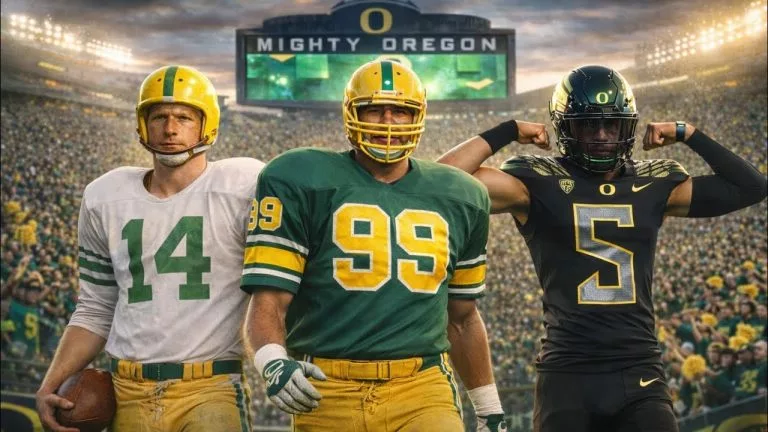
This is the key: Oregon’s “uniform madness” wasn’t just about being loud. It was an early realization that college football was moving into a world where
attention is currency. Oregon used design as a competitive advantage—creating a program that looked futuristic, felt exclusive, and signaled innovation.
From there, Oregon became the sport’s most visible laboratory:
constant uniform iterations
bold colorways and thematic alternates
helmet experimentation as identity
a branding approach that treated each game like a product drop
In a sport addicted to tradition, Oregon built a tradition out of
reinvention.
The Evolution of Oregon Ducks Football Uniforms…
Facilities as brand statements: turning infrastructure into recruiting
The uniforms grabbed eyeballs. The facilities closed recruits.
Phil Knight’s giving to Oregon has been enormous and unusually targeted toward turning the athletic experience into a premium product—both for athletes and for perception. One of the most visible examples is the
Hatfield-Dowlin Complex, Oregon’s football operations center, completed in
2013
with a Phil and Penny Knight donation.
Hatfield-Dowlin became symbolic because it wasn’t merely functional—it was a statement of what Oregon wanted to be: modern, elite, player-first, and unapologetically high-end. Its amenities and design were part of the message:
this is not a normal college football operation.
That facility-forward approach created a flywheel:
Better facilities improve player experience and development
Recruits see an NFL-like environment
Media coverage amplifies the “Oregon is different” narrative
The brand becomes self-sustaining
At Oregon, buildings weren’t just construction projects. They were
marketing.
The “University of Nike” effect: power, leverage, and backlash
Oregon’s rise came with a label that has followed the program for decades: “University of Nike.” And like any powerful label, it cuts both ways.
On one hand, Nike proximity gave Oregon:
unmatched design credibility
a recruiting differentiator few schools can replicate
national visibility that outpaced its traditional football footprint
On the other hand, it created persistent criticisms:
that Oregon’s brand was “purchased”
that the school’s athletic identity became too dependent on one donor/company
that institutional priorities were distorted toward athletics
Those tensions are part of the story. Oregon’s model worked because it combined money with design and strategy—but it also guaranteed the program would be judged differently. When you become a national symbol, you don’t get to be treated like a normal program anymore.
The post-Saban era of college athletics: Oregon adapts faster than most
Here’s where “up to date” matters.
The current college sports era isn’t defined by facilities or uniforms alone. It’s defined by
Name, Image, Likeness (NIL)
and the reality that player movement and compensation structures shape rosters as much as coaching does.
Oregon didn’t just react to NIL—it helped
professionalize
it.
In 2021, Phil Knight and other Oregon-connected leadership helped launch
Division Street, an Oregon-focused NIL company, with former
Nike executives
in leadership roles (including CEO Rosemary St. Clair, per reporting and Division Street’s own materials).
Division Street’s evolution—plus its consumer-facing brand work like
Ducks of a Feather
product drops—reflects Oregon’s defining advantage: the ability to merge athletics, commerce, and storytelling in a way most schools can’t. Coverage and releases around Ducks of a Feather/Nike collaborations underline how Oregon’s NIL ecosystem has leaned into premium branding and collectible culture rather than treating NIL as purely transactional.
In other words: Oregon didn’t just try to “keep up” with NIL. It tried to make NIL feel like Oregon—exclusive, creative, and culturally loud.
Knight’s broader philanthropy: the brand expands beyond sports
A crucial nuance: while Oregon athletics is the public-facing headline, Knight’s influence also extends deeply into academics and research.
The University of Oregon has documented major Knight gifts supporting the
Phil and Penny Knight Campus for Accelerating Scientific Impact, including a second
$500 million
gift announced in
2021
to expand the initiative.
And in 2025, the Knights made national news for a massive
$2 billion
pledge to Oregon Health & Science University’s Knight Cancer Institute—one of the largest gifts ever reported to a U.S. university/academic health center.
That matters for “brand evolution” because it shows Knight’s legacy in Oregon isn’t only football uniforms—it’s a broader Oregon philanthropic footprint that reinforces the state’s identity around sport, health, and innovation.
Where things stand now: Oregon’s brand advantage is real—and still unique
Phil Knight stepped down from Nike’s board and became “chairman emeritus,” formalizing the transition out of day-to-day corporate leadership while remaining an iconic figure.
But Oregon’s brand machine doesn’t depend on his daily involvement anymore. The relationship is now institutionalized:
Oregon’s visual identity is intertwined with Nike design history
its recruiting pitch is built on innovation + resources
its NIL approach is shaped by Oregon-connected professional marketing infrastructure
The result is that Oregon has become what many schools
want
to be: a program whose brand is so strong it functions like a national franchise.
The honest conclusion: Oregon’s evolution is the future—and the warning
Phil Knight’s impact created one of the most remarkable brand evolutions in college sports history. Oregon proved that:
design can be a competitive advantage
facilities can be recruiting weapons
narrative can be as powerful as tradition
NIL can be packaged and professionalized
But Oregon also illustrates the unavoidable tension of modern college sports: when a program becomes a brand-first operation, it will always face questions about money, influence, and identity.
Oregon’s story is not simply “Nike made them.” It’s “Oregon learned how to win the modern era first.”
And that, more than any uniform, is why the Ducks became the model everyone else is still chasing.
Up To $1500 in Bonus Bets Paid Back if your First Bet Does Not Win
T&Cs apply
4.5/5
Gambling problem? Call 1-800-GAMBLER or 1-800-MY-RESET (Available in the US) 877-8-HOPENY or text HOPENY (467369) (NY) 1-800-327-5050 (MA), 1-800-BETS-OFF (IA), 1-800-981-0023 (PR). 21+ only. Please Gamble Responsibly. See BetMGM.com for Terms. First Bet Offer for new customers only (if applicable). Subject to eligibility requirements. Bonus bets are non-withdrawable. In partnership with Kansas Crossing Casino and Hotel. Promotional offers not available in Mississippi, Massachusetts, New York, Ontario, or Puerto Rico.
New DraftKings Customer: SPEND $5, GET $200 IN BONUSES
T&Cs apply
4.5/5
To be eligible for DraftKings Sportsbook and the Promotion, you must be physically located in AR, AZ, CO, CT, DC, IA, IL, IN, KS, KY, LA (select parishes), MA, MD, ME, MI, MO, NC, NJ, NH, NY, OH, OR, PA, PR (residents only), TN, VA, VT, WY, WV, CA-ONT or CA-AB (each an “Eligible Jurisdiction” or, collectively, the “Eligible Jurisdictions”). Must be 21+ years of age or older (18+ if in DC/NH/PR/WY/CA-AB) (19+ in CA-ONT). GAMBLING PROBLEM? CALL 1-800-GAMBLER or 1-800-MY-RESET, (800) 327-5050 or visit gamblinghelplinema.org (MA) Please Gamble Responsibly. 888-789-7777/visit ccpg.org (CT), or visit www.mdgamblinghelp.org (MD), 1-800-981-0023 (PR). 21+ and present in most states. (18+ DC/NH/PR/WY). Void in CAN. Eligibility restrictions apply. On behalf of Boot Hill Casino (KS). Pass-thru of per wager tax may apply in IL. 1 per new DraftKings customer. $5+ first-time bet req. Max. $200 issued as non-withdrawable Bonus Bets. Stake removed from payout. Reward issued as $50 in Bonus Bets every 7 days via click-to-claim for 21 days. Bonus Bets and click-to-claims expire 7 days (168hrs) after issuance. Terms: Promos | DraftKings Sportsbook . Ends 9/20/26 at 11:59 PM ET. Sponsored by DK.
Must be 21+. GAMBLING PROBLEM? CALL 1-800-GAMBLER OR CALL 1-800-MY-RESET, www.mdgamblinghelp.org (MD), (800)-327-5050 or gamblinghelplinema.org (MA), Call (877)8-HOPENY or text HOPENY (467369) (NY), (888) 789-7777 or ccpg.org (CT), morethanagame.nc.gov (NC), 1800gambler.net (WV)
Bet $1 and get double the winnings up to $25 for your next 10 bets
T&Cs apply
4.4/5
21+ New users only. Must register using eligible promo code. First bet after registration must qualify. Max. Bonus Bet: $1,000. Bonus Bet expires 14 days after receipt. Void where prohibited. See Caesars.com/promos for full terms. Gambling Problem? 1-800-GAMBLER (1-800-426-2537)
21+ and present in OH. Gambling Problem? Call 1-800-GAMBLER.
This site is using
Cloudflare
and adheres to the
Google Safe Browsing Program. We adapted
Google's Privacy Guidelines
to keep your data safe at all times.
Close
Ready to Win Big? Join the Elite with Our Sports Betting Deals!
FanDuel Promo
New Users – Get $350 in Bonus Bets when you wager $5 for 7 days
Up To $1500 in Bonus Bets Paid Back if your First Bet Does Not Win
Best Slots
T&Cs and 21+ apply
Gambling problem? Call 1-800-GAMBLER or 1-800-MY-RESET (Available in the US) 877-8-HOPENY or text HOPENY (467369) (NY) 1-800-327-5050 (MA), 1-800-BETS-OFF (IA), 1-800-981-0023 (PR). 21+ only. Please Gamble Responsibly. See BetMGM.com for Terms. First Bet Offer for new customers only (if applicable). Subject to eligibility requirements. Bonus bets are non-withdrawable. In partnership with Kansas Crossing Casino and Hotel. Promotional offers not available in Mississippi, Massachusetts, New York, Ontario, or Puerto Rico.
Code:
Open BetMGM
Get Bonus
DraftKings Promo
New DraftKings Customer: SPEND $5, GET $200 IN BONUSES
Newcomer
T&Cs and 21+ apply
To be eligible for DraftKings Sportsbook and the Promotion, you must be physically located in AR, AZ, CO, CT, DC, IA, IL, IN, KS, KY, LA (select parishes), MA, MD, ME, MI, MO, NC, NJ, NH, NY, OH, OR, PA, PR (residents only), TN, VA, VT, WY, WV, CA-ONT or CA-AB (each an “Eligible Jurisdiction” or, collectively, the “Eligible Jurisdictions”). Must be 21+ years of age or older (18+ if in DC/NH/PR/WY/CA-AB) (19+ in CA-ONT). GAMBLING PROBLEM? CALL 1-800-GAMBLER or 1-800-MY-RESET, (800) 327-5050 or visit gamblinghelplinema.org (MA) Please Gamble Responsibly. 888-789-7777/visit ccpg.org (CT), or visit www.mdgamblinghelp.org (MD), 1-800-981-0023 (PR). 21+ and present in most states. (18+ DC/NH/PR/WY). Void in CAN. Eligibility restrictions apply. On behalf of Boot Hill Casino (KS). Pass-thru of per wager tax may apply in IL. 1 per new DraftKings customer. $5+ first-time bet req. Max. $200 issued as non-withdrawable Bonus Bets. Stake removed from payout. Reward issued as $50 in Bonus Bets every 7 days via click-to-claim for 21 days. Bonus Bets and click-to-claims expire 7 days (168hrs) after issuance. Terms: Promos | DraftKings Sportsbook . Ends 9/20/26 at 11:59 PM ET. Sponsored by DK.
Code:
Open DraftKings
Get Bonus
Find out what the legends have to say about sports this week....