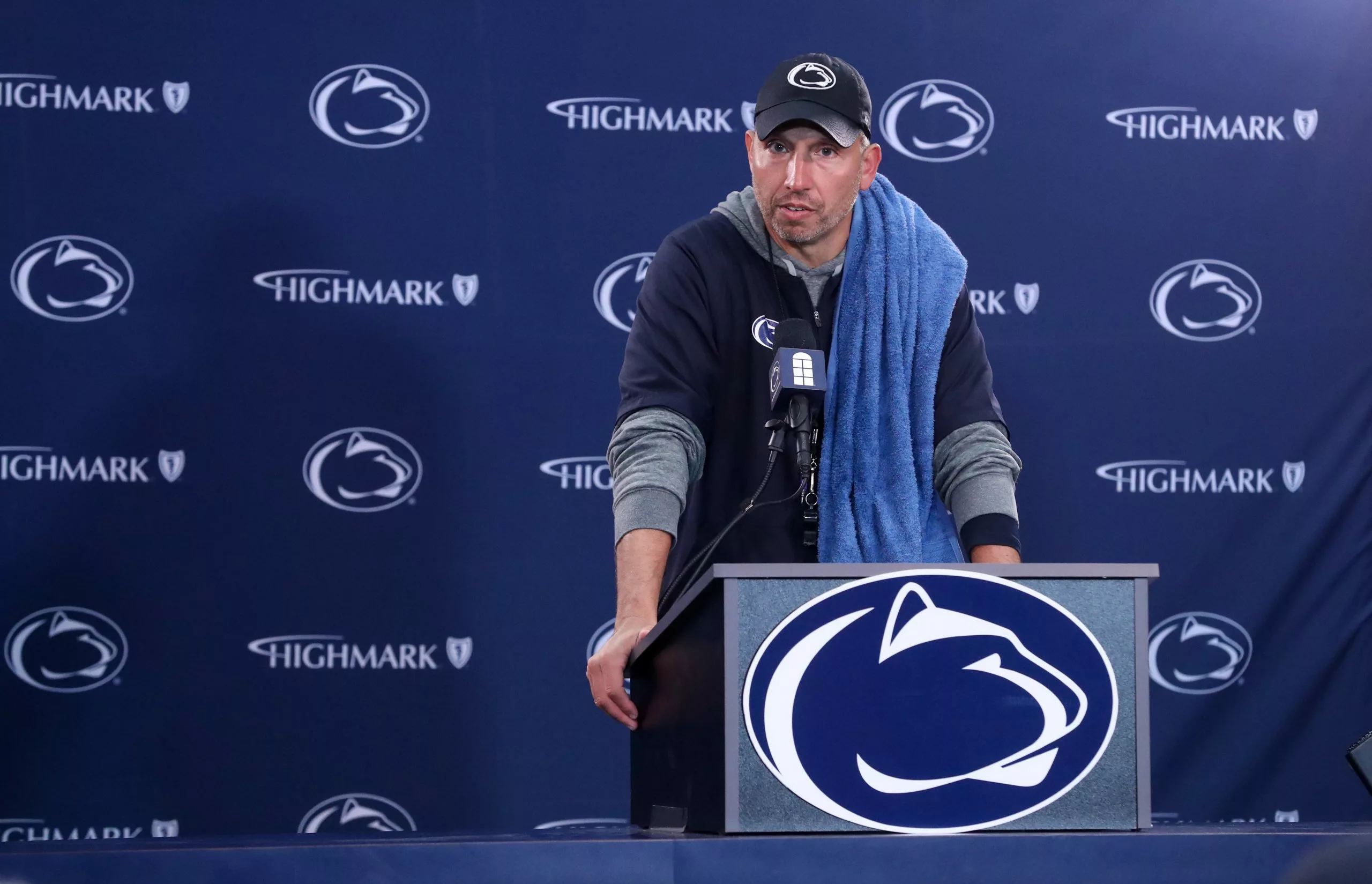
Apr 25, 2026; University Park, PA, USA; Penn State Nittany Lions head coach Matt Campbell answers questions from the media following the Penn State Blue-White Spring game at Beaver Stadium. Mandatory Credit: Matthew O'Haren-Imagn Images
James Franklin recruited as well as almost anyone in college football, and it was not enough. Penn State signed top-15 classes year after year under him, and for more than a decade, the Nittany Lions turned all that talent into good seasons that fell short of great ones. The wait finally ran out last fall, when a team that opened with national title expectations lost three straight, and Franklin was fired on October 12 after a 3-3 start.
The hire that followed is where things got interesting. Penn State gave Matt Campbell an eight-year contract worth $70.5 million to leave Iowa State, and Campbell showed up with a way of building rosters that runs against nearly everything the program had been doing. He does not chase hype, and this fall, the Big Ten finds out whether that can win the games Franklin could not.
The star chase that never paid off
For years, the recruiting rankings told Penn State fans a breakthrough was coming. The Lions stacked blue-chip signees, sat near the top of the sport on signing day, and still finished behind Ohio State almost every time it mattered. The roster always looked loaded in February and always seemed to come up a little short in November, and eventually that gap stopped looking like bad luck and started looking like a pattern.
Campbell made his name doing the opposite. Iowa State has none of Penn State’s recruiting pull, so he won by finding overlooked players and coaching them up over three and four years until the Cyclones became a Big 12 contender. When the hire was announced, one assessment described him as more of a player developer than an ace recruiter, the kind of line that reads like faint praise at a blue-blood program. At Penn State, it is the entire plan.
Development over vanity names
None of this means Campbell has quit recruiting, and it would be lazy to say he has. He has changed what Penn State recruits for, chasing players who fit a specific role and then developing them into it instead of collecting the highest-ranked names on the board. A breakdown of his approach put it simply, noting that high school recruiting and development is his bread and butter, with the transfer portal set to add young talent he can grow rather than finished stars to plug in.
His general manager, Derek Hoodier, came with him from Iowa State and said the quiet part in plain terms. “I think we always want to sign a large high school class,” Hoodier told reporters. “That will always be our philosophy. And I think the root and the core nucleus of our program is always going to be high school recruiting and development along the way.” In a sport that loves a loud answer, that is a deliberately boring one, and it tends to sound boring only until January arrives.
Betting on an old school philosophy
The trouble with this strategy is that it produces no headlines in July. A roster full of developing linemen and high-character role players does not win the offseason, does not top a portal ranking, and does not give the national media anything shiny to talk about, so it gets ignored right up until it starts winning. Campbell does not appear bothered by that. He has leaned hard on stability instead, telling the Big Ten Network that “continuity is so big” and calling it the foundation of everything he built in Ames.
So the gamble is real, and it is worth naming plainly. Penn State paid superstar money for a coach whose whole philosophy rejects the superstar model, betting that a decade of expensive near-misses gets fixed by chasing less and teaching more. If Campbell is right, college football may finally have to admit what plenty of people have quietly believed for years, that development beats recruiting rankings. If he is wrong, the school will have spent $70 million to learn the same painful lesson twice. Either way, the answer will show up sooner or later, and it will be one of the
best stories in the Big Ten.
Up To $1500 in Bonus Bets Paid Back if your First Bet Does Not Win
T&Cs apply
4.5/5
Gambling problem? Call 1-800-GAMBLER or 1-800-MY-RESET (Available in the US) 877-8-HOPENY or text HOPENY (467369) (NY) 1-800-327-5050 (MA), 1-800-BETS-OFF (IA), 1-800-981-0023 (PR). 21+ only. Please Gamble Responsibly. See BetMGM.com for Terms. First Bet Offer for new customers only (if applicable). Subject to eligibility requirements. Bonus bets are non-withdrawable. In partnership with Kansas Crossing Casino and Hotel. Promotional offers not available in Mississippi, Massachusetts, New York, Ontario, or Puerto Rico.
New DraftKings Customers: Spend $5+ Get $150 in Bonuses
T&Cs apply
4.5/5
GAMBLING PROBLEM? CALL 1-800-GAMBLER or 1-800-MY-RESET, (800) 327-5050 or visit gamblinghelplinema.org (MA). Please Gamble Responsibly. 888-789-7777/visit ccpg.org (CT), or visit www.mdgamblinghelp.org (MD), 1-800-981-0023 (PR). 21+ and present in most states. (18+ DC/NH/PR/WY). Void in CAN. Eligibility restrictions apply. On behalf of Boot Hill Casino (KS). Pass-thru of per wager tax may apply in IL. 1 per new DraftKings customer. $5+ first-time bet req. Max. $150 issued as non-withdrawable Bonus Bets. Stake removed from payout. Reward issued as $50 in Bonus Bets every 7 days via click-to-claim for 14 days. Bonus Bets and click-to-claims expire 7 days (168hrs) after issuance. Terms: sportsbook.draftkings.com/promos. Ends 10/11/26 at 11:59 PM ET. Sponsored by DK.
Must be 21+. GAMBLING PROBLEM? CALL 1-800-GAMBLER OR CALL 1-800-MY-RESET, www.mdgamblinghelp.org (MD), (800)-327-5050 or gamblinghelplinema.org (MA), Call (877)8-HOPENY or text HOPENY (467369) (NY), (888) 789-7777 or ccpg.org (CT), morethanagame.nc.gov (NC), 1800gambler.net (WV)
Bet $1 and get double the winnings up to $25 for your next 10 bets
T&Cs apply
4.4/5
21+ New users only. Must register using eligible promo code. First bet after registration must qualify. Max. Bonus Bet: $1,000. Bonus Bet expires 14 days after receipt. Void where prohibited. See Caesars.com/promos for full terms. Gambling Problem? 1-800-GAMBLER (1-800-426-2537)
21+ and present in OH. Gambling Problem? Call 1-800-GAMBLER.
This site is using
Cloudflare
and adheres to the
Google Safe Browsing Program. We adapted
Google's Privacy Guidelines
to keep your data safe at all times.
Close
Ready to Win Big? Join the Elite with Our Sports Betting Deals!
FanDuel Promo
New Users – Get $250 in Bonus Bets when you wager $5 for 5 days
Up To $1500 in Bonus Bets Paid Back if your First Bet Does Not Win
Best Slots
T&Cs and 21+ apply
Gambling problem? Call 1-800-GAMBLER or 1-800-MY-RESET (Available in the US) 877-8-HOPENY or text HOPENY (467369) (NY) 1-800-327-5050 (MA), 1-800-BETS-OFF (IA), 1-800-981-0023 (PR). 21+ only. Please Gamble Responsibly. See BetMGM.com for Terms. First Bet Offer for new customers only (if applicable). Subject to eligibility requirements. Bonus bets are non-withdrawable. In partnership with Kansas Crossing Casino and Hotel. Promotional offers not available in Mississippi, Massachusetts, New York, Ontario, or Puerto Rico.
Code:
Open BetMGM
Get Bonus
DraftKings Promo
New DraftKings Customers: Spend $5+ Get $150 in Bonuses
Newcomer
T&Cs and 21+ apply
GAMBLING PROBLEM? CALL 1-800-GAMBLER or 1-800-MY-RESET, (800) 327-5050 or visit gamblinghelplinema.org (MA). Please Gamble Responsibly. 888-789-7777/visit ccpg.org (CT), or visit www.mdgamblinghelp.org (MD), 1-800-981-0023 (PR). 21+ and present in most states. (18+ DC/NH/PR/WY). Void in CAN. Eligibility restrictions apply. On behalf of Boot Hill Casino (KS). Pass-thru of per wager tax may apply in IL. 1 per new DraftKings customer. $5+ first-time bet req. Max. $150 issued as non-withdrawable Bonus Bets. Stake removed from payout. Reward issued as $50 in Bonus Bets every 7 days via click-to-claim for 14 days. Bonus Bets and click-to-claims expire 7 days (168hrs) after issuance. Terms: sportsbook.draftkings.com/promos. Ends 10/11/26 at 11:59 PM ET. Sponsored by DK.
Code:
Open DraftKings
Get Bonus
Find out what the legends have to say about sports this week....