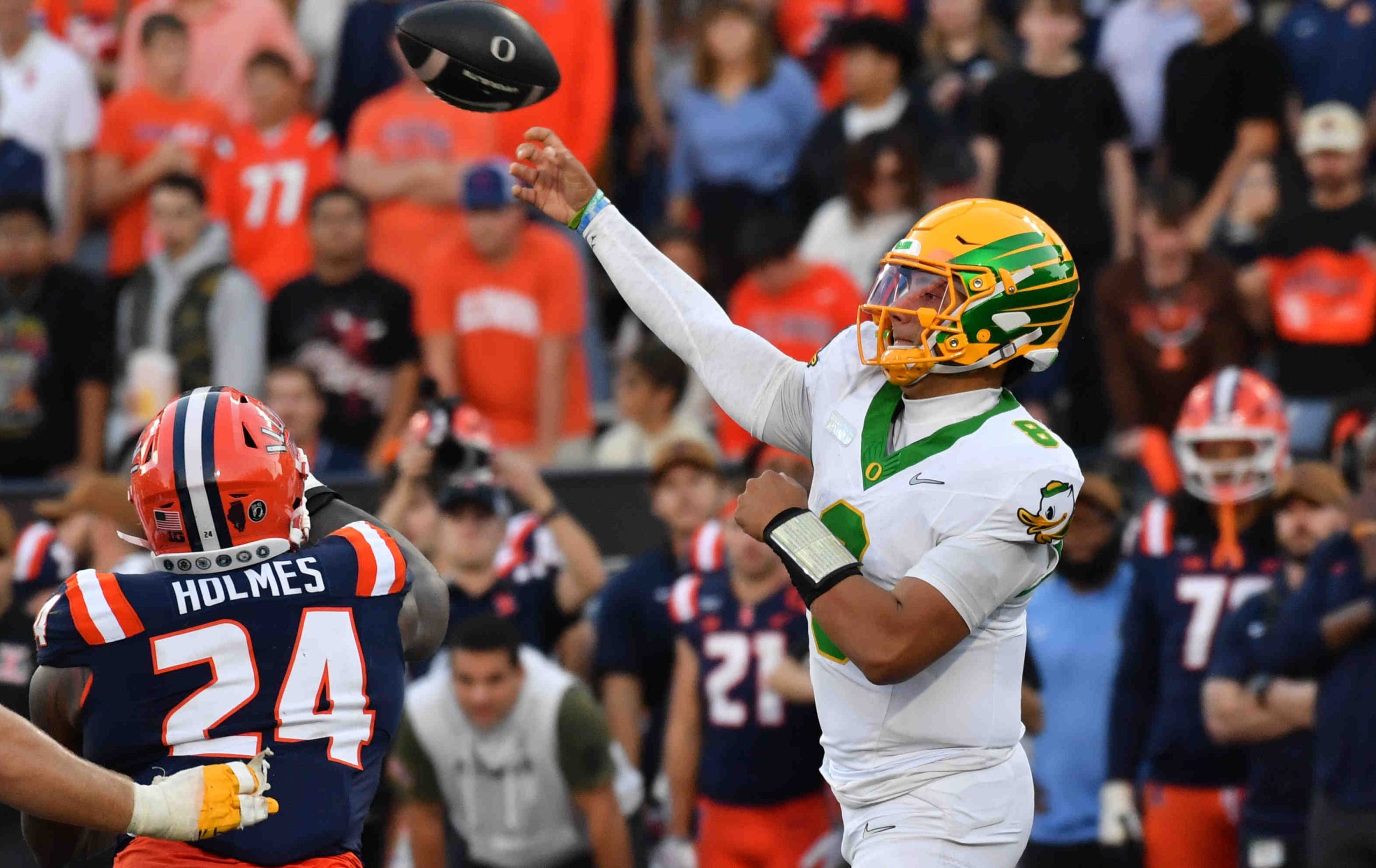
Oct 24, 2026; Champaign, Illinois, USA; Oregon Ducks quarterback Dylan Raiola (8) passes the ball during the second half against the Illinois Fighting Illini at Gies Memorial Stadium. Mandatory Credit: Ron Johnson-Imagn Images
Oregon opened Saturday’s game at Illinois with the kind of possession that should have established a foundation.
The Ducks drove 75 yards in 11 plays, finishing with a Jordon Davison touchdown run. They later extended their advantage to 10–0. From there, Illinois scored the game’s final 21 points, handing Oregon a 21–10 defeat that left both teams 4–3 overall and 2–2 in Big Ten play.
The opening drive demonstrated that Oregon could execute. The remaining afternoon exposed its inability to sustain that execution.
For Dan Lanning, that is the central problem. The Ducks need an offense that can function after the opening sequence, respond when an opponent gains confidence and finish possessions when the game remains within reach.
Illinois deserves substantial credit for making those tasks difficult. Bret Bielema’s team recovered from an early deficit, kept Oregon scoreless after halftime and delivered the offensive plays necessary to turn defensive resistance into a victory.
A Good Opening Cannot Carry an Entire Game
The first possession showed several elements
Oregon
needed throughout the afternoon.
The Ducks mixed productive runs with timely completions. They converted third downs and finished near the goal line. The sequence included a 25-yard completion to Dakorien Moore and a third-and-five conversion to Jamari Johnson.
That kind of variety forces a defense to account for multiple possibilities. It also gives the quarterback manageable situations and keeps the offense from relying on difficult throws to extend every possession.
The concern is how quickly that rhythm became difficult to reproduce.
An effective opening series provides evidence that a plan can work. Maintaining success requires adapting as defenders recognize formations, anticipate routes and change how they attack.
Oregon’s offense never found enough answers to prevent the game from moving away from it.
The Ducks continued to have opportunities. They could not turn those opportunities into the points needed to regain control.
The Passing Numbers Need Context
Dylan Raiola completed
27 of 41 passes for 246 yards.
Those totals do not describe an offense that was completely unable to move the ball. They also do not establish an efficient performance.
A completion helps only as much as the situation allows. A short gain on an early down can keep the offense on schedule. The same gain on third-and-long can end a possession.
Oregon needs to examine where its throws are going, how quickly the ball arrives and whether receivers have a realistic opportunity to continue after the catch.
The responsibility extends beyond Raiola.
Protection must give routes time to develop. Receivers must arrive where the quarterback expects them. Play calls must create useful answers against the coverage presented.
When those elements fail to connect, an offense can accumulate completions without consistently threatening the scoreboard.
Saturday illustrated that distinction.
Illinois Made Oregon Earn Its Yards
The Illini’s defensive performance should be evaluated as an achievement in its own right.
Illinois held Oregon scoreless in the second half while its offense gradually supplied the points needed to move ahead.
That required sustained concentration. The defense could not treat one successful series as sufficient, particularly while the score remained close.
Illinois repeatedly made Oregon execute another snap rather than allowing a modest completion to become an easy first down. Its resistance gave the offense time to improve.
The results support crediting Illinois for its response. They do not, by themselves, establish every coverage or pressure adjustment that produced it. What is clear is that the Ducks’ early success did not become a pattern.
Illinois stayed organized enough to keep the game within reach, then made Oregon play from behind.
That changed the demands on an offense already struggling to finish.
Laughery Gave Illinois the Breakthrough
Aidan Laughery’s
75-yard touchdown run
cut Oregon’s lead to 10–7 late in the first half. He finished with
123 rushing yards.
The timing mattered.
Oregon had just extended its lead. Illinois immediately supplied a response that prevented the Ducks from carrying a comfortable advantage into halftime.
An explosive run can change more than the score. It rewards an offense for remaining committed, energizes the sideline and forces the opposing defense to reconsider how aggressively it can pursue other responsibilities.
Illinois still had to build on the opportunity. Laughery’s run gave it a starting point.
For Oregon, the challenge was to answer without abandoning the execution that had worked early. The Ducks never produced the scoring response needed to make that touchdown a temporary interruption.
Clayton and Dixon Finished What the Defense Started
Illinois did not need an enormous passing total to win. It needed important completions at the right moments.
Michael Clayton II threw two touchdown passes in his first start. The second went to Collin Dixon for
23 yards with 2:29 remaining, extending Illinois’ lead to 21–10.
That finishing play deserves emphasis.
The Illini had an opportunity to create separation, and they executed. Clayton delivered the throw. Dixon completed the catch. Illinois turned a narrow advantage into a two-score lead late in the game.
The contrast with Oregon was significant. The Ducks produced more passing yardage, but Illinois converted its passing opportunities into touchdowns.
Efficiency is ultimately tied to what possessions accomplish. Illinois made its most consequential offensive moments count.
Lanning Needs More Than a Demand for Better Execution
Telling players to execute better is accurate only up to a point. Oregon’s staff must identify the specific breakdowns making execution difficult.
Are early-down calls consistently producing manageable situations? Does the quarterback have a clear answer when the defense takes away the preferred route? Are the Ducks using formations and motion to help reveal coverage? Can they protect long enough to threaten beyond the short passing game?
Those questions should shape the response.
Simplifying selected assignments could help if hesitation is contributing to mistakes. Greater variety could help if opponents are recognizing tendencies. The correct answer depends on the film, not on a general demand to become more aggressive.
Oregon must also distinguish between moving quickly and playing efficiently. Tempo has value when the offense is organized. It offers less when unsuccessful possessions repeatedly return the defense to the field.
The Ducks need an approach they can sustain after the opponent adjusts.
Illinois Earned This Result
It would be too easy to describe Saturday entirely as an
Oregon failure.
Illinois absorbed an early deficit, found an explosive rushing play, defended consistently after halftime and completed the touchdown pass that put the game away.
Those are accomplishments that explain the result.
For Oregon, the warning is equally clear. An encouraging opening and respectable passing totals cannot compensate for a scoreless second half.
Lanning’s offense must become more reliable between its best moments. Until it does, opponents have reason to believe they can withstand the initial burst and take control later.
Illinois did exactly that—and earned the victory that followed.
New Users – Get $350 in Bonus Bets when you wager $5 for 7 days
T&Cs apply
4.6/5
Gambling Problem? Call 1-800-GAMBLER or 1-800-MY-RESET. Call 1-888-789-7777 or visit ccpgg.org/chat (CT). Hope is here. GamblingHelpLineMA.org or call (800) 327-5050 for 24/7 support (MA). Visit www.mdgamblinghelp.org (MD). Call 1-877-8HOPE-NY or text HOPENY (NY). 21+ (18+ DC, WY) and present in select states (for KS, in affiliation with Kansas Star Casino). Find online real money wagering only. Min $5 wager required for 7 consecutive days. $5 free play credit. Bonus issued as non-withdrawable bonus with cash withdrawable bonus with cash withdrawable. Bonus bets which expire 7 days after receipt. Restrictions apply. See terms at sportsbook.fanduel.com. Call 1-877-770-7867 (LA).
Up To $1500 in Bonus Bets Paid Back if your First Bet Does Not Win
T&Cs apply
4.5/5
Gambling problem? Call 1-800-GAMBLER or 1-800-MY-RESET (Available in the US) 877-8-HOPENY or text HOPENY (467369) (NY) 1-800-327-5050 (MA), 1-800-BETS-OFF (IA), 1-800-981-0023 (PR). 21+ only. Please Gamble Responsibly. See BetMGM.com for Terms. First Bet Offer for new customers only (if applicable). Subject to eligibility requirements. Bonus bets are non-withdrawable. In partnership with Kansas Crossing Casino and Hotel. Promotional offers not available in Mississippi, Massachusetts, New York, Ontario, or Puerto Rico.
New DraftKings Customers: Bet $5, Get $200 + 3 Months of NBA League Pass!
T&Cs apply
4.5/5
GAMBLING PROBLEM? CALL 1-800-GAMBLER or 1-800-MY-RESET, (800) 327-5050 or visit gamblinghelplinema.org (MA). Please Gamble Responsibly. 888-789-7777/visit ccpg.org (CT), or visit www.mdgamblinghelp.org (MD), 1-800-981-0023 (PR). 21+ and present in most states. (18+ DC/NH/PR/WY). Void in CAN. Eligibility restrictions apply. On behalf of Boot Hill Casino (KS). Pass-thru of per wager tax may apply in IL. 1 per new Sportsbook customer. $5+ first-time bet req. Max. $200 issued as non-withdrawable Bonus Bets. Stake removed from payout. Reward issued as $50 in Bonus Bets every 7 days via click-to-claim for 21 days. Bonus Bets and click-to-claims expire 7 days (168hrs) after issuance. Terms: dkng.co/offer. Get 1 promo code to redeem a 3-month NBA League Pass subscription, complimentary of DraftKings. Subscription auto-renews monthly at then-current price (currently $16.99/mo); cancel anytime. Terms, restrictions, and eligibility requirements apply. Redeem League Pass by 12/19/26 at 11:59 PM ET. Addt’l terms: support.watch.nba.com/hc/en-us/articles/9165532876183-League-Pass-Terms-of-Use_. Ends 11/29/26 at 11:59 PM ET. Sponsored by DK.
Must be 21+. GAMBLING PROBLEM? CALL 1-800-GAMBLER OR CALL 1-800-MY-RESET, www.mdgamblinghelp.org (MD), (800)-327-5050 or gamblinghelplinema.org (MA), Call (877)8-HOPENY or text HOPENY (467369) (NY), (888) 789-7777 or ccpg.org (CT), morethanagame.nc.gov (NC), 1800gambler.net (WV)
Bet $1 and get double the winnings up to $25 for your next 10 bets
T&Cs apply
4.4/5
21+ New users only. Must register using eligible promo code. First bet after registration must qualify. Max. Bonus Bet: $1,000. Bonus Bet expires 14 days after receipt. Void where prohibited. See Caesars.com/promos for full terms. Gambling Problem? 1-800-GAMBLER (1-800-426-2537)
21+ and present in OH. Gambling Problem? Call 1-800-GAMBLER.
This site is using
Cloudflare
and adheres to the
Google Safe Browsing Program. We adapted
Google's Privacy Guidelines
to keep your data safe at all times.
Close
Ready to Win Big? Join the Elite with Our Sports Betting Deals!
FanDuel Promo
New Users – Get $350 in Bonus Bets when you wager $5 for 7 days
Our Favorite
T&Cs and 21+ apply
Gambling Problem? Call 1-800-GAMBLER or 1-800-MY-RESET. Call 1-888-789-7777 or visit ccpgg.org/chat (CT). Hope is here. GamblingHelpLineMA.org or call (800) 327-5050 for 24/7 support (MA). Visit www.mdgamblinghelp.org (MD). Call 1-877-8HOPE-NY or text HOPENY (NY). 21+ (18+ DC, WY) and present in select states (for KS, in affiliation with Kansas Star Casino). Find online real money wagering only. Min $5 wager required for 7 consecutive days. $5 free play credit. Bonus issued as non-withdrawable bonus with cash withdrawable bonus with cash withdrawable. Bonus bets which expire 7 days after receipt. Restrictions apply. See terms at sportsbook.fanduel.com. Call 1-877-770-7867 (LA).
Code:
Open FanDuel
Get Bonus
BetMGM Promo
Up To $1500 in Bonus Bets Paid Back if your First Bet Does Not Win
Best Slots
T&Cs and 21+ apply
Gambling problem? Call 1-800-GAMBLER or 1-800-MY-RESET (Available in the US) 877-8-HOPENY or text HOPENY (467369) (NY) 1-800-327-5050 (MA), 1-800-BETS-OFF (IA), 1-800-981-0023 (PR). 21+ only. Please Gamble Responsibly. See BetMGM.com for Terms. First Bet Offer for new customers only (if applicable). Subject to eligibility requirements. Bonus bets are non-withdrawable. In partnership with Kansas Crossing Casino and Hotel. Promotional offers not available in Mississippi, Massachusetts, New York, Ontario, or Puerto Rico.
Code:
Open BetMGM
Get Bonus
DraftKings Promo
New DraftKings Customers: Bet $5, Get $200 + 3 Months of NBA League Pass!
Newcomer
T&Cs and 21+ apply
GAMBLING PROBLEM? CALL 1-800-GAMBLER or 1-800-MY-RESET, (800) 327-5050 or visit gamblinghelplinema.org (MA). Please Gamble Responsibly. 888-789-7777/visit ccpg.org (CT), or visit www.mdgamblinghelp.org (MD), 1-800-981-0023 (PR). 21+ and present in most states. (18+ DC/NH/PR/WY). Void in CAN. Eligibility restrictions apply. On behalf of Boot Hill Casino (KS). Pass-thru of per wager tax may apply in IL. 1 per new Sportsbook customer. $5+ first-time bet req. Max. $200 issued as non-withdrawable Bonus Bets. Stake removed from payout. Reward issued as $50 in Bonus Bets every 7 days via click-to-claim for 21 days. Bonus Bets and click-to-claims expire 7 days (168hrs) after issuance. Terms: dkng.co/offer. Get 1 promo code to redeem a 3-month NBA League Pass subscription, complimentary of DraftKings. Subscription auto-renews monthly at then-current price (currently $16.99/mo); cancel anytime. Terms, restrictions, and eligibility requirements apply. Redeem League Pass by 12/19/26 at 11:59 PM ET. Addt’l terms: support.watch.nba.com/hc/en-us/articles/9165532876183-League-Pass-Terms-of-Use_. Ends 11/29/26 at 11:59 PM ET. Sponsored by DK.
Code:
Open DraftKings
Get Bonus
Find out what the legends have to say about sports this week....
New Users – Get $350 in Bonus Bets when you wager $5 for 7 days
Gambling Problem? Call 1-800-GAMBLER or 1-800-MY-RESET. Call 1-888-789-7777 or visit ccpgg.org/chat (CT). Hope is here. GamblingHelpLineMA.org or call (800) 327-5050 for 24/7 support (MA). Visit www.mdgamblinghelp.org (MD). Call 1-877-8HOPE-NY or text HOPENY (NY). 21+ (18+ DC, WY) and present in select states (for KS, in affiliation with Kansas Star Casino). Find online real money wagering only. Min $5 wager required for 7 consecutive days. $5 free play credit. Bonus issued as non-withdrawable bonus with cash withdrawable bonus with cash withdrawable. Bonus bets which expire 7 days after receipt. Restrictions apply. See terms at sportsbook.fanduel.com. Call 1-877-770-7867 (LA).