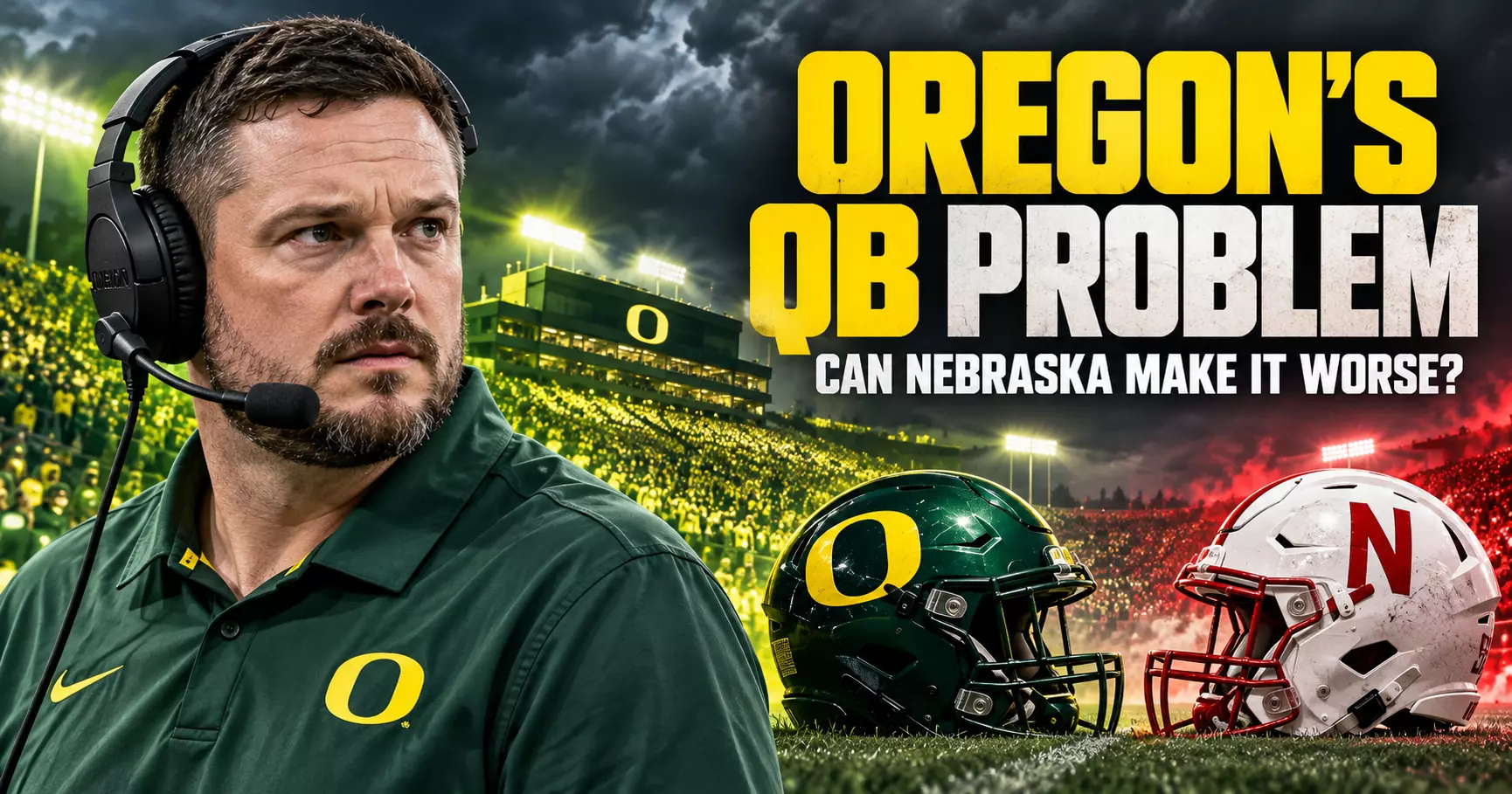
Oregon built its quarterback room to withstand an injury. After Saturday’s loss to UCLA, the Ducks must determine if that depth is enough
Oregon built its quarterback room to withstand an injury. After Saturday’s loss to UCLA, the Ducks must determine whether that depth can still protect their season.
Dante Moore remained sidelined following a concussion suffered at USC. Dylan Raiola struggled badly in his first Oregon start, and Brock Thomas provided a fourth-quarter spark that nearly rescued a game the offense had spent most of the afternoon giving away.
The result was a 17–15 defeat, seven Oregon turnovers and considerably more uncertainty than Dan Lanning wanted entering the Nebraska game.
Now the Ducks face a decision with consequences beyond one position. They need a quarterback who can restore some stability to an offense that is putting the rest of the team under unnecessary pressure.
Raiola’s Nebraska Reunion Is No Longer the Main Story
When Raiola transferred to
Oregon
after two seasons at Nebraska, a meeting with his former program was always going to draw attention.
But the storyline has changed.
Raiola made 22 starts for the Cornhuskers. Now, with Nebraska coming to Autzen Stadium, he must compete for the opportunity to start against them if Moore remains unavailable. Oregon has not announced its starter, and reporting on Lanning’s comments describes a competition between Raiola and Thomas.
That is the appropriate approach.
The emotional significance of facing a former team cannot outweigh the responsibility to give Oregon its best chance to win. Familiarity with Nebraska’s personnel might help Raiola, but it does not erase the mistakes against UCLA.
For Lanning, the question is whether Raiola can return to the composed football he displayed at USC or whether Thomas offers the more dependable option right now.
One Terrible Start Does Not Erase Raiola’s Ability
Raiola completed just six of 19 passes for 43 yards against UCLA. He threw two interceptions and lost a fumble before Thomas replaced him.
Those numbers demand scrutiny. They also should not become the only evidence considered.
Raiola helped Oregon win at USC after Moore was injured. The Ducks have seen him operate successfully in a difficult road environment. That performance matters when assessing whether the UCLA game reflected correctable problems or something more persistent.
The next evaluation belongs on the practice field and in the film room. Can he identify coverage more decisively? Can he find the available answer when pressure disrupts the original play? Can he protect the ball without becoming so cautious that the passing game stalls?
Lanning has praised Raiola’s response to being benched and his continued support of teammates. That is encouraging for the locker room, but composure after a setback must become better execution during the next opportunity.
Oregon needs both.
Brock Thomas Earned a Serious Look
Thomas entered in the fourth quarter and completed 11 of 15 passes for 156 yards and a touchdown. His 44-yard scoring connection with Evan Stewart brought Oregon within two points late in the game.
He gave an offense that had struggled to move the ball a chance to win.
That should earn him meaningful consideration. It should not automatically settle the competition.
Playing in relief and preparing as the starter present different challenges. Nebraska can study Thomas’s performance, build a plan around his tendencies and force him to make decisions he did not encounter against UCLA.
Still, the Ducks cannot dismiss productive football merely because it came from a quarterback lower on the depth chart.
If Thomas continues to deliver the clearest decisions and most consistent execution in practice, Lanning should be willing to select him. The job must follow the evidence rather than the preseason order.
Moore’s Availability Comes First
The most important variable remains Moore’s recovery.
Oregon’s official game preview identifies the concussion suffered at USC as the reason he missed UCLA. Until he is cleared and available, the coaching staff must build a workable plan around its other quarterbacks.
Even a return would not remove every offensive concern.
A starting quarterback can improve communication and timing. He cannot personally solve every protection breakdown, missed block or ball-security mistake.
The Ducks therefore need to avoid treating Moore’s availability as their entire recovery plan. Whoever starts needs an offense capable of supporting him.
Seven Turnovers Point to a Bigger Failure
It would be easy to make Raiola the explanation for everything that went wrong.
It would also be incomplete.
Oregon committed seven turnovers against UCLA. Raiola accounted for two interceptions and a lost fumble, so the full breakdown extended beyond those three plays.
That distinction matters when deciding what to change.
Ball security must improve throughout the offense. Protection must give the quarterback a reasonable opportunity to execute. The running game must create manageable situations rather than leave the passing attack to rescue possession after possession.
Oregon finished with just 73 rushing yards against UCLA. That is a difficult foundation for any quarterback, particularly one trying to establish confidence.
The staff should prioritize plays its chosen starter can execute reliably, with clear answers against pressure. A smaller, dependable menu is more useful than an ambitious plan that produces repeated mistakes.
Nebraska Can Make the Problems More Expensive
Nebraska arrives 5–1, with a 2–1 conference record. The Cornhuskers lead the nation in opponent third-down conversion percentage at 19.72%, according to Oregon’s game notes.
That makes early-down efficiency especially important.
Oregon cannot repeatedly ask its quarterback to rescue difficult third downs against a defense already effective at getting off the field. Avoiding negative plays, securing the football and generating ordinary gains will matter as much as finding a spectacular touchdown.
The Ducks also need sustained possessions that allow their own defense to recover. Against UCLA, Oregon held the Bruins to 140 rushing yards and forced three turnovers. The offense failed to convert that assistance into a victory.
Another performance like that would make winning unnecessarily difficult again.
Lanning Needs a Solution That Lasts Beyond Saturday
The Ducks are 3–2 and unranked in the
AP poll
after opening the season at No. 2. Another loss would further complicate their playoff prospects.
The Big Ten’s acknowledgment of an incorrect ball spot on Oregon’s late two-point conversion attempt deserves attention, but it does not explain the broader offensive performance.
Lanning’s task is to turn the quarterback decision into a coherent plan: choose the best available option, protect him, establish usable early-down production and stop surrendering possessions.
Raiola has experience and evidence of a higher level of play. Thomas has earned consideration through his performance. Moore’s availability remains the central uncertainty.
New Users – Get $350 in Bonus Bets when you wager $5 for 7 days
T&Cs apply
4.6/5
Gambling Problem? Call 1-800-GAMBLER or 1-800-MY-RESET. Call 1-888-789-7777 or visit ccpgg.org/chat (CT). Hope is here. GamblingHelpLineMA.org or call (800) 327-5050 for 24/7 support (MA). Visit www.mdgamblinghelp.org (MD). Call 1-877-8HOPE-NY or text HOPENY (NY). 21+ (18+ DC, WY) and present in select states (for KS, in affiliation with Kansas Star Casino). Find online real money wagering only. Min $5 wager required for 7 consecutive days. $5 free play credit. Bonus issued as non-withdrawable bonus with cash withdrawable bonus with cash withdrawable. Bonus bets which expire 7 days after receipt. Restrictions apply. See terms at sportsbook.fanduel.com. Call 1-877-770-7867 (LA).
Up To $1500 in Bonus Bets Paid Back if your First Bet Does Not Win
T&Cs apply
4.5/5
Gambling problem? Call 1-800-GAMBLER or 1-800-MY-RESET (Available in the US) 877-8-HOPENY or text HOPENY (467369) (NY) 1-800-327-5050 (MA), 1-800-BETS-OFF (IA), 1-800-981-0023 (PR). 21+ only. Please Gamble Responsibly. See BetMGM.com for Terms. First Bet Offer for new customers only (if applicable). Subject to eligibility requirements. Bonus bets are non-withdrawable. In partnership with Kansas Crossing Casino and Hotel. Promotional offers not available in Mississippi, Massachusetts, New York, Ontario, or Puerto Rico.
New DraftKings Customers: Bet $5, Get $200 + 3 Months of NBA League Pass!
T&Cs apply
4.5/5
GAMBLING PROBLEM? CALL 1-800-GAMBLER or 1-800-MY-RESET, (800) 327-5050 or visit gamblinghelplinema.org (MA). Please Gamble Responsibly. 888-789-7777/visit ccpg.org (CT), or visit www.mdgamblinghelp.org (MD), 1-800-981-0023 (PR). 21+ and present in most states. (18+ DC/NH/PR/WY). Void in CAN. Eligibility restrictions apply. On behalf of Boot Hill Casino (KS). Pass-thru of per wager tax may apply in IL. 1 per new Sportsbook customer. $5+ first-time bet req. Max. $200 issued as non-withdrawable Bonus Bets. Stake removed from payout. Reward issued as $50 in Bonus Bets every 7 days via click-to-claim for 21 days. Bonus Bets and click-to-claims expire 7 days (168hrs) after issuance. Terms: dkng.co/offer. Get 1 promo code to redeem a 3-month NBA League Pass subscription, complimentary of DraftKings. Subscription auto-renews monthly at then-current price (currently $16.99/mo); cancel anytime. Terms, restrictions, and eligibility requirements apply. Redeem League Pass by 12/19/26 at 11:59 PM ET. Addt’l terms: support.watch.nba.com/hc/en-us/articles/9165532876183-League-Pass-Terms-of-Use_. Ends 11/29/26 at 11:59 PM ET. Sponsored by DK.
Must be 21+. GAMBLING PROBLEM? CALL 1-800-GAMBLER OR CALL 1-800-MY-RESET, www.mdgamblinghelp.org (MD), (800)-327-5050 or gamblinghelplinema.org (MA), Call (877)8-HOPENY or text HOPENY (467369) (NY), (888) 789-7777 or ccpg.org (CT), morethanagame.nc.gov (NC), 1800gambler.net (WV)
Bet $1 and get double the winnings up to $25 for your next 10 bets
T&Cs apply
4.4/5
21+ New users only. Must register using eligible promo code. First bet after registration must qualify. Max. Bonus Bet: $1,000. Bonus Bet expires 14 days after receipt. Void where prohibited. See Caesars.com/promos for full terms. Gambling Problem? 1-800-GAMBLER (1-800-426-2537)
21+ and present in OH. Gambling Problem? Call 1-800-GAMBLER.
This site is using
Cloudflare
and adheres to the
Google Safe Browsing Program. We adapted
Google's Privacy Guidelines
to keep your data safe at all times.
Close
Ready to Win Big? Join the Elite with Our Sports Betting Deals!
FanDuel Promo
New Users – Get $350 in Bonus Bets when you wager $5 for 7 days
Our Favorite
T&Cs and 21+ apply
Gambling Problem? Call 1-800-GAMBLER or 1-800-MY-RESET. Call 1-888-789-7777 or visit ccpgg.org/chat (CT). Hope is here. GamblingHelpLineMA.org or call (800) 327-5050 for 24/7 support (MA). Visit www.mdgamblinghelp.org (MD). Call 1-877-8HOPE-NY or text HOPENY (NY). 21+ (18+ DC, WY) and present in select states (for KS, in affiliation with Kansas Star Casino). Find online real money wagering only. Min $5 wager required for 7 consecutive days. $5 free play credit. Bonus issued as non-withdrawable bonus with cash withdrawable bonus with cash withdrawable. Bonus bets which expire 7 days after receipt. Restrictions apply. See terms at sportsbook.fanduel.com. Call 1-877-770-7867 (LA).
Code:
Open FanDuel
Get Bonus
BetMGM Promo
Up To $1500 in Bonus Bets Paid Back if your First Bet Does Not Win
Best Slots
T&Cs and 21+ apply
Gambling problem? Call 1-800-GAMBLER or 1-800-MY-RESET (Available in the US) 877-8-HOPENY or text HOPENY (467369) (NY) 1-800-327-5050 (MA), 1-800-BETS-OFF (IA), 1-800-981-0023 (PR). 21+ only. Please Gamble Responsibly. See BetMGM.com for Terms. First Bet Offer for new customers only (if applicable). Subject to eligibility requirements. Bonus bets are non-withdrawable. In partnership with Kansas Crossing Casino and Hotel. Promotional offers not available in Mississippi, Massachusetts, New York, Ontario, or Puerto Rico.
Code:
Open BetMGM
Get Bonus
DraftKings Promo
New DraftKings Customers: Bet $5, Get $200 + 3 Months of NBA League Pass!
Newcomer
T&Cs and 21+ apply
GAMBLING PROBLEM? CALL 1-800-GAMBLER or 1-800-MY-RESET, (800) 327-5050 or visit gamblinghelplinema.org (MA). Please Gamble Responsibly. 888-789-7777/visit ccpg.org (CT), or visit www.mdgamblinghelp.org (MD), 1-800-981-0023 (PR). 21+ and present in most states. (18+ DC/NH/PR/WY). Void in CAN. Eligibility restrictions apply. On behalf of Boot Hill Casino (KS). Pass-thru of per wager tax may apply in IL. 1 per new Sportsbook customer. $5+ first-time bet req. Max. $200 issued as non-withdrawable Bonus Bets. Stake removed from payout. Reward issued as $50 in Bonus Bets every 7 days via click-to-claim for 21 days. Bonus Bets and click-to-claims expire 7 days (168hrs) after issuance. Terms: dkng.co/offer. Get 1 promo code to redeem a 3-month NBA League Pass subscription, complimentary of DraftKings. Subscription auto-renews monthly at then-current price (currently $16.99/mo); cancel anytime. Terms, restrictions, and eligibility requirements apply. Redeem League Pass by 12/19/26 at 11:59 PM ET. Addt’l terms: support.watch.nba.com/hc/en-us/articles/9165532876183-League-Pass-Terms-of-Use_. Ends 11/29/26 at 11:59 PM ET. Sponsored by DK.
Code:
Open DraftKings
Get Bonus
Find out what the legends have to say about sports this week....
New Users – Get $350 in Bonus Bets when you wager $5 for 7 days
Gambling Problem? Call 1-800-GAMBLER or 1-800-MY-RESET. Call 1-888-789-7777 or visit ccpgg.org/chat (CT). Hope is here. GamblingHelpLineMA.org or call (800) 327-5050 for 24/7 support (MA). Visit www.mdgamblinghelp.org (MD). Call 1-877-8HOPE-NY or text HOPENY (NY). 21+ (18+ DC, WY) and present in select states (for KS, in affiliation with Kansas Star Casino). Find online real money wagering only. Min $5 wager required for 7 consecutive days. $5 free play credit. Bonus issued as non-withdrawable bonus with cash withdrawable bonus with cash withdrawable. Bonus bets which expire 7 days after receipt. Restrictions apply. See terms at sportsbook.fanduel.com. Call 1-877-770-7867 (LA).