The Trojans are 4–0. Their offense is averaging 43 points per game. Jayden Maiava is playing efficient football, is it all real?
Lincoln Riley has spent the opening month of the 2026 college football season attempting to prove that USC has finally changed.
The Trojans are 4–0. Their offense is averaging 43 points per game. Jayden Maiava is playing efficient football, and USC has already won its Big Ten opener on the road.
Yet one uncomfortable question continues following Riley and the Trojans:
Is USC actually different, or has another talented offense temporarily concealed the same problems?
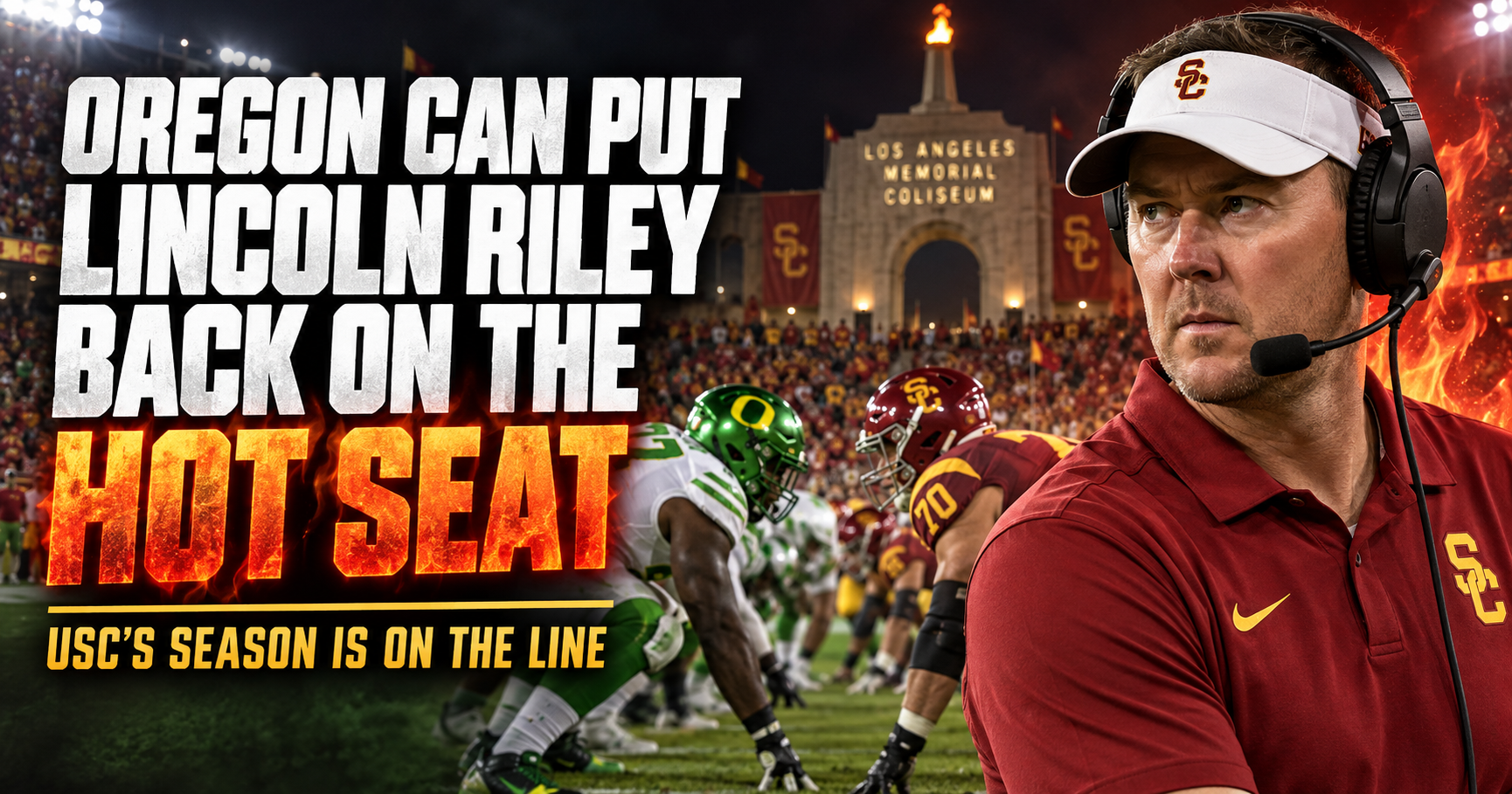
No. 20 Oregon will provide the answer Saturday night at the Los Angeles Memorial Coliseum.
A
USC victory
would move the No. 12 Trojans into the center of the Big Ten and College Football Playoff conversations. It would also give Riley the kind of meaningful win he has struggled to produce during his tenure in Los Angeles.
A loss—especially another defeat involving poor tackling, defensive breakdowns and a lack of physicality—would place Riley directly back on the hot seat.
USC Survived Rutgers but Solved Nothing
USC defeated Rutgers 42–35 in its Big Ten opener, but the final score was much more encouraging than the performance.
The Trojans never trailed and produced 461 yards of offense while averaging 7.3 yards per play. Maiava completed enough important throws, King Miller rushed for 102 yards, and Riley Wormley scored two touchdowns.
Those numbers suggest USC delivered a strong road performance.
The defensive numbers tell a different story.
Rutgers entered the game 0–3 after losses to UMass and Boston College. The Scarlet Knights had struggled to score against considerably less talented opponents. Against USC, they produced 460 yards and 35 points.
Rutgers outgained the Trojans 289–209 in the second half and remained within striking distance until the closing minutes. Running back Antwan Raymond rushed for 122 yards, while quarterback Dylan Lonergan threw for 252 yards and three touchdowns.
USC needed two Rutgers interceptions—including a 99-yard touchdown return—to avoid a potentially embarrassing defeat.
The Trojans won the game, but the performance revived every concern Riley was supposed to have eliminated.
The defense surrendered explosive plays. USC struggled to control the line of scrimmage. An inferior opponent became increasingly confident as the game progressed.
Against Rutgers, the Trojans survived.
Against Oregon, those problems could become fatal.
Gary Patterson Was Supposed to Change the Defense
Riley hired veteran coach Gary Patterson to repair a defense that has repeatedly prevented USC from competing for championships.
Patterson arrived with an impressive reputation. He built TCU into a national program, developed strong defenses without always possessing elite recruiting classes and was expected to bring experience and accountability to USC.
The early results have been inconsistent.
USC shut out Fresno State and allowed only 116 total yards in an encouraging defensive performance. But the Trojans surrendered 26 points to San Jose State, 30 to Louisiana and 35 to Rutgers.
Some of those points came after games were decided. The Rutgers performance cannot be explained away so easily.
The Scarlet Knights averaged nearly six yards per play and generated five plays of at least 20 yards. USC did not consistently pressure Lonergan, and its defense had difficulty preventing Rutgers from extending drives.
That is the exact type of performance Patterson was hired to eliminate.
Nobody should expect a coordinator to completely transform a defense in four games. But the Trojans do not need perfection. They need evidence that their worst habits are being corrected.
Oregon will test every part of Patterson’s defense.
The Ducks have speed at receiver, power in the backfield and a veteran quarterback capable of taking advantage of coverage mistakes. If USC cannot communicate, tackle and remain disciplined, the game could quickly resemble the Trojans’ most frustrating defeats under Riley.
USC’s Physicality Is Still on Trial
The word “soft” has followed Riley throughout his career.
It was used at Oklahoma when his teams produced elite offenses but struggled defensively in the College Football Playoff. It followed him to USC, where talented teams repeatedly lost games at the line of scrimmage.
The criticism can sometimes become lazy. USC has improved its recruiting and invested heavily in both lines. The Trojans are not physically identical to Riley’s first USC team.
But performances like the Rutgers game keep the criticism alive.
An 0–3 opponent should not rush for 168 yards and control significant stretches of the second half against a supposed playoff contender. USC should not require a late offensive drive to secure a game in which its defense scored a 99-yard touchdown.
The Oregon game is an opportunity to change that perception.
If USC can establish its running game, protect Maiava and prevent the Ducks from controlling the line of scrimmage, the Trojans will demonstrate measurable progress.
If Oregon pushes USC around, the familiar label will return immediately.
Riley cannot complain about that. His team must remove the criticism by playing differently.
Oregon Is Desperate Too
USC is not the only team entering this game under pressure.
Oregon was ranked No. 6
before suffering a shocking 39–31 loss at Oklahoma State. The Cowboys entered that game carrying a 12-game losing streak, yet they produced 554 yards and scored the final 10 points after Oregon briefly took the lead.
Dan Lanning admitted that his team lacked offensive rhythm, surrendered too many explosive plays, demonstrated poor eye discipline and failed at the point of attack.
The loss damaged Oregon’s playoff position and raised questions about whether the Ducks were as complete as expected.
Oregon responded by destroying Portland State 84–0. Dante Moore threw four first-half touchdown passes to four different receivers, and Jordon Davison scored twice before halftime. The Ducks broke the program’s single-game scoring record.
That result proved Oregon could overwhelm an FCS opponent. It did not prove the Oklahoma State loss was an aberration.
Saturday will provide a much more meaningful answer.
A second road loss would leave Oregon 2–2 and place its playoff hopes in immediate danger. The Ducks still must face Ohio State later in the season and would have almost no margin for error.
USC is playing to prove it belongs among the contenders.
Oregon is playing to keep its season from slipping away.
Jayden Maiava Gives USC a Chance
USC’s greatest advantage remains its offense.
Maiava threw for 277 yards and two touchdowns against Rutgers. He distributed the ball effectively, avoided the crippling mistake and helped USC score in every quarter.
Miller added balance with 102 rushing yards, while the Trojans finished with 184 yards on the ground. USC averaged 5.9 yards per rushing attempt and 8.7 yards per pass against Rutgers.
Riley’s offense is difficult to defend when the running game is productive. Defenses cannot focus entirely on Maiava, and play-action creates opportunities for USC’s receivers down the field.
That balance will be essential against Oregon.
The Ducks will attempt to pressure Maiava, disrupt USC’s timing and prevent the Trojans from generating easy completions. Riley must remain patient with the running game instead of abandoning it after a few unsuccessful plays.
USC cannot turn Saturday into a game in which Maiava must create everything.
The quarterback has played well, but Oregon is talented enough to capitalize if he becomes predictable.
Dante Moore Can Expose USC’s Secondary
Moore has experienced an unusual start to the season.
He struggled to establish consistent rhythm during Oregon’s first two games, including the defeat at Oklahoma State. He then looked nearly unstoppable during the 84-point destruction of Portland State.
Through three games, Moore has completed approximately 68 percent of his passes and thrown nine touchdowns without an interception.
Those numbers should concern USC.
Rutgers repeatedly found openings in the Trojans’ secondary. Lonergan completed only half his passes, but his three touchdowns and multiple explosive completions allowed the Scarlet Knights to stay in the game.
Moore is more accurate, more experienced and surrounded by significantly better skill players.
USC must generate pressure without exposing its secondary to easy opportunities. Patterson will need to disguise coverages and make Moore hold the ball longer than he wants.
If Moore remains comfortable, Oregon has enough offensive firepower to turn the game into another USC shootout.
That would place all the pressure back on Riley and Maiava.
Oregon Has Owned the Recent Series
USC leads the all-time series, but Oregon has controlled the rivalry recently.
The Ducks have won four consecutive meetings, including a 42–27 victory in 2025 and a 36–27 win in 2023. USC has not defeated Oregon since 2016.
Riley has never beaten Oregon as USC’s head coach.
That matters because Riley’s tenure has lacked signature victories. USC has produced exciting quarterbacks, impressive offensive statistics and stretches of national relevance, but the Trojans have rarely defeated elite opponents when the stakes were highest.
Oregon represents a chance to change the narrative.
The Ducks are vulnerable enough to be beaten but talented enough for the victory to matter nationally. USC does not need to defeat an undefeated top-five opponent to validate its progress. It needs to defeat a respected program that has consistently stood between the Trojans and conference supremacy.
A win would be one of Riley’s most important at USC.
A loss would feel like more of the same.
USC’s Schedule Makes This Game Even Bigger
The Oregon game begins a difficult stretch for the Trojans.
After facing the Ducks, USC must play Washington, travel to Penn State and Wisconsin, host Ohio State and eventually visit defending national champion Indiana.
That schedule contains very few comfortable Saturdays.
If USC defeats Oregon, the Trojans will move to 5–0 with a nationally relevant victory and growing confidence. Even if they stumble later, they will have evidence that this team can defeat quality opponents.
If USC loses, the pressure entering the rest of the schedule will become enormous.
A 4–1 record would not end USC’s playoff hopes, but another loss would become increasingly difficult to absorb. The Trojans could quickly move from undefeated contender to another talented team fighting merely to remain ranked.
That is why Saturday is about much more than one Big Ten game.
It will shape every conversation surrounding Riley for the rest of the season.
The Coliseum Must Finally Feel Like an Advantage
USC’s opening crowd against San Jose State was disappointing.
The announced attendance of 51,144 was the smallest for a USC home game since Riley arrived in 2022. Extreme heat contributed to the empty seats, but the visual still reinforced the idea that the program has not completely recaptured the attention of Los Angeles.
There should be no excuse against Oregon.
This is a prime-time game between ranked conference opponents. It features two nationally known coaches and two programs with playoff expectations.
USC needs a real home-field advantage. The Coliseum must be loud enough to disrupt Oregon’s communication and energetic enough to make the game feel important.
Riley was hired to make USC nationally relevant again. That includes creating games that matter to the city and filling the stadium when the season reaches a defining moment.
Saturday qualifies.
Riley Can Change the Conversation—or Lose Control of It
Lincoln Riley
is not coaching for his job on one September night.
But he is coaching for control of the narrative surrounding his program.
A victory would make USC 5–0, give Riley his first win over Oregon and establish the Trojans as legitimate Big Ten and playoff contenders. It would offer proof that the defensive investment, roster changes and emphasis on physicality are producing results.
A loss would revive every old criticism.
If USC allows another opponent to run freely, exploit coverage breakdowns and dominate the line of scrimmage, fans will conclude that nothing has fundamentally changed. The undefeated start will be dismissed as the product of a manageable schedule.
Riley has had plenty of talented offenses. He has coached excellent quarterbacks and produced impressive statistics.
What he has not done at USC is consistently win games like this.
Oregon is vulnerable, desperate and dangerous. The Ducks are good enough to expose USC but flawed enough that the Trojans have no excuse for accepting another moral victory.
This is Lincoln Riley’s opportunity to prove USC is finally becoming the program it promised to be.
If the Trojans fail, the hot-seat conversation will not merely return.
New Users – Get $350 in Bonus Bets when you wager $5 for 7 days
T&Cs apply
4.6/5
Gambling Problem? Call 1-800-GAMBLER or 1-800-MY-RESET. Call 1-888-789-7777 or visit ccpgg.org/chat (CT). Hope is here. GamblingHelpLineMA.org or call (800) 327-5050 for 24/7 support (MA). Visit www.mdgamblinghelp.org (MD). Call 1-877-8HOPE-NY or text HOPENY (NY). 21+ (18+ DC, WY) and present in select states (for KS, in affiliation with Kansas Star Casino). Find online real money wagering only. Min $5 wager required for 7 consecutive days. $5 free play credit. Bonus issued as non-withdrawable bonus with cash withdrawable bonus with cash withdrawable. Bonus bets which expire 7 days after receipt. Restrictions apply. See terms at sportsbook.fanduel.com. Call 1-877-770-7867 (LA).
Up To $1500 in Bonus Bets Paid Back if your First Bet Does Not Win
T&Cs apply
4.5/5
Gambling problem? Call 1-800-GAMBLER or 1-800-MY-RESET (Available in the US) 877-8-HOPENY or text HOPENY (467369) (NY) 1-800-327-5050 (MA), 1-800-BETS-OFF (IA), 1-800-981-0023 (PR). 21+ only. Please Gamble Responsibly. See BetMGM.com for Terms. First Bet Offer for new customers only (if applicable). Subject to eligibility requirements. Bonus bets are non-withdrawable. In partnership with Kansas Crossing Casino and Hotel. Promotional offers not available in Mississippi, Massachusetts, New York, Ontario, or Puerto Rico.
New DraftKings Customers: Bet $5, Get $200 + 3 Months of NBA League Pass!
T&Cs apply
4.5/5
GAMBLING PROBLEM? CALL 1-800-GAMBLER or 1-800-MY-RESET, (800) 327-5050 or visit gamblinghelplinema.org (MA). Please Gamble Responsibly. 888-789-7777/visit ccpg.org (CT), or visit www.mdgamblinghelp.org (MD), 1-800-981-0023 (PR). 21+ and present in most states. (18+ DC/NH/PR/WY). Void in CAN. Eligibility restrictions apply. On behalf of Boot Hill Casino (KS). Pass-thru of per wager tax may apply in IL. 1 per new Sportsbook customer. $5+ first-time bet req. Max. $200 issued as non-withdrawable Bonus Bets. Stake removed from payout. Reward issued as $50 in Bonus Bets every 7 days via click-to-claim for 21 days. Bonus Bets and click-to-claims expire 7 days (168hrs) after issuance. Terms: dkng.co/offer. Get 1 promo code to redeem a 3-month NBA League Pass subscription, complimentary of DraftKings. Subscription auto-renews monthly at then-current price (currently $16.99/mo); cancel anytime. Terms, restrictions, and eligibility requirements apply. Redeem League Pass by 12/19/26 at 11:59 PM ET. Addt’l terms: support.watch.nba.com/hc/en-us/articles/9165532876183-League-Pass-Terms-of-Use_. Ends 11/29/26 at 11:59 PM ET. Sponsored by DK.
Must be 21+. GAMBLING PROBLEM? CALL 1-800-GAMBLER OR CALL 1-800-MY-RESET, www.mdgamblinghelp.org (MD), (800)-327-5050 or gamblinghelplinema.org (MA), Call (877)8-HOPENY or text HOPENY (467369) (NY), (888) 789-7777 or ccpg.org (CT), morethanagame.nc.gov (NC), 1800gambler.net (WV)
Bet $1 and get double the winnings up to $25 for your next 10 bets
T&Cs apply
4.4/5
21+ New users only. Must register using eligible promo code. First bet after registration must qualify. Max. Bonus Bet: $1,000. Bonus Bet expires 14 days after receipt. Void where prohibited. See Caesars.com/promos for full terms. Gambling Problem? 1-800-GAMBLER (1-800-426-2537)
21+ and present in OH. Gambling Problem? Call 1-800-GAMBLER.
This site is using
Cloudflare
and adheres to the
Google Safe Browsing Program. We adapted
Google's Privacy Guidelines
to keep your data safe at all times.
Close
Ready to Win Big? Join the Elite with Our Sports Betting Deals!
FanDuel Promo
New Users – Get $350 in Bonus Bets when you wager $5 for 7 days
Our Favorite
T&Cs and 21+ apply
Gambling Problem? Call 1-800-GAMBLER or 1-800-MY-RESET. Call 1-888-789-7777 or visit ccpgg.org/chat (CT). Hope is here. GamblingHelpLineMA.org or call (800) 327-5050 for 24/7 support (MA). Visit www.mdgamblinghelp.org (MD). Call 1-877-8HOPE-NY or text HOPENY (NY). 21+ (18+ DC, WY) and present in select states (for KS, in affiliation with Kansas Star Casino). Find online real money wagering only. Min $5 wager required for 7 consecutive days. $5 free play credit. Bonus issued as non-withdrawable bonus with cash withdrawable bonus with cash withdrawable. Bonus bets which expire 7 days after receipt. Restrictions apply. See terms at sportsbook.fanduel.com. Call 1-877-770-7867 (LA).
Code:
Open FanDuel
Get Bonus
BetMGM Promo
Up To $1500 in Bonus Bets Paid Back if your First Bet Does Not Win
Best Slots
T&Cs and 21+ apply
Gambling problem? Call 1-800-GAMBLER or 1-800-MY-RESET (Available in the US) 877-8-HOPENY or text HOPENY (467369) (NY) 1-800-327-5050 (MA), 1-800-BETS-OFF (IA), 1-800-981-0023 (PR). 21+ only. Please Gamble Responsibly. See BetMGM.com for Terms. First Bet Offer for new customers only (if applicable). Subject to eligibility requirements. Bonus bets are non-withdrawable. In partnership with Kansas Crossing Casino and Hotel. Promotional offers not available in Mississippi, Massachusetts, New York, Ontario, or Puerto Rico.
Code:
Open BetMGM
Get Bonus
DraftKings Promo
New DraftKings Customers: Bet $5, Get $200 + 3 Months of NBA League Pass!
Newcomer
T&Cs and 21+ apply
GAMBLING PROBLEM? CALL 1-800-GAMBLER or 1-800-MY-RESET, (800) 327-5050 or visit gamblinghelplinema.org (MA). Please Gamble Responsibly. 888-789-7777/visit ccpg.org (CT), or visit www.mdgamblinghelp.org (MD), 1-800-981-0023 (PR). 21+ and present in most states. (18+ DC/NH/PR/WY). Void in CAN. Eligibility restrictions apply. On behalf of Boot Hill Casino (KS). Pass-thru of per wager tax may apply in IL. 1 per new Sportsbook customer. $5+ first-time bet req. Max. $200 issued as non-withdrawable Bonus Bets. Stake removed from payout. Reward issued as $50 in Bonus Bets every 7 days via click-to-claim for 21 days. Bonus Bets and click-to-claims expire 7 days (168hrs) after issuance. Terms: dkng.co/offer. Get 1 promo code to redeem a 3-month NBA League Pass subscription, complimentary of DraftKings. Subscription auto-renews monthly at then-current price (currently $16.99/mo); cancel anytime. Terms, restrictions, and eligibility requirements apply. Redeem League Pass by 12/19/26 at 11:59 PM ET. Addt’l terms: support.watch.nba.com/hc/en-us/articles/9165532876183-League-Pass-Terms-of-Use_. Ends 11/29/26 at 11:59 PM ET. Sponsored by DK.
Code:
Open DraftKings
Get Bonus
Find out what the legends have to say about sports this week....
New Users – Get $350 in Bonus Bets when you wager $5 for 7 days
Gambling Problem? Call 1-800-GAMBLER or 1-800-MY-RESET. Call 1-888-789-7777 or visit ccpgg.org/chat (CT). Hope is here. GamblingHelpLineMA.org or call (800) 327-5050 for 24/7 support (MA). Visit www.mdgamblinghelp.org (MD). Call 1-877-8HOPE-NY or text HOPENY (NY). 21+ (18+ DC, WY) and present in select states (for KS, in affiliation with Kansas Star Casino). Find online real money wagering only. Min $5 wager required for 7 consecutive days. $5 free play credit. Bonus issued as non-withdrawable bonus with cash withdrawable bonus with cash withdrawable. Bonus bets which expire 7 days after receipt. Restrictions apply. See terms at sportsbook.fanduel.com. Call 1-877-770-7867 (LA).