No. 4 Ole Miss travels to Gainesville for a top-25 SEC showdown against No. 21 Florida on Saturday afternoon. Both teams enter the matchup 3–0
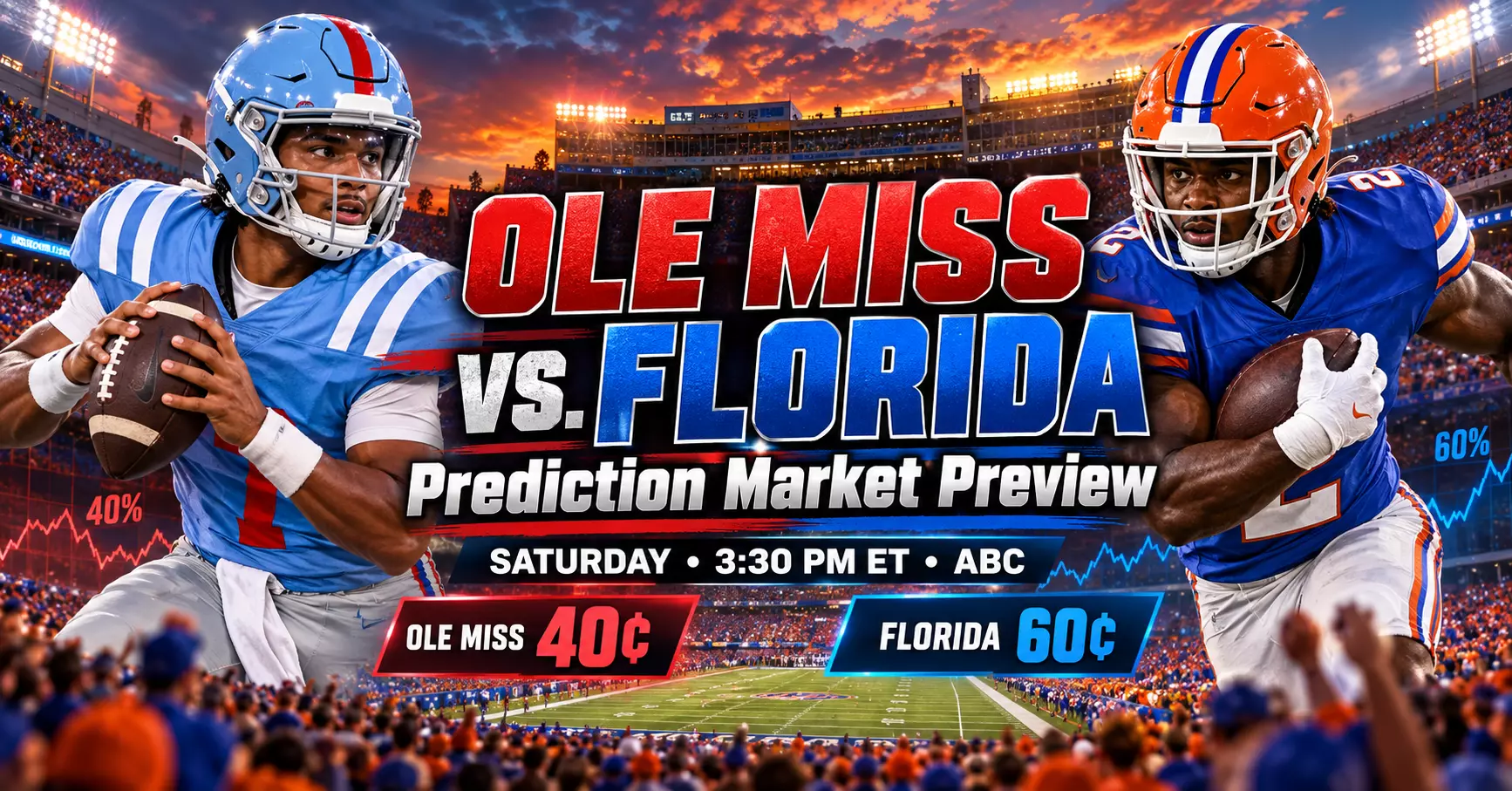
No. 4 Ole Miss travels to Gainesville for a top-25 SEC showdown against No. 21 Florida on Saturday afternoon. Both teams enter the matchup 3–0 overall and 1–0 in conference play, but only one will leave Ben Hill Griffin Stadium looking like a legitimate College Football Playoff contender.
Ole Miss earned its biggest victory of the season last Saturday, defeating LSU 32–24 in Lane Kiffin’s emotional return to Oxford. Florida survived a much different challenge, overcoming Auburn 44–39 at Jordan-Hare Stadium to give Jon Sumrall his first SEC victory as the Gators’ head coach.
Despite the difference in rankings, Florida enters the weekend as a slight home favorite. That creates two compelling event-contract opportunities: the outright winner and the point spread.
Game Information
Matchup:
No. 4 Ole Miss Rebels at No. 21 Florida Gators
Date:
Saturday, September 26, 2026
Kickoff:
3:30 p.m. ET
Location:
Ben Hill Griffin Stadium, Gainesville, Florida
Television:
ABC
Records:
Ole Miss 3–0, Florida 3–0
Point spread:
Florida -3.5
ABC will broadcast the game nationally, with Sean McDonough, Greg McElroy and Katie George assigned to the coverage.
Current Ole Miss vs. Florida Prediction Market Prices
The following market refers to the team that will be declared the winner of the Ole Miss–Florida game.
These percentages and contract prices can move as people buy, sell and trade event contracts. Participants should check the available market immediately before making a purchase.
Florida’s status as the favorite may surprise anyone looking only at the rankings. Ole Miss is ranked fourth nationally after defeating LSU, while Florida recently entered the rankings at No. 21. The location, Florida’s rushing attack and questions surrounding the health of Ole Miss running back Kewan Lacy have helped push the Gators ahead in the market.
Ole Miss Rebels Matchup Preview
Ole Miss has already survived two significant tests.
The Rebels opened their season with a 41–38 victory over Louisville before defeating Charlotte 41–9. Their 32–24 victory over LSU was the performance that moved Ole Miss to No. 4 and established Trinidad Chambliss as an early Heisman Trophy candidate.
Chambliss has thrown for 924 yards through three games, giving Ole Miss one of the country’s most productive passing attacks. Deuce Alexander leads the Rebels with 295 receiving yards, but Chambliss has distributed the football effectively enough to prevent defenses from concentrating on one target.
His mobility will also be important against Florida. The Gators will attempt to collapse the pocket and force Chambliss to make hurried decisions. His ability to escape pressure and create outside the structure of the play could determine whether Ole Miss can sustain drives in a hostile environment.
The major concern for Pete Golding’s team is Lacy’s injured left shoulder.
Lacy left the LSU game during the third quarter after rushing for 43 yards and one touchdown on nine carries. X-rays were negative, but his availability against Florida remains uncertain. The former Doak Walker Award finalist has produced 191 yards and four touchdowns through three games.
If Lacy cannot play—or is significantly limited—Florida can devote more attention to Chambliss and the passing game. Sophomore JT Lindsey would likely receive an expanded role, but asking him to replace Lacy’s production in Gainesville would be a major challenge.
Florida Gators Matchup Preview
Florida’s 44–39 victory at Auburn showed why the Gators are becoming one of the SEC’s most dangerous teams.
Sumrall’s team did not play a perfect game, but it remained composed in a difficult road environment. Florida responded whenever Auburn threatened to seize control and demonstrated that its early offensive success was not solely the product of an easy schedule.
Jadan Baugh has become the centerpiece of the Florida offense. The junior has rushed for 458 yards and eight touchdowns while averaging 8.5 yards per carry through three games.
Those numbers make Baugh the most important player in Saturday’s matchup.
Florida will want to establish him early, control possession and prevent Chambliss from turning the game into an offensive shootout. If Baugh consistently reaches the second level, Ole Miss will be forced to bring additional defenders toward the line of scrimmage. That will create favorable opportunities for Florida’s passing game.
The Gators are averaging 54 points per game, but their defense remains a concern after surrendering 39 points to Auburn. Florida cannot afford busted coverages or missed tackles against Chambliss. Ole Miss has too much speed and can turn a minor mistake into a touchdown.
The Swamp gives Florida an important advantage, but crowd noise cannot replace disciplined defense. The Gators must pressure Chambliss without allowing him to escape and produce explosive plays with his legs.
Prediction Market No. 1: Outright Winner
Florida to defeat Ole Miss
Florida’s approximately 60¢ winner contract is the more attractive outright position.
Ole Miss deserves its No. 4 ranking after beating LSU, but this is a difficult emotional turnaround. The Rebels are moving from a highly anticipated home game against their former coach into a hostile road matchup against another undefeated SEC opponent.
Florida, meanwhile, has already shown it can win a close conference game away from home. The Gators now return to Gainesville with confidence, momentum and one of the country’s most productive running backs.
The uncertainty surrounding Lacy also favors Florida. Ole Miss can still generate offense through Chambliss, but losing or limiting its best running back would make the Rebels more predictable.
This should remain close into the fourth quarter, but Florida’s rushing attack and home-field advantage give the Gators a narrow edge.
Prediction Market No. 2: Point Spread
Ole Miss +3.5
Florida is the preferred outright winner, but Ole Miss plus 3.5 points is the stronger point-spread position.
The Rebels have enough offensive firepower to remain within one possession even if Florida controls much of the game. Chambliss is experienced, protects the football and can create explosive plays under pressure. Ole Miss has also shown it can respond when games become physical and emotionally charged.
Florida surrendered 39 points to Auburn, which suggests the Gators are not likely to pull away easily from a quarterback playing as well as Chambliss.
A three-point Florida victory would produce the ideal result for these two positions: Florida wins the game outright while Ole Miss finishes within the 3.5-point spread.
This approach recognizes Florida’s advantages without ignoring Ole Miss’ ability to keep the game close.
Players to Watch
Trinidad Chambliss, Ole Miss quarterback
Chambliss is the biggest reason Ole Miss can win in Gainesville. He must remain patient, avoid forcing passes and use his mobility when Florida’s pass rush breaks containment.
Jadan Baugh, Florida running back
Baugh gives Florida the ability to control the game physically. If he approaches his season average of 8.5 yards per carry, the Gators will be difficult to stop.
Kewan Lacy, Ole Miss running back
Lacy’s availability could move the market before kickoff. Even if he plays, participants should watch for reports about whether his shoulder will limit his workload or ability to absorb contact.
Deuce Alexander, Ole Miss wide receiver
Alexander gives Chambliss a dangerous downfield option. Florida’s secondary must prevent him from generating momentum-changing explosive plays.
The Verdict
This is one of the most evenly matched games of the weekend.
Ole Miss has the higher ranking, the more established quarterback and the confidence created by beating LSU. Florida has home-field advantage, an explosive rushing attack and the benefit of catching the Rebels immediately after an emotional rivalry game.
Florida’s defense will give up yards, and Chambliss should create enough explosive plays to keep Ole Miss within striking distance. The difference should be Baugh and Florida’s ability to control the line of scrimmage during the fourth quarter.
The preferred outright position is Florida at approximately 60¢. The preferred point-spread position is Ole Miss plus 3.5 points.
Final Prediction
Florida 34, Ole Miss 31
Outright-winner prediction:
Florida
Point-spread prediction:
Ole Miss +3.5
Projected market result:
Florida wins, but Ole Miss finishes within the spread
Prediction market trading involves financial risk and may not be appropriate for everyone. Contract prices can change before the game, and participants can lose the full amount used to purchase a contract.
Up To $1500 in Bonus Bets Paid Back if your First Bet Does Not Win
T&Cs apply
4.5/5
Gambling problem? Call 1-800-GAMBLER or 1-800-MY-RESET (Available in the US) 877-8-HOPENY or text HOPENY (467369) (NY) 1-800-327-5050 (MA), 1-800-BETS-OFF (IA), 1-800-981-0023 (PR). 21+ only. Please Gamble Responsibly. See BetMGM.com for Terms. First Bet Offer for new customers only (if applicable). Subject to eligibility requirements. Bonus bets are non-withdrawable. In partnership with Kansas Crossing Casino and Hotel. Promotional offers not available in Mississippi, Massachusetts, New York, Ontario, or Puerto Rico.
New DraftKings Customers: Spend $5+ Get $150 in Bonuses
T&Cs apply
4.5/5
GAMBLING PROBLEM? CALL 1-800-GAMBLER or 1-800-MY-RESET, (800) 327-5050 or visit gamblinghelplinema.org (MA). Please Gamble Responsibly. 888-789-7777/visit ccpg.org (CT), or visit www.mdgamblinghelp.org (MD), 1-800-981-0023 (PR). 21+ and present in most states. (18+ DC/NH/PR/WY). Void in CAN. Eligibility restrictions apply. On behalf of Boot Hill Casino (KS). Pass-thru of per wager tax may apply in IL. 1 per new DraftKings customer. $5+ first-time bet req. Max. $150 issued as non-withdrawable Bonus Bets. Stake removed from payout. Reward issued as $50 in Bonus Bets every 7 days via click-to-claim for 14 days. Bonus Bets and click-to-claims expire 7 days (168hrs) after issuance. Terms: sportsbook.draftkings.com/promos. Ends 10/11/26 at 11:59 PM ET. Sponsored by DK.
Must be 21+. GAMBLING PROBLEM? CALL 1-800-GAMBLER OR CALL 1-800-MY-RESET, www.mdgamblinghelp.org (MD), (800)-327-5050 or gamblinghelplinema.org (MA), Call (877)8-HOPENY or text HOPENY (467369) (NY), (888) 789-7777 or ccpg.org (CT), morethanagame.nc.gov (NC), 1800gambler.net (WV)
Bet $1 and get double the winnings up to $25 for your next 10 bets
T&Cs apply
4.4/5
21+ New users only. Must register using eligible promo code. First bet after registration must qualify. Max. Bonus Bet: $1,000. Bonus Bet expires 14 days after receipt. Void where prohibited. See Caesars.com/promos for full terms. Gambling Problem? 1-800-GAMBLER (1-800-426-2537)
21+ and present in OH. Gambling Problem? Call 1-800-GAMBLER.
This site is using
Cloudflare
and adheres to the
Google Safe Browsing Program. We adapted
Google's Privacy Guidelines
to keep your data safe at all times.
Close
Ready to Win Big? Join the Elite with Our Sports Betting Deals!
FanDuel Promo
New Users – Get $250 in Bonus Bets when you wager $5 for 5 days
Up To $1500 in Bonus Bets Paid Back if your First Bet Does Not Win
Best Slots
T&Cs and 21+ apply
Gambling problem? Call 1-800-GAMBLER or 1-800-MY-RESET (Available in the US) 877-8-HOPENY or text HOPENY (467369) (NY) 1-800-327-5050 (MA), 1-800-BETS-OFF (IA), 1-800-981-0023 (PR). 21+ only. Please Gamble Responsibly. See BetMGM.com for Terms. First Bet Offer for new customers only (if applicable). Subject to eligibility requirements. Bonus bets are non-withdrawable. In partnership with Kansas Crossing Casino and Hotel. Promotional offers not available in Mississippi, Massachusetts, New York, Ontario, or Puerto Rico.
Code:
Open BetMGM
Get Bonus
DraftKings Promo
New DraftKings Customers: Spend $5+ Get $150 in Bonuses
Newcomer
T&Cs and 21+ apply
GAMBLING PROBLEM? CALL 1-800-GAMBLER or 1-800-MY-RESET, (800) 327-5050 or visit gamblinghelplinema.org (MA). Please Gamble Responsibly. 888-789-7777/visit ccpg.org (CT), or visit www.mdgamblinghelp.org (MD), 1-800-981-0023 (PR). 21+ and present in most states. (18+ DC/NH/PR/WY). Void in CAN. Eligibility restrictions apply. On behalf of Boot Hill Casino (KS). Pass-thru of per wager tax may apply in IL. 1 per new DraftKings customer. $5+ first-time bet req. Max. $150 issued as non-withdrawable Bonus Bets. Stake removed from payout. Reward issued as $50 in Bonus Bets every 7 days via click-to-claim for 14 days. Bonus Bets and click-to-claims expire 7 days (168hrs) after issuance. Terms: sportsbook.draftkings.com/promos. Ends 10/11/26 at 11:59 PM ET. Sponsored by DK.
Code:
Open DraftKings
Get Bonus
Find out what the legends have to say about sports this week....