Oklahoma State Lost 69–3 to Oregon Last Year—Saturday It Humiliated the Ducks in one of the biggest upsets ever
One year ago, Oregon embarrassed Oklahoma State on national television.
The Ducks scored 69 points. The Cowboys scored three. It was not competitive, respectable or remotely close. Oregon treated Oklahoma State like an overmatched lower-division opponent, winning by 66 points and providing another painful illustration of how far the Cowboys had fallen.
On Saturday, Oklahoma State did more than gain revenge.
The Cowboys humiliated Oregon.
Unranked
Oklahoma State
entered the game as a 23.5-point underdog, carrying a 21-game losing streak against FBS opponents and coming off a 24–10 loss to Tulsa. Oregon arrived ranked sixth nationally after beginning the season at No. 2 and having won 27 of its previous 30 games.
None of that mattered once Drew Mestemaker took control.
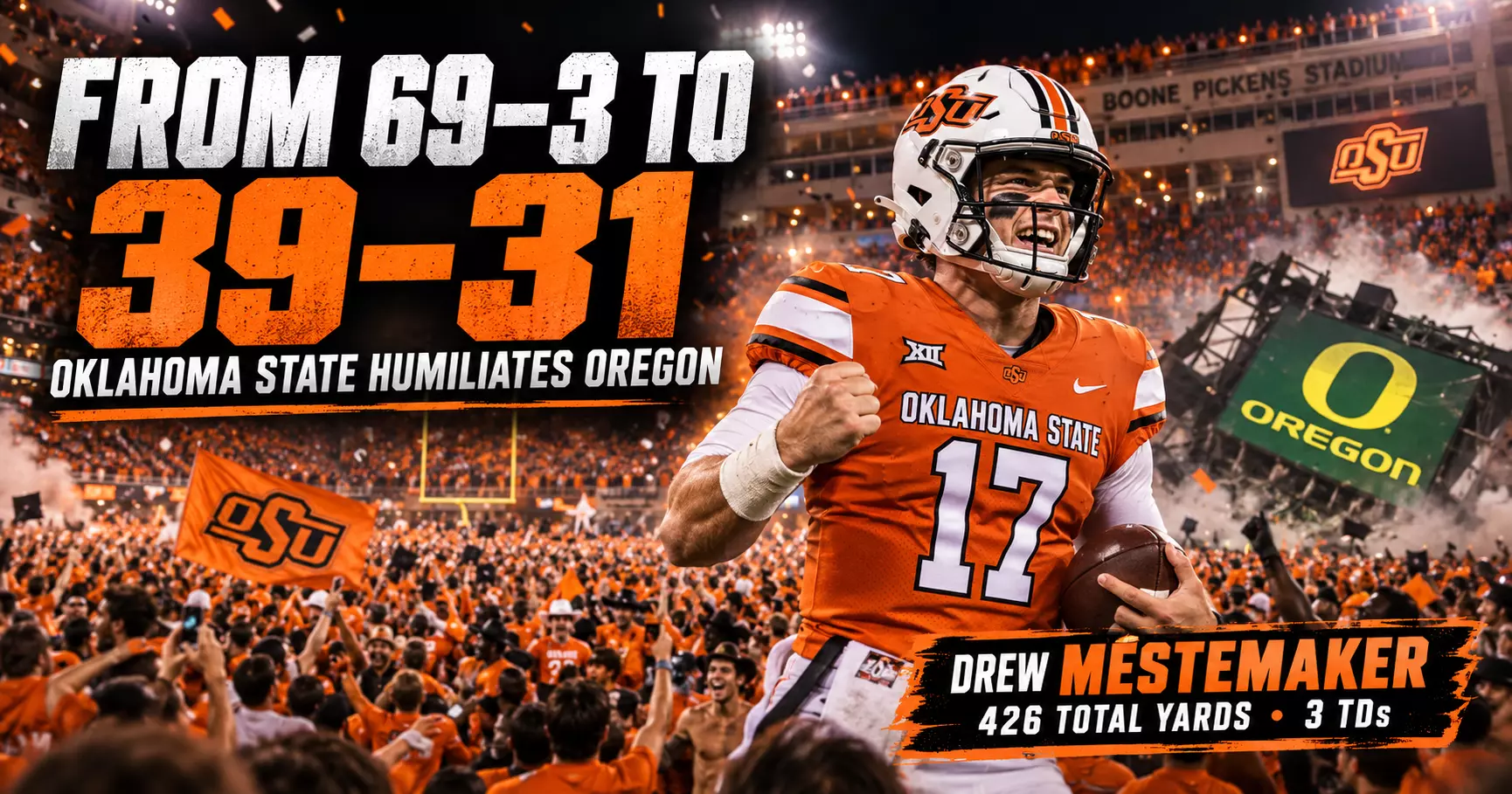
The Oklahoma State quarterback delivered one of the greatest individual performances of the young college football season, passing for 317 yards and two touchdowns while rushing for 109 yards and another score. He accumulated 426 yards of total offense and led the Cowboys to a stunning 39–31 victory at Boone Pickens Stadium.
This was not a fluke created by a blocked kick, a series of strange turnovers or one lucky play.
Oklahoma State outgained Oregon 554–281.
The Cowboys doubled the offensive production of a team with national championship expectations. They were more physical, more explosive and more composed in the most important moments. Oregon needed two interceptions—one returned for a touchdown and another that created a short scoring opportunity—just to remain within striking distance.
Without those plays, Oklahoma State might have blown out the Ducks.
At the center of everything was Mestemaker, who did not merely manage the game. He dominated it.
Drew Mestemaker Was the Best Player on the Field
Oregon entered the game with the more celebrated roster, the higher ranking and the quarterback receiving national awards attention.
Mestemaker made all of it irrelevant.
He completed 26 of 43 passes for 317 yards and two touchdowns. He also carried the ball six times for 109 yards, finishing with an extraordinary average of more than 18 yards per rushing attempt.
Those rushing numbers were not inflated by meaningless scrambles after the outcome had been decided. Mestemaker repeatedly punished Oregon at critical moments. When the Ducks covered Oklahoma State’s receivers, he escaped the pocket. When Oregon lost discipline along the line of scrimmage, he attacked the open space. When the Cowboys needed a first down, he trusted his legs and moved the chains.
His most memorable play came in the fourth quarter.
With Oklahoma State needing an answer, Mestemaker broke loose for a 10-yard touchdown and launched himself toward the goal line. For a moment, he appeared suspended above the Oregon defenders trying to stop him.
Mestemaker later joked that he felt as if he had been in the air for a year. For Oklahoma State fans, the entire play must have felt unreal.
It was fearless, athletic and perfectly timed. It was also the moment when Oklahoma State’s upset began to feel less like a possibility and more like an approaching reality.
Mestemaker did not play like a quarterback hoping to survive against the nation’s sixth-ranked team. He played like he expected to beat it.
That confidence spread throughout the Oklahoma State sideline.
Two Interceptions Could Not Break Him
Mestemaker’s final statistics were outstanding, but they do not fully explain why his performance was so impressive.
He had to overcome adversity within the game.
Two of his first-half passes were intercepted after being tipped. Oregon converted those turnovers into 14 points, including a defensive touchdown. The mistakes gave the Ducks life during a first half in which their offense was being thoroughly outplayed.
Many quarterbacks would have become hesitant after two interceptions against a top-10 opponent. They would have started holding the football, avoiding difficult throws and allowing the defense to control the remainder of the game.
Mestemaker never stopped attacking.
He continued pushing the ball downfield. He continued trusting his receivers. He continued making decisions with the confidence of a quarterback who understood that Oklahoma State could not beat Oregon by becoming conservative.
That mentality mattered.
Mestemaker connected with Wyatt Young for a 52-yard touchdown, one of the defining plays of the afternoon. Young finished with five receptions for 121 yards, giving Oklahoma State the vertical threat Oregon was supposed to possess.
The Cowboys did not shrink their playbook because of two unlucky interceptions. Eric Morris and offensive coordinator Sean Brophy continued placing the game in Mestemaker’s hands.
He rewarded their confidence by producing 426 total yards and three touchdowns.
The interceptions did not define his afternoon. His response to them did.
Mestemaker’s Journey Makes the Performance Even More Remarkable
He did not become a full-time starting quarterback in high school. When he arrived at North Texas, he was an overlooked walk-on without the recruiting profile normally attached to an eventual major-conference star.
Then someone finally gave him a legitimate opportunity.
Mestemaker exploded during the 2025 season, leading the nation with 4,379 passing yards. That was the second-highest passing total ever produced by an FBS freshman, trailing only C.J. Stroud. He threw 34 touchdown passes, helped North Texas finish 12–2 and produced a school-record 608-yard passing performance.
When Morris left North Texas to rebuild Oklahoma State, Mestemaker followed him to Stillwater.
That relationship proved essential Saturday.
Morris believed in Mestemaker before the rest of the country understood what he could become. Mestemaker trusted Morris enough to follow him into one of the most difficult rebuilding projects in college football.
Their reunion immediately encountered trouble. Oklahoma State opened the season by losing 24–10 to Tulsa, increasing the fear that the Cowboys’ miserable 2025 campaign had carried into another year.
One week later, Mestemaker delivered the performance that could transform the entire program.
He did it against Oregon, the same opponent that had beaten Oklahoma State by 66 points the previous season.
He did it against a roster filled with blue-chip recruits and future NFL players.
He did it while carrying the expectations of a fan base that had waited 728 days to celebrate a victory over an FBS opponent.
Mestemaker was not supposed to be the best quarterback on that field.
He was not supposed to be close.
Instead, he made Oregon’s defense look helpless.
Oklahoma State Controlled Oregon From the Opening Snap
The upset did not emerge from nowhere in the fourth quarter.
Oklahoma State established its physical advantage immediately.
On the Cowboys’ first offensive play, running back Caleb Hawkins broke loose for 75 yards. Oregon prevented that possession from ending in a touchdown, but the run sent an unmistakable message: Oklahoma State was not afraid of Oregon’s speed or defensive reputation.
Hawkins finished with 110 rushing yards and a touchdown on 23 carries. Combined with Mestemaker’s 109 yards, Oklahoma State attacked Oregon on the ground while still producing more than 300 yards through the air.
The Cowboys forced Oregon to defend everything.
If the Ducks devoted extra defenders to stopping Hawkins, Mestemaker found opportunities downfield. If they dropped into coverage, he took off running. When they pressured him, he escaped. When they hesitated, he attacked.
Oklahoma State finished with 554 total yards against a defense that expected to compete for a national championship.
Oregon managed only 281.
That difference is what made the result humiliating for the Ducks. Oregon did not lose because Oklahoma State made one more play in an otherwise even game. The Ducks were physically and statistically dominated by a program that had not beaten an FBS opponent in nearly two years.
Oregon’s two defensive interceptions disguised how one-sided the game actually was.
The Cowboys were better at the line of scrimmage, more explosive in space and far more productive at quarterback.
Championship contenders are expected to survive difficult road environments, and Oregon appeared ready to do exactly that during the second half.
After trailing 24–17 at halftime, the Ducks improved offensively and eventually moved ahead in the fourth quarter. It was the type of moment when an underdog often realizes the opportunity has passed. Oklahoma State had played well, but Oregon seemed ready to restore the expected order.
Mestemaker refused to allow it.
He led Oklahoma State’s response and scored the airborne 10-yard touchdown that put the Cowboys back in front. His ability to answer Oregon’s surge may have been more impressive than anything he did while Oklahoma State was leading.
The situation demanded composure.
Mestemaker provided it.
Oregon had the ranking, the experience and the deeper roster. Once the Ducks reclaimed the lead, all the pressure shifted to Oklahoma State. The Cowboys were facing the possibility of being praised for playing well before ultimately suffering their 22nd consecutive FBS loss.
Mestemaker was not interested in a moral victory.
He attacked Oregon’s defense, reclaimed the lead and then used his legs again to help Oklahoma State secure the decisive first down. On a third-and-short play late in the game, he ran up the middle for seven yards, allowing the Cowboys to protect their advantage and move closer to victory.
The spectacular touchdown will receive most of the attention. That late first-down run demonstrated the same toughness and awareness.
Mestemaker understood exactly what the game required, and he delivered it.
Eric Morris Has Already Changed the Program
Oklahoma State
hired Morris to repair a program that collapsed during the final years of Mike Gundy’s tenure.
The size of the challenge was enormous.
The Cowboys finished 1–11 in 2025 and entered Saturday with the longest active losing streak against FBS competition. Their only victory during that miserable season came against an FCS opponent. The proud program that once competed for Big 12 championships had become one of the weakest teams in a major conference.
Morris brought his system, his staff and his quarterback from North Texas. He also brought Hawkins, giving Oklahoma State two essential players from the North Texas offense that won 12 games in 2025.
The opening loss to Tulsa suggested the rebuild might require considerable time.
Then came Oregon.
One victory does not mean Oklahoma State is ready to win the Big 12. The Cowboys remain a developing team with obvious weaknesses, including their red-zone execution and vulnerability to turnovers.
But Saturday proved that the culture has already changed.
Oklahoma State played aggressively. The Cowboys did not appear intimidated when Oregon recovered from its slow start. They trusted their system and continued attacking a defense loaded with superior recruiting rankings.
Most importantly, they believed their quarterback could win the game.
That belief was justified.
Dan Lanning and Oregon Were Thoroughly Exposed
The result creates serious questions for Oregon.
The Ducks struggled to defeat Boise State in their opener, falling behind before escaping with a 34–27 victory. That performance caused them to fall from No. 2 to No. 6 in the rankings.
Oklahoma State completed the exposure.
Oregon’s offense
produced only 281 yards. Dante Moore passed for 191 yards and two touchdowns but could not match Mestemaker’s command or explosiveness. The Ducks struggled to sustain drives and depended on defensive scores to remain competitive.
Lanning had been 35–0 against unranked opponents as Oregon’s head coach. His team had not lost to an unranked opponent since 2021.
That streak ended against a program that had lost 21 consecutive FBS games.
This was not simply an early-season loss to a dangerous opponent. Oklahoma State had lost to Tulsa one week earlier. The Cowboys entered the game carrying the scars of a 1–11 season and a 69–3 destruction at Oregon’s hands.
If the Ducks are truly a national championship team, this is the type of opponent they should overwhelm.
Instead, Oklahoma State overwhelmed them.
Oregon can still recover and reach the College Football Playoff, but the Ducks must confront the truth about their first two performances. They have not looked physical enough, consistent enough or disciplined enough to compete with the best teams in the country.
Saturday’s final margin was eight points.
The difference between the teams was much larger.
From 69–3 to 39–31
College football produces upsets every season, but few contain this much history, humiliation and redemption.
Oklahoma State did not merely defeat the team ranked sixth in the country. The Cowboys defeated the program that had destroyed them 69–3 one year earlier.
They ended a 21-game losing streak against FBS opponents. They gave Morris his first major victory in Stillwater. They overwhelmed Oregon statistically and sent thousands of fans pouring onto the field.
The celebration continued when Oklahoma State supporters tore down the west goalpost, carried it out of Boone Pickens Stadium and threw it into Theta Pond.
After 728 days without an FBS victory, restraint was never going to be an option.
Neither was overlooking the quarterback responsible for the celebration.
Mestemaker was brilliant. His 317 passing yards displayed his command of Morris’ offense. His 109 rushing yards showed his athleticism and ability to improvise. His two touchdown passes punished Oregon through the air, while his fourth-quarter touchdown run became the signature image of the upset.
Most importantly, he refused to allow the two tipped interceptions to change the way he played.
Oklahoma State needed its quarterback to be fearless, and Mestemaker was fearless.
The Cowboys needed him to outplay a nationally celebrated opponent, and he did.
They needed him to produce the finest performance of his career on the biggest stage Oklahoma State had experienced in years.
He delivered 426 yards, three touchdowns and a victory that will be remembered in Stillwater for generations.
New Users – Get $350 in Bonus Bets when you wager $5 for 7 days
T&Cs apply
4.6/5
Gambling Problem? Call 1-800-GAMBLER or 1-800-MY-RESET. Call 1-888-789-7777 or visit ccpgg.org/chat (CT). Hope is here. GamblingHelpLineMA.org or call (800) 327-5050 for 24/7 support (MA). Visit www.mdgamblinghelp.org (MD). Call 1-877-8HOPE-NY or text HOPENY (NY). 21+ (18+ DC, WY) and present in select states (for KS, in affiliation with Kansas Star Casino). Find online real money wagering only. Min $5 wager required for 7 consecutive days. $5 free play credit. Bonus issued as non-withdrawable bonus with cash withdrawable bonus with cash withdrawable. Bonus bets which expire 7 days after receipt. Restrictions apply. See terms at sportsbook.fanduel.com. Call 1-877-770-7867 (LA).
Up To $1500 in Bonus Bets Paid Back if your First Bet Does Not Win
T&Cs apply
4.5/5
Gambling problem? Call 1-800-GAMBLER or 1-800-MY-RESET (Available in the US) 877-8-HOPENY or text HOPENY (467369) (NY) 1-800-327-5050 (MA), 1-800-BETS-OFF (IA), 1-800-981-0023 (PR). 21+ only. Please Gamble Responsibly. See BetMGM.com for Terms. First Bet Offer for new customers only (if applicable). Subject to eligibility requirements. Bonus bets are non-withdrawable. In partnership with Kansas Crossing Casino and Hotel. Promotional offers not available in Mississippi, Massachusetts, New York, Ontario, or Puerto Rico.
New DraftKings Customers: Bet $5, Get $200 + 3 Months of NBA League Pass!
T&Cs apply
4.5/5
GAMBLING PROBLEM? CALL 1-800-GAMBLER or 1-800-MY-RESET, (800) 327-5050 or visit gamblinghelplinema.org (MA). Please Gamble Responsibly. 888-789-7777/visit ccpg.org (CT), or visit www.mdgamblinghelp.org (MD), 1-800-981-0023 (PR). 21+ and present in most states. (18+ DC/NH/PR/WY). Void in CAN. Eligibility restrictions apply. On behalf of Boot Hill Casino (KS). Pass-thru of per wager tax may apply in IL. 1 per new Sportsbook customer. $5+ first-time bet req. Max. $200 issued as non-withdrawable Bonus Bets. Stake removed from payout. Reward issued as $50 in Bonus Bets every 7 days via click-to-claim for 21 days. Bonus Bets and click-to-claims expire 7 days (168hrs) after issuance. Terms: dkng.co/offer. Get 1 promo code to redeem a 3-month NBA League Pass subscription, complimentary of DraftKings. Subscription auto-renews monthly at then-current price (currently $16.99/mo); cancel anytime. Terms, restrictions, and eligibility requirements apply. Redeem League Pass by 12/19/26 at 11:59 PM ET. Addt’l terms: support.watch.nba.com/hc/en-us/articles/9165532876183-League-Pass-Terms-of-Use_. Ends 11/29/26 at 11:59 PM ET. Sponsored by DK.
Must be 21+. GAMBLING PROBLEM? CALL 1-800-GAMBLER OR CALL 1-800-MY-RESET, www.mdgamblinghelp.org (MD), (800)-327-5050 or gamblinghelplinema.org (MA), Call (877)8-HOPENY or text HOPENY (467369) (NY), (888) 789-7777 or ccpg.org (CT), morethanagame.nc.gov (NC), 1800gambler.net (WV)
Bet $1 and get double the winnings up to $25 for your next 10 bets
T&Cs apply
4.4/5
21+ New users only. Must register using eligible promo code. First bet after registration must qualify. Max. Bonus Bet: $1,000. Bonus Bet expires 14 days after receipt. Void where prohibited. See Caesars.com/promos for full terms. Gambling Problem? 1-800-GAMBLER (1-800-426-2537)
21+ and present in OH. Gambling Problem? Call 1-800-GAMBLER.
This site is using
Cloudflare
and adheres to the
Google Safe Browsing Program. We adapted
Google's Privacy Guidelines
to keep your data safe at all times.
Close
Ready to Win Big? Join the Elite with Our Sports Betting Deals!
FanDuel Promo
New Users – Get $350 in Bonus Bets when you wager $5 for 7 days
Our Favorite
T&Cs and 21+ apply
Gambling Problem? Call 1-800-GAMBLER or 1-800-MY-RESET. Call 1-888-789-7777 or visit ccpgg.org/chat (CT). Hope is here. GamblingHelpLineMA.org or call (800) 327-5050 for 24/7 support (MA). Visit www.mdgamblinghelp.org (MD). Call 1-877-8HOPE-NY or text HOPENY (NY). 21+ (18+ DC, WY) and present in select states (for KS, in affiliation with Kansas Star Casino). Find online real money wagering only. Min $5 wager required for 7 consecutive days. $5 free play credit. Bonus issued as non-withdrawable bonus with cash withdrawable bonus with cash withdrawable. Bonus bets which expire 7 days after receipt. Restrictions apply. See terms at sportsbook.fanduel.com. Call 1-877-770-7867 (LA).
Code:
Open FanDuel
Get Bonus
BetMGM Promo
Up To $1500 in Bonus Bets Paid Back if your First Bet Does Not Win
Best Slots
T&Cs and 21+ apply
Gambling problem? Call 1-800-GAMBLER or 1-800-MY-RESET (Available in the US) 877-8-HOPENY or text HOPENY (467369) (NY) 1-800-327-5050 (MA), 1-800-BETS-OFF (IA), 1-800-981-0023 (PR). 21+ only. Please Gamble Responsibly. See BetMGM.com for Terms. First Bet Offer for new customers only (if applicable). Subject to eligibility requirements. Bonus bets are non-withdrawable. In partnership with Kansas Crossing Casino and Hotel. Promotional offers not available in Mississippi, Massachusetts, New York, Ontario, or Puerto Rico.
Code:
Open BetMGM
Get Bonus
DraftKings Promo
New DraftKings Customers: Bet $5, Get $200 + 3 Months of NBA League Pass!
Newcomer
T&Cs and 21+ apply
GAMBLING PROBLEM? CALL 1-800-GAMBLER or 1-800-MY-RESET, (800) 327-5050 or visit gamblinghelplinema.org (MA). Please Gamble Responsibly. 888-789-7777/visit ccpg.org (CT), or visit www.mdgamblinghelp.org (MD), 1-800-981-0023 (PR). 21+ and present in most states. (18+ DC/NH/PR/WY). Void in CAN. Eligibility restrictions apply. On behalf of Boot Hill Casino (KS). Pass-thru of per wager tax may apply in IL. 1 per new Sportsbook customer. $5+ first-time bet req. Max. $200 issued as non-withdrawable Bonus Bets. Stake removed from payout. Reward issued as $50 in Bonus Bets every 7 days via click-to-claim for 21 days. Bonus Bets and click-to-claims expire 7 days (168hrs) after issuance. Terms: dkng.co/offer. Get 1 promo code to redeem a 3-month NBA League Pass subscription, complimentary of DraftKings. Subscription auto-renews monthly at then-current price (currently $16.99/mo); cancel anytime. Terms, restrictions, and eligibility requirements apply. Redeem League Pass by 12/19/26 at 11:59 PM ET. Addt’l terms: support.watch.nba.com/hc/en-us/articles/9165532876183-League-Pass-Terms-of-Use_. Ends 11/29/26 at 11:59 PM ET. Sponsored by DK.
Code:
Open DraftKings
Get Bonus
Find out what the legends have to say about sports this week....
New Users – Get $350 in Bonus Bets when you wager $5 for 7 days
Gambling Problem? Call 1-800-GAMBLER or 1-800-MY-RESET. Call 1-888-789-7777 or visit ccpgg.org/chat (CT). Hope is here. GamblingHelpLineMA.org or call (800) 327-5050 for 24/7 support (MA). Visit www.mdgamblinghelp.org (MD). Call 1-877-8HOPE-NY or text HOPENY (NY). 21+ (18+ DC, WY) and present in select states (for KS, in affiliation with Kansas Star Casino). Find online real money wagering only. Min $5 wager required for 7 consecutive days. $5 free play credit. Bonus issued as non-withdrawable bonus with cash withdrawable bonus with cash withdrawable. Bonus bets which expire 7 days after receipt. Restrictions apply. See terms at sportsbook.fanduel.com. Call 1-877-770-7867 (LA).