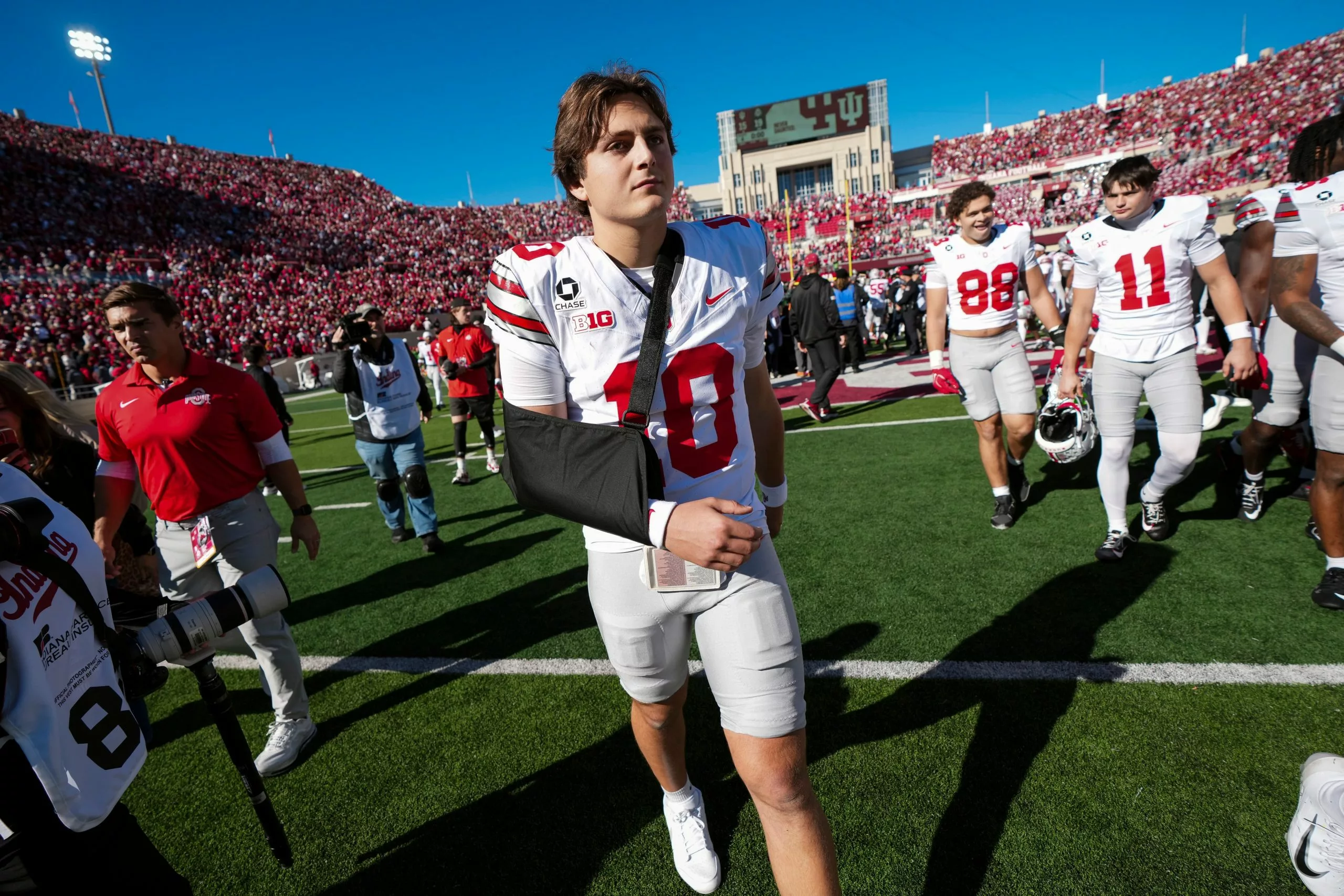
Ohio State Buckeyes quarterback Julian Sayin (10) leaves the field in a sling following the 19-15 win over the Indiana Hoosiers in the NCAA football game at Memorial Stadium Stadium in Bloomington, Ind. on Oct. 17, 2026.
Ohio State’s championship challenge now extends well beyond choosing a replacement quarterback.
Julian Sayin will miss several weeks with an injury to his throwing arm, leaving the Buckeyes to prepare Luke Fahey and Tavien St. Clair for greater responsibility. Running back Ja’Kobi Jackson has also undergone surgery for a Lisfranc injury in his foot. Neither situation provides a firm return date around which Ohio State can safely build its plans.
The injuries affect connected parts of the offense. An inexperienced quarterback benefits from a productive running game. A running game becomes harder to sustain when defenses doubt the passing threat. Protection must hold up long enough for the quarterback to make sound decisions, while those decisions must come quickly enough to help the protection.
Ohio State still has a path forward. Maintaining its
championship trajectory
will require the supporting cast to make that path manageable.
The Quarterback Competition Is Only Part of the Answer
Ryan Day said Fahey is ahead of St. Clair, but both will receive opportunities during the bye week as Ohio State evaluates its options. Sayin’s status has been described as indefinite, making preparation for an extended absence necessary.
The temptation is to make the entire discussion about which backup possesses the greater upside.
That matters. So does determining which quarterback can operate the offense most consistently with the players currently available.
The staff must evaluate protection recognition, accuracy, decision-making and command of the play call. It also needs to identify which concepts each quarterback executes confidently enough to use when the defense knows a pass is coming.
Practice offers time to establish that foundation. It cannot reproduce every challenge of a consequential road possession.
Ohio State’s job is to make sure its next quarterback enters those situations with dependable answers.
Ja’Kobi Jackson’s Absence Removes Useful Production
Jackson had rushed for 354 yards and six touchdowns on 59 carries before his injury, averaging six yards per attempt. He was Ohio State’s second-leading rusher.
Replacing those contributions carries added importance during a quarterback transition.
A reliable running game can keep a young passer from spending an afternoon trying to overcome unfavorable situations. It can also force linebackers and safeties to respect something besides the passing attack.
But handing the ball off more often will accomplish little if the runs repeatedly produce second-and-long.
The Buckeyes need effective blocking, correct reads from their backs and enough variation to prevent defenses from attacking a narrow set of tendencies. The goal should be useful production on early downs, with explosive gains providing an additional benefit.
Jackson’s absence increases the importance of the available backs executing all their responsibilities. That includes receiving and pass protection when their assignments require it.
Bo Jackson Cannot Carry the Solution Alone
Bo Jackson rushed for 56 yards on 18 carries against Indiana and caught a two-yard touchdown pass in the 19–15 victory. His longest run was 12 yards.
That performance illustrates the difficulty of asking the running game to solve everything against a strong front.
Ohio State needs to create favorable conditions for its backs. Simply increasing the workload without improving the circumstances risks producing more crowded running lanes and more difficult passing downs.
Formation changes and motion can help reveal defensive intentions. A credible quick passing game can make defenders hesitate before committing aggressively to the run.
The relationship must work in both directions: rushing production supports the quarterback, and efficient passing creates room for the backs.
The Buckeyes cannot afford an approach in which one struggling component continually makes the other’s job harder.
Protection Becomes a Collective Responsibility
Pass protection begins up front, but an inexperienced quarterback changes what must happen around the blocking.
The quarterback needs to recognize potential pressure, understand the protection’s limitations and know where the ball should go if a defender arrives unblocked. Receivers must reach the expected spots on time. Backs must identify their assignments before stepping into a rush lane.
A missed communication can overwhelm an otherwise sound play.
Ohio State should prioritize a core of passing concepts its new starter can execute decisively. Quick throws, defined reads and selective movement of the launch point could help, depending on which quarterback wins the job.
Extra protection has a place, too, particularly when the Buckeyes want to attack downfield. Keeping another blocker in, however, leaves fewer receivers running routes. The staff must weigh that tradeoff against the coverage it expects.
The objective is coordinated execution that gives the quarterback enough time—and a clear understanding of how to use it.
Jeremiah Smith Must Remain Central
Jeremiah Smith supplied one of the decisive plays against Indiana, catching a 38-yard touchdown on fourth down that extended Ohio State’s lead to 19–7.
His presence gives the next quarterback an important resource. Ohio State should find ways to make that resource accessible without demanding difficult throws on every possession.
Shorter routes can create opportunities for Smith to gain yards after the catch. Formation changes can help prevent a defense from presenting the same coverage picture repeatedly. Complementary routes must give the quarterback another answer when additional attention goes toward Smith.
The danger is allowing the importance of one receiver to become a reason to force the ball.
An efficient offense uses the defense’s attention to its advantage. Sometimes that means delivering to Smith. Sometimes it means recognizing the opportunity his coverage creates elsewhere.
Manageable Third Downs Could Decide the Transition
The most useful assistance
Ohio State
can provide its quarterbacks may come before third down.
A productive first-down run, an accurate short completion or a well-executed screen can preserve options. A penalty or negative play can eliminate them.
That distinction becomes especially important when an opponent wants to test a new starter’s ability to recognize pressure and deliver into tight coverage.
Third-and-short keeps the run credible. Third-and-long allows the defense to concentrate much more heavily on the quarterback.
Ohio State also needs restraint in judging individual possessions. Taking an available completion can be the right decision even when it does not produce a spectacular gain. Throwing the ball away can preserve field position and prevent a damaging turnover.
The Buckeyes must still generate enough offense to win. They can pursue that production through decisions that limit unnecessary difficulty.
The Championship Standard Now Applies to Everyone
The bye week gives Ohio State time to prepare before visiting USC on October 31. It does not resolve the uncertainty surrounding either injured player.
The Buckeyes therefore need an offense capable of functioning with the personnel available now.
That means protection that communicates, backs who turn available space into useful gains, receivers who provide dependable targets and a quarterback who understands where his answers are.
Sayin’s injury will command the attention. Jackson’s surgery makes clear why the response must involve the entire offense.
Ohio State’s championship hopes now depend on how effectively that group supports whoever takes the next snap.
New Users – Get $350 in Bonus Bets when you wager $5 for 7 days
T&Cs apply
4.6/5
Gambling Problem? Call 1-800-GAMBLER or 1-800-MY-RESET. Call 1-888-789-7777 or visit ccpgg.org/chat (CT). Hope is here. GamblingHelpLineMA.org or call (800) 327-5050 for 24/7 support (MA). Visit www.mdgamblinghelp.org (MD). Call 1-877-8HOPE-NY or text HOPENY (NY). 21+ (18+ DC, WY) and present in select states (for KS, in affiliation with Kansas Star Casino). Find online real money wagering only. Min $5 wager required for 7 consecutive days. $5 free play credit. Bonus issued as non-withdrawable bonus with cash withdrawable bonus with cash withdrawable. Bonus bets which expire 7 days after receipt. Restrictions apply. See terms at sportsbook.fanduel.com. Call 1-877-770-7867 (LA).
Up To $1500 in Bonus Bets Paid Back if your First Bet Does Not Win
T&Cs apply
4.5/5
Gambling problem? Call 1-800-GAMBLER or 1-800-MY-RESET (Available in the US) 877-8-HOPENY or text HOPENY (467369) (NY) 1-800-327-5050 (MA), 1-800-BETS-OFF (IA), 1-800-981-0023 (PR). 21+ only. Please Gamble Responsibly. See BetMGM.com for Terms. First Bet Offer for new customers only (if applicable). Subject to eligibility requirements. Bonus bets are non-withdrawable. In partnership with Kansas Crossing Casino and Hotel. Promotional offers not available in Mississippi, Massachusetts, New York, Ontario, or Puerto Rico.
New DraftKings Customers: Bet $5, Get $200 + 3 Months of NBA League Pass!
T&Cs apply
4.5/5
GAMBLING PROBLEM? CALL 1-800-GAMBLER or 1-800-MY-RESET, (800) 327-5050 or visit gamblinghelplinema.org (MA). Please Gamble Responsibly. 888-789-7777/visit ccpg.org (CT), or visit www.mdgamblinghelp.org (MD), 1-800-981-0023 (PR). 21+ and present in most states. (18+ DC/NH/PR/WY). Void in CAN. Eligibility restrictions apply. On behalf of Boot Hill Casino (KS). Pass-thru of per wager tax may apply in IL. 1 per new Sportsbook customer. $5+ first-time bet req. Max. $200 issued as non-withdrawable Bonus Bets. Stake removed from payout. Reward issued as $50 in Bonus Bets every 7 days via click-to-claim for 21 days. Bonus Bets and click-to-claims expire 7 days (168hrs) after issuance. Terms: dkng.co/offer. Get 1 promo code to redeem a 3-month NBA League Pass subscription, complimentary of DraftKings. Subscription auto-renews monthly at then-current price (currently $16.99/mo); cancel anytime. Terms, restrictions, and eligibility requirements apply. Redeem League Pass by 12/19/26 at 11:59 PM ET. Addt’l terms: support.watch.nba.com/hc/en-us/articles/9165532876183-League-Pass-Terms-of-Use_. Ends 11/29/26 at 11:59 PM ET. Sponsored by DK.
Must be 21+. GAMBLING PROBLEM? CALL 1-800-GAMBLER OR CALL 1-800-MY-RESET, www.mdgamblinghelp.org (MD), (800)-327-5050 or gamblinghelplinema.org (MA), Call (877)8-HOPENY or text HOPENY (467369) (NY), (888) 789-7777 or ccpg.org (CT), morethanagame.nc.gov (NC), 1800gambler.net (WV)
Bet $1 and get double the winnings up to $25 for your next 10 bets
T&Cs apply
4.4/5
21+ New users only. Must register using eligible promo code. First bet after registration must qualify. Max. Bonus Bet: $1,000. Bonus Bet expires 14 days after receipt. Void where prohibited. See Caesars.com/promos for full terms. Gambling Problem? 1-800-GAMBLER (1-800-426-2537)
21+ and present in OH. Gambling Problem? Call 1-800-GAMBLER.
This site is using
Cloudflare
and adheres to the
Google Safe Browsing Program. We adapted
Google's Privacy Guidelines
to keep your data safe at all times.
Close
Ready to Win Big? Join the Elite with Our Sports Betting Deals!
FanDuel Promo
New Users – Get $350 in Bonus Bets when you wager $5 for 7 days
Our Favorite
T&Cs and 21+ apply
Gambling Problem? Call 1-800-GAMBLER or 1-800-MY-RESET. Call 1-888-789-7777 or visit ccpgg.org/chat (CT). Hope is here. GamblingHelpLineMA.org or call (800) 327-5050 for 24/7 support (MA). Visit www.mdgamblinghelp.org (MD). Call 1-877-8HOPE-NY or text HOPENY (NY). 21+ (18+ DC, WY) and present in select states (for KS, in affiliation with Kansas Star Casino). Find online real money wagering only. Min $5 wager required for 7 consecutive days. $5 free play credit. Bonus issued as non-withdrawable bonus with cash withdrawable bonus with cash withdrawable. Bonus bets which expire 7 days after receipt. Restrictions apply. See terms at sportsbook.fanduel.com. Call 1-877-770-7867 (LA).
Code:
Open FanDuel
Get Bonus
BetMGM Promo
Up To $1500 in Bonus Bets Paid Back if your First Bet Does Not Win
Best Slots
T&Cs and 21+ apply
Gambling problem? Call 1-800-GAMBLER or 1-800-MY-RESET (Available in the US) 877-8-HOPENY or text HOPENY (467369) (NY) 1-800-327-5050 (MA), 1-800-BETS-OFF (IA), 1-800-981-0023 (PR). 21+ only. Please Gamble Responsibly. See BetMGM.com for Terms. First Bet Offer for new customers only (if applicable). Subject to eligibility requirements. Bonus bets are non-withdrawable. In partnership with Kansas Crossing Casino and Hotel. Promotional offers not available in Mississippi, Massachusetts, New York, Ontario, or Puerto Rico.
Code:
Open BetMGM
Get Bonus
DraftKings Promo
New DraftKings Customers: Bet $5, Get $200 + 3 Months of NBA League Pass!
Newcomer
T&Cs and 21+ apply
GAMBLING PROBLEM? CALL 1-800-GAMBLER or 1-800-MY-RESET, (800) 327-5050 or visit gamblinghelplinema.org (MA). Please Gamble Responsibly. 888-789-7777/visit ccpg.org (CT), or visit www.mdgamblinghelp.org (MD), 1-800-981-0023 (PR). 21+ and present in most states. (18+ DC/NH/PR/WY). Void in CAN. Eligibility restrictions apply. On behalf of Boot Hill Casino (KS). Pass-thru of per wager tax may apply in IL. 1 per new Sportsbook customer. $5+ first-time bet req. Max. $200 issued as non-withdrawable Bonus Bets. Stake removed from payout. Reward issued as $50 in Bonus Bets every 7 days via click-to-claim for 21 days. Bonus Bets and click-to-claims expire 7 days (168hrs) after issuance. Terms: dkng.co/offer. Get 1 promo code to redeem a 3-month NBA League Pass subscription, complimentary of DraftKings. Subscription auto-renews monthly at then-current price (currently $16.99/mo); cancel anytime. Terms, restrictions, and eligibility requirements apply. Redeem League Pass by 12/19/26 at 11:59 PM ET. Addt’l terms: support.watch.nba.com/hc/en-us/articles/9165532876183-League-Pass-Terms-of-Use_. Ends 11/29/26 at 11:59 PM ET. Sponsored by DK.
Code:
Open DraftKings
Get Bonus
Find out what the legends have to say about sports this week....
New Users – Get $350 in Bonus Bets when you wager $5 for 7 days
Gambling Problem? Call 1-800-GAMBLER or 1-800-MY-RESET. Call 1-888-789-7777 or visit ccpgg.org/chat (CT). Hope is here. GamblingHelpLineMA.org or call (800) 327-5050 for 24/7 support (MA). Visit www.mdgamblinghelp.org (MD). Call 1-877-8HOPE-NY or text HOPENY (NY). 21+ (18+ DC, WY) and present in select states (for KS, in affiliation with Kansas Star Casino). Find online real money wagering only. Min $5 wager required for 7 consecutive days. $5 free play credit. Bonus issued as non-withdrawable bonus with cash withdrawable bonus with cash withdrawable. Bonus bets which expire 7 days after receipt. Restrictions apply. See terms at sportsbook.fanduel.com. Call 1-877-770-7867 (LA).