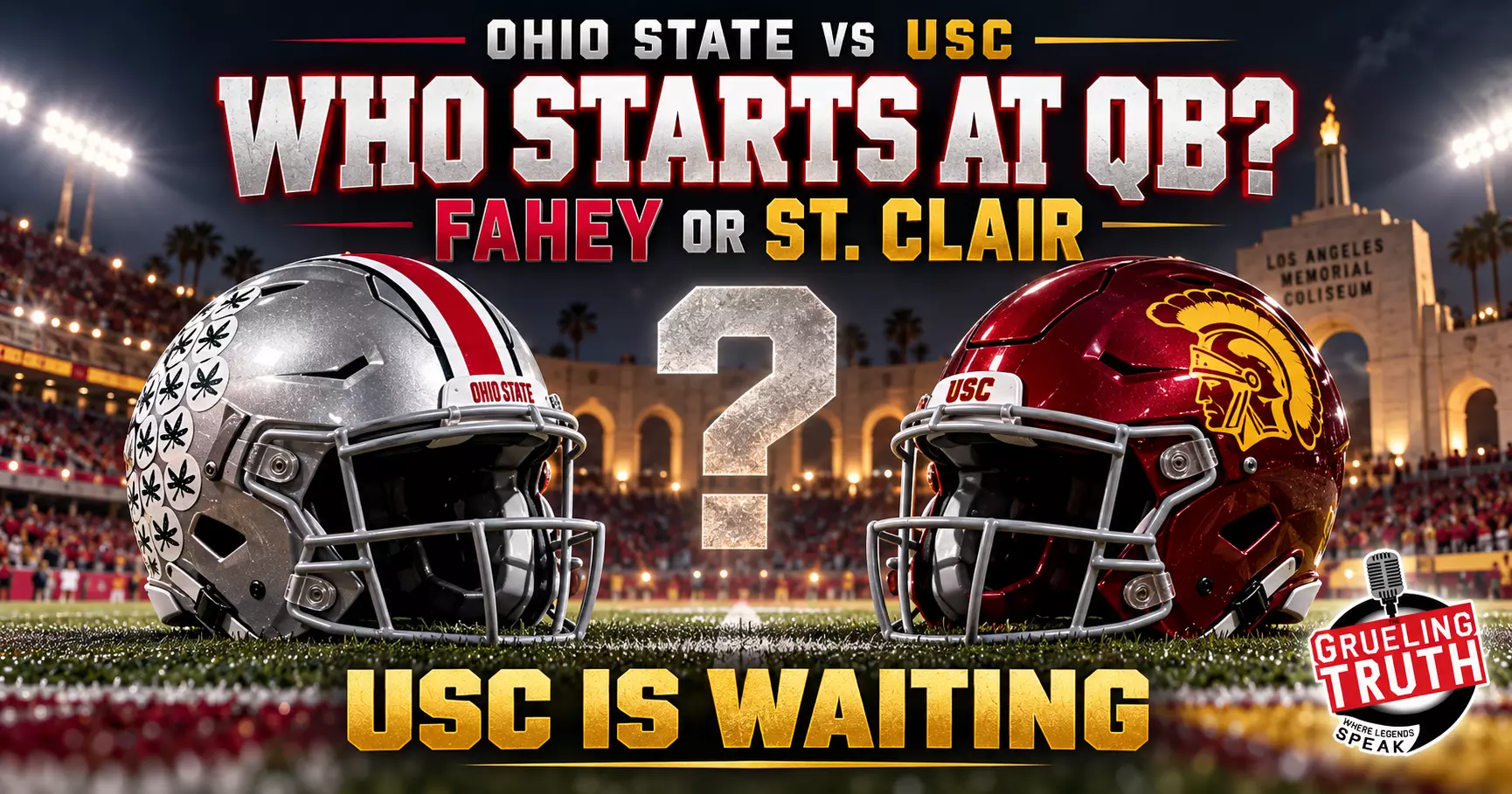
Ohio State has had a bye week to prepare for life without Julian Sayin. It still has not publicly identified the quarterback who will take the first snap against USC.
Ohio State has had a bye week to prepare for life without Julian Sayin. It still has not publicly identified the quarterback who will take the first snap against USC.
Ryan Day declined to name a starter Tuesday, leaving
Luke Fahey and Tavien St. Clair
in contention for Saturday’s game in Los Angeles. Sayin remains sidelined indefinitely following the throwing-arm injury he suffered during the Buckeyes’ victory over Indiana.
For No. 2 Ohio State, the decision matters. So does everything surrounding it.
Neither candidate has started a college game. Whoever gets the assignment will face the demands of operating on the road while leading a team with championship expectations. The Buckeyes’ best response is to build an offense that gives its new quarterback clear decisions, dependable protection and opportunities to involve its best players.
That starts well before third down.
Fahey Has the Previous Edge—but Limited Experience
Fahey entered the Indiana game after
Sayin’s injury, and Day reiterated Tuesday that he had been ahead of St. Clair going into that matchup. However, the coach continued to evaluate both players and left open the possibility that both could appear against USC.
That gives Fahey a meaningful starting point in the competition. It does not give him an extensive record of game experience.
He has completed
nine of 13 passes for 203 yards, with
two touchdowns and two interceptions
this season. St. Clair has completed
five of seven for 52 yards, with
one touchdown and one interception.
Those samples are too small to support confident claims about which quarterback will handle a full game better. Completion percentages from a handful of appearances cannot establish command of protections, consistency against pressure or the ability to recover after a difficult series.
Fahey’s immediate challenge is moving from replacement duty to responsibility for an entire offensive plan. Preparing to enter a game is different from opening it, establishing a rhythm and responding as the defense adjusts.
St. Clair’s challenge is earning the staff’s trust after entering the season behind Fahey. His opportunity depends on demonstrating that he can turn preparation into reliable decisions.
The competition should be judged through those practical demands rather than recruiting reputation.
Ohio State Must Make Protection a Shared Responsibility
A young quarterback’s protection begins with the offensive line, but it cannot end there.
The quarterback
must recognize where pressure could come from. Running backs and tight ends must execute their assignments. Receivers must understand when the ball needs to arrive quickly.
Coaches also have to choose concepts that connect those responsibilities.
A route combination that requires time to develop makes little sense if the protection cannot provide it. A quick throw only helps if the receiver is available and the quarterback knows where to go with the ball.
Against USC, Ohio State should prioritize a manageable collection of answers to pressure. That can include quick-game concepts, defined reads and selected movement throws when they fit the quarterback’s strengths.
The objective is to reduce unnecessary uncertainty. A first-time starter already has enough to process without being asked to solve every defensive problem after the snap.
Manageable Third Downs Begin on First Down
The easiest way to make either quarterback’s assignment harder is to repeatedly place him in obvious passing situations.
Third-and-long gives a defense more freedom. Rushers can attack with less concern about the run, coverage can protect the first-down marker and disguised pressure becomes more difficult to sort out.
Ohio State needs useful production before reaching that point.
Running back
Bo Jackson has 516 yards on 107 carries, giving the Buckeyes an established rushing option. But their most recent game also supplied a warning: Ohio State finished with
78 rushing yards against Indiana.
The answer cannot simply be to run more often. Unproductive early-down runs would leave the new starter facing the same difficult situations the offense should be trying to avoid.
Balance must involve efficiency.
A successful first-down pass can make the next rushing attempt more credible. A productive run can open a straightforward play-action opportunity. Ohio State needs those elements to support one another rather than becoming predictable in an effort to protect the quarterback.
Jeremiah Smith Should Be an Early Answer
Ohio State does not have to manufacture a new offensive centerpiece.
Jeremiah Smith enters the USC game with 52 receptions for 984 yards and 12 touchdowns.
His production makes him the obvious player to involve as the Buckeyes adjust.
The important distinction is how they involve him.
Asking a new quarterback to repeatedly hold the ball and wait for Smith to win downfield would place too much responsibility on protection and timing. Ohio State should also look for ways to get its best receiver involved through more immediate decisions.
Quick throws, movement before the snap and formations that make it harder to crowd his release are reasonable options. Those are potential approaches, not confirmation of what the Buckeyes will call Saturday.
Early involvement can help the quarterback establish rhythm while requiring USC to account for Smith throughout the possession.
But the ball cannot be forced toward him regardless of coverage. If the Trojans devote extra attention to Smith, Ohio State needs its quarterback to recognize the opportunity created elsewhere.
Using an elite receiver effectively includes accepting the openings his presence gives teammates.
Playing Both Quarterbacks Requires a Clear Purpose
Day’s willingness to consider both players gives Ohio State flexibility. It also creates a planning challenge.
A second quarterback can offer a different package or provide an answer if circumstances change. Frequent changes without a clear purpose can make it harder for either player to establish rhythm.
Day indicated Tuesday that he did not want the starter spending the game looking over his shoulder after every mistake.
That is an important balance.
A first-time starter needs accountability, but he also needs enough confidence to make the throw the offense requires. If every incompletion feels like a potential substitution, caution can become hesitation.
Ohio State should know what it wants from each quarterback before deciding how much to use both. The plan needs to serve the offense rather than prolong the competition during the game.
USC Has Its Own Response to Make
The Trojans enter this matchup after a
24–7 loss at Wisconsin
that knocked them out of the AP rankings.
That result should not lead Ohio State to treat the trip as a comfortable setting for a quarterback debut. USC has an opportunity to change its own conversation by defeating a highly ranked opponent at home.
For the Trojans’ defense, the goal should be to make the replacement quarterback responsible for difficult decisions: disrupt early downs, challenge protections and prevent easy completions from becoming an immediate source of confidence.
Ohio State’s task is to avoid giving USC those conditions.
The Buckeyes do not need their new starter to reproduce Sayin’s entire role immediately. They need him to execute the assignment in front of him, supported by a team capable of winning in more than one way.
Naming the quarterback will answer the week’s most visible question. Protection, early-down efficiency and the use of Smith will determine how well that answer works.
New Users - Get $200 in Bonus Bets when you wager $5 for 4 days
T&Cs apply
4.6/5
Gambling Problem? Call 1-800-GAMBLER or 1-800-MY-RESET. Visit www.mdgamblinghelp.org (MD). 1-888-789-7777 or ccpg.org/chat (CT). Hope is here. GamblingHelpLineMA.org or (800) 327-5050 for 24/7 support (MA). 1-877-8-HOPENY or text HOPENY (467369) (NY). 21+ (18+ D.C., WY) and present in select states (for KS, in affiliation with Kansas Star Casino). First online real money wager only. Min $5 wager required for 4 consecutive days. $5 first deposit required. Bonus issued as nonwithdrawable bonus bets which expire 5 days after receipt. Restrictions apply. See terms at sportsbook.fanduel.com. Call 1-877-770-7867 (LA).
Get Up to $1,000 Back in Bonus Bets Over Your First 10 Days
T&Cs apply
4.5/5
Gambling problem? Call 1-800-GAMBLER or 1-800-MY-RESET (Available in the US) 877-8-HOPENY or text HOPENY (467369) (NY) 1-800-327-5050 (MA), 1-800-BETS-OFF (IA), 21+ only. Please Gamble Responsibly. Visit mdgamblinghelp.org (MD). See BetMGM.com for Terms. New Player Offer for new players only. Subject to eligibility requirements. Bonus bets are non-withdrawable. In partnership with Kansas Crossing Casino and Hotel. This promotional offer is not available in NJ, MA, MI, NV, NY, ON, PA, PR, and WV.
GAMBLING PROBLEM? CALL 1-800-GAMBLER or 1-800-MY-RESET, (800) 327-5050 or visit gamblinghelplinema.org (MA). Please Gamble Responsibly. 888-789-7777/visit ccpg.org (CT), or visit www.mdgamblinghelp.org (MD), 1-800-981-0023 (PR). 21+ and present in most states. (18+ DC/NH/PR/WY). Void in CAN. Eligibility restrictions apply. On behalf of Boot Hill Casino (KS). Pass-thru of per wager tax may apply in IL. 1 per new Sportsbook customer. $5+ first-time bet req. Max. $200 issued as non-withdrawable Bonus Bets. Stake removed from payout. Reward issued as $50 in Bonus Bets every 7 days via click-to-claim for 21 days. Bonus Bets and click-to-claims expire 7 days (168hrs) after issuance. Terms: dkng.co/offer. Get 1 promo code to redeem a 3-month NBA League Pass subscription, complimentary of DraftKings. Subscription auto-renews monthly at then-current price (currently $16.99/mo); cancel anytime. Terms, restrictions, and eligibility requirements apply. Redeem League Pass by 12/19/26 at 11:59 PM ET. Addt’l terms: support.watch.nba.com/hc/en-us/articles/9165532876183-League-Pass-Terms-of-Use_. Ends 11/29/26 at 11:59 PM ET. Sponsored by DK.
Must be 21+. GAMBLING PROBLEM? CALL 1-800-GAMBLER OR CALL 1-800-MY-RESET, www.mdgamblinghelp.org (MD), (800)-327-5050 or gamblinghelplinema.org (MA), Call (877)8-HOPENY or text HOPENY (467369) (NY), (888) 789-7777 or ccpg.org (CT), morethanagame.nc.gov (NC), 1800gambler.net (WV)
Bet $1 and get double the winnings up to $25 for your next 10 bets
T&Cs apply
4.4/5
21+ New users only. Must register using eligible promo code. First bet after registration must qualify. Max. Bonus Bet: $1,000. Bonus Bet expires 14 days after receipt. Void where prohibited. See Caesars.com/promos for full terms. Gambling Problem? 1-800-GAMBLER (1-800-426-2537)
21+ and present in OH. Gambling Problem? Call 1-800-GAMBLER.
The sweepstakes and social casinos featured here are for adults aged 18 or over. No purchase is necessary to enter or win, and every operator offers a free way to get Sweeps Coins. Availability in Ohio varies by operator. Offers are subject to each operator's terms. Need a break? Call or text 1-800-MY-RESET (24/7) or visit https://ncpgambling.org. We may earn a commission when you sign up through links on this site. This does not change how we review operators.
This site is using
Cloudflare
and adheres to the
Google Safe Browsing Program. We adapted
Google's Privacy Guidelines
to keep your data safe at all times.
Close
Ready to Win Big? Join the Elite with Our Sports Betting Deals!
FanDuel Promo
New Users - Get $200 in Bonus Bets when you wager $5 for 4 days
Our Favorite
T&Cs and 21+ apply
Gambling Problem? Call 1-800-GAMBLER or 1-800-MY-RESET. Visit www.mdgamblinghelp.org (MD). 1-888-789-7777 or ccpg.org/chat (CT). Hope is here. GamblingHelpLineMA.org or (800) 327-5050 for 24/7 support (MA). 1-877-8-HOPENY or text HOPENY (467369) (NY). 21+ (18+ D.C., WY) and present in select states (for KS, in affiliation with Kansas Star Casino). First online real money wager only. Min $5 wager required for 4 consecutive days. $5 first deposit required. Bonus issued as nonwithdrawable bonus bets which expire 5 days after receipt. Restrictions apply. See terms at sportsbook.fanduel.com. Call 1-877-770-7867 (LA).
Code:
Open FanDuel
Get Bonus
BetMGM Promo
Get Up to $1,000 Back in Bonus Bets Over Your First 10 Days
Best Slots
T&Cs and 21+ apply
Gambling problem? Call 1-800-GAMBLER or 1-800-MY-RESET (Available in the US) 877-8-HOPENY or text HOPENY (467369) (NY) 1-800-327-5050 (MA), 1-800-BETS-OFF (IA), 21+ only. Please Gamble Responsibly. Visit mdgamblinghelp.org (MD). See BetMGM.com for Terms. New Player Offer for new players only. Subject to eligibility requirements. Bonus bets are non-withdrawable. In partnership with Kansas Crossing Casino and Hotel. This promotional offer is not available in NJ, MA, MI, NV, NY, ON, PA, PR, and WV.
Code:
Open BetMGM
Get Bonus
DraftKings Promo
Bet $5, Get $200 + 3 Months of NBA League Pass
Newcomer
T&Cs and 21+ apply
GAMBLING PROBLEM? CALL 1-800-GAMBLER or 1-800-MY-RESET, (800) 327-5050 or visit gamblinghelplinema.org (MA). Please Gamble Responsibly. 888-789-7777/visit ccpg.org (CT), or visit www.mdgamblinghelp.org (MD), 1-800-981-0023 (PR). 21+ and present in most states. (18+ DC/NH/PR/WY). Void in CAN. Eligibility restrictions apply. On behalf of Boot Hill Casino (KS). Pass-thru of per wager tax may apply in IL. 1 per new Sportsbook customer. $5+ first-time bet req. Max. $200 issued as non-withdrawable Bonus Bets. Stake removed from payout. Reward issued as $50 in Bonus Bets every 7 days via click-to-claim for 21 days. Bonus Bets and click-to-claims expire 7 days (168hrs) after issuance. Terms: dkng.co/offer. Get 1 promo code to redeem a 3-month NBA League Pass subscription, complimentary of DraftKings. Subscription auto-renews monthly at then-current price (currently $16.99/mo); cancel anytime. Terms, restrictions, and eligibility requirements apply. Redeem League Pass by 12/19/26 at 11:59 PM ET. Addt’l terms: support.watch.nba.com/hc/en-us/articles/9165532876183-League-Pass-Terms-of-Use_. Ends 11/29/26 at 11:59 PM ET. Sponsored by DK.
Code:
Open DraftKings
Get Bonus
Find out what the legends have to say about sports this week....
New Users - Get $200 in Bonus Bets when you wager $5 for 4 days
Gambling Problem? Call 1-800-GAMBLER or 1-800-MY-RESET. Visit www.mdgamblinghelp.org (MD). 1-888-789-7777 or ccpg.org/chat (CT). Hope is here. GamblingHelpLineMA.org or (800) 327-5050 for 24/7 support (MA). 1-877-8-HOPENY or text HOPENY (467369) (NY). 21+ (18+ D.C., WY) and present in select states (for KS, in affiliation with Kansas Star Casino). First online real money wager only. Min $5 wager required for 4 consecutive days. $5 first deposit required. Bonus issued as nonwithdrawable bonus bets which expire 5 days after receipt. Restrictions apply. See terms at sportsbook.fanduel.com. Call 1-877-770-7867 (LA).