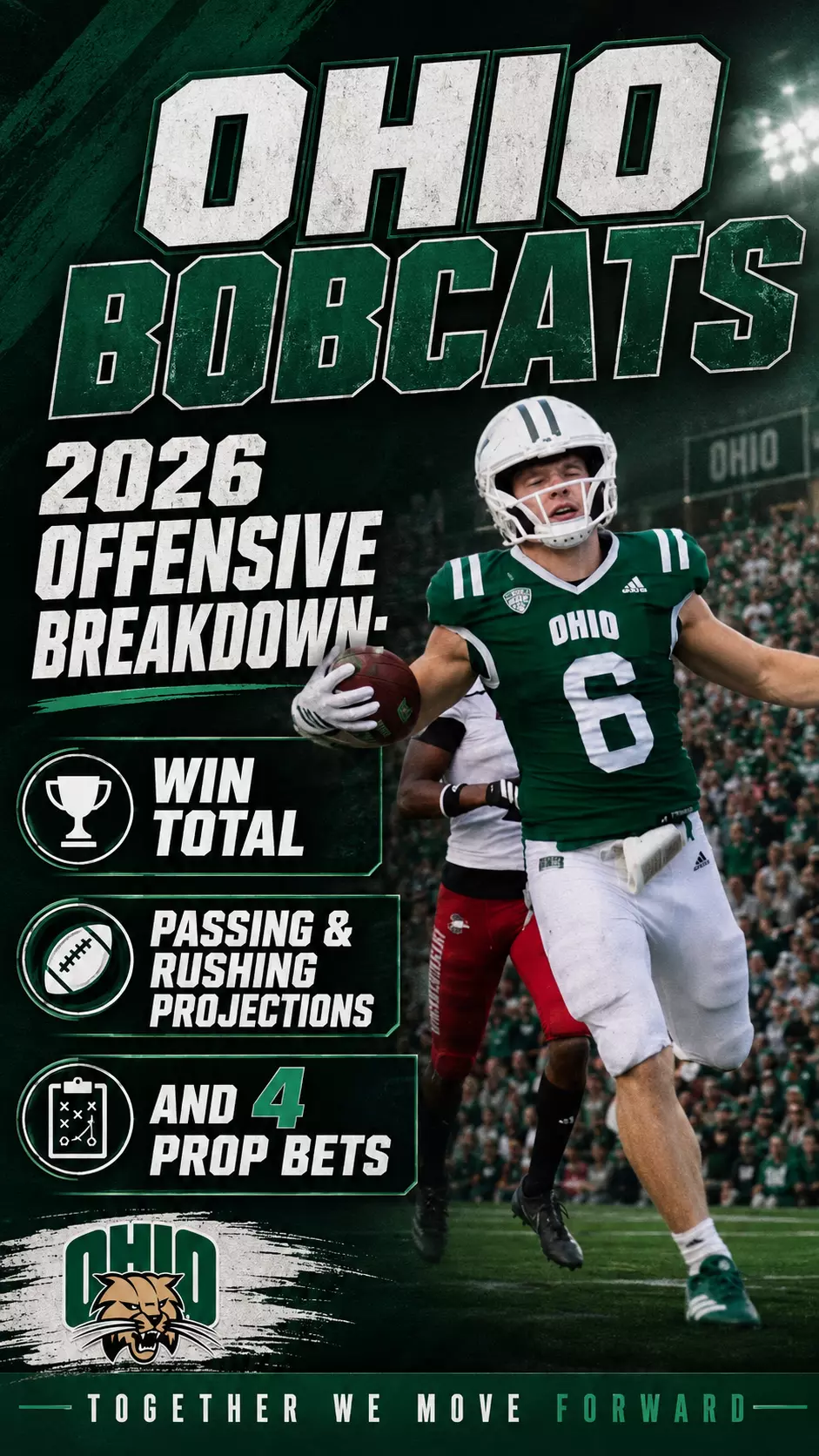
The Ohio Bobcats enter the 2026 college football season attempting to maintain one of the most consistent winning programs in the Mid-American Conference despite significant turnover at quarterback, running back and wide receiver.
Ohio finished
9-4 overall and 6-2 in the MAC in 2025, closing the season with a 17-10 victory over UNLV in the Frisco Bowl. The Bobcats averaged
27.8 points and 411.5 yards per game, producing 5,350 yards of total offense. Ohio rushed for an impressive
2,956 yards and 32 touchdowns
while throwing for
2,394 yards and 14 scores.
That offense was built around several veteran stars who must now be replaced.
Quarterback
Parker Navarro
threw for 2,375 yards and 14 touchdowns last season while also making a major contribution to the rushing attack. Running back
Sieh Bangura
finished his final season as one of the MAC’s best backs, and wide receiver
Chase Hendricks
surpassed 1,000 receiving yards.
The good news is that Ohio didn’t enter the offseason without a plan.
The Bobcats added former New Hampshire quarterback
Matt Vezza, who produced
2,673 passing yards, 19 passing touchdowns, 601 rushing yards and eight rushing touchdowns
in 2025.
Ohio also returns one of the MAC’s most intriguing young running backs in
Duncan Brune, while UConn transfer
Victor Rosa
adds another experienced option to the backfield.
The Bobcats will also have continuity within the offensive system. First-year head coach
John Hauser
retained offensive coordinator and quarterbacks coach
Scott Isphording, who will continue calling plays in 2026.
Ohio was selected fourth in the MAC coaches preseason poll behind Western Michigan, Miami and Toledo, but the Bobcats still have enough offensive talent to challenge for another winning season.
Ohio Bobcats 2026 Offensive Projections
Projected Record:
7-5
Projected Team Passing Yards:
2,650
Projected Team Rushing Yards:
2,300
Projected Total Offense:
4,950 yards
Projected Passing Touchdowns:
22
Projected Rushing Touchdowns:
23
Projected Offensive Touchdowns:
45-47
Projected Points Per Game:
28-30
Biggest Offensive Strength:
Dual-Threat Quarterback and Running Back Depth
Biggest Offensive Question:
Can Ohio replace the explosive production lost from Parker Navarro, Sieh Bangura and Chase Hendricks?
Quarterback Breakdown: Matt Vezza
Matt Vezza may be the most important newcomer on Ohio’s entire roster.
Replacing Navarro is difficult because the former Ohio quarterback affected games with both his arm and legs.
Navarro threw for
2,375 yards and 14 touchdowns
last season, and Ohio’s offense also benefited substantially from his mobility.
Vezza provides many of the same characteristics.
The former New Hampshire quarterback appeared in 13 games last season and completed
226 passes for 2,673 yards and 19 touchdowns. More importantly for Ohio’s offensive system, Vezza also rushed 151 times for
601 yards and eight touchdowns.
That makes his fit in Athens particularly interesting.
Ohio doesn’t have to completely redesign the offense around a traditional pocket passer.
Isphording can continue using quarterback runs, read-option concepts, zone reads and designed movement because Vezza has already demonstrated the ability to become a major part of a rushing attack.
His best passing performance last season came against Bryant, when he completed 27 passes for
328 yards and five touchdowns. He also rushed 15 times for a season-high 99 yards against William & Mary. Vezza earned third-team All-CAA recognition for his performance.
The obvious concern is the jump in competition.
Vezza produced those statistics at the FCS level.
The MAC is not the Big Ten or SEC, but the overall speed and depth of FBS defenses will still represent a significant increase.
He will get an immediate reminder of that when Ohio opens the season at Nebraska.
Still, Ohio has an excellent track record of developing quarterbacks under Isphording.
Ohio’s offensive coordinator has previously worked with Navarro, Kurtis Rourke and Nathan Rourke during his tenure in Athens.
Vezza doesn’t need to become an elite passer.
If he protects the football, throws for approximately 220 yards per game and contributes 500-plus rushing yards, Ohio should remain difficult to defend.
Matt Vezza Projection: 2,500-2,650 passing yards, 21-23 passing touchdowns, 500-600 rushing yards and 6-8 rushing touchdowns.
Ohio Running Game Breakdown
Ohio’s running game was dominant in 2025.
The Bobcats led the MAC with
2,956 rushing yards, averaging 227.4 rushing yards per game while scoring 32 touchdowns on the ground.
Replacing that production will be difficult.
Bangura was the centerpiece of the rushing attack and finished the season with
1,392 rushing yards and 15 touchdowns.
However, Ohio already has an experienced replacement candidate.
Duncan Brune
rushed for
585 yards and eight touchdowns
last season while appearing in all 13 games. He recorded his first career 100-yard performance against Northern Illinois and scored multiple rushing touchdowns against both NIU and UMass.
Brune enters 2026 with considerably more responsibility.
At 5-foot-11 and 218 pounds, he has enough size to handle carries between the tackles, but his athletic background suggests additional explosiveness. Ohio lists Brune with a 10.85-second personal best in the 100-meter dash.
The Bobcats also added
Victor Rosa
from UConn.
Rosa rushed for 155 yards and two touchdowns on only 30 attempts last season while catching 15 passes for 147 yards and another touchdown.
His most important value may be experience.
Ohio doesn’t need to ask Brune to immediately replace all of Bangura’s production.
Brune can become the primary runner while Rosa handles a complementary role, and Vezza can contribute significant rushing production from quarterback.
That last part is critical.
Vezza rushed for
601 yards and eight touchdowns
last year at New Hampshire.
If he approaches even 500 rushing yards at Ohio, the Bobcats could lose a 1,300-yard running back and still maintain a dangerous ground game.
Ohio’s running attack probably won’t average 227 yards per game again.
It doesn’t have to.
An average around 190 rushing yards would still make the Bobcats one of the more productive rushing offenses in the MAC.
Projected Team Rushing Yards: 2,300
Projected Rushing Touchdowns: 23
Ohio Offensive Line Breakdown
Ohio’s offensive line may determine whether the Bobcats can successfully rebuild their rushing attack.
The 2025 group was excellent.
Ohio led the MAC in rushing and received postseason All-MAC recognition from offensive linemen
Davion Weatherspoon, Jordon Jones and Nick Marinaro.
Replacing that experience represents one of the offense’s biggest challenges.
There are still returning pieces.
Josh Waite
played in all 13 games last season and helped Ohio average a conference-leading 227 rushing yards per game.
Seth Anstead
appeared in 12 games for the Bobcats last season, giving Ohio another player with experience in the system.
The Bobcats also attacked the position through recruiting and the transfer portal.
One of the biggest additions is
CJ Dawson II, a 6-foot-2, 327-pound transfer from Gardner-Webb who earned honorable mention All-Big South recognition after appearing in 24 games during the previous two seasons. Athlon Sports placed Dawson on its preseason third-team All-MAC offense.
Ohio also has veteran options such as
Tigana Cisse, Joshua Johnson, Cassius Hulbert and Sandro Malicevic
on the 2026 roster.
The question isn’t necessarily talent.
It is chemistry.
Ohio’s previous line helped create one of the most productive ground games in the country.
The new group has to develop quickly because the offense is breaking in a new quarterback and replacing its leading running back at the same time.
If the line performs well, Vezza and Brune should have enough talent to keep Ohio’s rushing identity intact.
Ohio Passing Game Breakdown
Wide receiver may represent Ohio’s biggest offensive rebuilding project.
The Bobcats must replace
Chase Hendricks, who caught passes for
1,037 yards and seven touchdowns
last season and became only the fourth receiver in program history to surpass 1,000 yards in a single year.
Ohio also loses other meaningful receiving production from the 2025 offense.
That creates an opportunity for several younger and previously underutilized players.
Dom Dorwart
may be one of the top breakout candidates.
Dorwart appeared in all 13 games last season and made seven starts, catching 11 passes for 119 yards. The 6-foot-2 receiver also brings legitimate speed after running a 10.66-second 100-meter dash during his high school career.
Max Rodarte
provides additional experience.
Rodarte caught seven passes for 86 yards in four appearances last season and previously produced
45 receptions for 790 yards and nine touchdowns
at City College of San Francisco before joining Ohio.
Another intriguing option is
Preston Bowman.
The Kentucky transfer did not produce college statistics last season, but he was a three-star recruit from Pickerington North who caught
59 passes for 1,248 yards and 13 touchdowns
during his senior high school season.
Ohio also added
Ian Ver Steeg
from Wake Forest. Ver Steeg saw limited offensive opportunities for the Demon Deacons, but he provides another veteran athlete to compete for snaps.
Eian Pugh
returns after catching six passes for 75 yards in five appearances last season. At 6-foot-3, he provides another bigger target on the perimeter.
There is no obvious Hendricks replacement.
That is the concern.
Ohio may have to distribute the football more evenly rather than depending on one receiver to consistently produce 100-yard games.
Vezza’s experience should help.
He supported a 2,600-yard passing offense at New Hampshire and has demonstrated that he can push the football downfield.
Ohio simply needs one or two receivers to emerge early.
If Bowman develops quickly or Dorwart takes a significant step forward, the Bobcats could actually become deeper even while losing their established No. 1 receiver.
Projected Team Passing Yards: 2,650
Projected Passing Touchdowns: 22
Ohio Bobcats 2026 Win Total
Ohio’s current regular-season win total sits at
6.5 victories.
VegasInsider’s August 12 board lists Ohio at 6.5 across multiple sportsbooks, with Over prices ranging roughly from
-120 to -132.
That number reflects both Ohio’s recent success and the significant offensive turnover.
The schedule begins with a difficult trip to
Nebraska
before Ohio hosts Jacksonville State.
The Bobcats then travel to South Alabama and host Stonehill to complete September.
A 2-2 record during that stretch would be acceptable.
A 3-1 start would put the Over in excellent position.
MAC play provides several opportunities.
Ohio travels to
Kent State, Sacramento State, Akron and Miami, while Central Michigan, Eastern Michigan, Ball State and Toledo visit Athens.
The biggest factor may be home-field advantage.
Ohio enters 2026 with a
13-game home winning streak, the longest in program history.
That makes games against Jacksonville State, Stonehill, Central Michigan, Eastern Michigan, Ball State and Toledo particularly important.
The Bobcats were selected fourth in the MAC preseason coaches poll, meaning they are still viewed as one of the conference’s better teams despite their personnel losses.
My projection has Ohio finishing
7-5, narrowly clearing the 6.5-win total.
Four Ohio Bobcats 2026 Prop Bets
Note:
Ohio’s 6.5-win total is a current sportsbook market. The statistical season props below are
projection-based betting benchmarks
because full-season Group of Five passing, rushing and touchdown markets are not consistently posted by every sportsbook.
Prop Bet #1: Ohio Over 6.5 Regular-Season Wins
DraftKings
4.5/5
Tip: Ohio Over 6.5 Regular-Season Wins
13-Game Home Winning Streak
Manageable MAC Schedule
Proven Offensive System
New DraftKings Customers: Bet $5, Get $200 + 3 Months of NBA League Pass!
Get bonus now
GAMBLING PROBLEM? CALL 1-800-GAMBLER or 1-800-MY-RESET, (800) 327-5050 or visit gamblinghelplinema.org (MA). Please Gamble Responsibly. 888-789-7777/visit ccpg.org (CT), or visit www.mdgamblinghelp.org (MD), 1-800-981-0023 (PR). 21+ and present in most states. (18+ DC/NH/PR/WY). Void in CAN. Eligibility restrictions apply. On behalf of Boot Hill Casino (KS). Pass-thru of per wager tax may apply in IL. 1 per new Sportsbook customer. $5+ first-time bet req. Max. $200 issued as non-withdrawable Bonus Bets. Stake removed from payout. Reward issued as $50 in Bonus Bets every 7 days via click-to-claim for 21 days. Bonus Bets and click-to-claims expire 7 days (168hrs) after issuance. Terms: dkng.co/offer. Get 1 promo code to redeem a 3-month NBA League Pass subscription, complimentary of DraftKings. Subscription auto-renews monthly at then-current price (currently $16.99/mo); cancel anytime. Terms, restrictions, and eligibility requirements apply. Redeem League Pass by 12/19/26 at 11:59 PM ET. Addt’l terms: support.watch.nba.com/hc/en-us/articles/9165532876183-League-Pass-Terms-of-Use_. Ends 11/29/26 at 11:59 PM ET. Sponsored by DK.
Why the Over Is a Good Bet
Ohio has established one of the strongest winning cultures in the MAC.
The Bobcats have won
40 games over the last four seasons
and enter 2026 with a 13-game home winning streak.
That home schedule creates a path to seven victories.
Stonehill should provide an excellent opportunity.
Jacksonville State, Central Michigan, Eastern Michigan and Ball State are all games where Ohio should be extremely competitive.
Toledo is difficult, but that game is also in Athens.
The Bobcats also avoid having to completely rebuild their offensive system.
Isphording remains the offensive coordinator and quarterbacks coach, providing continuity for a roster undergoing major personnel changes.
Vezza’s dual-threat ability should also allow Ohio to retain many of the concepts that worked with Navarro.
Seven wins is very achievable.
Why the Under Is a Good Bet
Ohio is replacing an enormous amount of offensive production.
Navarro is gone.
Bangura is gone.
Hendricks is gone.
Three offensive linemen who earned All-MAC recognition last season also must be replaced.
That is a substantial amount of turnover for any program.
Vezza also has to make the transition from FCS football to the FBS level.
The schedule creates additional problems.
Nebraska should be a major underdog spot.
South Alabama on the road is difficult.
Miami is one of the preseason MAC favorites, while Toledo was picked ahead of Ohio in the preseason coaches poll.
If the rebuilt offense takes several weeks to develop, Ohio could find itself chasing bowl eligibility late in the season.
Projection: Ohio finishes 7-5
Bet: Over 6.5 Wins
Confidence: 6.5/10
Prop Bet #2: Matt Vezza Over 2,399.5 Passing Yards
FanDuel
4.6/5
Tip: Matt Vezza Over 2,399.5 Passing Yards
2,673 Yards Last Season
Proven Dual-Threat Starter
Experienced Quarterback Coaching
New Users – Get $350 in Bonus Bets when you wager $5 for 7 days
Get bonus now
Gambling Problem? Call 1-800-GAMBLER or 1-800-MY-RESET. Call 1-888-789-7777 or visit ccpgg.org/chat (CT). Hope is here. GamblingHelpLineMA.org or call (800) 327-5050 for 24/7 support (MA). Visit www.mdgamblinghelp.org (MD). Call 1-877-8HOPE-NY or text HOPENY (NY). 21+ (18+ DC, WY) and present in select states (for KS, in affiliation with Kansas Star Casino). Find online real money wagering only. Min $5 wager required for 7 consecutive days. $5 free play credit. Bonus issued as non-withdrawable bonus with cash withdrawable bonus with cash withdrawable. Bonus bets which expire 7 days after receipt. Restrictions apply. See terms at sportsbook.fanduel.com. Call 1-877-770-7867 (LA).
Why the Over Is a Good Bet
Vezza already surpassed this number last season.
He threw for
2,673 yards and 19 touchdowns
at New Hampshire while completing 226 passes.
He now enters an Ohio offense coordinated by Isphording, who has helped develop multiple successful Bobcats quarterbacks, including Nathan Rourke, Kurtis Rourke and Navarro.
Vezza needs to average approximately
200 passing yards per game
to reach 2,400 during the regular season.
Ohio averaged 184 passing yards per game last season with an offense heavily committed to the run.
With Bangura gone, the Bobcats could become slightly more balanced.
The schedule may also create additional passing opportunities.
Nebraska could force Ohio into a pass-heavy second half, while games against Miami and Toledo may require the offense to continue attacking late.
Why the Under Is a Good Bet
The move from New Hampshire to Ohio represents an increase in competition.
Vezza will face FBS defensive fronts every week and must adjust to narrower throwing windows.
Ohio also has uncertainty at receiver.
Hendricks produced 1,037 yards last season, while the current receiving room does not return anyone close to that proven production.
The Bobcats may also continue emphasizing the rushing attack.
Vezza himself is a major runner.
When a play breaks down, he is more likely than a traditional pocket quarterback to scramble for 10 yards instead of completing another pass.
That helps Ohio’s offense but can reduce his passing-yardage total.
Projection: 2,500-2,650 Passing Yards
Bet: Over 2,399.5 Passing Yards
Confidence: 7/10
Prop Bet #3: Ohio Over 2,149.5 Team Rushing Yards
Caesars
4.4/5
Tip: Ohio Over 2,149.5 Team Rushing Yards
Duncan Brune Breakout Potential
Matt Vezza’s 600-Yard Rushing Ability
Deep Backfield Rotation
Bet $1 and get double the winnings up to $25 for your next 10 bets
–
21+ New users only. Must register using eligible promo code. First bet after registration must qualify. Max. Bonus Bet: $1,000. Bonus Bet expires 14 days after receipt. Void where prohibited. See Caesars.com/promos for full terms. Gambling Problem? 1-800-GAMBLER (1-800-426-2537)
Why the Over Is a Good Bet
This is my favorite Ohio offensive prop.
The Bobcats rushed for
2,956 yards last season, easily surpassing this benchmark.
Yes, Bangura is gone.
But Ohio doesn’t have to replace his production with one player.
Brune already rushed for 585 yards and eight touchdowns as the No. 2 option.
Vezza rushed for 601 yards and eight touchdowns at New Hampshire.
Rosa provides another experienced running back after contributing as both a runner and receiver at UConn.
If Brune approaches 900-1,000 yards and Vezza contributes 500-600, Ohio would already be well on the way toward the number before accounting for Rosa and the remainder of the backfield.
The offensive philosophy also favors the Over.
Ohio has consistently valued a physical rushing attack, and Isphording remains in place as offensive coordinator.
Why the Under Is a Good Bet
Losing Bangura matters.
He was one of the MAC’s premier running backs and finished last season with 1,392 yards and 15 touchdowns.
Ohio is also rebuilding much of its offensive line.
Weatherspoon, Jones and Marinaro all received All-MAC recognition last season, so the blocking unit has significant production and experience to replace.
Vezza’s FCS rushing numbers also shouldn’t automatically be transferred to the MAC.
FBS defensive linemen and linebackers will close running lanes more quickly.
There is also injury risk.
Dual-threat quarterbacks absorb more contact, and losing Vezza for even a few games would remove a significant portion of Ohio’s projected rushing production.
Projection: 2,300 Team Rushing Yards
Bet: Over 2,149.5 Team Rushing Yards
Confidence: 7.5/10
Prop Bet #4: Ohio Over 42.5 Offensive Touchdowns
BetMGM
4.5/5
Tip: Ohio Over 42.5 Offensive Touchdowns
Dual-Threat Quarterback
Multiple Goal-Line Running Options
Favorable MAC Matchups
Up To $1500 in Bonus Bets Paid Back if your First Bet Does Not Win
Get bonus now
Gambling problem? Call 1-800-GAMBLER or 1-800-MY-RESET (Available in the US) 877-8-HOPENY or text HOPENY (467369) (NY) 1-800-327-5050 (MA), 1-800-BETS-OFF (IA), 1-800-981-0023 (PR). 21+ only. Please Gamble Responsibly. See BetMGM.com for Terms. First Bet Offer for new customers only (if applicable). Subject to eligibility requirements. Bonus bets are non-withdrawable. In partnership with Kansas Crossing Casino and Hotel. Promotional offers not available in Mississippi, Massachusetts, New York, Ontario, or Puerto Rico.
Why the Over Is a Good Bet
Ohio scored
49 offensive touchdowns
last season, including 32 rushing touchdowns and 14 through the air.
The Bobcats are losing major touchdown producers, but Vezza gives the offense a proven replacement capable of creating scores in multiple ways.
He accounted for
27 touchdowns at New Hampshire last season — 19 passing and eight rushing.
Brune scored eight rushing touchdowns despite operating behind Bangura for much of the season.
That gives Ohio two established red-zone threats.
The schedule also provides scoring opportunities.
Stonehill should allow Ohio to produce multiple touchdowns, while several MAC opponents present more manageable defensive matchups than Nebraska.
Ohio only needs to average a little more than 3.5 offensive touchdowns per game to surpass 42.5.
For a program that averaged nearly 28 points per game last season, that is achievable.
Why the Under Is a Good Bet
Touchdown efficiency may be where Ohio feels its personnel losses the most.
Bangura accounted for 15 rushing touchdowns.
Hendricks caught seven touchdown passes.
Navarro was responsible for essentially all of Ohio’s passing touchdowns while also contributing in the running game.
Those are difficult numbers to replace immediately.
The new receiving corps is also inexperienced.
Ohio may consistently move the football but settle for more field goals if a dependable red-zone receiver does not emerge.
The early schedule creates another challenge.
Nebraska could hold Ohio to a relatively low scoring total, and Jacksonville State and South Alabama will both test the rebuilt offense before conference play begins.
Projection: 45-47 Offensive Touchdowns
Bet: Over 42.5 Offensive Touchdowns
Confidence: 6.5/10
Best Ohio Bobcats 2026 Prop Bet
Ohio’s rushing-yardage Over is the offensive wager I trust the most.
The Bobcats don’t need to come close to matching last season’s 2,956 rushing yards for the bet to cash.
They need roughly
180 rushing yards per game.
That is realistic for this personnel.
Brune already demonstrated that he can produce when given opportunities, finishing last season with 585 yards and eight touchdowns.
Vezza brings another major rushing component after producing 601 yards and eight scores at New Hampshire.
Rosa provides additional depth, and Ohio still has experienced offensive linemen such as Waite while adding players like Dawson.
Bangura’s departure means the rushing attack will look different.
It doesn’t mean it has to become ineffective.
Conclusion
The Ohio Bobcats enter the 2026 season with more offensive uncertainty than they have faced in several years, but there are still enough pieces in place to keep the program among the MAC’s most competitive teams.
Ohio is replacing Parker Navarro, Sieh Bangura and Chase Hendricks — three players who were central to an offense that averaged 411.5 yards per game last season.
That is significant turnover.
But Ohio may have found an ideal quarterback to keep the system functioning.
Matt Vezza arrives after producing
2,673 passing yards, 19 passing touchdowns, 601 rushing yards and eight rushing scores
at New Hampshire.
His dual-threat style should allow Scott Isphording to keep many of the concepts that made the offense successful with Navarro. Isphording’s continued presence is particularly important as Ohio transitions to John Hauser’s first full season as head coach.
The backfield also has potential.
Duncan Brune enters the season ready for a much larger role after rushing for 585 yards and eight touchdowns as the secondary option last year.
Victor Rosa provides additional experience, while Vezza effectively gives Ohio another running back whenever he keeps the football.
The passing game creates more uncertainty.
Ohio does not return a proven replacement for Hendricks’ 1,037 receiving yards, meaning Dorwart, Bowman, Rodarte, Pugh and the rest of the receiving corps must develop quickly.
The offensive line also has to replace multiple All-MAC players from last year’s dominant rushing attack.
My projection has Ohio producing approximately
2,650 passing yards, 2,300 rushing yards and 45-47 offensive touchdowns while averaging 28-30 points per game.
That would represent a slight change in offensive style rather than a complete collapse.
The 2026 schedule gives the Bobcats a realistic opportunity to remain a winning team.
Nebraska is an extremely difficult opener, and road games at South Alabama and Miami will test Ohio. However, the Bobcats get six games at Frank Solich Field, where they enter the season riding a program-record 13-game winning streak.
The current win total of
6.5 victories
feels appropriately challenging.
My prediction is
7-5, narrowly cashing the Over.
An 8-4 season is possible if Vezza transitions smoothly and Ohio’s rebuilt offensive line performs close to last year’s level.
A 6-6 season is equally realistic if the new receiving corps struggles or Ohio’s offensive-line losses prove more significant than expected.
From an offensive betting perspective, the strongest wager is
Ohio Over 2,149.5 team rushing yards.
The Bobcats already have Brune.
They added a quarterback who rushed for more than 600 yards last season.
And they have enough depth at running back to spread the workload.
Ohio may not reproduce the nearly 3,000 rushing yards it generated in 2025.
It doesn’t need to.
If Vezza gives the Bobcats stability at quarterback, Brune emerges as the next productive Ohio running back and the rebuilt offensive line develops quickly, the
Ohio Bobcats should once again field one of the MAC’s most balanced offenses and contend for another bowl appearance in 2026.
New Users – Get $350 in Bonus Bets when you wager $5 for 7 days
T&Cs apply
4.6/5
Gambling Problem? Call 1-800-GAMBLER or 1-800-MY-RESET. Call 1-888-789-7777 or visit ccpgg.org/chat (CT). Hope is here. GamblingHelpLineMA.org or call (800) 327-5050 for 24/7 support (MA). Visit www.mdgamblinghelp.org (MD). Call 1-877-8HOPE-NY or text HOPENY (NY). 21+ (18+ DC, WY) and present in select states (for KS, in affiliation with Kansas Star Casino). Find online real money wagering only. Min $5 wager required for 7 consecutive days. $5 free play credit. Bonus issued as non-withdrawable bonus with cash withdrawable bonus with cash withdrawable. Bonus bets which expire 7 days after receipt. Restrictions apply. See terms at sportsbook.fanduel.com. Call 1-877-770-7867 (LA).
Up To $1500 in Bonus Bets Paid Back if your First Bet Does Not Win
T&Cs apply
4.5/5
Gambling problem? Call 1-800-GAMBLER or 1-800-MY-RESET (Available in the US) 877-8-HOPENY or text HOPENY (467369) (NY) 1-800-327-5050 (MA), 1-800-BETS-OFF (IA), 1-800-981-0023 (PR). 21+ only. Please Gamble Responsibly. See BetMGM.com for Terms. First Bet Offer for new customers only (if applicable). Subject to eligibility requirements. Bonus bets are non-withdrawable. In partnership with Kansas Crossing Casino and Hotel. Promotional offers not available in Mississippi, Massachusetts, New York, Ontario, or Puerto Rico.
New DraftKings Customers: Bet $5, Get $200 + 3 Months of NBA League Pass!
T&Cs apply
4.5/5
GAMBLING PROBLEM? CALL 1-800-GAMBLER or 1-800-MY-RESET, (800) 327-5050 or visit gamblinghelplinema.org (MA). Please Gamble Responsibly. 888-789-7777/visit ccpg.org (CT), or visit www.mdgamblinghelp.org (MD), 1-800-981-0023 (PR). 21+ and present in most states. (18+ DC/NH/PR/WY). Void in CAN. Eligibility restrictions apply. On behalf of Boot Hill Casino (KS). Pass-thru of per wager tax may apply in IL. 1 per new Sportsbook customer. $5+ first-time bet req. Max. $200 issued as non-withdrawable Bonus Bets. Stake removed from payout. Reward issued as $50 in Bonus Bets every 7 days via click-to-claim for 21 days. Bonus Bets and click-to-claims expire 7 days (168hrs) after issuance. Terms: dkng.co/offer. Get 1 promo code to redeem a 3-month NBA League Pass subscription, complimentary of DraftKings. Subscription auto-renews monthly at then-current price (currently $16.99/mo); cancel anytime. Terms, restrictions, and eligibility requirements apply. Redeem League Pass by 12/19/26 at 11:59 PM ET. Addt’l terms: support.watch.nba.com/hc/en-us/articles/9165532876183-League-Pass-Terms-of-Use_. Ends 11/29/26 at 11:59 PM ET. Sponsored by DK.
Must be 21+. GAMBLING PROBLEM? CALL 1-800-GAMBLER OR CALL 1-800-MY-RESET, www.mdgamblinghelp.org (MD), (800)-327-5050 or gamblinghelplinema.org (MA), Call (877)8-HOPENY or text HOPENY (467369) (NY), (888) 789-7777 or ccpg.org (CT), morethanagame.nc.gov (NC), 1800gambler.net (WV)
Bet $1 and get double the winnings up to $25 for your next 10 bets
T&Cs apply
4.4/5
21+ New users only. Must register using eligible promo code. First bet after registration must qualify. Max. Bonus Bet: $1,000. Bonus Bet expires 14 days after receipt. Void where prohibited. See Caesars.com/promos for full terms. Gambling Problem? 1-800-GAMBLER (1-800-426-2537)
21+ and present in OH. Gambling Problem? Call 1-800-GAMBLER.
This site is using
Cloudflare
and adheres to the
Google Safe Browsing Program. We adapted
Google's Privacy Guidelines
to keep your data safe at all times.
Close
Ready to Win Big? Join the Elite with Our Sports Betting Deals!
FanDuel Promo
New Users – Get $350 in Bonus Bets when you wager $5 for 7 days
Our Favorite
T&Cs and 21+ apply
Gambling Problem? Call 1-800-GAMBLER or 1-800-MY-RESET. Call 1-888-789-7777 or visit ccpgg.org/chat (CT). Hope is here. GamblingHelpLineMA.org or call (800) 327-5050 for 24/7 support (MA). Visit www.mdgamblinghelp.org (MD). Call 1-877-8HOPE-NY or text HOPENY (NY). 21+ (18+ DC, WY) and present in select states (for KS, in affiliation with Kansas Star Casino). Find online real money wagering only. Min $5 wager required for 7 consecutive days. $5 free play credit. Bonus issued as non-withdrawable bonus with cash withdrawable bonus with cash withdrawable. Bonus bets which expire 7 days after receipt. Restrictions apply. See terms at sportsbook.fanduel.com. Call 1-877-770-7867 (LA).
Code:
Open FanDuel
Get Bonus
BetMGM Promo
Up To $1500 in Bonus Bets Paid Back if your First Bet Does Not Win
Best Slots
T&Cs and 21+ apply
Gambling problem? Call 1-800-GAMBLER or 1-800-MY-RESET (Available in the US) 877-8-HOPENY or text HOPENY (467369) (NY) 1-800-327-5050 (MA), 1-800-BETS-OFF (IA), 1-800-981-0023 (PR). 21+ only. Please Gamble Responsibly. See BetMGM.com for Terms. First Bet Offer for new customers only (if applicable). Subject to eligibility requirements. Bonus bets are non-withdrawable. In partnership with Kansas Crossing Casino and Hotel. Promotional offers not available in Mississippi, Massachusetts, New York, Ontario, or Puerto Rico.
Code:
Open BetMGM
Get Bonus
DraftKings Promo
New DraftKings Customers: Bet $5, Get $200 + 3 Months of NBA League Pass!
Newcomer
T&Cs and 21+ apply
GAMBLING PROBLEM? CALL 1-800-GAMBLER or 1-800-MY-RESET, (800) 327-5050 or visit gamblinghelplinema.org (MA). Please Gamble Responsibly. 888-789-7777/visit ccpg.org (CT), or visit www.mdgamblinghelp.org (MD), 1-800-981-0023 (PR). 21+ and present in most states. (18+ DC/NH/PR/WY). Void in CAN. Eligibility restrictions apply. On behalf of Boot Hill Casino (KS). Pass-thru of per wager tax may apply in IL. 1 per new Sportsbook customer. $5+ first-time bet req. Max. $200 issued as non-withdrawable Bonus Bets. Stake removed from payout. Reward issued as $50 in Bonus Bets every 7 days via click-to-claim for 21 days. Bonus Bets and click-to-claims expire 7 days (168hrs) after issuance. Terms: dkng.co/offer. Get 1 promo code to redeem a 3-month NBA League Pass subscription, complimentary of DraftKings. Subscription auto-renews monthly at then-current price (currently $16.99/mo); cancel anytime. Terms, restrictions, and eligibility requirements apply. Redeem League Pass by 12/19/26 at 11:59 PM ET. Addt’l terms: support.watch.nba.com/hc/en-us/articles/9165532876183-League-Pass-Terms-of-Use_. Ends 11/29/26 at 11:59 PM ET. Sponsored by DK.
Code:
Open DraftKings
Get Bonus
Find out what the legends have to say about sports this week....
New Users – Get $350 in Bonus Bets when you wager $5 for 7 days
Gambling Problem? Call 1-800-GAMBLER or 1-800-MY-RESET. Call 1-888-789-7777 or visit ccpgg.org/chat (CT). Hope is here. GamblingHelpLineMA.org or call (800) 327-5050 for 24/7 support (MA). Visit www.mdgamblinghelp.org (MD). Call 1-877-8HOPE-NY or text HOPENY (NY). 21+ (18+ DC, WY) and present in select states (for KS, in affiliation with Kansas Star Casino). Find online real money wagering only. Min $5 wager required for 7 consecutive days. $5 free play credit. Bonus issued as non-withdrawable bonus with cash withdrawable bonus with cash withdrawable. Bonus bets which expire 7 days after receipt. Restrictions apply. See terms at sportsbook.fanduel.com. Call 1-877-770-7867 (LA).