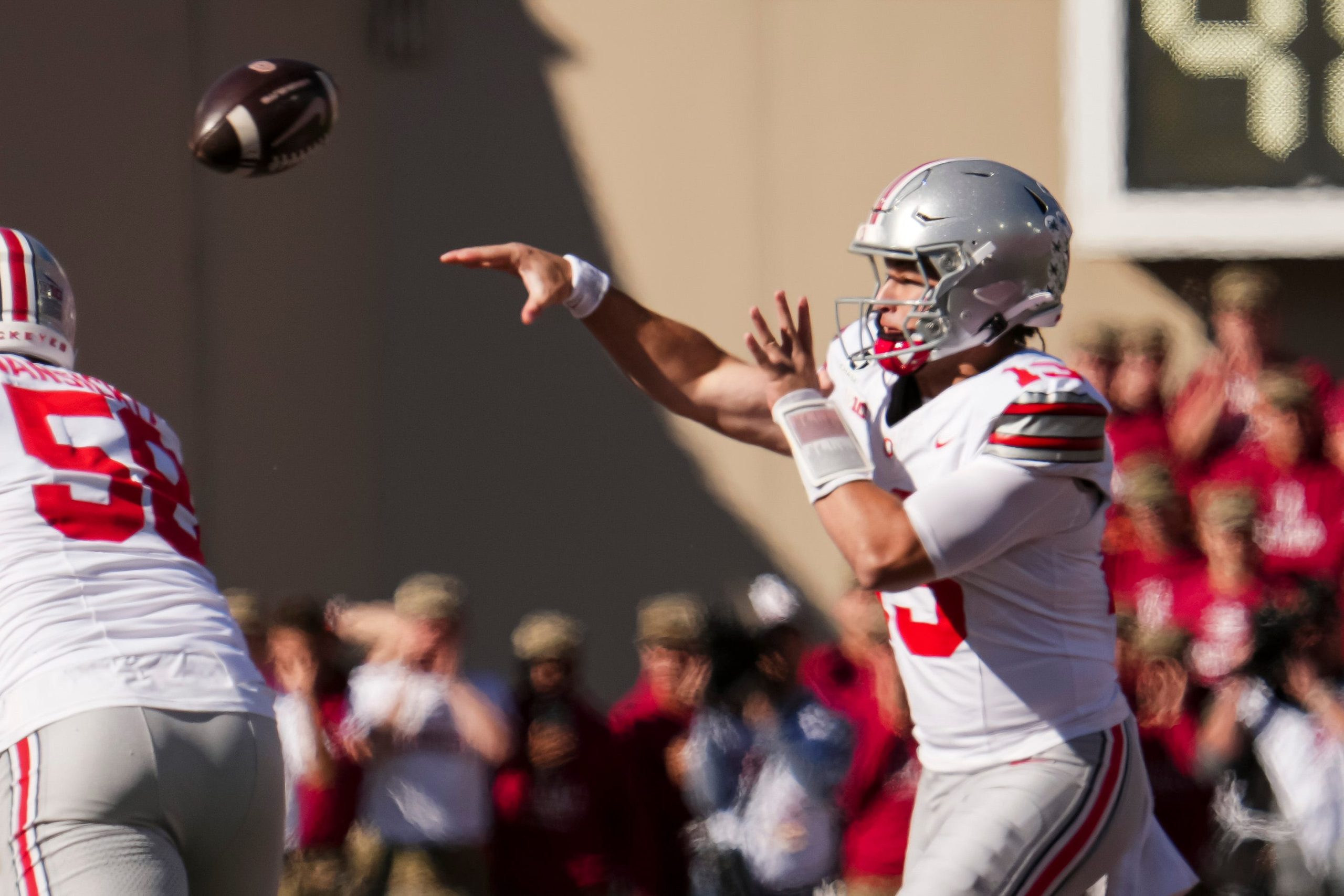
Ohio State Buckeyes quarterback Luke Fahey (13) throws after starter Julian Sayin left the game during the NCAA football game against the Indiana Hoosiers at Memorial Stadium Stadium in Bloomington, Ind. on Oct. 17, 2026.
Ohio State left Bloomington with the victory it needed. It also left with a problem that could reshape its season.
The Buckeyes defeated Indiana
19–15 on October 17, improving to
6–1 overall and 4–0 in Big Ten play. They ended the Hoosiers’ 22-game winning streak and strengthened their position in the conference championship race. But Julian Sayin’s fourth-quarter injury changed the outlook at quarterback.
Now the focus shifts to Luke Fahey, Tavien St. Clair and how effectively Ryan Day can prepare an offense around a different starter.
The timing offers Ohio State one important advantage: a bye week before its October 31 trip to USC. That gives the Buckeyes additional practice time to establish their plan.
What it does not provide is certainty about Sayin’s recovery—or an easy route through the remaining schedule.
The Latest on Sayin: An Extended Absence, With Details Still Unsettled
Day’s most recent public update reinforced the expectation that Ohio State will be without its starting quarterback for a significant period.
Speaking Monday on the Buckeye Roundtable show, Day said Sayin would be out
“at least several weeks”
and was still undergoing testing and medical discussions. A definitive return date had not been established in that update.
The Buckeyes cannot organize the next several games around an assumed return against a particular opponent. They need an offense capable of operating for however long Sayin remains unavailable.
The immediate assignment is to prepare Fahey to lead that offense while ensuring St. Clair is ready to enter if needed.
Fahey Has the First Opportunity
Fahey replaced Sayin against Indiana and attempted two passes, both incomplete. That brief appearance offers little basis for a firm judgment about his ability to lead the offense with a full week—or two—of preparation.
There is an enormous difference between entering a close road game unexpectedly and preparing as the anticipated starter.
With first-team practice repetitions, a quarterback can develop timing with his receivers, become more comfortable directing protection and work through the situations most likely to arise against the next opponent.
Day expressed confidence in Fahey’s preparation Monday, saying he comes to work ready and has the team’s respect. St. Clair is positioned behind him while Sayin is sidelined.
That gives Ohio State a starting point. It does not eliminate the need to evaluate both quarterbacks throughout practice.
St. Clair Must Receive Meaningful Preparation
St. Clair’s role has become substantially more important.
The quarterback behind Fahey must be ready to operate the offense if an injury, ineffective performance or another circumstance requires a change. Ohio State cannot afford to prepare one replacement adequately and leave itself vulnerable behind him.
That creates a difficult practice balance.
Fahey needs enough repetitions to build confidence and command. St. Clair needs enough work to remain a credible option. The staff must evaluate how each handles pressure, communicates adjustments and responds after a mistake.
Recruiting reputations cannot settle those questions. Neither can a handful of game snaps.
Ohio State needs its decisions to reflect what the quarterbacks demonstrate in the offense they will actually be asked to run.
Simplify the Decisions Without Making the Offense Predictable
The most important adjustment should concern the quarterback’s workload.
A replacement starter should not automatically inherit every responsibility assigned to an experienced starter. Ohio State can narrow certain reads, emphasize familiar concepts and build clear answers into its protection calls.
Quick throws, play-action passes and selected movement of the pocket are reasonable tools to consider. The objective should be to give the quarterback a defined starting point and an understandable response when the defense changes its appearance.
However, simplification has limits.
If Ohio State becomes overwhelmingly predictable, opponents can crowd the line of scrimmage and attack the same tendencies repeatedly. The Buckeyes still need enough variety to threaten different areas of the field.
The right approach is a focused offense that the quarterback can execute confidently, with complementary plays that punish defensive overreaction.
Jeremiah Smith Must Remain Central
Ohio State’s passing game still has an extraordinary resource in Jeremiah Smith.
Against Indiana, Smith caught four passes for 68 yards and a touchdown. His production included the fourth-quarter scoring play that helped establish the Buckeyes’ winning margin.
A quarterback change should not reduce him to an occasional target on difficult downs.
Ohio State should look for ways to involve Smith through manageable throws as well as deeper opportunities. Motion, formation changes and route combinations can help create favorable situations without requiring the quarterback to hold the ball through an extended progression.
But forcing the ball to Smith regardless of coverage would create another problem.
The Buckeyes need the replacement starter to recognize when the defense has committed extra attention to their leading receiver and use the space that creates elsewhere. Smith’s value includes what his presence can open for teammates.
The Running Game Has to Provide Real Support
An inexperienced quarterback benefits from productive early downs. That places additional responsibility on Ohio State’s offensive line and rushing attack.
The Buckeyes need runs that create manageable situations and prevent defenses from treating every important snap as an obvious passing down.
That does not require abandoning the passing game or repeatedly running into unfavorable defensive numbers. It requires enough efficiency to preserve choices.
Second-and-six gives a play-caller options. Third-and-long allows the defense to disguise pressure and force the quarterback into a more demanding situation.
Ohio State must also avoid penalties and missed assignments that erase its own advantages. A quarterback transition becomes much harder when the rest of the offense adds unnecessary difficulty.
Protection Must Be a Shared Responsibility
The offensive line will receive immediate scrutiny, but protecting Fahey or St. Clair will require coordination across the offense.
The quarterback must identify threats and understand when the ball needs to leave his hand. Running backs must execute their protection assignments. Receivers must recognize situations that require an immediate answer.
Against an inexperienced starter, defenses have reason to test communication.
They can show pressure before retreating into coverage, bring a defender from an unexpected position or attempt to force a protection adjustment late in the play clock.
Ohio State’s bye-week work should make those situations familiar. The goal is to reduce hesitation before it becomes a free rusher, a hurried throw or a preventable turnover.
The Remaining Schedule Gives Ohio State Little Room to Drift
USC presents the immediate challenge: travel, road communication and the possibility of a first collegiate start in an unfamiliar environment.
The games afterward will test whether the offense can keep developing as opponents gather film on the replacement quarterback. What succeeds initially will invite adjustments.
Northwestern also belongs in the discussion. Ohio State must prepare for all five opponents rather than treating certain games as bridges between the more prominent matchups.
The Defense Must Help Without Carrying an Impossible Burden
Ohio State’s defense gives the team a foundation during this transition. Holding Indiana to 15 points was a significant part of Saturday’s victory.
That support should influence the offensive plan.
The Buckeyes do not need their new starter to chase a spectacular play on every possession. Protecting the football, managing field position and taking available scoring opportunities can complement a strong defense.
But excessive caution can become counterproductive.
Repeated empty possessions increase the defense’s workload and leave the game dependent on a very small number of decisive snaps. Ohio State still needs an offense capable of sustaining drives and scoring touchdowns.
The defense can provide stability. The offense must contribute enough to make that stability matter.
The Championship Standard Now Requires Adaptation
Ohio State’s ambitions remain intact. Winning at Indiana improved its position, and one injury does not erase the talent throughout the roster.
It does change the assignment.
Day and his staff must determine what Fahey can execute reliably, prepare St. Clair to contribute if necessary and distribute more responsibility across the offense. The line, receivers and running backs all have a role in making the quarterback’s job manageable.
The bye week creates time to begin that process. The trip to USC will provide the first substantial test of the result.
Ohio State proved it could beat Indiana. Its next challenge is building an offense that can keep winning while Sayin’s return remains uncertain.
New Users – Get $350 in Bonus Bets when you wager $5 for 7 days
T&Cs apply
4.6/5
Gambling Problem? Call 1-800-GAMBLER or 1-800-MY-RESET. Call 1-888-789-7777 or visit ccpgg.org/chat (CT). Hope is here. GamblingHelpLineMA.org or call (800) 327-5050 for 24/7 support (MA). Visit www.mdgamblinghelp.org (MD). Call 1-877-8HOPE-NY or text HOPENY (NY). 21+ (18+ DC, WY) and present in select states (for KS, in affiliation with Kansas Star Casino). Find online real money wagering only. Min $5 wager required for 7 consecutive days. $5 free play credit. Bonus issued as non-withdrawable bonus with cash withdrawable bonus with cash withdrawable. Bonus bets which expire 7 days after receipt. Restrictions apply. See terms at sportsbook.fanduel.com. Call 1-877-770-7867 (LA).
Up To $1500 in Bonus Bets Paid Back if your First Bet Does Not Win
T&Cs apply
4.5/5
Gambling problem? Call 1-800-GAMBLER or 1-800-MY-RESET (Available in the US) 877-8-HOPENY or text HOPENY (467369) (NY) 1-800-327-5050 (MA), 1-800-BETS-OFF (IA), 1-800-981-0023 (PR). 21+ only. Please Gamble Responsibly. See BetMGM.com for Terms. First Bet Offer for new customers only (if applicable). Subject to eligibility requirements. Bonus bets are non-withdrawable. In partnership with Kansas Crossing Casino and Hotel. Promotional offers not available in Mississippi, Massachusetts, New York, Ontario, or Puerto Rico.
New DraftKings Customers: Bet $5, Get $200 + 3 Months of NBA League Pass!
T&Cs apply
4.5/5
GAMBLING PROBLEM? CALL 1-800-GAMBLER or 1-800-MY-RESET, (800) 327-5050 or visit gamblinghelplinema.org (MA). Please Gamble Responsibly. 888-789-7777/visit ccpg.org (CT), or visit www.mdgamblinghelp.org (MD), 1-800-981-0023 (PR). 21+ and present in most states. (18+ DC/NH/PR/WY). Void in CAN. Eligibility restrictions apply. On behalf of Boot Hill Casino (KS). Pass-thru of per wager tax may apply in IL. 1 per new Sportsbook customer. $5+ first-time bet req. Max. $200 issued as non-withdrawable Bonus Bets. Stake removed from payout. Reward issued as $50 in Bonus Bets every 7 days via click-to-claim for 21 days. Bonus Bets and click-to-claims expire 7 days (168hrs) after issuance. Terms: dkng.co/offer. Get 1 promo code to redeem a 3-month NBA League Pass subscription, complimentary of DraftKings. Subscription auto-renews monthly at then-current price (currently $16.99/mo); cancel anytime. Terms, restrictions, and eligibility requirements apply. Redeem League Pass by 12/19/26 at 11:59 PM ET. Addt’l terms: support.watch.nba.com/hc/en-us/articles/9165532876183-League-Pass-Terms-of-Use_. Ends 11/29/26 at 11:59 PM ET. Sponsored by DK.
Must be 21+. GAMBLING PROBLEM? CALL 1-800-GAMBLER OR CALL 1-800-MY-RESET, www.mdgamblinghelp.org (MD), (800)-327-5050 or gamblinghelplinema.org (MA), Call (877)8-HOPENY or text HOPENY (467369) (NY), (888) 789-7777 or ccpg.org (CT), morethanagame.nc.gov (NC), 1800gambler.net (WV)
Bet $1 and get double the winnings up to $25 for your next 10 bets
T&Cs apply
4.4/5
21+ New users only. Must register using eligible promo code. First bet after registration must qualify. Max. Bonus Bet: $1,000. Bonus Bet expires 14 days after receipt. Void where prohibited. See Caesars.com/promos for full terms. Gambling Problem? 1-800-GAMBLER (1-800-426-2537)
21+ and present in OH. Gambling Problem? Call 1-800-GAMBLER.
This site is using
Cloudflare
and adheres to the
Google Safe Browsing Program. We adapted
Google's Privacy Guidelines
to keep your data safe at all times.
Close
Ready to Win Big? Join the Elite with Our Sports Betting Deals!
FanDuel Promo
New Users – Get $350 in Bonus Bets when you wager $5 for 7 days
Our Favorite
T&Cs and 21+ apply
Gambling Problem? Call 1-800-GAMBLER or 1-800-MY-RESET. Call 1-888-789-7777 or visit ccpgg.org/chat (CT). Hope is here. GamblingHelpLineMA.org or call (800) 327-5050 for 24/7 support (MA). Visit www.mdgamblinghelp.org (MD). Call 1-877-8HOPE-NY or text HOPENY (NY). 21+ (18+ DC, WY) and present in select states (for KS, in affiliation with Kansas Star Casino). Find online real money wagering only. Min $5 wager required for 7 consecutive days. $5 free play credit. Bonus issued as non-withdrawable bonus with cash withdrawable bonus with cash withdrawable. Bonus bets which expire 7 days after receipt. Restrictions apply. See terms at sportsbook.fanduel.com. Call 1-877-770-7867 (LA).
Code:
Open FanDuel
Get Bonus
BetMGM Promo
Up To $1500 in Bonus Bets Paid Back if your First Bet Does Not Win
Best Slots
T&Cs and 21+ apply
Gambling problem? Call 1-800-GAMBLER or 1-800-MY-RESET (Available in the US) 877-8-HOPENY or text HOPENY (467369) (NY) 1-800-327-5050 (MA), 1-800-BETS-OFF (IA), 1-800-981-0023 (PR). 21+ only. Please Gamble Responsibly. See BetMGM.com for Terms. First Bet Offer for new customers only (if applicable). Subject to eligibility requirements. Bonus bets are non-withdrawable. In partnership with Kansas Crossing Casino and Hotel. Promotional offers not available in Mississippi, Massachusetts, New York, Ontario, or Puerto Rico.
Code:
Open BetMGM
Get Bonus
DraftKings Promo
New DraftKings Customers: Bet $5, Get $200 + 3 Months of NBA League Pass!
Newcomer
T&Cs and 21+ apply
GAMBLING PROBLEM? CALL 1-800-GAMBLER or 1-800-MY-RESET, (800) 327-5050 or visit gamblinghelplinema.org (MA). Please Gamble Responsibly. 888-789-7777/visit ccpg.org (CT), or visit www.mdgamblinghelp.org (MD), 1-800-981-0023 (PR). 21+ and present in most states. (18+ DC/NH/PR/WY). Void in CAN. Eligibility restrictions apply. On behalf of Boot Hill Casino (KS). Pass-thru of per wager tax may apply in IL. 1 per new Sportsbook customer. $5+ first-time bet req. Max. $200 issued as non-withdrawable Bonus Bets. Stake removed from payout. Reward issued as $50 in Bonus Bets every 7 days via click-to-claim for 21 days. Bonus Bets and click-to-claims expire 7 days (168hrs) after issuance. Terms: dkng.co/offer. Get 1 promo code to redeem a 3-month NBA League Pass subscription, complimentary of DraftKings. Subscription auto-renews monthly at then-current price (currently $16.99/mo); cancel anytime. Terms, restrictions, and eligibility requirements apply. Redeem League Pass by 12/19/26 at 11:59 PM ET. Addt’l terms: support.watch.nba.com/hc/en-us/articles/9165532876183-League-Pass-Terms-of-Use_. Ends 11/29/26 at 11:59 PM ET. Sponsored by DK.
Code:
Open DraftKings
Get Bonus
Find out what the legends have to say about sports this week....
New Users – Get $350 in Bonus Bets when you wager $5 for 7 days
Gambling Problem? Call 1-800-GAMBLER or 1-800-MY-RESET. Call 1-888-789-7777 or visit ccpgg.org/chat (CT). Hope is here. GamblingHelpLineMA.org or call (800) 327-5050 for 24/7 support (MA). Visit www.mdgamblinghelp.org (MD). Call 1-877-8HOPE-NY or text HOPENY (NY). 21+ (18+ DC, WY) and present in select states (for KS, in affiliation with Kansas Star Casino). Find online real money wagering only. Min $5 wager required for 7 consecutive days. $5 free play credit. Bonus issued as non-withdrawable bonus with cash withdrawable bonus with cash withdrawable. Bonus bets which expire 7 days after receipt. Restrictions apply. See terms at sportsbook.fanduel.com. Call 1-877-770-7867 (LA).