The
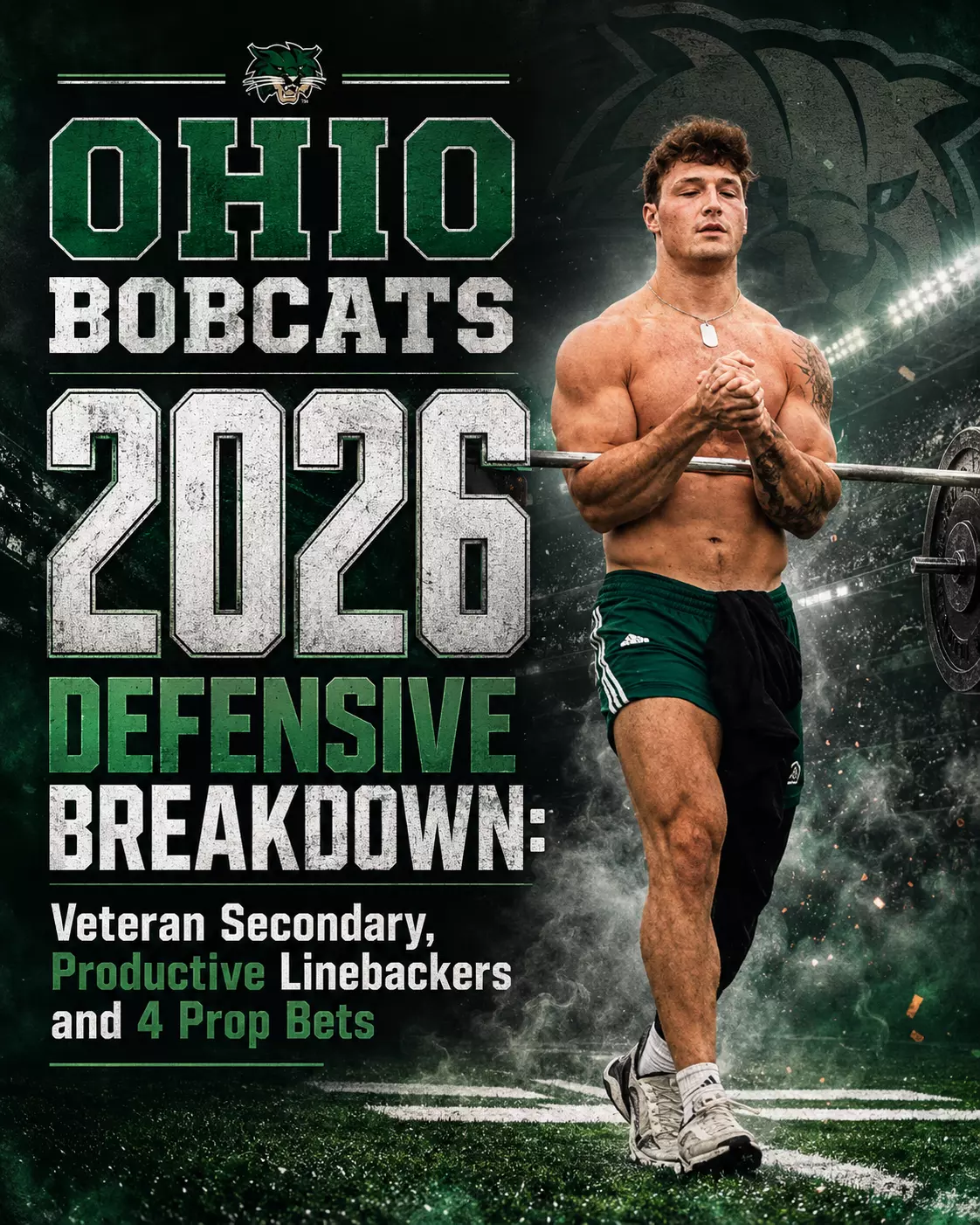
Ohio Bobcats enter the 2026 college football season with a new head coach and defensive coordinator but enough returning production to once again field one of the better defenses in the Mid-American Conference.
Ohio finished
9-4 overall and 6-2 in MAC play in 2025, allowing only
21.9 points and 352.1 total yards per game. Opponents averaged 144.0 rushing yards and 208.1 passing yards per contest. The Bobcats also held opponents to only
33.3% on third down
while recording 24 sacks and 12 interceptions.
Those numbers weren’t spectacular in every category.
They were consistently effective.
Ohio held West Virginia to 10 points.
Western Michigan scored only 17.
Miami scored 20.
And the Bobcats finished the season by holding UNLV to
10 points in a 17-10 bowl victory.
Now comes a transition.
John Hauser takes over as head coach, while
Kurt Mattix returns to Athens as defensive coordinator
after spending the 2025 season at Charlotte. Mattix isn’t unfamiliar with the program. He coached Ohio’s defensive ends and served as pass-rush specialist during the Bobcats’
2024 MAC championship season.
That familiarity should reduce the adjustment period.
Ohio also retained its defensive position coaches, including defensive-line coach Tremayne Scott, cornerbacks coach De’Angelo Smith, defensive ends coach Jeff Phelps, linebackers coach Chris Woods and defensive assistant Joe Tresey.
And there are legitimate veteran building blocks.
DJ Walker
returns after starting all 13 games and intercepting two passes.
Michael Molnar
returns after recording an incredible 73 tackles despite playing only eight games.
Charlie Christopher
returns after producing 63 tackles.
Nehemiah Dukes
returns after starting every game along the defensive line.
And Ohio strengthened the secondary with productive transfers
Eli Thompson
and
Darren James-Hamilton.
The Bobcats aren’t rebuilding from nothing.
They are attempting to maintain an established defensive identity while replacing selected pieces.
Ohio Bobcats 2026 Defensive Projections
Projected Record:
7-5
Projected Points Allowed Per Game:
20-22
Projected Total Defense:
325-345 yards per game
Projected Rushing Defense:
130-140 yards per game
Projected Passing Defense:
195-210 yards per game
Projected Team Sacks:
25-29
Projected Interceptions:
12-15
Projected Total Takeaways:
19-22
Projected Tackles for Loss:
65-75
Biggest Defensive Strength:
Linebacker Production and Secondary Experience
Biggest Defensive Question:
Can Ohio generate enough consistent pressure after finishing with only 24 sacks last season?
Kurt Mattix’s Ohio Defense
The biggest reason to believe Ohio can remain strong defensively is
Kurt Mattix.
Mattix returns to Athens after previously working on the Bobcats’ 2024 MAC championship staff.
That season ended with Ohio dominating Miami
38-3 in the MAC Championship Game, and Mattix worked directly with a defensive front that featured Bradley Weaver, who finished with 15 tackles for loss and 8.5 sacks.
Mattix brings considerably more experience than one season at Ohio.
He previously served as defensive coordinator and linebackers coach at San Diego State from 2020 through 2023.
During that stretch, San Diego State ranked
ninth nationally in rushing defense, 17th in total defense and 18th in scoring defense and pass-efficiency defense. His 2023 defense also forced 18 turnovers.
That résumé fits what Ohio wants to be.
Stop the run.
Create difficult third downs.
Pressure quarterbacks.
Force turnovers.
And avoid giving offenses easy scoring opportunities.
The 2025 Bobcats already accomplished much of that.
Opponents converted only one-third of their third downs.
Ohio allowed fewer than 22 points per game.
The Bobcats intercepted 12 passes.
And opponents scored touchdowns on only 20 of 39 red-zone opportunities.
The biggest area for improvement is pressure.
Ohio finished with
24 sacks in 13 games.
That isn’t terrible.
It also isn’t dominant.
Mattix’s background as both a defensive coordinator and pass-rush specialist gives Ohio an opportunity to improve that number.
He doesn’t need one player to record 12 sacks.
The Bobcats need several defenders consistently creating pressure.
That is where the defensive front becomes extremely important.
Ohio Defensive Line Breakdown
Ohio’s defensive line begins with
Nehemiah Dukes.
Dukes started all 13 games last season and finished with
30 tackles, two tackles for loss and one sack.
Those numbers don’t immediately look dominant.
But defensive tackles are frequently judged by more than sacks.
Dukes’ job is to control the interior.
Occupy blockers.
Keep offensive linemen away from Molnar and Christopher.
And prevent offenses from consistently creating five-yard rushing gains on first down.
His experience matters.
Dukes played every game last season and enters 2026 as a
Phil Steele Preseason Second-Team All-MAC selection.
That gives Mattix a veteran centerpiece inside.
Evan Herrmann
also returns after appearing in all 13 games and recording
15 tackles, two tackles for loss and his first career sack.
Herrmann brings an interesting background.
He originally signed with Vanderbilt before eventually reaching Ohio.
Now he has a full season of Bobcats experience.
That should increase his opportunity.
Ohio also added veteran
Tyler Gillison.
Gillison spent 2025 at Michigan State after previously playing at Cincinnati. During his Cincinnati tenure, he appeared in 10 games in 2023 and recorded
15 tackles and 2.5 tackles for loss
while playing outside linebacker.
That versatility could become useful.
Gillison can potentially give Mattix a bigger edge option in some packages or reduce inside when Ohio wants additional speed on passing downs.
The Bobcats’ current defensive front also includes players such as
Isaiah Street, Nathan Hale, Owen DiFranco, Ike Ackerman and several younger defensive linemen
competing for rotational snaps.
The key is depth.
Ohio allowed
144 rushing yards per game and 4.4 yards per attempt
last season.
Those numbers were respectable.
They can improve.
If Dukes becomes an All-MAC-caliber interior defender and Herrmann takes another step, the Bobcats could push the rushing average closer to 135 yards per game.
That would make Mattix’s entire defense more dangerous.
Projected Ohio Rushing Defense: 130-140 yards per game
Ohio Edge-Rusher Breakdown
This may be the position group that determines whether Ohio’s defense moves from good to excellent.
The Bobcats recorded only
24 sacks in 2025.
Somebody needs to emerge.
One of the most intriguing candidates is
Joseph Marsh.
Marsh appeared in 12 games last season and recorded
eight tackles and two sacks.
He registered sacks against Northern Illinois and Miami.
The raw Ohio production is modest.
His previous résumé is considerably more interesting.
At College of the Canyons in 2023, Marsh recorded
36 tackles, 15.5 tackles for loss and seven sacks, along with a forced fumble and fumble recovery.
That demonstrates legitimate pass-rushing ability.
Now the question is whether Marsh can translate more of that production to the FBS level.
Two sacks could become four.
Four could become five.
Ohio doesn’t necessarily need a double-digit sack player.
It needs someone opposing offensive tackles must respect.
Owen DiFranco
provides another potential edge option, while Gillison’s versatility could allow him to contribute in pass-rushing situations. Ohio also continues to develop several younger defensive ends.
Another important factor is coaching continuity.
Jeff Phelps remains Ohio’s pass-rush specialist and defensive ends coach
even with the change at head coach and coordinator.
That is valuable.
Players don’t have to relearn every technical detail.
Mattix can add his concepts while Phelps continues developing the individual rushers.
My expectation is improvement, but not an enormous statistical explosion.
Going from 24 sacks to approximately 27 would be enough to change several games.
A three-sack improvement doesn’t sound dramatic.
But one additional third-down sack against Miami or Toledo can determine a MAC game.
Projected Ohio Team Sacks: 25-29
Ohio Linebacker Breakdown
This could be the best position group on Ohio’s defense.
Everything begins with
Michael Molnar.
Molnar’s 2025 statistics are remarkable because he didn’t play a complete season.
He appeared in only
eight games.
He still recorded
73 tackles, 5.5 tackles for loss and 1.5 sacks.
That is more than nine tackles per game.
Over a 12-game regular season, that pace would produce approximately
110 tackles.
Nobody should automatically project that total.
But it demonstrates Molnar’s potential.
He can find the football.
He can finish tackles.
He can attack downhill.
And he has already proven he can produce within Ohio’s defense.
Molnar earned MAC Defensive Player of the Week honors following Ohio’s victory over West Virginia and enters 2026 as a
Phil Steele Preseason Second-Team All-MAC selection.
Then there is
Charlie Christopher.
Christopher appeared in all 13 games last season and made six starts.
He finished with
63 tackles, 3.5 tackles for loss, 1.5 sacks, two pass breakups, a forced fumble and a fumble recovery.
That is an excellent second linebacker.
Consider the combined production.
Molnar: 73 tackles in eight games.
Christopher: 63 tackles in 13.
That is
136 tackles of returning production
between two players, despite Molnar missing five games and Christopher starting fewer than half the schedule.
Christopher has also received preseason recognition as a
Phil Steele Third-Team All-MAC selection.
Ohio has additional depth.
Jack Fries
returns.
Wisconsin transfer
Cody Raymond
adds another option.
William Marzolf
joins the group after transferring from Mars Hill.
And several younger linebackers will compete for rotational snaps.
The depth gives Mattix options.
But Molnar is the key.
If he remains healthy, Ohio could have one of the MAC’s most productive linebackers.
Michael Molnar Projection: 85-100 tackles, 7-9 tackles for loss and 2-4 sacks
Charlie Christopher Projection: 65-75 tackles, 5-7 tackles for loss and 2-3 sacks
Michael Molnar: Ohio’s Defensive Engine
Michael Molnar may be the most important player on Ohio’s entire defense.
The numbers explain why.
Seventy-three tackles.
In eight games.
That is extraordinary production.
The biggest question isn’t whether Molnar can make tackles.
It is whether he can stay on the field for a complete season.
If Molnar plays 12 games and simply averages seven tackles per contest, he reaches 84.
If he approaches last season’s pace, he could challenge 100.
His importance goes beyond statistics.
Ohio’s defense has several new pieces.
The secondary added transfers.
The defensive line will use a deeper rotation.
Mattix is returning as coordinator.
Having an experienced linebacker in the middle helps connect everything.
Molnar can communicate adjustments.
Help set the front.
Recognize formations.
And make sure the defense is aligned correctly before the snap.
That becomes especially important on the road.
Ohio begins the season at Nebraska and later travels to South Alabama, Kent State, Sacramento State, Akron and Miami.
A defense with experienced communication generally travels better.
Molnar can provide that.
Michael Molnar Projection: 85-100 tackles, 7-9 tackles for loss, 2-4 sacks and multiple forced turnovers.
Ohio Secondary Breakdown
Ohio’s secondary could become the deepest part of the defense.
It starts with
DJ Walker.
Walker started every game in 2025 and served as one of Ohio’s defensive captains.
He finished with
61 tackles, six tackles for loss, two interceptions and a pass breakup.
And that came after another productive 2024 season.
Walker recorded 53 tackles, seven tackles for loss, an interception, seven pass breakups and a forced fumble during Ohio’s MAC championship year.
He earned Second-Team All-MAC honors that season.
Now the national recognition has arrived.
Walker was named to the
2026 Paycom Jim Thorpe Award preseason watch list
and was the
only MAC player among the 35 defensive backs selected.
He also enters the season as a Phil Steele
Preseason First-Team All-MAC selection.
That gives Ohio a legitimate star on the back end.
But what makes the secondary particularly interesting is the transfer additions.
Eli Thompson
arrives from Holy Cross after an outstanding 2025 season.
Thompson started all 12 games and recorded
85 tackles, 5.5 tackles for loss, one sack and four interceptions.
He earned Second-Team All-Patriot League recognition.
Four interceptions immediately get attention.
But the 85 tackles may be even more important.
Thompson isn’t simply a coverage player.
He tackles.
He plays around the football.
He can contribute near the line of scrimmage.
And he has repeatedly demonstrated ball skills, with interceptions across multiple college seasons.
Then there is
Darren James-Hamilton.
James-Hamilton transfers from Elon after recording
80 tackles, seven pass breakups and two interceptions
in 2025.
He also forced and recovered a fumble and earned
Second-Team All-CAA honors.
Think about what Ohio has added.
Thompson produced 85 tackles and four interceptions.
James-Hamilton produced 80 tackles and two interceptions.
That is
165 tackles and six interceptions of 2025 transfer production
entering the secondary.
Then add Walker.
Ohio suddenly has enormous experience around the football.
Veteran
Ronald Jackson Jr.
adds additional depth after previous stops at Montana and Akron. Jackson has starting experience and owns a career interception.
Ohio’s roster also includes
JT Haskins, Tony Mathis, Caleb Chamberlin, KJ Sejour, Cam Cope, Bobby Miller, Kendall Bannister and Andrew Vera
among the defensive backs competing for roles.
The challenge is chemistry.
Walker understands Ohio’s system.
The transfers do not yet possess the same experience inside it.
That matters.
One missed coverage assignment can produce a 70-yard touchdown.
But the amount of proven college production gives Ohio a better starting point than many teams rebuilding a secondary.
The Bobcats intercepted
12 passes in 2025.
There is enough ball production on this roster to match or exceed that number.
Projected Ohio Interceptions: 12-15
DJ Walker: Ohio’s Defensive Star
DJ Walker enters 2026 with an opportunity to become one of the MAC’s premier defensive players.
He has everything Ohio needs from a veteran safety.
Experience.
Tackling production.
Big-play ability.
Leadership.
And consistency.
Walker has started
26 consecutive games over the last two seasons
and produced 114 tackles during that span.
He has also demonstrated that he can make plays in important moments.
Walker intercepted passes against Bowling Green and UNLV last season, with the latter coming in Ohio’s bowl victory.
Now he has even more talent around him.
Thompson can make plays.
James-Hamilton can make plays.
That could actually make Walker more dangerous.
He doesn’t have to compensate for inexperienced teammates on every snap.
Mattix can move him.
Use him near the line.
Drop him deep.
Bring pressure.
Or disguise coverage.
The biggest statistical question is interceptions.
Walker has three over the last two seasons.
Can he turn two interceptions into three or four?
The pass rush will influence that answer.
If Ohio forces more hurried throws, Walker should get more opportunities.
DJ Walker Projection: 60-70 tackles, 5-7 tackles for loss, 5-8 pass breakups and 2-4 interceptions.
Four Ohio Bobcats 2026 Defensive Prop Bets
Note:
Full-season college football defensive player and team statistical props are not consistently offered at every sportsbook. The lines below should therefore be treated as
projection-based betting benchmarks, not claims that every sportsbook currently lists these exact markets.
Prop Bet #1: Ohio Under 22.5 Points Allowed Per Game
DraftKings
4.5/5
Tip: Ohio Under 22.5 Points Allowed Per Game
21.9 PPG Allowed in 2025
Kurt Mattix Returns
Veteran Linebackers and Secondary
New DraftKings Customers: Bet $5, Get $200 + 3 Months of NBA League Pass!
Get bonus now
GAMBLING PROBLEM? CALL 1-800-GAMBLER or 1-800-MY-RESET, (800) 327-5050 or visit gamblinghelplinema.org (MA). Please Gamble Responsibly. 888-789-7777/visit ccpg.org (CT), or visit www.mdgamblinghelp.org (MD), 1-800-981-0023 (PR). 21+ and present in most states. (18+ DC/NH/PR/WY). Void in CAN. Eligibility restrictions apply. On behalf of Boot Hill Casino (KS). Pass-thru of per wager tax may apply in IL. 1 per new Sportsbook customer. $5+ first-time bet req. Max. $200 issued as non-withdrawable Bonus Bets. Stake removed from payout. Reward issued as $50 in Bonus Bets every 7 days via click-to-claim for 21 days. Bonus Bets and click-to-claims expire 7 days (168hrs) after issuance. Terms: dkng.co/offer. Get 1 promo code to redeem a 3-month NBA League Pass subscription, complimentary of DraftKings. Subscription auto-renews monthly at then-current price (currently $16.99/mo); cancel anytime. Terms, restrictions, and eligibility requirements apply. Redeem League Pass by 12/19/26 at 11:59 PM ET. Addt’l terms: support.watch.nba.com/hc/en-us/articles/9165532876183-League-Pass-Terms-of-Use_. Ends 11/29/26 at 11:59 PM ET. Sponsored by DK.
Why the Under Is a Good Bet
Ohio already finished below this benchmark last season.
The Bobcats allowed
21.9 points per game.
And there are legitimate reasons to believe the defense can remain around that level.
Molnar returns.
Christopher returns.
Walker returns.
Dukes returns.
Ohio added Thompson and James-Hamilton to the secondary.
Mattix brings extensive defensive-coordinator experience and familiarity with the program.
The schedule also contains several opportunities for strong defensive performances.
Stonehill comes to Athens.
Ohio plays Kent State.
Central Michigan.
Eastern Michigan.
Akron.
Ball State.
Not every opponent projects as an elite scoring offense.
Ohio doesn’t need dramatic improvement.
Maintaining approximately last year’s scoring-defense level is enough.
Why the Over Is a Good Bet
The schedule begins with a major challenge.
Ohio opens at
Nebraska.
The Bobcats also travel to South Alabama and later face Toledo in the regular-season finale.
A couple of 35-point games can dramatically change a scoring-defense average.
There is also transition risk.
New head coach.
New defensive coordinator.
New transfer defensive backs.
And uncertainty around who becomes Ohio’s primary pass rusher.
The Bobcats were good defensively last year, but they weren’t dominant enough to guarantee another sub-22-point average.
Projection: 20-22 Points Allowed Per Game
Bet: Under 22.5 Points Allowed Per Game
Confidence: 8/10
Prop Bet #2: Ohio Over 23.5 Team Sacks
FanDuel
4.6/5
Tip: Ohio Over 23.5 Team Sacks
24 Sacks in 2025
Kurt Mattix’s Pass-Rush Background
Joseph Marsh Breakout Potential
New Users – Get $350 in Bonus Bets when you wager $5 for 7 days
Get bonus now
Gambling Problem? Call 1-800-GAMBLER or 1-800-MY-RESET. Call 1-888-789-7777 or visit ccpgg.org/chat (CT). Hope is here. GamblingHelpLineMA.org or call (800) 327-5050 for 24/7 support (MA). Visit www.mdgamblinghelp.org (MD). Call 1-877-8HOPE-NY or text HOPENY (NY). 21+ (18+ DC, WY) and present in select states (for KS, in affiliation with Kansas Star Casino). Find online real money wagering only. Min $5 wager required for 7 consecutive days. $5 free play credit. Bonus issued as non-withdrawable bonus with cash withdrawable bonus with cash withdrawable. Bonus bets which expire 7 days after receipt. Restrictions apply. See terms at sportsbook.fanduel.com. Call 1-877-770-7867 (LA).
Why the Over Is a Good Bet
Ohio recorded
24 sacks last season.
This benchmark only asks the Bobcats to match that total.
Mattix’s background matters.
He previously served as Ohio’s pass-rush specialist and defensive ends coach during the 2024 MAC championship season before returning as defensive coordinator.
Phelps also remains on staff as defensive ends coach and pass-rush specialist.
Then there is Marsh.
He recorded two sacks last season but previously produced
seven sacks and 15.5 tackles for loss
at College of the Canyons.
Gillison provides another experienced option.
Molnar and Christopher can blitz from linebacker.
Ohio doesn’t need one 10-sack star.
Five or six players contributing three or four sacks can get the Bobcats beyond 23.5.
Why the Under Is a Good Bet
The obvious concern is proven production.
Ohio doesn’t return a defender who recorded seven or eight sacks last season.
Marsh had two.
Dukes had one.
Herrmann had one.
Gillison recorded limited production at Michigan State in 2025.
That means the Over depends heavily on development.
The Nebraska opener could also make the statistical climb more difficult.
And if Ohio’s secondary plays as well as projected, Mattix may not need to blitz aggressively every week.
The Bobcats could remain an excellent defense while finishing with only 21 or 22 sacks.
Projection: 25-29 Team Sacks
Bet: Over 23.5 Team Sacks
Confidence: 7/10
Prop Bet #3: Michael Molnar Over 79.5 Tackles
Caesars
4.4/5
Tip: Michael Molnar Over 79.5 Tackles
73 Tackles in Only Eight Games
Proven Every-Down Production
Preseason All-MAC Recognition
Bet $1 and get double the winnings up to $25 for your next 10 bets
–
21+ New users only. Must register using eligible promo code. First bet after registration must qualify. Max. Bonus Bet: $1,000. Bonus Bet expires 14 days after receipt. Void where prohibited. See Caesars.com/promos for full terms. Gambling Problem? 1-800-GAMBLER (1-800-426-2537)
Why the Over Is a Good Bet
This may be the most intriguing Ohio defensive prop.
Molnar recorded
73 tackles in only eight games
last season.
He needs only seven additional tackles to reach 80.
If Molnar plays 12 games, he could average just
6.7 tackles per game
and surpass this benchmark.
Last season he averaged more than nine.
Even substantial regression in his per-game production would still create a path to the Over.
He also enters 2026 as one of Ohio’s established defensive leaders.
The Bobcats don’t have a reason to reduce his role when healthy.
And Mattix’s defense should keep linebackers heavily involved in stopping the run.
Why the Under Is a Good Bet
The health question is impossible to ignore.
Molnar played only eight games last season.
Full-season player props always carry injury risk.
Missing another four or five games would make 80 tackles extremely difficult.
Ohio also has more defensive depth.
Christopher is productive.
Thompson and James-Hamilton are high-volume tacklers in the secondary.
A better overall defense could distribute tackles among more players.
And if Ohio controls several MAC games, opponents may simply run fewer offensive snaps.
Projection: 85-100 Tackles
Bet: Over 79.5 Tackles
Confidence: 8/10
Prop Bet #4: Ohio Over 11.5 Team Interceptions
BetMGM
4.5/5
Tip: Ohio Over 11.5 Team Interceptions
12 INTs in 2025
Eli Thompson Had Four INTs
DJ Walker Leads Veteran Secondary
Up To $1500 in Bonus Bets Paid Back if your First Bet Does Not Win
Get bonus now
Gambling problem? Call 1-800-GAMBLER or 1-800-MY-RESET (Available in the US) 877-8-HOPENY or text HOPENY (467369) (NY) 1-800-327-5050 (MA), 1-800-BETS-OFF (IA), 1-800-981-0023 (PR). 21+ only. Please Gamble Responsibly. See BetMGM.com for Terms. First Bet Offer for new customers only (if applicable). Subject to eligibility requirements. Bonus bets are non-withdrawable. In partnership with Kansas Crossing Casino and Hotel. Promotional offers not available in Mississippi, Massachusetts, New York, Ontario, or Puerto Rico.
Why the Over Is a Good Bet
Ohio intercepted
12 passes last season.
The secondary may actually possess more proven ball production entering 2026.
Walker intercepted two passes for Ohio.
Thompson arrives after intercepting
four passes at Holy Cross.
James-Hamilton intercepted
two at Elon.
That is eight 2025 interceptions between three players now wearing Ohio uniforms.
There are also reasons to expect quarterback pressure to improve slightly.
Better pressure creates hurried decisions.
Hurried decisions create takeaway opportunities.
Twelve interceptions across 12 regular-season games only requires one per contest.
Given the experience in this secondary, that is attainable.
Why the Under Is a Good Bet
Transfer statistics don’t automatically translate.
Thompson’s four interceptions came at Holy Cross.
James-Hamilton’s two came at Elon.
MAC quarterbacks and receivers present a different level of weekly competition.
Interceptions are also inherently unpredictable.
A defender can play excellent coverage without getting an opportunity to catch the football.
The Bobcats could dramatically improve their passing defense while finishing with nine or 10 interceptions.
And increased respect for Walker could cause quarterbacks to deliberately avoid his area of the field.
Projection: 12-15 Interceptions
Bet: Over 11.5 Interceptions
Confidence: 7.5/10
Best Ohio Bobcats 2026 Defensive Prop Bet
Michael Molnar Over 79.5 tackles is my favorite Ohio defensive wager.
The statistical foundation is difficult to ignore.
Molnar recorded
73 tackles in only eight games.
He doesn’t need to maintain his 2025 pace.
He doesn’t need 110 tackles.
He doesn’t even need 90.
He needs 80.
Over a 12-game regular season, that requires approximately 6.7 tackles per game.
Molnar averaged more than nine last season.
The biggest risk is health.
That is real.
But if Molnar plays 11 or 12 games, the opportunities should exist.
He will be around the football.
He will be one of Mattix’s primary linebackers.
And Ohio’s schedule contains enough opponents committed to running the football that tackle opportunities should remain plentiful.
My projection is
85-100 tackles.
That makes Over 79.5 my strongest Ohio defensive prop.
How Ohio’s Defense Could Determine the 2026 Season
Ohio’s regular-season win total was listed at
6.5 victories at BetMGM as of August 7, with the Over priced as the favored side. The Bobcats also carried the fourth-best MAC championship odds at that book.
That closely matches the conference expectations.
Ohio was picked
fourth in the 2026 MAC coaches preseason poll.
The schedule provides a path to seven or eight victories.
But it also provides immediate tests.
Ohio opens
September 5 at Nebraska.
Then comes Jacksonville State at home.
The Bobcats travel to South Alabama before hosting Stonehill.
MAC play includes Kent State, Central Michigan, Sacramento State, Eastern Michigan, Akron, Miami, Ball State and Toledo.
The November stretch could determine everything.
At Akron.
At Miami.
Ball State.
Toledo.
Ohio lost to Ball State last season.
The Bobcats beat Miami 24-20.
Toledo remains one of the conference’s most talented programs.
Those aren’t games where Ohio can expect the offense to simply score 40 points every week.
The defense must travel.
That is where Walker and Molnar become important.
They have played in rivalry games.
They have played postseason football.
They understand what Ohio’s defensive standard looks like.
The transfer secondary could make the biggest difference.
Ohio already held opponents to 208 passing yards per game last season.
If Thompson and James-Hamilton immediately translate their production to MAC competition, the Bobcats could reduce that number below 200.
That would give Ohio a championship-caliber secondary.
The other question is sacks.
Twenty-four isn’t enough to consistently dominate close conference games.
Twenty-seven or 28 could be.
One additional sack per month sounds insignificant.
In one-possession MAC games, it isn’t.
My projection is
7-5, giving Ohio a lean toward the Over on a 6.5-win benchmark and keeping the Bobcats firmly in the MAC championship race.
Conclusion
The
Ohio Bobcats enter the 2026 season with enough defensive talent and experience to remain one of the Mid-American Conference’s most difficult teams to play.
The 2025 defense established a strong foundation.
Ohio allowed only
21.9 points and 352.1 total yards per game.
Opponents converted just 33.3% of their third downs.
The Bobcats intercepted 12 passes.
They recorded 24 sacks.
And they finished the season by holding UNLV to 10 points in a bowl victory.
Now the challenge is maintaining that standard through transition.
John Hauser takes over as head coach.
Kurt Mattix returns as defensive coordinator.
Fortunately, Ohio retained its defensive position coaches, giving the Bobcats considerably more continuity than a normal team experiencing a head-coaching change.
The returning talent is legitimate.
Michael Molnar
recorded 73 tackles despite playing only eight games.
Charlie Christopher
recorded 63 tackles and 3.5 tackles for loss.
DJ Walker
started every game, produced 61 tackles and intercepted two passes.
Nehemiah Dukes
started all 13 games along the defensive line.
Then Ohio added major secondary production.
Eli Thompson arrives after producing
85 tackles and four interceptions.
Darren James-Hamilton arrives after producing
80 tackles, seven pass breakups and two interceptions.
That gives Mattix an unusually experienced defensive backfield.
The biggest question is pass rush.
Ohio recorded only 24 sacks last season.
Joseph Marsh has breakout potential after recording two sacks during his first season with the Bobcats and previously producing seven sacks at the junior-college level.
If Marsh emerges and the defensive line produces more interior pressure, Ohio’s secondary becomes even more dangerous.
My projection has the Bobcats allowing approximately
20-22 points and 325-345 total yards per game, while producing
25-29 sacks, 12-15 interceptions and 19-22 total takeaways.
Those numbers would place Ohio among the MAC’s better defenses again.
From a betting perspective, my strongest defensive play is
Michael Molnar Over 79.5 tackles.
Seventy-three tackles in eight games provides too much evidence to ignore.
If Molnar stays healthy, 80 is a very reachable benchmark.
The biggest defensive star remains Walker.
The Thorpe Award watch-list selection brings leadership, tackling ability and turnover production to a secondary filled with new pieces.
And perhaps the most intriguing newcomer is Thompson.
Four interceptions and 85 tackles at Holy Cross demonstrate that he understands how to find the football.
Now he must prove it against MAC competition.
The opening trip to Nebraska will immediately test Ohio’s new defense.
But the season won’t ultimately be defined by Nebraska.
It will be defined by Miami.
Ball State.
Toledo.
Central Michigan.
The games that determine whether Ohio returns to Detroit.
If Molnar remains healthy, Walker continues playing at an All-MAC level, Thompson and James-Hamilton successfully strengthen the secondary and Mattix develops a more dangerous pass rush,
the Ohio Bobcats should once again possess a defense capable of carrying them into the MAC championship race — and potentially giving the program another opportunity to play for a conference title.
New Users – Get $350 in Bonus Bets when you wager $5 for 7 days
T&Cs apply
4.6/5
Gambling Problem? Call 1-800-GAMBLER or 1-800-MY-RESET. Call 1-888-789-7777 or visit ccpgg.org/chat (CT). Hope is here. GamblingHelpLineMA.org or call (800) 327-5050 for 24/7 support (MA). Visit www.mdgamblinghelp.org (MD). Call 1-877-8HOPE-NY or text HOPENY (NY). 21+ (18+ DC, WY) and present in select states (for KS, in affiliation with Kansas Star Casino). Find online real money wagering only. Min $5 wager required for 7 consecutive days. $5 free play credit. Bonus issued as non-withdrawable bonus with cash withdrawable bonus with cash withdrawable. Bonus bets which expire 7 days after receipt. Restrictions apply. See terms at sportsbook.fanduel.com. Call 1-877-770-7867 (LA).
Up To $1500 in Bonus Bets Paid Back if your First Bet Does Not Win
T&Cs apply
4.5/5
Gambling problem? Call 1-800-GAMBLER or 1-800-MY-RESET (Available in the US) 877-8-HOPENY or text HOPENY (467369) (NY) 1-800-327-5050 (MA), 1-800-BETS-OFF (IA), 1-800-981-0023 (PR). 21+ only. Please Gamble Responsibly. See BetMGM.com for Terms. First Bet Offer for new customers only (if applicable). Subject to eligibility requirements. Bonus bets are non-withdrawable. In partnership with Kansas Crossing Casino and Hotel. Promotional offers not available in Mississippi, Massachusetts, New York, Ontario, or Puerto Rico.
New DraftKings Customers: Bet $5, Get $200 + 3 Months of NBA League Pass!
T&Cs apply
4.5/5
GAMBLING PROBLEM? CALL 1-800-GAMBLER or 1-800-MY-RESET, (800) 327-5050 or visit gamblinghelplinema.org (MA). Please Gamble Responsibly. 888-789-7777/visit ccpg.org (CT), or visit www.mdgamblinghelp.org (MD), 1-800-981-0023 (PR). 21+ and present in most states. (18+ DC/NH/PR/WY). Void in CAN. Eligibility restrictions apply. On behalf of Boot Hill Casino (KS). Pass-thru of per wager tax may apply in IL. 1 per new Sportsbook customer. $5+ first-time bet req. Max. $200 issued as non-withdrawable Bonus Bets. Stake removed from payout. Reward issued as $50 in Bonus Bets every 7 days via click-to-claim for 21 days. Bonus Bets and click-to-claims expire 7 days (168hrs) after issuance. Terms: dkng.co/offer. Get 1 promo code to redeem a 3-month NBA League Pass subscription, complimentary of DraftKings. Subscription auto-renews monthly at then-current price (currently $16.99/mo); cancel anytime. Terms, restrictions, and eligibility requirements apply. Redeem League Pass by 12/19/26 at 11:59 PM ET. Addt’l terms: support.watch.nba.com/hc/en-us/articles/9165532876183-League-Pass-Terms-of-Use_. Ends 11/29/26 at 11:59 PM ET. Sponsored by DK.
Must be 21+. GAMBLING PROBLEM? CALL 1-800-GAMBLER OR CALL 1-800-MY-RESET, www.mdgamblinghelp.org (MD), (800)-327-5050 or gamblinghelplinema.org (MA), Call (877)8-HOPENY or text HOPENY (467369) (NY), (888) 789-7777 or ccpg.org (CT), morethanagame.nc.gov (NC), 1800gambler.net (WV)
Bet $1 and get double the winnings up to $25 for your next 10 bets
T&Cs apply
4.4/5
21+ New users only. Must register using eligible promo code. First bet after registration must qualify. Max. Bonus Bet: $1,000. Bonus Bet expires 14 days after receipt. Void where prohibited. See Caesars.com/promos for full terms. Gambling Problem? 1-800-GAMBLER (1-800-426-2537)
21+ and present in OH. Gambling Problem? Call 1-800-GAMBLER.
This site is using
Cloudflare
and adheres to the
Google Safe Browsing Program. We adapted
Google's Privacy Guidelines
to keep your data safe at all times.
Close
Ready to Win Big? Join the Elite with Our Sports Betting Deals!
FanDuel Promo
New Users – Get $350 in Bonus Bets when you wager $5 for 7 days
Our Favorite
T&Cs and 21+ apply
Gambling Problem? Call 1-800-GAMBLER or 1-800-MY-RESET. Call 1-888-789-7777 or visit ccpgg.org/chat (CT). Hope is here. GamblingHelpLineMA.org or call (800) 327-5050 for 24/7 support (MA). Visit www.mdgamblinghelp.org (MD). Call 1-877-8HOPE-NY or text HOPENY (NY). 21+ (18+ DC, WY) and present in select states (for KS, in affiliation with Kansas Star Casino). Find online real money wagering only. Min $5 wager required for 7 consecutive days. $5 free play credit. Bonus issued as non-withdrawable bonus with cash withdrawable bonus with cash withdrawable. Bonus bets which expire 7 days after receipt. Restrictions apply. See terms at sportsbook.fanduel.com. Call 1-877-770-7867 (LA).
Code:
Open FanDuel
Get Bonus
BetMGM Promo
Up To $1500 in Bonus Bets Paid Back if your First Bet Does Not Win
Best Slots
T&Cs and 21+ apply
Gambling problem? Call 1-800-GAMBLER or 1-800-MY-RESET (Available in the US) 877-8-HOPENY or text HOPENY (467369) (NY) 1-800-327-5050 (MA), 1-800-BETS-OFF (IA), 1-800-981-0023 (PR). 21+ only. Please Gamble Responsibly. See BetMGM.com for Terms. First Bet Offer for new customers only (if applicable). Subject to eligibility requirements. Bonus bets are non-withdrawable. In partnership with Kansas Crossing Casino and Hotel. Promotional offers not available in Mississippi, Massachusetts, New York, Ontario, or Puerto Rico.
Code:
Open BetMGM
Get Bonus
DraftKings Promo
New DraftKings Customers: Bet $5, Get $200 + 3 Months of NBA League Pass!
Newcomer
T&Cs and 21+ apply
GAMBLING PROBLEM? CALL 1-800-GAMBLER or 1-800-MY-RESET, (800) 327-5050 or visit gamblinghelplinema.org (MA). Please Gamble Responsibly. 888-789-7777/visit ccpg.org (CT), or visit www.mdgamblinghelp.org (MD), 1-800-981-0023 (PR). 21+ and present in most states. (18+ DC/NH/PR/WY). Void in CAN. Eligibility restrictions apply. On behalf of Boot Hill Casino (KS). Pass-thru of per wager tax may apply in IL. 1 per new Sportsbook customer. $5+ first-time bet req. Max. $200 issued as non-withdrawable Bonus Bets. Stake removed from payout. Reward issued as $50 in Bonus Bets every 7 days via click-to-claim for 21 days. Bonus Bets and click-to-claims expire 7 days (168hrs) after issuance. Terms: dkng.co/offer. Get 1 promo code to redeem a 3-month NBA League Pass subscription, complimentary of DraftKings. Subscription auto-renews monthly at then-current price (currently $16.99/mo); cancel anytime. Terms, restrictions, and eligibility requirements apply. Redeem League Pass by 12/19/26 at 11:59 PM ET. Addt’l terms: support.watch.nba.com/hc/en-us/articles/9165532876183-League-Pass-Terms-of-Use_. Ends 11/29/26 at 11:59 PM ET. Sponsored by DK.
Code:
Open DraftKings
Get Bonus
Find out what the legends have to say about sports this week....
New Users – Get $350 in Bonus Bets when you wager $5 for 7 days
Gambling Problem? Call 1-800-GAMBLER or 1-800-MY-RESET. Call 1-888-789-7777 or visit ccpgg.org/chat (CT). Hope is here. GamblingHelpLineMA.org or call (800) 327-5050 for 24/7 support (MA). Visit www.mdgamblinghelp.org (MD). Call 1-877-8HOPE-NY or text HOPENY (NY). 21+ (18+ DC, WY) and present in select states (for KS, in affiliation with Kansas Star Casino). Find online real money wagering only. Min $5 wager required for 7 consecutive days. $5 free play credit. Bonus issued as non-withdrawable bonus with cash withdrawable bonus with cash withdrawable. Bonus bets which expire 7 days after receipt. Restrictions apply. See terms at sportsbook.fanduel.com. Call 1-877-770-7867 (LA).