College football’s biggest games do more than rearrange the rankings. They force us to reconsider which teams can actually win a national championship.
College football’s biggest games do more than rearrange the rankings. They force us to reconsider which teams can actually win a national championship.
That is what makes Notre Dame’s trip to BYU so compelling.
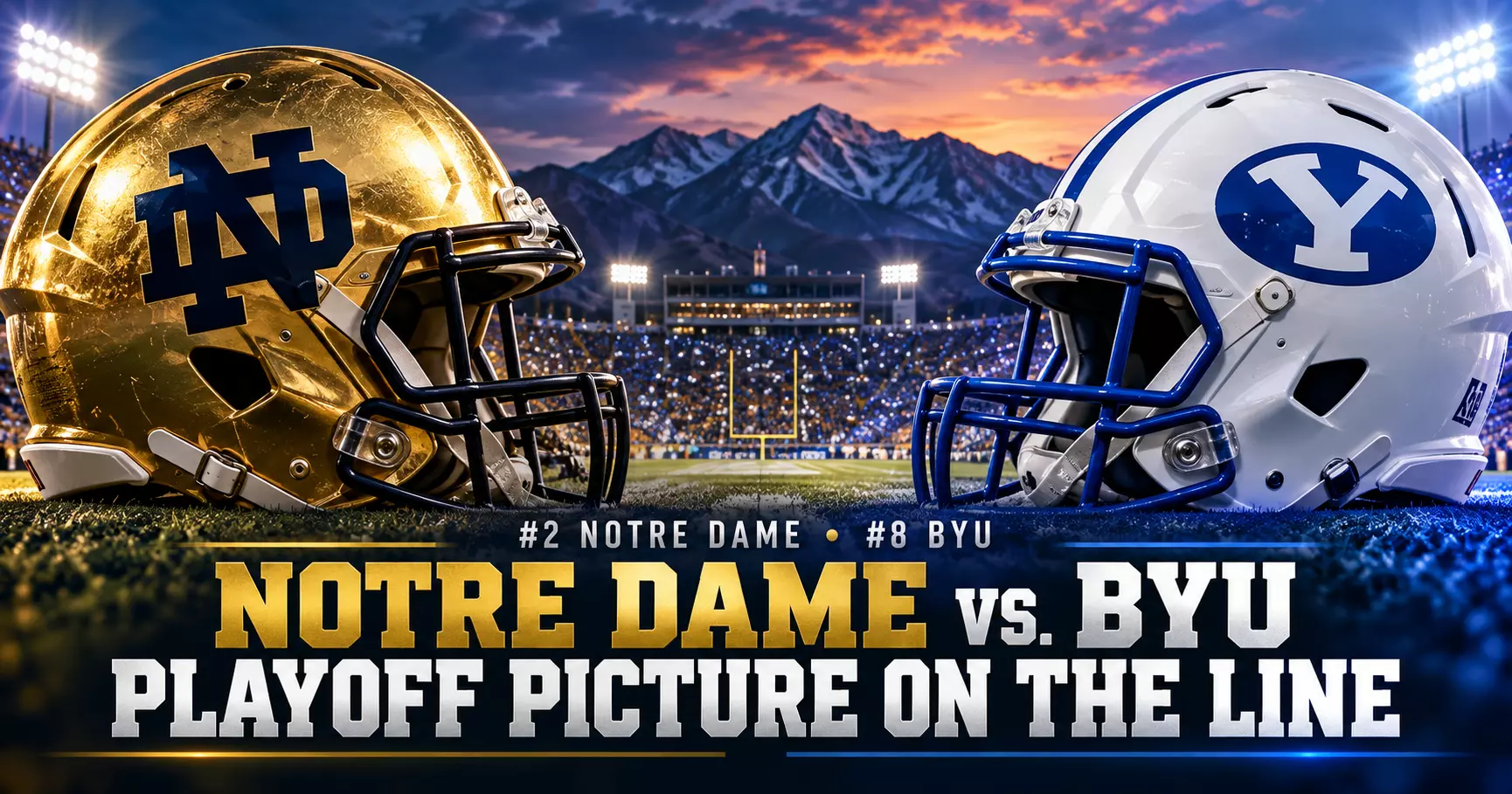
The Fighting Irish enter the week ranked No. 2 at 6–0. The Cougars are No. 8 at 5–0. Their Saturday, October 17 matchup at LaVell Edwards Stadium kicks off at 7:30 p.m. Eastern on ABC. It will be the first matchup between two top-10 teams in Provo in BYU history.
Ohio State’s visit to Indiana deserves its enormous audience. But anyone who treats Notre Dame–BYU as a secondary attraction could miss a game with consequences well beyond South Bend and Provo.
For Notre Dame, this is an opportunity to strengthen its championship credentials away from home. For BYU, it is a chance to put a victory over one of the country’s highest-ranked teams on its résumé.
Neither can clinch a
playoff berth
in October. Either can dramatically improve its position.
Notre Dame Has the Ranking—Now Comes a Major Road Examination
Notre Dame arrives after a 58–7 demolition of Stanford. The Irish overwhelmed the Cardinal with explosive plays, while their defense allowed just 202 total yards.
Freshman Jonaz Walton rushed for 181 yards on 13 carries, scoring on runs of 97 and 40 yards. CJ Carr added touchdown passes, and Notre Dame showed how quickly a game can get away from an opponent that loses control at the line of scrimmage.
The challenge now is carrying that effectiveness into a game where the opponent has the talent, confidence and home crowd to answer.
A victory in Provo would give Notre Dame an especially valuable result: a road win against a team currently ranked in the top 10. It would strengthen the argument that the Irish belong among the championship favorites.
The manner of victory would also tell us something. Can Notre Dame establish its running game when the defense knows what is coming? Can Carr deliver when a possession requires a difficult third-down conversion? Can the Irish recover if BYU lands the first significant blow?
Those questions matter more than another comfortable afternoon against an overmatched opponent.
BYU Can Earn a Victory That Changes the Conversation
BYU’s opportunity is enormous because Notre Dame’s ranking gives this game significance that a routine conference victory cannot duplicate.
Beat the No. 2 team, and the Cougars would have a result that belongs in any serious comparison of playoff contenders. It would give BYU stronger evidence when its schedule and accomplishments are measured against teams from other conferences.
That would not make the remainder of the schedule irrelevant. The Cougars would still need to keep winning, and the eventual value of this result would depend partly on how Notre Dame finishes.
But a victory would establish that BYU can beat an opponent near the top of the national rankings.
The Cougars also have reasons to believe they can do it. Their 24–10 victory over Iowa State featured a defense that limited the Cyclones to 200 total yards and a quarterback capable of generating offense in several ways.
BYU does not need to play a flawless game. It needs to make Notre Dame earn its possessions and convert enough of its own opportunities into points.
Bear Bachmeier Is the Matchup Notre Dame Must Solve
Bear Bachmeier threw for 329 yards and two touchdowns against Iowa State while adding 109 rushing yards. That combination presents a difficult preparation problem.
Notre Dame’s pass rush cannot simply attack his starting point in the pocket. Defenders must maintain their responsibilities when he escapes, and coverage players must remain disciplined when a play lasts longer than expected.
An aggressive rush can create a sack. It can also open a running lane that turns a manageable third down into another BYU possession.
My view is that Notre Dame’s ability to contain Bachmeier without becoming passive could decide the game. The Irish need pressure that forces hurried decisions while keeping him from repeatedly rescuing stalled drives with his legs.
For BYU, the balance is equally important. Bachmeier’s mobility should complement the passing game. If the Cougars repeatedly need him to escape immediate pressure, their offense could become difficult to sustain.
Can BYU Keep Notre Dame’s Running Game Under Control?
Walton’s performance against Stanford gives BYU an obvious concern: Notre Dame can turn a small defensive mistake into an explosive touchdown.
The Cougars must tackle well and maintain their gaps. Overcommitting to the run, however, could give Carr favorable opportunities through the air.
That creates a demanding choice. BYU needs enough defenders involved near the line to prevent Notre Dame from controlling the game on the ground, while preserving coverage against receivers and backs working into space.
Notre Dame should be willing to accept modest gains early. A steady running game can keep Carr in favorable situations and make the defense commit before the Irish attack elsewhere.
For BYU, forcing obvious passing downs would change the terms of the contest. It would make protection, crowd noise and Carr’s decisions under pressure more influential.
Empty Possessions Could Be the Difference
BYU went 0-for-3 on fourth-down attempts against Iowa State. The Cougars still won, but leaving opportunities unfinished becomes more expensive against Notre Dame.
That does not mean BYU should abandon aggressive decisions. It means those decisions need to produce points often enough to justify the risk.
A long drive that ends without a score can waste the work required to move the ball against a strong defense. A turnover or special-teams mistake can also hand the opponent a short field.
My expectation is that the winner will combine explosive plays with fewer wasted possessions. Both teams have the ability to move the ball. The more revealing question is which one finishes when the field tightens and the defense has less space to protect.
Why This Deserves Attention Alongside Indiana–Ohio State
No. 4 Ohio State against No. 5 Indiana will help define the Big Ten race. Notre Dame against BYU offers another valuable comparison between highly ranked teams with different schedules.
An Irish victory would strengthen Notre Dame’s case near the top of the national picture. A
BYU victory
would give the Cougars a major result against an opponent outside the Big 12.
A close loss would leave either team with a path forward. A decisive defeat would raise harder questions about the loser’s championship ceiling.
The AP rankings are not the playoff committee’s rankings, and Saturday’s result will not settle December’s field. But it will provide evidence that future debates will return to.
Notre Dame has an opportunity to validate its position. BYU has an opportunity to improve its own.
By Saturday night, one of them could have a much stronger championship argument.
Up To $1500 in Bonus Bets Paid Back if your First Bet Does Not Win
T&Cs apply
4.5/5
Gambling problem? Call 1-800-GAMBLER or 1-800-MY-RESET (Available in the US) 877-8-HOPENY or text HOPENY (467369) (NY) 1-800-327-5050 (MA), 1-800-BETS-OFF (IA), 1-800-981-0023 (PR). 21+ only. Please Gamble Responsibly. See BetMGM.com for Terms. First Bet Offer for new customers only (if applicable). Subject to eligibility requirements. Bonus bets are non-withdrawable. In partnership with Kansas Crossing Casino and Hotel. Promotional offers not available in Mississippi, Massachusetts, New York, Ontario, or Puerto Rico.
New DraftKings Customers: Spend $5+ Get $150 in Bonuses
T&Cs apply
4.5/5
GAMBLING PROBLEM? CALL 1-800-GAMBLER or 1-800-MY-RESET, (800) 327-5050 or visit gamblinghelplinema.org (MA). Please Gamble Responsibly. 888-789-7777/visit ccpg.org (CT), or visit www.mdgamblinghelp.org (MD), 1-800-981-0023 (PR). 21+ and present in most states. (18+ DC/NH/PR/WY). Void in CAN. Eligibility restrictions apply. On behalf of Boot Hill Casino (KS). Pass-thru of per wager tax may apply in IL. 1 per new DraftKings customer. $5+ first-time bet req. Max. $150 issued as non-withdrawable Bonus Bets. Stake removed from payout. Reward issued as $50 in Bonus Bets every 7 days via click-to-claim for 14 days. Bonus Bets and click-to-claims expire 7 days (168hrs) after issuance. Terms: sportsbook.draftkings.com/promos. Ends 10/11/26 at 11:59 PM ET. Sponsored by DK.
Must be 21+. GAMBLING PROBLEM? CALL 1-800-GAMBLER OR CALL 1-800-MY-RESET, www.mdgamblinghelp.org (MD), (800)-327-5050 or gamblinghelplinema.org (MA), Call (877)8-HOPENY or text HOPENY (467369) (NY), (888) 789-7777 or ccpg.org (CT), morethanagame.nc.gov (NC), 1800gambler.net (WV)
Bet $1 and get double the winnings up to $25 for your next 10 bets
T&Cs apply
4.4/5
21+ New users only. Must register using eligible promo code. First bet after registration must qualify. Max. Bonus Bet: $1,000. Bonus Bet expires 14 days after receipt. Void where prohibited. See Caesars.com/promos for full terms. Gambling Problem? 1-800-GAMBLER (1-800-426-2537)
21+ and present in OH. Gambling Problem? Call 1-800-GAMBLER.
This site is using
Cloudflare
and adheres to the
Google Safe Browsing Program. We adapted
Google's Privacy Guidelines
to keep your data safe at all times.
Close
Ready to Win Big? Join the Elite with Our Sports Betting Deals!
FanDuel Promo
New Users – Get $250 in Bonus Bets when you wager $5 for 5 days
Up To $1500 in Bonus Bets Paid Back if your First Bet Does Not Win
Best Slots
T&Cs and 21+ apply
Gambling problem? Call 1-800-GAMBLER or 1-800-MY-RESET (Available in the US) 877-8-HOPENY or text HOPENY (467369) (NY) 1-800-327-5050 (MA), 1-800-BETS-OFF (IA), 1-800-981-0023 (PR). 21+ only. Please Gamble Responsibly. See BetMGM.com for Terms. First Bet Offer for new customers only (if applicable). Subject to eligibility requirements. Bonus bets are non-withdrawable. In partnership with Kansas Crossing Casino and Hotel. Promotional offers not available in Mississippi, Massachusetts, New York, Ontario, or Puerto Rico.
Code:
Open BetMGM
Get Bonus
DraftKings Promo
New DraftKings Customers: Spend $5+ Get $150 in Bonuses
Newcomer
T&Cs and 21+ apply
GAMBLING PROBLEM? CALL 1-800-GAMBLER or 1-800-MY-RESET, (800) 327-5050 or visit gamblinghelplinema.org (MA). Please Gamble Responsibly. 888-789-7777/visit ccpg.org (CT), or visit www.mdgamblinghelp.org (MD), 1-800-981-0023 (PR). 21+ and present in most states. (18+ DC/NH/PR/WY). Void in CAN. Eligibility restrictions apply. On behalf of Boot Hill Casino (KS). Pass-thru of per wager tax may apply in IL. 1 per new DraftKings customer. $5+ first-time bet req. Max. $150 issued as non-withdrawable Bonus Bets. Stake removed from payout. Reward issued as $50 in Bonus Bets every 7 days via click-to-claim for 14 days. Bonus Bets and click-to-claims expire 7 days (168hrs) after issuance. Terms: sportsbook.draftkings.com/promos. Ends 10/11/26 at 11:59 PM ET. Sponsored by DK.
Code:
Open DraftKings
Get Bonus
Find out what the legends have to say about sports this week....