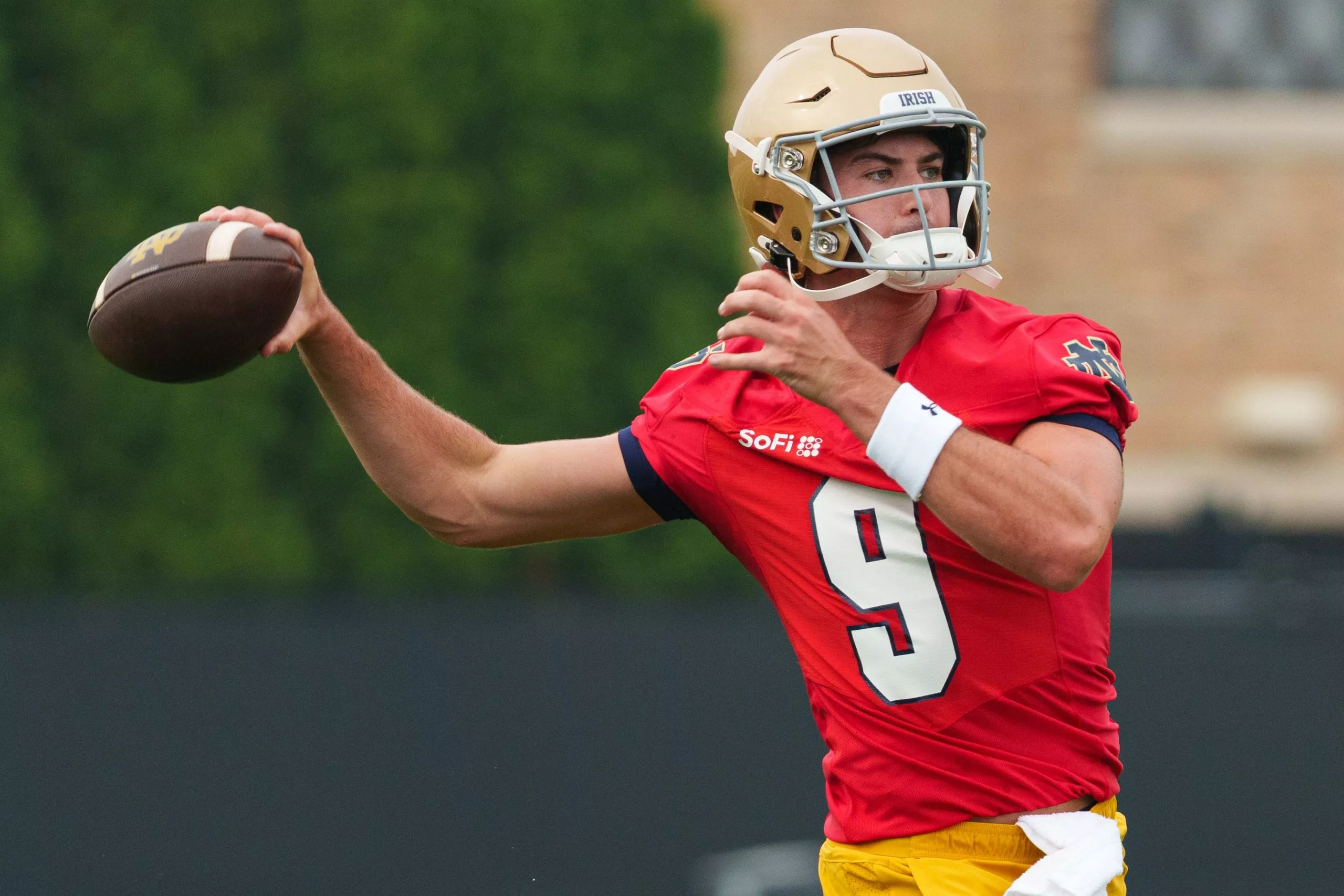
Quarterback Teddy Jarrard during a Notre Dame football practice at Irish Athletic Center on Thursday, Aug. 6, 2026, in South Bend.
At some point this fall, Marcus Freeman will have to decide that CJ Carr has done enough for the day. The Notre Dame backup quarterback behind him will then inherit an offense built around a starter who threw for 2,741 yards and 24 touchdowns in 2025. Freeman’s decision will only make sense if the player entering behind Carr can keep enough of that offense functioning.
Carr’s 2025 season gave Notre Dame something (certainty at quarterback) it did not have entering last fall. An On3 quarterback breakdown noted how unusual his efficiency was for a first-year starter, but the more important development now is what sits behind him. Notre Dame has three young quarterbacks competing for a job that could become part of Freeman’s game management rather than simply emergency insurance.
The Notre Dame Backup Quarterback Must Preserve Carr’s Offense
The challenge begins before the snap. Offensive coordinator Mike Denbrock has given Carr more authority at the line, and summer reporting on Carr’s command describes a quarterback trusted to process what he sees before the play begins. The replacement will not inherit that experience automatically (Carr has 12 career starts; the three players behind him have none).
That is why the Notre Dame backup quarterback competition matters beyond injury insurance. If Freeman can pull Carr late in a comfortable game, the replacement has to preserve enough of the offense for the decision to make actual football sense. A simplified emergency package is useful for an injury; a functioning second unit gives the staff another way to manage a game.
The battle has three names (Blake Hebert, Noah Grubbs, and Teddy Jarrard). Herbert is a sophomore on Notre Dame’s 2026 roster and did not appear in a game last season. A recent depth-chart report also noted a personal absence that cost him camp time. Grubbs enrolled in January and went through spring practice. Jarrard arrived in June after reclassifying from 2027 to 2026.
Jarrard’s late arrival makes his progress especially interesting. Irish Sports Daily reported Aug. 12 that Denbrock was impressed by the freshman’s approach to learning the offense despite the head start held by Hebert and Grubbs (Jarrard had only been on campus for roughly two months). Sports Illustrated previously reported on his recruiting status, but the camp development matters more now. That does not make him the favorite, but it keeps the race from becoming a simple seniority decision.
Three Quarterbacks, Three Different Starting Points
Hebert has program familiarity. Grubbs has spring-practice experience. Jarrard has made up ground with less time in the building. None has enough college game evidence to make the choice obvious, so camp performance has to carry the unusual weight.
One Foot Down writer Joshua Vowles uses the biblical story of Moses and his successor, Joshua, as a metaphor for the backup situation. He argues that a quarterback who can run the actual offense would give Notre Dame another way to manage games without exposing Carr to unnecessary snaps. While the prophet analogy is a media metaphor rather than a Notre Dame staff term, the football point is simple: Feeman needs to trust the backup with the real offense when Carr leaves.
That question carries extra weight after 2025. Notre Dame went 10-2, rebounding from opening losses to Miami and Texas A&M to win 10 straight games, yet somehow managed to miss the College Football Playoff. Freeman’s response was direct: “It’s up to us to leave no doubt.” The message gives this competition a larger context because Notre Dame is trying to remove more uncertainty in 2026.
For the Notre Dame backup quarterback race, recent history offers a useful reminder. In the 2018 Citrus Bowl, Ian Book came off the bench and threw two fourth-quarter touchdowns, including a 55-yard winner to Miles Boykin. Book had started the season behind Brandon Wimbush before becoming the answer when the offense needed one.
The first test comes Sept 6 against Wisconsin at Lambeau Field. Notre Dame is No. 4 in the preseason AP poll, with Miami, BYU, and SMU among the ranked opponents later on the schedule. If the Irish build leads, the quarterback behind Carr will matter far more than his depth chart label suggests (protecting Carr only works if the offense remains functional).
The battle, then, is about finding a Notre Dame backup quarterback whom Freeman trusts with enough of Denbrock’s system to keep the Irish playing the same brand of football when Carr comes out. If one provides that answer, then Notre Dame gains another way to control games while protecting its most important offensive player. That fits
Freeman’s message to the program
(leave no doubt).
New Users – Get $350 in Bonus Bets when you wager $5 for 7 days
T&Cs apply
4.6/5
Gambling Problem? Call 1-800-GAMBLER or 1-800-MY-RESET. Call 1-888-789-7777 or visit ccpgg.org/chat (CT). Hope is here. GamblingHelpLineMA.org or call (800) 327-5050 for 24/7 support (MA). Visit www.mdgamblinghelp.org (MD). Call 1-877-8HOPE-NY or text HOPENY (NY). 21+ (18+ DC, WY) and present in select states (for KS, in affiliation with Kansas Star Casino). Find online real money wagering only. Min $5 wager required for 7 consecutive days. $5 free play credit. Bonus issued as non-withdrawable bonus with cash withdrawable bonus with cash withdrawable. Bonus bets which expire 7 days after receipt. Restrictions apply. See terms at sportsbook.fanduel.com. Call 1-877-770-7867 (LA).
Up To $1500 in Bonus Bets Paid Back if your First Bet Does Not Win
T&Cs apply
4.5/5
Gambling problem? Call 1-800-GAMBLER or 1-800-MY-RESET (Available in the US) 877-8-HOPENY or text HOPENY (467369) (NY) 1-800-327-5050 (MA), 1-800-BETS-OFF (IA), 1-800-981-0023 (PR). 21+ only. Please Gamble Responsibly. See BetMGM.com for Terms. First Bet Offer for new customers only (if applicable). Subject to eligibility requirements. Bonus bets are non-withdrawable. In partnership with Kansas Crossing Casino and Hotel. Promotional offers not available in Mississippi, Massachusetts, New York, Ontario, or Puerto Rico.
New DraftKings Customers: Bet $5, Get $200 + 3 Months of NBA League Pass!
T&Cs apply
4.5/5
GAMBLING PROBLEM? CALL 1-800-GAMBLER or 1-800-MY-RESET, (800) 327-5050 or visit gamblinghelplinema.org (MA). Please Gamble Responsibly. 888-789-7777/visit ccpg.org (CT), or visit www.mdgamblinghelp.org (MD), 1-800-981-0023 (PR). 21+ and present in most states. (18+ DC/NH/PR/WY). Void in CAN. Eligibility restrictions apply. On behalf of Boot Hill Casino (KS). Pass-thru of per wager tax may apply in IL. 1 per new Sportsbook customer. $5+ first-time bet req. Max. $200 issued as non-withdrawable Bonus Bets. Stake removed from payout. Reward issued as $50 in Bonus Bets every 7 days via click-to-claim for 21 days. Bonus Bets and click-to-claims expire 7 days (168hrs) after issuance. Terms: dkng.co/offer. Get 1 promo code to redeem a 3-month NBA League Pass subscription, complimentary of DraftKings. Subscription auto-renews monthly at then-current price (currently $16.99/mo); cancel anytime. Terms, restrictions, and eligibility requirements apply. Redeem League Pass by 12/19/26 at 11:59 PM ET. Addt’l terms: support.watch.nba.com/hc/en-us/articles/9165532876183-League-Pass-Terms-of-Use_. Ends 11/29/26 at 11:59 PM ET. Sponsored by DK.
Must be 21+. GAMBLING PROBLEM? CALL 1-800-GAMBLER OR CALL 1-800-MY-RESET, www.mdgamblinghelp.org (MD), (800)-327-5050 or gamblinghelplinema.org (MA), Call (877)8-HOPENY or text HOPENY (467369) (NY), (888) 789-7777 or ccpg.org (CT), morethanagame.nc.gov (NC), 1800gambler.net (WV)
Bet $1 and get double the winnings up to $25 for your next 10 bets
T&Cs apply
4.4/5
21+ New users only. Must register using eligible promo code. First bet after registration must qualify. Max. Bonus Bet: $1,000. Bonus Bet expires 14 days after receipt. Void where prohibited. See Caesars.com/promos for full terms. Gambling Problem? 1-800-GAMBLER (1-800-426-2537)
21+ and present in OH. Gambling Problem? Call 1-800-GAMBLER.
This site is using
Cloudflare
and adheres to the
Google Safe Browsing Program. We adapted
Google's Privacy Guidelines
to keep your data safe at all times.
Close
Ready to Win Big? Join the Elite with Our Sports Betting Deals!
FanDuel Promo
New Users – Get $350 in Bonus Bets when you wager $5 for 7 days
Our Favorite
T&Cs and 21+ apply
Gambling Problem? Call 1-800-GAMBLER or 1-800-MY-RESET. Call 1-888-789-7777 or visit ccpgg.org/chat (CT). Hope is here. GamblingHelpLineMA.org or call (800) 327-5050 for 24/7 support (MA). Visit www.mdgamblinghelp.org (MD). Call 1-877-8HOPE-NY or text HOPENY (NY). 21+ (18+ DC, WY) and present in select states (for KS, in affiliation with Kansas Star Casino). Find online real money wagering only. Min $5 wager required for 7 consecutive days. $5 free play credit. Bonus issued as non-withdrawable bonus with cash withdrawable bonus with cash withdrawable. Bonus bets which expire 7 days after receipt. Restrictions apply. See terms at sportsbook.fanduel.com. Call 1-877-770-7867 (LA).
Code:
Open FanDuel
Get Bonus
BetMGM Promo
Up To $1500 in Bonus Bets Paid Back if your First Bet Does Not Win
Best Slots
T&Cs and 21+ apply
Gambling problem? Call 1-800-GAMBLER or 1-800-MY-RESET (Available in the US) 877-8-HOPENY or text HOPENY (467369) (NY) 1-800-327-5050 (MA), 1-800-BETS-OFF (IA), 1-800-981-0023 (PR). 21+ only. Please Gamble Responsibly. See BetMGM.com for Terms. First Bet Offer for new customers only (if applicable). Subject to eligibility requirements. Bonus bets are non-withdrawable. In partnership with Kansas Crossing Casino and Hotel. Promotional offers not available in Mississippi, Massachusetts, New York, Ontario, or Puerto Rico.
Code:
Open BetMGM
Get Bonus
DraftKings Promo
New DraftKings Customers: Bet $5, Get $200 + 3 Months of NBA League Pass!
Newcomer
T&Cs and 21+ apply
GAMBLING PROBLEM? CALL 1-800-GAMBLER or 1-800-MY-RESET, (800) 327-5050 or visit gamblinghelplinema.org (MA). Please Gamble Responsibly. 888-789-7777/visit ccpg.org (CT), or visit www.mdgamblinghelp.org (MD), 1-800-981-0023 (PR). 21+ and present in most states. (18+ DC/NH/PR/WY). Void in CAN. Eligibility restrictions apply. On behalf of Boot Hill Casino (KS). Pass-thru of per wager tax may apply in IL. 1 per new Sportsbook customer. $5+ first-time bet req. Max. $200 issued as non-withdrawable Bonus Bets. Stake removed from payout. Reward issued as $50 in Bonus Bets every 7 days via click-to-claim for 21 days. Bonus Bets and click-to-claims expire 7 days (168hrs) after issuance. Terms: dkng.co/offer. Get 1 promo code to redeem a 3-month NBA League Pass subscription, complimentary of DraftKings. Subscription auto-renews monthly at then-current price (currently $16.99/mo); cancel anytime. Terms, restrictions, and eligibility requirements apply. Redeem League Pass by 12/19/26 at 11:59 PM ET. Addt’l terms: support.watch.nba.com/hc/en-us/articles/9165532876183-League-Pass-Terms-of-Use_. Ends 11/29/26 at 11:59 PM ET. Sponsored by DK.
Code:
Open DraftKings
Get Bonus
Find out what the legends have to say about sports this week....
New Users – Get $350 in Bonus Bets when you wager $5 for 7 days
Gambling Problem? Call 1-800-GAMBLER or 1-800-MY-RESET. Call 1-888-789-7777 or visit ccpgg.org/chat (CT). Hope is here. GamblingHelpLineMA.org or call (800) 327-5050 for 24/7 support (MA). Visit www.mdgamblinghelp.org (MD). Call 1-877-8HOPE-NY or text HOPENY (NY). 21+ (18+ DC, WY) and present in select states (for KS, in affiliation with Kansas Star Casino). Find online real money wagering only. Min $5 wager required for 7 consecutive days. $5 free play credit. Bonus issued as non-withdrawable bonus with cash withdrawable bonus with cash withdrawable. Bonus bets which expire 7 days after receipt. Restrictions apply. See terms at sportsbook.fanduel.com. Call 1-877-770-7867 (LA).