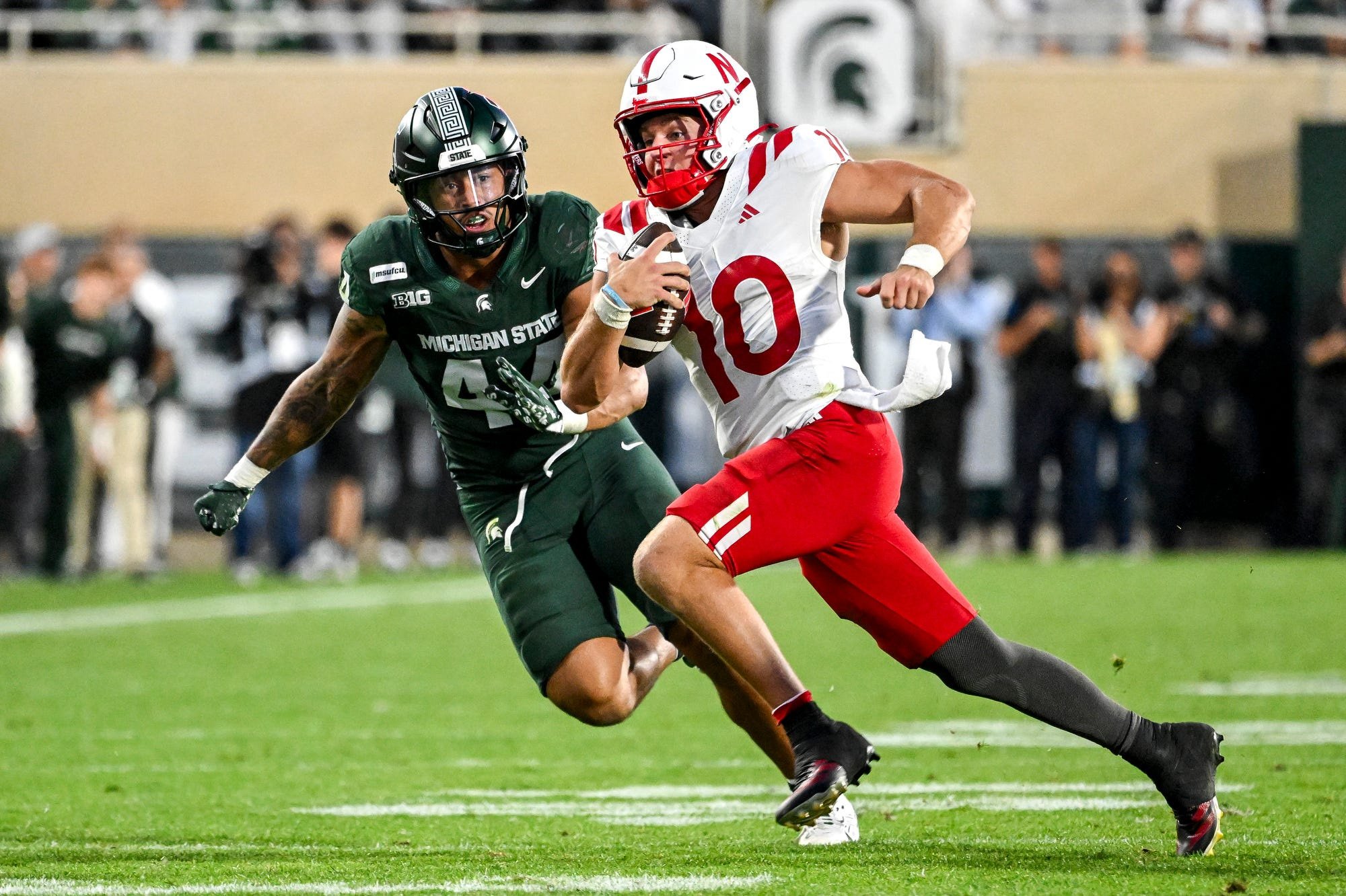
Michigan States Caleb Wheatland, left, closes in on Nebraskas Anthony Colandrea on a run during the third quarter on Saturday, Sept. 26, 2026, in East Lansing.
Nebraska has won every game on its schedule, scored at least 30 points in each of them and built an offense that looks considerably more dangerous than its absence from the AP Top 25 suggests.
The Huskers enter Saturday averaging 43.6 points and 475.6 yards per game. Yet they remain unranked, receiving 48 points in the latest AP voting.
That leaves Nebraska in an interesting position: successful enough to demand attention, but without the victory that would settle the biggest questions about its start.
Saturday provides that opportunity.
No. 7 Indiana visits Memorial Stadium as Nebraska’s first ranked opponent of the season.
For Matt Rhule’s team, this is the chance to show that its production reflects something that can survive against championship-caliber resistance.
The Huskers have earned optimism. Indiana will help determine how far that optimism should extend.
Nebraska Has Done More Than Merely Survive Its Schedule
The first five results deserve a fair reading.
Nebraska defeated Ohio 49–21, Bowling Green 56–7 and North Dakota 34–7 before opening Big Ten play with a 31–13 road victory over Michigan State and a 48–23 win against Maryland.
Those are convincing margins.
It is reasonable to question the strength of the opposition. It is also necessary to acknowledge that Nebraska consistently created separation.
An undefeated record built on narrow escapes would invite a different assessment. The Huskers have generally finished games with room to spare.
The distinction matters because beating manageable opponents comfortably is part of becoming a good team.
Nebraska
cannot prove everything through those victories, but it has supplied evidence that it is handling its current level of competition effectively.
The unresolved issue is what happens when the opponent significantly reduces its margin for error.
The Offense Has More Than One Way to Hurt a Defense
Nebraska’s offensive balance strengthens the argument that this start has substance.
The Huskers average 231 rushing yards per game and convert 52.4% of their third downs. They have exceeded 200 yards in both rushing and passing in four of their five games.
That gives a defense several problems to solve.
If Nebraska can establish the run, it can create more favorable situations for its passing game. If opponents commit additional defenders near the line, the Huskers have opportunities to attack elsewhere.
But balance against earlier opponents does not automatically translate into balance against Indiana.
The meaningful question is whether Nebraska can maintain enough rushing efficiency to keep its full offense available. An offense looks different when second-and-medium becomes second-and-long and the defense can anticipate a pass.
Saturday will reveal whether the Huskers can preserve their options when the easy yards disappear.
Anthony Colandrea Gives Nebraska a Valuable Extra Dimension
Anthony Colandrea’s performance against Maryland demonstrated why the quarterback is central to Nebraska’s improvement.
He completed 26 of 39 passes for 238 yards and three touchdowns while rushing for a career-high 108 yards on 10 carries.
His mobility adds another consideration for defenders.
A pass rush cannot focus exclusively on reaching a stationary target. Coverage that holds initially can still be challenged if the quarterback escapes and receivers adjust.
Those possibilities can turn a well-defended play into a productive one.
Against Indiana, however, Colandrea must distinguish between extending a possession and forcing something that is no longer available. A scramble that creates a first down is valuable. A desperate throw that gives the opponent a short field can change the game.
Nebraska needs his creativity. It also needs his judgment.
That combination will be more important than trying to reproduce last week’s individual totals.
Maryland Revealed Both Nebraska’s Progress and Its Problems
The Maryland victory is the most useful example of why Nebraska should inspire both confidence and caution.
The Huskers trailed 23–14 before scoring the game’s final 34 points. Dwayne McDougle III’s 81-yard interception return helped reverse the momentum, and Nebraska allowed only 95 yards after halftime.
That response deserves credit.
Nebraska recovered from a difficult opening, generated a decisive defensive play and took control. Those are meaningful signs of a team capable of adjusting rather than unraveling.
But the same game included 16 Nebraska penalties for 132 yards.
That is a serious concern entering a stronger matchup.
Penalties can erase successful plays, extend opposing possessions and turn reasonable third downs into difficult ones. Nebraska overcame them against Maryland. It should not expect the same outcome if it repeatedly gives Indiana additional opportunities.
The comeback demonstrated resilience. The mistakes showed how much cleaner the Huskers still need to become.
Indiana Will Test the Foundation of Nebraska’s Offense
Indiana’s recent run defense offers a particularly relevant challenge.
The Hoosiers held Northwestern and Rutgers to 32 and 59 rushing yards, respectively, in their first two conference games.
Nebraska must find out whether its rushing success can withstand that kind of resistance.
The offensive line needs to create workable space without relying on every carry becoming an explosive play. Colandrea needs enough protection to evaluate his options. Receivers must help keep drives alive when the defense contests the first read.
Sustained execution will matter.
The Huskers do not need to overwhelm Indiana on every possession. They need to avoid becoming predictable and give themselves enough productive drives to remain competitive.
If Nebraska can move the ball consistently without depending on defensive breakdowns, that would strengthen the argument that its offense is ready for the conference’s upper tier.
The Defense Has to Support the Breakthrough
An
offensive ranking
cannot carry Nebraska through this game by itself.
The defense must prevent Indiana from turning manageable gains into explosive plays. It also needs to recover from occasional losses without surrendering entire drives.
That requires discipline in run fits, reliable tackling and communication when the offense changes formations or tempo.
Nebraska’s attack will have difficult possessions. The defense cannot treat every empty offensive series as the beginning of a crisis.
A contender keeps a game within reach long enough to make its opportunities count.
Saturday will test whether Nebraska can do that against an opponent capable of applying pressure throughout four quarters.
A Victory Would Change the Conversation
There is no mystery about what would settle the rankings argument most convincingly.
Beat Indiana.
A competitive loss could still reveal progress, depending on how Nebraska plays. It would not provide the same evidence as defeating a top-10 opponent.
My assessment is that the Huskers’ start reflects real improvement, while leaving the extent of that improvement unresolved. Their scoring margins, offensive balance and response against Maryland all deserve recognition.
Their discipline and ability to sustain production against stronger opposition remain legitimate questions.
Nebraska has given itself a valuable opportunity. Saturday at noon Eastern, in front of its home crowd, the Huskers can replace arguments about what their record means with a result that speaks for itself.
New Users – Get $350 in Bonus Bets when you wager $5 for 7 days
T&Cs apply
4.6/5
Gambling Problem? Call 1-800-GAMBLER or 1-800-MY-RESET. Call 1-888-789-7777 or visit ccpgg.org/chat (CT). Hope is here. GamblingHelpLineMA.org or call (800) 327-5050 for 24/7 support (MA). Visit www.mdgamblinghelp.org (MD). Call 1-877-8HOPE-NY or text HOPENY (NY). 21+ (18+ DC, WY) and present in select states (for KS, in affiliation with Kansas Star Casino). Find online real money wagering only. Min $5 wager required for 7 consecutive days. $5 free play credit. Bonus issued as non-withdrawable bonus with cash withdrawable bonus with cash withdrawable. Bonus bets which expire 7 days after receipt. Restrictions apply. See terms at sportsbook.fanduel.com. Call 1-877-770-7867 (LA).
Up To $1500 in Bonus Bets Paid Back if your First Bet Does Not Win
T&Cs apply
4.5/5
Gambling problem? Call 1-800-GAMBLER or 1-800-MY-RESET (Available in the US) 877-8-HOPENY or text HOPENY (467369) (NY) 1-800-327-5050 (MA), 1-800-BETS-OFF (IA), 1-800-981-0023 (PR). 21+ only. Please Gamble Responsibly. See BetMGM.com for Terms. First Bet Offer for new customers only (if applicable). Subject to eligibility requirements. Bonus bets are non-withdrawable. In partnership with Kansas Crossing Casino and Hotel. Promotional offers not available in Mississippi, Massachusetts, New York, Ontario, or Puerto Rico.
New DraftKings Customers: Bet $5, Get $200 + 3 Months of NBA League Pass!
T&Cs apply
4.5/5
GAMBLING PROBLEM? CALL 1-800-GAMBLER or 1-800-MY-RESET, (800) 327-5050 or visit gamblinghelplinema.org (MA). Please Gamble Responsibly. 888-789-7777/visit ccpg.org (CT), or visit www.mdgamblinghelp.org (MD), 1-800-981-0023 (PR). 21+ and present in most states. (18+ DC/NH/PR/WY). Void in CAN. Eligibility restrictions apply. On behalf of Boot Hill Casino (KS). Pass-thru of per wager tax may apply in IL. 1 per new Sportsbook customer. $5+ first-time bet req. Max. $200 issued as non-withdrawable Bonus Bets. Stake removed from payout. Reward issued as $50 in Bonus Bets every 7 days via click-to-claim for 21 days. Bonus Bets and click-to-claims expire 7 days (168hrs) after issuance. Terms: dkng.co/offer. Get 1 promo code to redeem a 3-month NBA League Pass subscription, complimentary of DraftKings. Subscription auto-renews monthly at then-current price (currently $16.99/mo); cancel anytime. Terms, restrictions, and eligibility requirements apply. Redeem League Pass by 12/19/26 at 11:59 PM ET. Addt’l terms: support.watch.nba.com/hc/en-us/articles/9165532876183-League-Pass-Terms-of-Use_. Ends 11/29/26 at 11:59 PM ET. Sponsored by DK.
Must be 21+. GAMBLING PROBLEM? CALL 1-800-GAMBLER OR CALL 1-800-MY-RESET, www.mdgamblinghelp.org (MD), (800)-327-5050 or gamblinghelplinema.org (MA), Call (877)8-HOPENY or text HOPENY (467369) (NY), (888) 789-7777 or ccpg.org (CT), morethanagame.nc.gov (NC), 1800gambler.net (WV)
Bet $1 and get double the winnings up to $25 for your next 10 bets
T&Cs apply
4.4/5
21+ New users only. Must register using eligible promo code. First bet after registration must qualify. Max. Bonus Bet: $1,000. Bonus Bet expires 14 days after receipt. Void where prohibited. See Caesars.com/promos for full terms. Gambling Problem? 1-800-GAMBLER (1-800-426-2537)
21+ and present in OH. Gambling Problem? Call 1-800-GAMBLER.
This site is using
Cloudflare
and adheres to the
Google Safe Browsing Program. We adapted
Google's Privacy Guidelines
to keep your data safe at all times.
Close
Ready to Win Big? Join the Elite with Our Sports Betting Deals!
FanDuel Promo
New Users – Get $350 in Bonus Bets when you wager $5 for 7 days
Our Favorite
T&Cs and 21+ apply
Gambling Problem? Call 1-800-GAMBLER or 1-800-MY-RESET. Call 1-888-789-7777 or visit ccpgg.org/chat (CT). Hope is here. GamblingHelpLineMA.org or call (800) 327-5050 for 24/7 support (MA). Visit www.mdgamblinghelp.org (MD). Call 1-877-8HOPE-NY or text HOPENY (NY). 21+ (18+ DC, WY) and present in select states (for KS, in affiliation with Kansas Star Casino). Find online real money wagering only. Min $5 wager required for 7 consecutive days. $5 free play credit. Bonus issued as non-withdrawable bonus with cash withdrawable bonus with cash withdrawable. Bonus bets which expire 7 days after receipt. Restrictions apply. See terms at sportsbook.fanduel.com. Call 1-877-770-7867 (LA).
Code:
Open FanDuel
Get Bonus
BetMGM Promo
Up To $1500 in Bonus Bets Paid Back if your First Bet Does Not Win
Best Slots
T&Cs and 21+ apply
Gambling problem? Call 1-800-GAMBLER or 1-800-MY-RESET (Available in the US) 877-8-HOPENY or text HOPENY (467369) (NY) 1-800-327-5050 (MA), 1-800-BETS-OFF (IA), 1-800-981-0023 (PR). 21+ only. Please Gamble Responsibly. See BetMGM.com for Terms. First Bet Offer for new customers only (if applicable). Subject to eligibility requirements. Bonus bets are non-withdrawable. In partnership with Kansas Crossing Casino and Hotel. Promotional offers not available in Mississippi, Massachusetts, New York, Ontario, or Puerto Rico.
Code:
Open BetMGM
Get Bonus
DraftKings Promo
New DraftKings Customers: Bet $5, Get $200 + 3 Months of NBA League Pass!
Newcomer
T&Cs and 21+ apply
GAMBLING PROBLEM? CALL 1-800-GAMBLER or 1-800-MY-RESET, (800) 327-5050 or visit gamblinghelplinema.org (MA). Please Gamble Responsibly. 888-789-7777/visit ccpg.org (CT), or visit www.mdgamblinghelp.org (MD), 1-800-981-0023 (PR). 21+ and present in most states. (18+ DC/NH/PR/WY). Void in CAN. Eligibility restrictions apply. On behalf of Boot Hill Casino (KS). Pass-thru of per wager tax may apply in IL. 1 per new Sportsbook customer. $5+ first-time bet req. Max. $200 issued as non-withdrawable Bonus Bets. Stake removed from payout. Reward issued as $50 in Bonus Bets every 7 days via click-to-claim for 21 days. Bonus Bets and click-to-claims expire 7 days (168hrs) after issuance. Terms: dkng.co/offer. Get 1 promo code to redeem a 3-month NBA League Pass subscription, complimentary of DraftKings. Subscription auto-renews monthly at then-current price (currently $16.99/mo); cancel anytime. Terms, restrictions, and eligibility requirements apply. Redeem League Pass by 12/19/26 at 11:59 PM ET. Addt’l terms: support.watch.nba.com/hc/en-us/articles/9165532876183-League-Pass-Terms-of-Use_. Ends 11/29/26 at 11:59 PM ET. Sponsored by DK.
Code:
Open DraftKings
Get Bonus
Find out what the legends have to say about sports this week....
New Users – Get $350 in Bonus Bets when you wager $5 for 7 days
Gambling Problem? Call 1-800-GAMBLER or 1-800-MY-RESET. Call 1-888-789-7777 or visit ccpgg.org/chat (CT). Hope is here. GamblingHelpLineMA.org or call (800) 327-5050 for 24/7 support (MA). Visit www.mdgamblinghelp.org (MD). Call 1-877-8HOPE-NY or text HOPENY (NY). 21+ (18+ DC, WY) and present in select states (for KS, in affiliation with Kansas Star Casino). Find online real money wagering only. Min $5 wager required for 7 consecutive days. $5 free play credit. Bonus issued as non-withdrawable bonus with cash withdrawable bonus with cash withdrawable. Bonus bets which expire 7 days after receipt. Restrictions apply. See terms at sportsbook.fanduel.com. Call 1-877-770-7867 (LA).