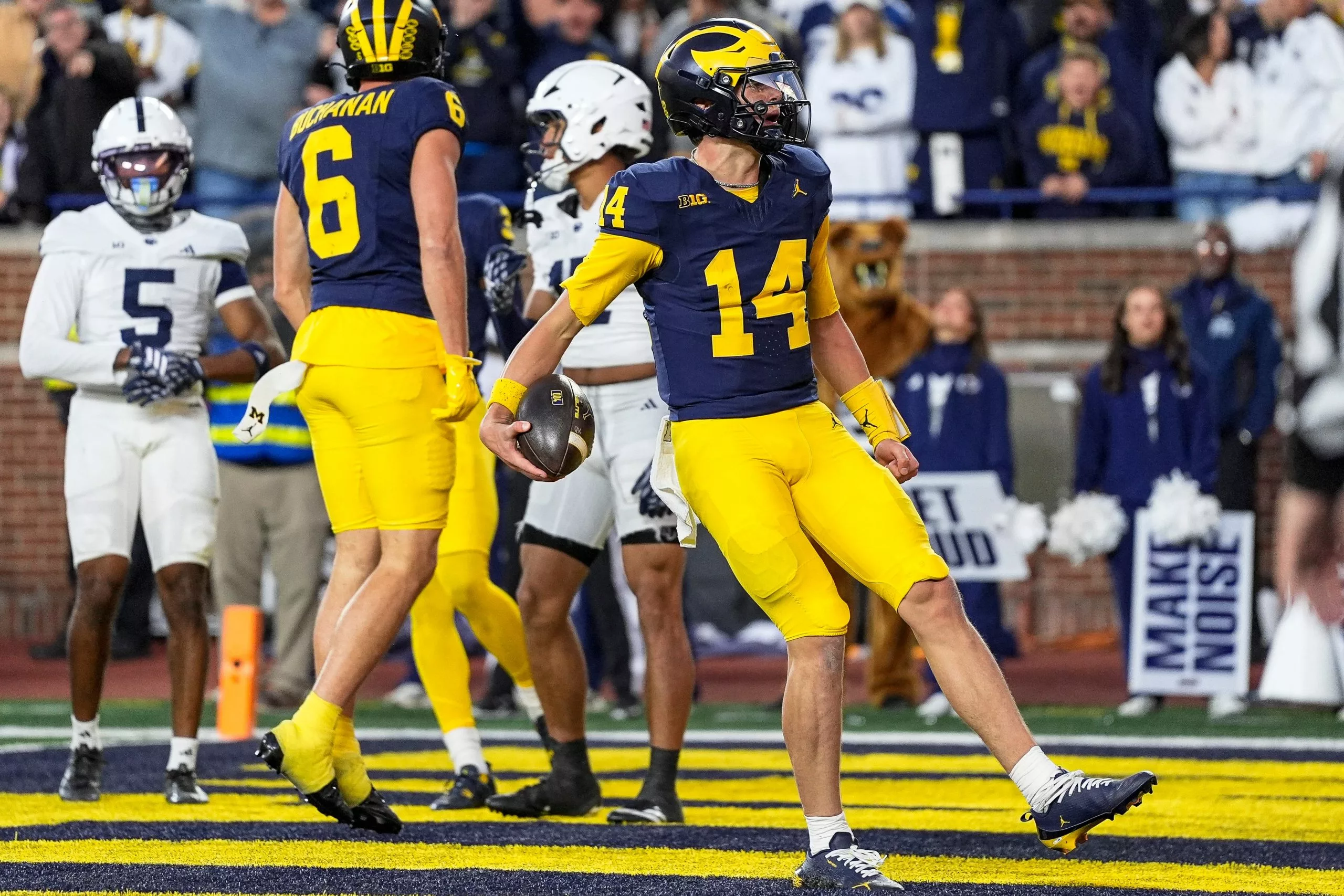
Michigan quarterback Tommy Carr (14) celebrates a touchdown against Penn State during the second half at Michigan Stadium in Ann Arbor on Saturday, Oct. 17, 2026.
Michigan found a way to beat Penn State. Now Kyle Whittingham must decide whether the quarterback who helped rescue that game should lead the Wolverines against Indiana.
Tommy Carr replaced Bryce Underwood at halftime Saturday, and Michigan turned a scoreless first half into a 21–18 victory. The Wolverines improved to 4–2 overall and earned their first Big Ten win of the season.
On Monday, Whittingham declined to announce his starter for this weekend’s home game against the sixth-ranked Hoosiers. He did, however, say the coaching staff had reached a decision and had a plan in place. The uncertainty is public; Michigan’s coaches have indicated they know how they intend to proceed.
That distinction matters. Keeping Indiana guessing can serve a purpose. Allowing indecision to disrupt Michigan’s own preparation would be another matter entirely.
The Wolverines need more than the right name on the lineup sheet. They need a quarterback and an offensive plan capable of surviving a defense that will test their execution far more thoroughly than one encouraging half can answer.
Carr Earned Consideration—but the Entire Comeback Matters
The case for Carr begins with what happened after he entered.
Michigan produced all 21 of its points after halftime. Carr completed five of seven passes for 47 yards, added 36 rushing yards and scored on a 12-yard run that gave the Wolverines a 21–11 lead late in the fourth quarter.
He supplied a useful contribution at a moment when
Michigan
desperately needed one.
But evaluating his performance requires acknowledging how the Wolverines won. They rushed for 174 yards in the second half, averaging 7.6 yards per carry, while their defense forced three second-half turnovers. All three Michigan touchdowns came on the ground.
Carr helped the offense function. The running game and defense also changed the circumstances around him.
That should prevent two opposite mistakes: dismissing his contribution because he threw only seven passes, or treating those seven attempts as proof that Michigan has solved its quarterback problem.
He earned a serious opportunity. He still has plenty to establish.
What Carr Offers: A Chance to Stabilize the Offense
Carr’s strongest immediate argument is that Michigan operated successfully with him in the game.
He completed the available throws, contributed as a runner and helped the Wolverines finish scoring opportunities. Against Penn State, that was enough to change the outcome.
Whittingham’s assessment also extended beyond Saturday. He praised Carr’s preparation, football intelligence and relationship with his teammates, describing a player who had improved through spring practice and fall camp before taking advantage of his opportunity.
Those qualities matter against Indiana.
A quarterback facing a difficult defense must understand his answers before the snap and recognize when the picture changes afterward. Knowing where to go with the football can be more valuable than attempting a spectacular play after the original opportunity disappears.
The argument for starting Carr is therefore straightforward: Michigan needs dependable execution, and its most recent evidence points toward giving him a longer look.
The limitation is equally clear. A productive half does not establish how he will handle an opponent preparing specifically for him, a stalled running game or a situation requiring repeated downfield completions.
Indiana would give him an immediate examination in all three areas.
What Underwood Offers: Arm Talent, Mobility and Experience
Underwood’s case rests on physical ability and a larger body of experience.
Even while discussing Carr’s performance Monday, Indiana coach Curt Cignetti acknowledged Underwood’s arm strength and ability to create with his legs. The Hoosiers are preparing for a quarterback who can threaten them beyond the structure of a play if he appears.
That ability has tactical value.
A mobile quarterback can punish a pass rush that loses discipline. A strong arm can challenge coverage across the field and create opportunities that are unavailable to a more limited passer.
But those possibilities must become reliable production.
Underwood completed five of 11 passes for 43 yards against Penn State before being replaced. He also threw two first-half interceptions, leaving Michigan without a point at the break.
His talent deserves consideration. So does the performance that prompted the change.
If Whittingham returns to Underwood, the decision needs to come with a convincing explanation inside the program: what the coaches believe he can execute against Indiana, how they will help him and why that gives Michigan its best chance.
Experience can support a decision. It cannot substitute for execution.
Indiana Is Already Preparing for Carr
The secrecy may have less practical value than Michigan hopes.
Cignetti said Monday that he assumed Carr would start after watching the Penn State game. He also left open the possibility of both quarterbacks appearing on the field together. Importantly, he observed that Michigan had not changed its offensive scheme substantially after halftime.
That suggests Indiana’s preparation can remain grounded in Michigan’s established offense.
The Hoosiers must account for different individual strengths, but they are not necessarily preparing for two entirely separate playbooks. Their defensive priorities can remain consistent: control the running game, maintain disciplined rush lanes and force the quarterback to make accurate decisions.
There is a difference between hiding a starter and hiding an offense.
Michigan can withhold the first. Its film reveals much of the second.
The Running Game Is Central to Either Decision
The most useful lesson from the Penn State victory may concern the players around the quarterback.
Michigan’s second-half rushing production gave Carr favorable circumstances. Explosive runs created scoring opportunities, reduced the need for a high-volume passing attack and allowed the Wolverines to lean into their strongest stretch of offensive football.
That formula deserves attention regardless of who starts.
The challenge is reproducing it against Indiana without assuming the same openings will appear.
Michigan cannot build its entire plan around the expectation of another 43-yard touchdown run or another short field supplied by a turnover. It needs to create manageable situations through consistent gains, sound blocking and complementary passing concepts.
For Carr, that would allow him to build rhythm without carrying the offense immediately.
For Underwood, it would reduce the number of possessions that depend on him manufacturing a difficult play.
Either
quarterback
becomes easier to defend if Indiana can stop the run without compromising its coverage.
Michigan Needs a Plan for the First Setback
Whittingham said Monday that he has never favored a quarterback platoon. That does not rule out a situational package, but it provides little basis for assuming Michigan intends to alternate its quarterbacks throughout the game.
The more important issue is how the staff handles adversity.
If Carr starts, does one stalled possession suddenly revive the debate? If Underwood starts, does every incompletion bring the possibility of an immediate change?
The coaches need clear standards for evaluating performance. A quarterback cannot control every protection failure, dropped pass or unsuccessful run. He can control his decisions, ball security and execution within the play.
Michigan should judge those elements rather than react to every disappointing result.
That approach also needs to shape practice. The starter requires enough work with the first team to establish timing and command the game plan. The backup must remain ready without uncertainty consuming the preparation.
Public suspense is manageable. An offense unsure of its direction is much harder to repair.
Carr Has Earned the Next Opportunity
Based on the most recent performance, Carr deserves the opportunity to start.
That is an assessment of what Michigan needs now. The offense responded with him in the game, he contributed to the winning effort and his preparation has earned praise from his coach.
It is also a provisional judgment. Seven pass attempts cannot settle a quarterback’s future, and Underwood’s physical gifts remain relevant.
Whoever takes the first snap will face an Indiana team coming off a 19–15 loss to Ohio State and seeking an immediate response. Michigan should expect a demanding game in which the quarterback must handle pressure without repeatedly putting the defense in difficult positions.
Whittingham says Michigan has its plan. Saturday will test whether that plan produces an offense the Wolverines can trust.
Beating Penn State gave Michigan an opening. Choosing and preparing the right quarterback will determine what it can do with it.
New Users – Get $350 in Bonus Bets when you wager $5 for 7 days
T&Cs apply
4.6/5
Gambling Problem? Call 1-800-GAMBLER or 1-800-MY-RESET. Call 1-888-789-7777 or visit ccpgg.org/chat (CT). Hope is here. GamblingHelpLineMA.org or call (800) 327-5050 for 24/7 support (MA). Visit www.mdgamblinghelp.org (MD). Call 1-877-8HOPE-NY or text HOPENY (NY). 21+ (18+ DC, WY) and present in select states (for KS, in affiliation with Kansas Star Casino). Find online real money wagering only. Min $5 wager required for 7 consecutive days. $5 free play credit. Bonus issued as non-withdrawable bonus with cash withdrawable bonus with cash withdrawable. Bonus bets which expire 7 days after receipt. Restrictions apply. See terms at sportsbook.fanduel.com. Call 1-877-770-7867 (LA).
Up To $1500 in Bonus Bets Paid Back if your First Bet Does Not Win
T&Cs apply
4.5/5
Gambling problem? Call 1-800-GAMBLER or 1-800-MY-RESET (Available in the US) 877-8-HOPENY or text HOPENY (467369) (NY) 1-800-327-5050 (MA), 1-800-BETS-OFF (IA), 1-800-981-0023 (PR). 21+ only. Please Gamble Responsibly. See BetMGM.com for Terms. First Bet Offer for new customers only (if applicable). Subject to eligibility requirements. Bonus bets are non-withdrawable. In partnership with Kansas Crossing Casino and Hotel. Promotional offers not available in Mississippi, Massachusetts, New York, Ontario, or Puerto Rico.
New DraftKings Customers: Bet $5, Get $200 + 3 Months of NBA League Pass!
T&Cs apply
4.5/5
GAMBLING PROBLEM? CALL 1-800-GAMBLER or 1-800-MY-RESET, (800) 327-5050 or visit gamblinghelplinema.org (MA). Please Gamble Responsibly. 888-789-7777/visit ccpg.org (CT), or visit www.mdgamblinghelp.org (MD), 1-800-981-0023 (PR). 21+ and present in most states. (18+ DC/NH/PR/WY). Void in CAN. Eligibility restrictions apply. On behalf of Boot Hill Casino (KS). Pass-thru of per wager tax may apply in IL. 1 per new Sportsbook customer. $5+ first-time bet req. Max. $200 issued as non-withdrawable Bonus Bets. Stake removed from payout. Reward issued as $50 in Bonus Bets every 7 days via click-to-claim for 21 days. Bonus Bets and click-to-claims expire 7 days (168hrs) after issuance. Terms: dkng.co/offer. Get 1 promo code to redeem a 3-month NBA League Pass subscription, complimentary of DraftKings. Subscription auto-renews monthly at then-current price (currently $16.99/mo); cancel anytime. Terms, restrictions, and eligibility requirements apply. Redeem League Pass by 12/19/26 at 11:59 PM ET. Addt’l terms: support.watch.nba.com/hc/en-us/articles/9165532876183-League-Pass-Terms-of-Use_. Ends 11/29/26 at 11:59 PM ET. Sponsored by DK.
Must be 21+. GAMBLING PROBLEM? CALL 1-800-GAMBLER OR CALL 1-800-MY-RESET, www.mdgamblinghelp.org (MD), (800)-327-5050 or gamblinghelplinema.org (MA), Call (877)8-HOPENY or text HOPENY (467369) (NY), (888) 789-7777 or ccpg.org (CT), morethanagame.nc.gov (NC), 1800gambler.net (WV)
Bet $1 and get double the winnings up to $25 for your next 10 bets
T&Cs apply
4.4/5
21+ New users only. Must register using eligible promo code. First bet after registration must qualify. Max. Bonus Bet: $1,000. Bonus Bet expires 14 days after receipt. Void where prohibited. See Caesars.com/promos for full terms. Gambling Problem? 1-800-GAMBLER (1-800-426-2537)
21+ and present in OH. Gambling Problem? Call 1-800-GAMBLER.
This site is using
Cloudflare
and adheres to the
Google Safe Browsing Program. We adapted
Google's Privacy Guidelines
to keep your data safe at all times.
Close
Ready to Win Big? Join the Elite with Our Sports Betting Deals!
FanDuel Promo
New Users – Get $350 in Bonus Bets when you wager $5 for 7 days
Our Favorite
T&Cs and 21+ apply
Gambling Problem? Call 1-800-GAMBLER or 1-800-MY-RESET. Call 1-888-789-7777 or visit ccpgg.org/chat (CT). Hope is here. GamblingHelpLineMA.org or call (800) 327-5050 for 24/7 support (MA). Visit www.mdgamblinghelp.org (MD). Call 1-877-8HOPE-NY or text HOPENY (NY). 21+ (18+ DC, WY) and present in select states (for KS, in affiliation with Kansas Star Casino). Find online real money wagering only. Min $5 wager required for 7 consecutive days. $5 free play credit. Bonus issued as non-withdrawable bonus with cash withdrawable bonus with cash withdrawable. Bonus bets which expire 7 days after receipt. Restrictions apply. See terms at sportsbook.fanduel.com. Call 1-877-770-7867 (LA).
Code:
Open FanDuel
Get Bonus
BetMGM Promo
Up To $1500 in Bonus Bets Paid Back if your First Bet Does Not Win
Best Slots
T&Cs and 21+ apply
Gambling problem? Call 1-800-GAMBLER or 1-800-MY-RESET (Available in the US) 877-8-HOPENY or text HOPENY (467369) (NY) 1-800-327-5050 (MA), 1-800-BETS-OFF (IA), 1-800-981-0023 (PR). 21+ only. Please Gamble Responsibly. See BetMGM.com for Terms. First Bet Offer for new customers only (if applicable). Subject to eligibility requirements. Bonus bets are non-withdrawable. In partnership with Kansas Crossing Casino and Hotel. Promotional offers not available in Mississippi, Massachusetts, New York, Ontario, or Puerto Rico.
Code:
Open BetMGM
Get Bonus
DraftKings Promo
New DraftKings Customers: Bet $5, Get $200 + 3 Months of NBA League Pass!
Newcomer
T&Cs and 21+ apply
GAMBLING PROBLEM? CALL 1-800-GAMBLER or 1-800-MY-RESET, (800) 327-5050 or visit gamblinghelplinema.org (MA). Please Gamble Responsibly. 888-789-7777/visit ccpg.org (CT), or visit www.mdgamblinghelp.org (MD), 1-800-981-0023 (PR). 21+ and present in most states. (18+ DC/NH/PR/WY). Void in CAN. Eligibility restrictions apply. On behalf of Boot Hill Casino (KS). Pass-thru of per wager tax may apply in IL. 1 per new Sportsbook customer. $5+ first-time bet req. Max. $200 issued as non-withdrawable Bonus Bets. Stake removed from payout. Reward issued as $50 in Bonus Bets every 7 days via click-to-claim for 21 days. Bonus Bets and click-to-claims expire 7 days (168hrs) after issuance. Terms: dkng.co/offer. Get 1 promo code to redeem a 3-month NBA League Pass subscription, complimentary of DraftKings. Subscription auto-renews monthly at then-current price (currently $16.99/mo); cancel anytime. Terms, restrictions, and eligibility requirements apply. Redeem League Pass by 12/19/26 at 11:59 PM ET. Addt’l terms: support.watch.nba.com/hc/en-us/articles/9165532876183-League-Pass-Terms-of-Use_. Ends 11/29/26 at 11:59 PM ET. Sponsored by DK.
Code:
Open DraftKings
Get Bonus
Find out what the legends have to say about sports this week....
New Users – Get $350 in Bonus Bets when you wager $5 for 7 days
Gambling Problem? Call 1-800-GAMBLER or 1-800-MY-RESET. Call 1-888-789-7777 or visit ccpgg.org/chat (CT). Hope is here. GamblingHelpLineMA.org or call (800) 327-5050 for 24/7 support (MA). Visit www.mdgamblinghelp.org (MD). Call 1-877-8HOPE-NY or text HOPENY (NY). 21+ (18+ DC, WY) and present in select states (for KS, in affiliation with Kansas Star Casino). Find online real money wagering only. Min $5 wager required for 7 consecutive days. $5 free play credit. Bonus issued as non-withdrawable bonus with cash withdrawable bonus with cash withdrawable. Bonus bets which expire 7 days after receipt. Restrictions apply. See terms at sportsbook.fanduel.com. Call 1-877-770-7867 (LA).