Why Miami’s Defensive Line Is the Problem Indiana Hasn’t Solved Yet
From Miami’s point of view, the conversation around this matchup is already tilted in Indiana’s favor — and that’s exactly how the
Hurricanes
want it.
Indiana’s offensive line has earned praise for discipline, communication, and efficiency. They’ve handled size before. They’ve beaten respected fronts. None of that is dismissed inside Miami’s building.
But Miami’s defensive line believes this matchup isn’t about size alone.
It’s about
how Indiana wins — and how Miami is uniquely equipped to break that formula.
Miami’s Defensive Identity: Disruption Over Containment
Miami doesn’t aim to win slowly.
Their defensive line is coached with a single mandate:
disrupt the timing of the offense before it can settle.
That means:
Immediate vertical penetration
Aggressive first steps, even at the risk of giving ground later
Forcing offensive linemen to abandon angles
Making the quarterback reset his feet early
Indiana’s offensive line thrives on structure and rhythm. Miami’s front is designed to
destroy rhythm, not fight within it.
If Indiana’s line has to move laterally early and often, Miami feels it’s already winning.
The Alabama and Ohio State Comparison Cuts Both Ways
Indiana points to Alabama and Ohio State as proof it can handle size.
Miami counters with this:
Those fronts relied heavily on
discipline and pattern-matching. Miami’s line is less patient — and more chaotic.
Alabama and Ohio State wanted Indiana to make mistakes over time. Miami wants mistakes
immediately.
That philosophical difference matters.
Indiana’s clean games against larger fronts came when those defenses played within themselves. Miami has no intention of doing that.
Length Changes the Math
Miami’s defensive line believes its advantage isn’t just weight — it’s
length and reach.
Longer arms allow Miami’s defenders to:
Control offensive linemen without fully engaging
Keep vision on the ball longer
Collapse passing lanes even when blocks are technically sound
Disrupt throwing platforms without recording sacks
Indiana’s line can win leverage, but Miami’s length can still
alter throws
even on “lost” rushes.
Those small disruptions turn into tipped balls, rushed decisions, and short fields.
Indiana’s Tempo Is an Invitation, Not a Threat
Indiana views tempo as a weapon.
Miami sees it as an opportunity.
The Hurricanes rotate defensive linemen aggressively and are comfortable playing at pace because:
Their rotation is built for short, violent reps
Fresh legs are always on the field
Conditioning is emphasized for bursts, not marathons
Miami wants Indiana to play fast — because fast offenses
can’t adjust protection as often.
The faster Indiana snaps the ball, the fewer checks they make. That favors Miami’s penetration-heavy approach.
Winning Early Downs Changes Everything
From Miami’s perspective, this game hinges on first and second down.
If Miami:
Wins early downs
Forces Indiana into predictable passing situations
Creates third-and-7 or longer
Then the matchup tilts sharply.
Miami’s front is most dangerous when:
Indiana can’t hide its protections
The offensive line must hold blocks longer
The quarterback is forced to drift or climb
That’s where size and explosiveness compound.
Why Miami Believes Indiana’s Discipline Can Break
Indiana’s offensive line is disciplined — but discipline can crack under stress.
Miami’s strategy is to:
Stack penetration on one side
Force combo blocks to break early
Make linemen choose between helping inside or trusting edges
Those decisions happen in fractions of a second. Miami believes it can force Indiana’s linemen into
hesitation, and hesitation is death against an aggressive front.
The Hurricanes’ Closing Argument
Miami’s defensive line doesn’t believe Indiana’s offensive line is weak.
They believe it’s
structured
— and structure can be attacked.
Miami isn’t trying to outlast Indiana. They’re trying to
short-circuit
them.
If the Hurricanes win this matchup, it won’t be because Indiana wasn’t prepared. It will be because Miami:
Refused to play a clean game
Forced discomfort early
Turned small disruptions into momentum
Indiana wants order.
Miami wants chaos.
And from the Hurricanes’ perspective, chaos favors the defense — especially one built like theirs.
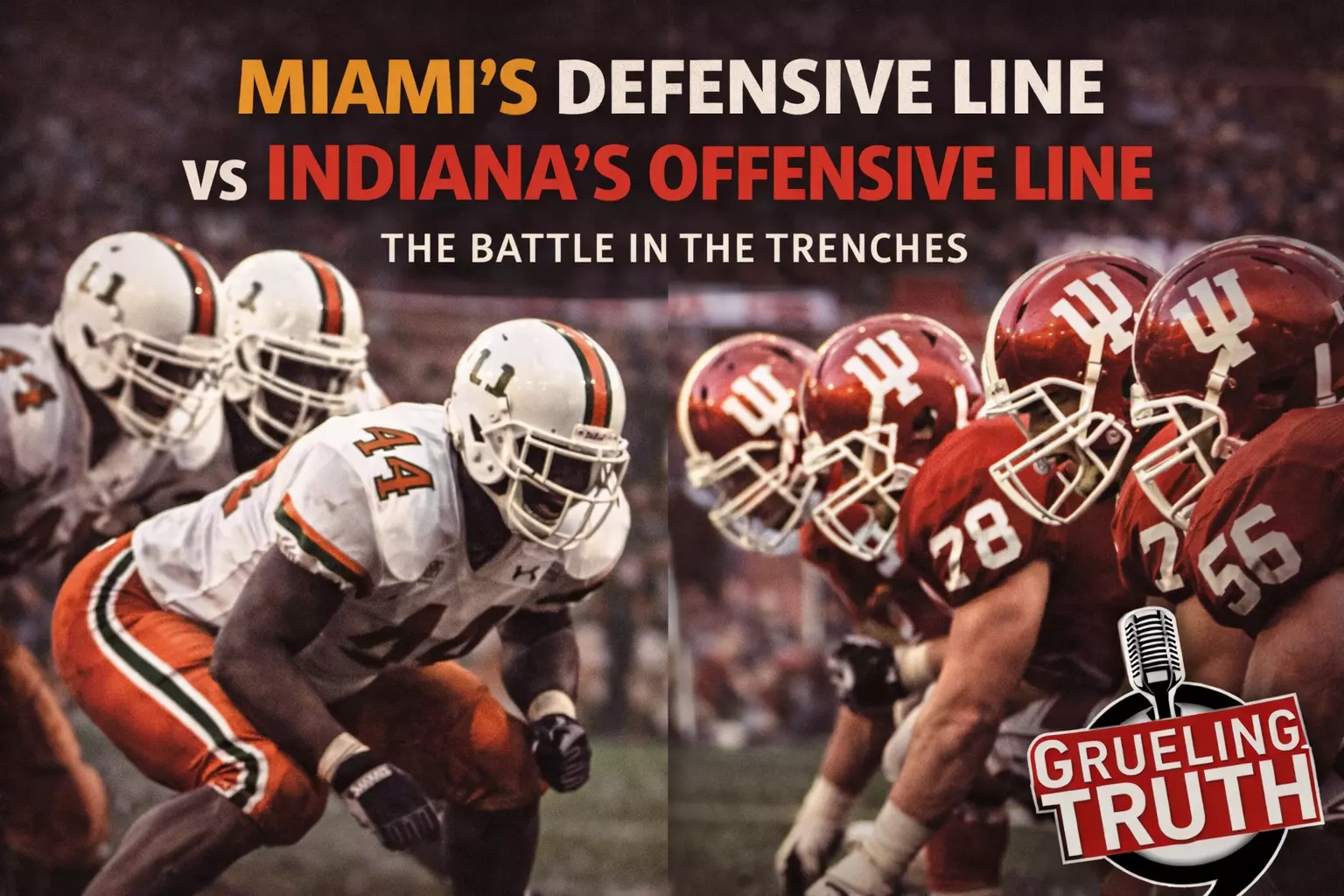
Miami’s Defensive Line vs. Indiana’s Offensive Line: Why Size Alone Won’t Decide This Game
Every major matchup involving Indiana this season eventually circles back to the same talking point:
“Indiana hasn’t seen a defensive line this big.”
Or more specifically:
“Miami’s size up front is going to overwhelm the Hoosiers.”
It’s an easy narrative. Miami’s defensive line
looks
the part—long, thick, explosive bodies built like SEC prototypes. On paper, it feels like a mismatch.
But Indiana has already faced — and beaten —
bigger, deeper, and more physically imposing defensive fronts
than what Miami brings into this game.
And more importantly, Indiana’s offensive line is built to
neutralize size, not absorb it.
This matchup won’t be decided by weight or height. It will be decided by
leverage, discipline, tempo, and intelligence
— all areas where Indiana quietly holds the edge.
Miami’s Defensive Line: Size, Length, and Disruption
Miami’s defensive front is legitimate. There’s no denying it.
They bring:
NFL-sized interior defenders
(300+ pounds)
Long edge players with reach and first-step burst
A rotation built to attack single gaps aggressively
A philosophy centered on penetration over containment
Miami wants chaos. Their defensive line is coached to:
Get vertical immediately
Collapse pockets quickly
Force hurried throws and negative plays
Win early downs with disruption
When Miami is successful, it’s because opposing offensive lines
panic
— overextending to stop penetration and opening themselves up to mistakes.
That’s where the perception comes from:
Indiana hasn’t faced this yet.
Except… they have.
The Size Myth: Alabama and Ohio State Were Bigger
If this were purely a size issue, Indiana would already be eliminated.
Indiana has already faced defensive lines from
Alabama and Ohio State, programs that:
Recruit more five-star linemen annually than Miami
Rotate deeper with NFL-caliber depth
Carry interior linemen in the
315–330 pound range
Feature edge rushers with both elite size
and
bend
Those fronts weren’t just big — they were
more complete
than Miami’s.
And Indiana didn’t just survive those games. They
controlled large portions of them, particularly in protection efficiency and down-to-down consistency.
So the question isn’t whether Indiana can handle size.
The question is whether Miami’s
style
is something Indiana struggles with.
And that answer is
no.
Indiana’s Offensive Line: Built for Control, Not Flash
Indiana’s offensive line is not designed to dominate highlight reels. It’s designed to
eliminate chaos.
Key traits:
Excellent
pre-snap communication
Clean pass sets with minimal wasted movement
Strong interior anchors who win with hand placement
Tackles who stay square and force rushers wide
A collective emphasis on
not losing
snaps
Indiana’s linemen are rarely out of position. That matters against a penetration-based front like Miami’s.
They force defenders to finish plays — something Miami’s line hasn’t consistently had to do against disciplined units.
Leverage Beats Size — And Indiana Wins Leverage
Here’s the quiet truth about big defensive lines:
Size only matters if leverage breaks.
Indiana’s offensive line excels at:
Playing with low pad level
Keeping hips underneath the body
Winning hand placement early
Forcing defenders to reset their feet
Miami’s defensive linemen are tall and long. That can be a disadvantage if they’re forced to play laterally and bend at the waist.
Indiana will attack that by:
Running directly at penetration lanes
Using quick double-teams before climbing
Trapping aggressive interior defenders
Forcing Miami’s ends to defend the run before rushing
The goal isn’t to overpower Miami. It’s to
make them uncomfortable.
Tempo: Indiana’s Silent Advantage
One area almost no one talks about:
tempo pressure on the defensive line.
Indiana’s offense plays at a pace that:
Limits defensive substitutions
Forces linemen to play extended snaps
Exposes conditioning gaps
Miami’s defensive line is at its best in short bursts. Indiana’s approach forces them into sustained drives — where technique erodes and hands get late.
This is where Indiana has quietly worn down bigger fronts all season.
Pass Protection: Indiana vs. Miami’s Rush Philosophy
Miami wants quick wins. Indiana denies them.
Indiana’s pass protection strategy:
Inside-out protection priority
Minimal help needed on early downs
Tight ends and backs used situationally, not desperately
Quarterback with strong pocket awareness
Miami doesn’t thrive when forced into
secondary rush moves. If the first step doesn’t win, Indiana’s line turns the play into a stalemate — and stalemates favor the offense.
How Indiana Will Win This Battle
Indiana wins this matchup by doing four specific things:
Stretch concepts, traps, and quick-hitters stress size disadvantages.
4.
Winning the Mental Game
Indiana’s line commits fewer penalties, misses fewer assignments, and doesn’t chase ghosts.
That’s how you beat size.
Final Verdict: Who Wins the Trench Battle?
This matchup isn’t a question of
who is bigger. It’s a question of
who controls the game’s rhythm when the noise dies down.
Miami’s defensive line will absolutely win moments. They’ll penetrate. They’ll create a few negative plays. They’ll force Indiana’s quarterback to reset his feet and speed up a couple of reads. That’s what aggressive, NFL-sized fronts do. Anyone expecting Indiana to dominate snap-to-snap is ignoring reality.
But trench battles aren’t decided by highlight plays.
They’re decided by
who loses fewer snaps
over sixty minutes.
And that’s where Indiana wins.
Indiana’s offensive line doesn’t need to overwhelm Miami to win this game. They need to
stay on schedule, eliminate mental errors, and force Miami’s defensive line to play longer, more disciplined drives than it wants to. That’s exactly what this Hoosier unit has done all season — against fronts just as large, and often deeper, than Miami’s.
Miami’s advantage is disruption. Indiana’s advantage is
control.
As the game progresses, Miami’s early penetration becomes harder to sustain. Indiana’s tempo limits substitutions. Combination blocks land cleaner. Hands stay inside. Defensive linemen are forced to finish plays instead of freelancing. That’s when size starts working
against
the defense.
By the fourth quarter, this game won’t feel like a mismatch. It will feel like work — the kind of work Indiana has embraced all year.
Final call:
Miami wins the early snaps. Indiana wins the down-to-down war.
And when the trench battle tilts from chaos to order,
Indiana’s offensive line
does just enough — consistently — to win the game.
Up To $1500 in Bonus Bets Paid Back if your First Bet Does Not Win
T&Cs apply
4.5/5
Gambling problem? Call 1-800-GAMBLER or 1-800-MY-RESET (Available in the US) 877-8-HOPENY or text HOPENY (467369) (NY) 1-800-327-5050 (MA), 1-800-BETS-OFF (IA), 1-800-981-0023 (PR). 21+ only. Please Gamble Responsibly. See BetMGM.com for Terms. First Bet Offer for new customers only (if applicable). Subject to eligibility requirements. Bonus bets are non-withdrawable. In partnership with Kansas Crossing Casino and Hotel. Promotional offers not available in Mississippi, Massachusetts, New York, Ontario, or Puerto Rico.
New DraftKings Customers: Spend $5+ Get $150 in Bonuses
T&Cs apply
4.5/5
GAMBLING PROBLEM? CALL 1-800-GAMBLER or 1-800-MY-RESET, (800) 327-5050 or visit gamblinghelplinema.org (MA). Please Gamble Responsibly. 888-789-7777/visit ccpg.org (CT), or visit www.mdgamblinghelp.org (MD), 1-800-981-0023 (PR). 21+ and present in most states. (18+ DC/NH/PR/WY). Void in CAN. Eligibility restrictions apply. On behalf of Boot Hill Casino (KS). Pass-thru of per wager tax may apply in IL. 1 per new DraftKings customer. $5+ first-time bet req. Max. $150 issued as non-withdrawable Bonus Bets. Stake removed from payout. Reward issued as $50 in Bonus Bets every 7 days via click-to-claim for 14 days. Bonus Bets and click-to-claims expire 7 days (168hrs) after issuance. Terms: sportsbook.draftkings.com/promos. Ends 10/11/26 at 11:59 PM ET. Sponsored by DK.
Must be 21+. GAMBLING PROBLEM? CALL 1-800-GAMBLER OR CALL 1-800-MY-RESET, www.mdgamblinghelp.org (MD), (800)-327-5050 or gamblinghelplinema.org (MA), Call (877)8-HOPENY or text HOPENY (467369) (NY), (888) 789-7777 or ccpg.org (CT), morethanagame.nc.gov (NC), 1800gambler.net (WV)
Bet $1 and get double the winnings up to $25 for your next 10 bets
T&Cs apply
4.4/5
21+ New users only. Must register using eligible promo code. First bet after registration must qualify. Max. Bonus Bet: $1,000. Bonus Bet expires 14 days after receipt. Void where prohibited. See Caesars.com/promos for full terms. Gambling Problem? 1-800-GAMBLER (1-800-426-2537)
21+ and present in OH. Gambling Problem? Call 1-800-GAMBLER.
This site is using
Cloudflare
and adheres to the
Google Safe Browsing Program. We adapted
Google's Privacy Guidelines
to keep your data safe at all times.
Close
Ready to Win Big? Join the Elite with Our Sports Betting Deals!
FanDuel Promo
New Users – Get $250 in Bonus Bets when you wager $5 for 5 days
Up To $1500 in Bonus Bets Paid Back if your First Bet Does Not Win
Best Slots
T&Cs and 21+ apply
Gambling problem? Call 1-800-GAMBLER or 1-800-MY-RESET (Available in the US) 877-8-HOPENY or text HOPENY (467369) (NY) 1-800-327-5050 (MA), 1-800-BETS-OFF (IA), 1-800-981-0023 (PR). 21+ only. Please Gamble Responsibly. See BetMGM.com for Terms. First Bet Offer for new customers only (if applicable). Subject to eligibility requirements. Bonus bets are non-withdrawable. In partnership with Kansas Crossing Casino and Hotel. Promotional offers not available in Mississippi, Massachusetts, New York, Ontario, or Puerto Rico.
Code:
Open BetMGM
Get Bonus
DraftKings Promo
New DraftKings Customers: Spend $5+ Get $150 in Bonuses
Newcomer
T&Cs and 21+ apply
GAMBLING PROBLEM? CALL 1-800-GAMBLER or 1-800-MY-RESET, (800) 327-5050 or visit gamblinghelplinema.org (MA). Please Gamble Responsibly. 888-789-7777/visit ccpg.org (CT), or visit www.mdgamblinghelp.org (MD), 1-800-981-0023 (PR). 21+ and present in most states. (18+ DC/NH/PR/WY). Void in CAN. Eligibility restrictions apply. On behalf of Boot Hill Casino (KS). Pass-thru of per wager tax may apply in IL. 1 per new DraftKings customer. $5+ first-time bet req. Max. $150 issued as non-withdrawable Bonus Bets. Stake removed from payout. Reward issued as $50 in Bonus Bets every 7 days via click-to-claim for 14 days. Bonus Bets and click-to-claims expire 7 days (168hrs) after issuance. Terms: sportsbook.draftkings.com/promos. Ends 10/11/26 at 11:59 PM ET. Sponsored by DK.
Code:
Open DraftKings
Get Bonus
Find out what the legends have to say about sports this week....