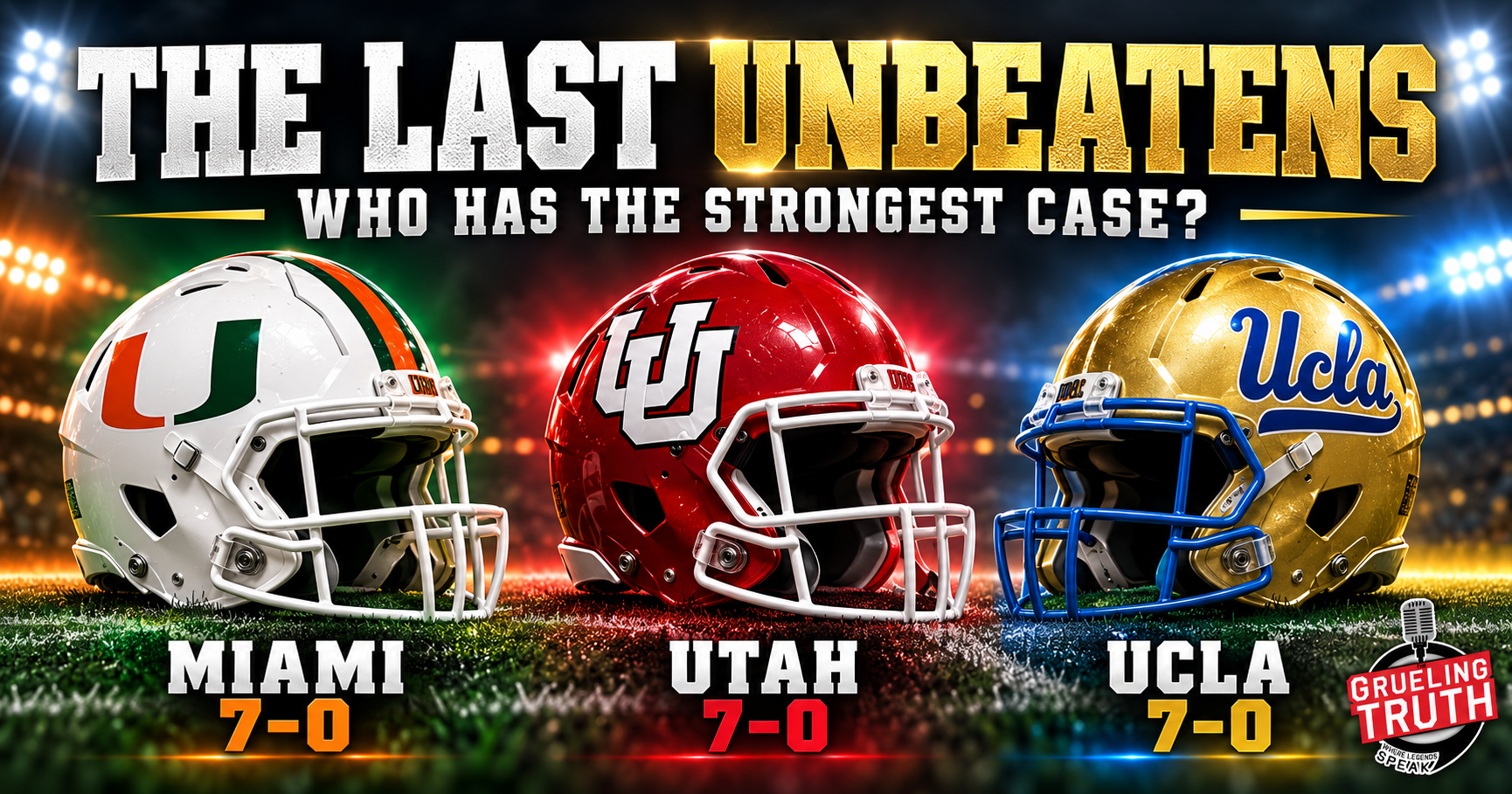
Three unbeaten teams remain in the Football Bowl Subdivision, and each has reached 7–0 through a different combination of strengths.
Three unbeaten teams remain in the Football Bowl Subdivision, and each has reached 7–0 through a different combination of strengths.
Miami has the most convincing passing attack of the group. Utah has a quarterback capable of changing a game with his legs and a defense that just delivered against a ranked opponent. UCLA has continued winning through a quarterback change while building a strong position in the Big Ten.
The latest Associated Press poll places
Miami first, Utah sixth and UCLA seventh. Those rankings establish the national pecking order, but they do not settle every comparison among the three.
The strongest résumé through eight weeks and the best outlook for November are different questions.
My assessment:
Miami has the strongest overall case today and the highest demonstrated offensive ceiling. Utah has the best recent statement win. UCLA has a credible argument built around defensive consistency and resilience—but also the most important unanswered quarterback question.
Miami Has the Strongest Overall Résumé
The Hurricanes’
case begins with winning convincingly away from home.
Miami defeated
Wake Forest 33–20 on the road
and won
41–13 at Clemson. Its latest result was a
52–23 victory over Pittsburgh, following the
43–35 double-overtime escape against Florida State.
The Wake Forest victory deserves particular weight. The Demon Deacons are now
No. 14 in the AP poll, giving Miami a road win over a team that has remained nationally relevant.
That matters more than evaluating opponents exclusively by their ranking on game day. A résumé changes as opponents supply additional evidence of their quality.
Miami’s record also contains several decisive performances. The Hurricanes have demonstrated an ability to build separation rather than relying on a succession of narrow finishes.
Florida State remains the caution. Needing two overtimes in a rivalry game does not invalidate the season, but it supplies a reminder that Miami can be pushed into uncomfortable situations.
The response against Pittsburgh strengthened the Hurricanes’ position. They followed a survival game with an emphatic performance.
Mensah Gives Miami the Clearest Offensive Advantage
Darian Mensah threw for
387 yards and four touchdowns against Pittsburgh, completing
31 of 37 passes. Miami converted ten of its first 12 third-down opportunities and scored on seven of its first eight possessions.
That is meaningful evidence of offensive control.
The Hurricanes can generate explosive plays, but the Pittsburgh performance also demonstrated their ability to extend possessions. Those qualities work together: a defense cannot concentrate solely on preventing deep completions if Miami continues moving the chains underneath.
Among these three teams, Miami currently offers the strongest demonstrated ability to win a game that requires substantial passing production.
That does not make the Hurricanes immune to pressure or mistakes. It does give them more flexibility when an opponent limits the running game or forces them to recover from a deficit.
The defensive evaluation requires greater restraint. Miami’s recent results include a significant challenge against Florida State and a much more comfortable afternoon against Pittsburgh. Its offense has supplied the clearest reason to rank the Hurricanes first in this comparison.
Utah Added the Most Important Recent Evidence
Utah’s
21–13 victory over Houston
strengthened its argument considerably.
The Utes held the Cougars below their previous season average in total offense and recovered after being held scoreless in the first half. Devon Dampier rushed for
150 yards and two touchdowns.
Houston remains ranked
No. 18, so this was a victory over an opponent whose season still supports a meaningful national standing.
Utah’s earlier results include a
43–10 win over Arkansas, a
31–17 victory at Iowa State
and a
27–24 escape at Colorado.
The Houston game provided a different examination. Utah had to overcome a deficit against a capable opponent and find production after its offense struggled.
That response raises confidence in the Utes’ ability to survive difficult games. It also identifies the issue they must address: their offense cannot assume a successful second-half recovery will always be available.
Dampier Gives Utah Another Way to Win
Dampier’s rushing ability makes Utah especially difficult to evaluate through passing production alone.
Against Houston, he completed
18 of 26 passes for 204 yards with two interceptions, while making his decisive contributions on the ground.
A quarterback who can produce substantial rushing yardage forces a defense to account for another ball carrier. Coverage decisions become more difficult when defenders must also respect his ability to escape or run by design.
But turnovers can undermine those advantages. Utah needs Dampier’s mobility to complement sound passing decisions, particularly against opponents capable of converting mistakes into touchdowns.
The defense supplies a strong foundation. Holding Houston to 13 points gave Utah time to recover offensively. That kind of support becomes increasingly valuable as the schedule intensifies.
UCLA’s Best Argument Is Its Recent Defensive Consistency
UCLA’s last three victories came against
Oregon, 17–15; Wisconsin, 17–7; and Michigan State, 28–10.
Allowing 32 combined points across those games gives the Bruins a concrete basis for confidence.
The Wisconsin result also gained value when the Badgers subsequently defeated USC and entered the AP poll at
No. 25.
UCLA’s résumé
is still less persuasive at the top than Miami’s. The Bruins need additional evidence against stronger opposition before their unbeaten record alone should carry them ahead.
Their resilience, however, deserves recognition.
Ty Dieffenbach took over after Nico Iamaleava’s injury during the Oregon game, then helped UCLA beat Wisconsin in his first FBS start. Against Michigan State, he completed
18 of 31 passes for 198 yards and a touchdown.
UCLA has maintained its direction through a significant personnel change. The remaining question is how the offense responds when the defense cannot keep an opponent’s scoring so low.
The Remaining Schedules Change the Comparison
Miami’s next two games are road trips to
North Carolina and Notre Dame, followed by home games against
Duke, Virginia Tech and Boston College.
The Notre Dame game is the clearest immediate opportunity to strengthen the Hurricanes’ résumé. It will also test their offensive execution away from home against a nationally prominent opponent.
Utah faces
Cincinnati away, BYU at home, Arizona away, TCU away and West Virginia at home.
That sequence offers considerable résumé-building potential. It also demands consistency through multiple road environments. Utah cannot afford to focus on the rivalry with BYU before handling Cincinnati.
UCLA has
Nevada at home, then
Minnesota away, Illinois at home, Michigan away and USC at home.
The Bruins have opportunities to strengthen their case, but their offense must continue developing. Their current formula is credible; the question is how well it holds when an opponent forces a different kind of game.
The Verdict: Miami Leads, With Different Questions Behind It
Miami has the strongest résumé of the three today.
Its road victory over Wake Forest, convincing performances elsewhere and demonstrated passing efficiency provide the most complete argument.
Miami also looks best equipped offensively for the remaining schedule.
Mensah gives the Hurricanes a proven way to sustain drives and generate points when a game becomes demanding.
Utah has the strongest recent statement, with its victory over Houston showing defensive quality and the value of Dampier’s mobility. Its remaining schedule creates an opportunity to challenge Miami’s résumé advantage.
UCLA has earned serious consideration through consistency, especially on defense and during its quarterback transition. More demanding offensive situations will reveal how high its ceiling reaches.
All three have protected their perfect records. November will test how effectively they can win when their preferred approach stops working.
New Users – Get $350 in Bonus Bets when you wager $5 for 7 days
T&Cs apply
4.6/5
Gambling Problem? Call 1-800-GAMBLER or 1-800-MY-RESET. Call 1-888-789-7777 or visit ccpgg.org/chat (CT). Hope is here. GamblingHelpLineMA.org or call (800) 327-5050 for 24/7 support (MA). Visit www.mdgamblinghelp.org (MD). Call 1-877-8HOPE-NY or text HOPENY (NY). 21+ (18+ DC, WY) and present in select states (for KS, in affiliation with Kansas Star Casino). Find online real money wagering only. Min $5 wager required for 7 consecutive days. $5 free play credit. Bonus issued as non-withdrawable bonus with cash withdrawable bonus with cash withdrawable. Bonus bets which expire 7 days after receipt. Restrictions apply. See terms at sportsbook.fanduel.com. Call 1-877-770-7867 (LA).
Up To $1500 in Bonus Bets Paid Back if your First Bet Does Not Win
T&Cs apply
4.5/5
Gambling problem? Call 1-800-GAMBLER or 1-800-MY-RESET (Available in the US) 877-8-HOPENY or text HOPENY (467369) (NY) 1-800-327-5050 (MA), 1-800-BETS-OFF (IA), 1-800-981-0023 (PR). 21+ only. Please Gamble Responsibly. See BetMGM.com for Terms. First Bet Offer for new customers only (if applicable). Subject to eligibility requirements. Bonus bets are non-withdrawable. In partnership with Kansas Crossing Casino and Hotel. Promotional offers not available in Mississippi, Massachusetts, New York, Ontario, or Puerto Rico.
New DraftKings Customers: Bet $5, Get $200 + 3 Months of NBA League Pass!
T&Cs apply
4.5/5
GAMBLING PROBLEM? CALL 1-800-GAMBLER or 1-800-MY-RESET, (800) 327-5050 or visit gamblinghelplinema.org (MA). Please Gamble Responsibly. 888-789-7777/visit ccpg.org (CT), or visit www.mdgamblinghelp.org (MD), 1-800-981-0023 (PR). 21+ and present in most states. (18+ DC/NH/PR/WY). Void in CAN. Eligibility restrictions apply. On behalf of Boot Hill Casino (KS). Pass-thru of per wager tax may apply in IL. 1 per new Sportsbook customer. $5+ first-time bet req. Max. $200 issued as non-withdrawable Bonus Bets. Stake removed from payout. Reward issued as $50 in Bonus Bets every 7 days via click-to-claim for 21 days. Bonus Bets and click-to-claims expire 7 days (168hrs) after issuance. Terms: dkng.co/offer. Get 1 promo code to redeem a 3-month NBA League Pass subscription, complimentary of DraftKings. Subscription auto-renews monthly at then-current price (currently $16.99/mo); cancel anytime. Terms, restrictions, and eligibility requirements apply. Redeem League Pass by 12/19/26 at 11:59 PM ET. Addt’l terms: support.watch.nba.com/hc/en-us/articles/9165532876183-League-Pass-Terms-of-Use_. Ends 11/29/26 at 11:59 PM ET. Sponsored by DK.
Must be 21+. GAMBLING PROBLEM? CALL 1-800-GAMBLER OR CALL 1-800-MY-RESET, www.mdgamblinghelp.org (MD), (800)-327-5050 or gamblinghelplinema.org (MA), Call (877)8-HOPENY or text HOPENY (467369) (NY), (888) 789-7777 or ccpg.org (CT), morethanagame.nc.gov (NC), 1800gambler.net (WV)
Bet $1 and get double the winnings up to $25 for your next 10 bets
T&Cs apply
4.4/5
21+ New users only. Must register using eligible promo code. First bet after registration must qualify. Max. Bonus Bet: $1,000. Bonus Bet expires 14 days after receipt. Void where prohibited. See Caesars.com/promos for full terms. Gambling Problem? 1-800-GAMBLER (1-800-426-2537)
21+ and present in OH. Gambling Problem? Call 1-800-GAMBLER.
This site is using
Cloudflare
and adheres to the
Google Safe Browsing Program. We adapted
Google's Privacy Guidelines
to keep your data safe at all times.
Close
Ready to Win Big? Join the Elite with Our Sports Betting Deals!
FanDuel Promo
New Users – Get $350 in Bonus Bets when you wager $5 for 7 days
Our Favorite
T&Cs and 21+ apply
Gambling Problem? Call 1-800-GAMBLER or 1-800-MY-RESET. Call 1-888-789-7777 or visit ccpgg.org/chat (CT). Hope is here. GamblingHelpLineMA.org or call (800) 327-5050 for 24/7 support (MA). Visit www.mdgamblinghelp.org (MD). Call 1-877-8HOPE-NY or text HOPENY (NY). 21+ (18+ DC, WY) and present in select states (for KS, in affiliation with Kansas Star Casino). Find online real money wagering only. Min $5 wager required for 7 consecutive days. $5 free play credit. Bonus issued as non-withdrawable bonus with cash withdrawable bonus with cash withdrawable. Bonus bets which expire 7 days after receipt. Restrictions apply. See terms at sportsbook.fanduel.com. Call 1-877-770-7867 (LA).
Code:
Open FanDuel
Get Bonus
BetMGM Promo
Up To $1500 in Bonus Bets Paid Back if your First Bet Does Not Win
Best Slots
T&Cs and 21+ apply
Gambling problem? Call 1-800-GAMBLER or 1-800-MY-RESET (Available in the US) 877-8-HOPENY or text HOPENY (467369) (NY) 1-800-327-5050 (MA), 1-800-BETS-OFF (IA), 1-800-981-0023 (PR). 21+ only. Please Gamble Responsibly. See BetMGM.com for Terms. First Bet Offer for new customers only (if applicable). Subject to eligibility requirements. Bonus bets are non-withdrawable. In partnership with Kansas Crossing Casino and Hotel. Promotional offers not available in Mississippi, Massachusetts, New York, Ontario, or Puerto Rico.
Code:
Open BetMGM
Get Bonus
DraftKings Promo
New DraftKings Customers: Bet $5, Get $200 + 3 Months of NBA League Pass!
Newcomer
T&Cs and 21+ apply
GAMBLING PROBLEM? CALL 1-800-GAMBLER or 1-800-MY-RESET, (800) 327-5050 or visit gamblinghelplinema.org (MA). Please Gamble Responsibly. 888-789-7777/visit ccpg.org (CT), or visit www.mdgamblinghelp.org (MD), 1-800-981-0023 (PR). 21+ and present in most states. (18+ DC/NH/PR/WY). Void in CAN. Eligibility restrictions apply. On behalf of Boot Hill Casino (KS). Pass-thru of per wager tax may apply in IL. 1 per new Sportsbook customer. $5+ first-time bet req. Max. $200 issued as non-withdrawable Bonus Bets. Stake removed from payout. Reward issued as $50 in Bonus Bets every 7 days via click-to-claim for 21 days. Bonus Bets and click-to-claims expire 7 days (168hrs) after issuance. Terms: dkng.co/offer. Get 1 promo code to redeem a 3-month NBA League Pass subscription, complimentary of DraftKings. Subscription auto-renews monthly at then-current price (currently $16.99/mo); cancel anytime. Terms, restrictions, and eligibility requirements apply. Redeem League Pass by 12/19/26 at 11:59 PM ET. Addt’l terms: support.watch.nba.com/hc/en-us/articles/9165532876183-League-Pass-Terms-of-Use_. Ends 11/29/26 at 11:59 PM ET. Sponsored by DK.
Code:
Open DraftKings
Get Bonus
Find out what the legends have to say about sports this week....
New Users – Get $350 in Bonus Bets when you wager $5 for 7 days
Gambling Problem? Call 1-800-GAMBLER or 1-800-MY-RESET. Call 1-888-789-7777 or visit ccpgg.org/chat (CT). Hope is here. GamblingHelpLineMA.org or call (800) 327-5050 for 24/7 support (MA). Visit www.mdgamblinghelp.org (MD). Call 1-877-8HOPE-NY or text HOPENY (NY). 21+ (18+ DC, WY) and present in select states (for KS, in affiliation with Kansas Star Casino). Find online real money wagering only. Min $5 wager required for 7 consecutive days. $5 free play credit. Bonus issued as non-withdrawable bonus with cash withdrawable bonus with cash withdrawable. Bonus bets which expire 7 days after receipt. Restrictions apply. See terms at sportsbook.fanduel.com. Call 1-877-770-7867 (LA).