Miami has a strong argument for the No. 1 ranking this morning. It also gave voters plenty of reasons to hesitate.
Miami has a strong argument for the No. 1 ranking this morning. It also gave voters plenty of reasons to hesitate.
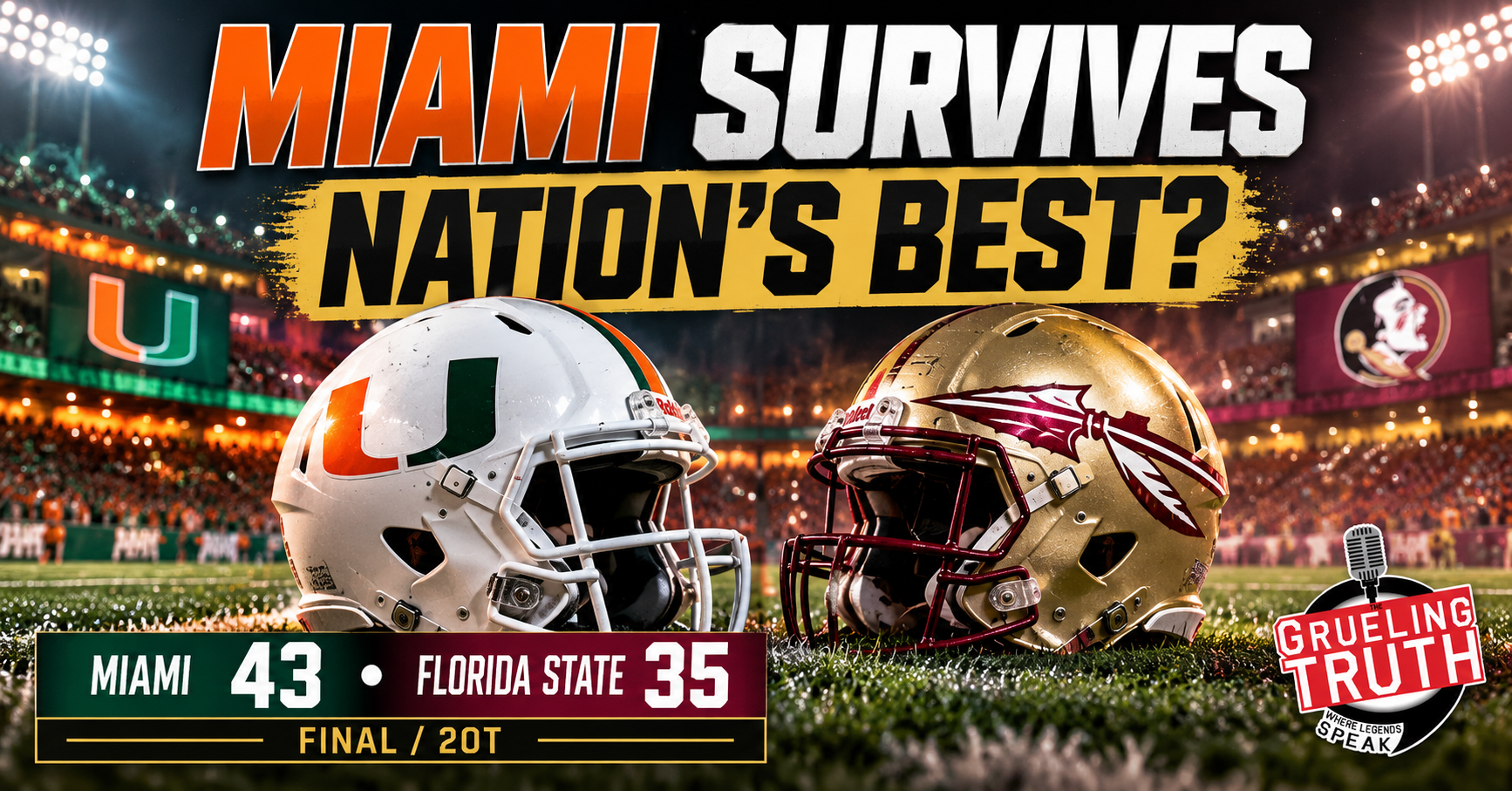
The Hurricanes escaped Florida State 43–35 in double overtime Saturday night, improving to 6–0 overall and 4–0 in the ACC. They remained standing through a weekend that knocked down much of college football’s established hierarchy.
That matters. Winning matters, particularly when the teams ahead of you fail to do it.
But a victory and a convincing performance are different things. Miami needed two extra periods and a disputed final play to defeat a Florida State team that left Hard Rock Stadium with a losing record.
The Hurricanes may deserve to lead the next Associated Press poll. Whether they looked like the best team in the country Saturday night is a much harder question.
Miami Earned the Right to Make Its Case
The argument for Miami begins with the most basic responsibility of a
championship contender: keep winning.
Georgia lost to Auburn. Notre Dame lost to BYU. Indiana, Alabama and Texas also fell. Five of the previous poll’s top seven teams suffered defeats, leaving voters with an unusually difficult evaluation.
Miami avoided joining them.
There is a tendency to treat a narrow victory as a failure when a highly ranked team plays a struggling opponent. That reaction can overlook the difficulty of winning when a game becomes uncomfortable.
The Hurricanes had opportunities to unravel. Instead, they produced the plays necessary to reach overtime, scored in both extra periods and finished with a defensive takeaway.
Nobody should dismiss that resilience.
An undefeated team does not need to apologize for winning a rivalry game. Miami’s players earned their celebration, and the Hurricanes have every right to argue that their unbeaten record should carry substantial weight in the rankings.
Malachi Toney Gave Miami a Championship-Caliber Performance
Whatever questions remain about the team, Malachi Toney delivered the kind of performance that can rescue a contender.
Toney caught 11 passes for 154 yards. In the second overtime, he caught a three-yard touchdown pass from Darian Mensah, then threw the two-point conversion to Cooper Barkate. Mensah finished with 326 passing yards and three touchdown passes, while Javian Mallory rushed for 108 yards.
Those contributions illustrate why Miami belongs in the championship discussion.
The Hurricanes have players capable of changing a possession even when the offense has struggled to establish control. Toney can turn a routine opportunity into a decisive play. Mensah can deliver when the defense knows Miami needs a completion.
That talent creates a substantial margin for recovery.
It also establishes a demanding standard. An offense with those weapons should expect to generate more than isolated moments of brilliance. Against the best opponents, Miami will need its execution between those moments to become more dependable.
Florida State Exposed Reasons for Concern
The case against Miami at No. 1 starts with how difficult the Hurricanes made this game.
Florida State entered with three defeats and left 3–4 overall. Yet the Seminoles pushed Miami through regulation and into a second overtime on the Hurricanes’ home field.
Rivalry intensity helps explain that result. It does not eliminate the need to examine it.
The Hurricanes allowed Florida State to remain dangerous deep into the night. They could not turn their talent advantage into sustained separation, and the game eventually reached a point where one play could have changed everything.
That is a vulnerable way to live.
A championship contender can survive an uneven Saturday. The concern is whether the same problems will reappear against an opponent better equipped to exploit them.
Miami needs to determine why it could not establish firmer control—and make corrections before another game reaches that stage.
The Final Ruling Will Remain Part of the Debate
The ending added controversy to an already complicated evaluation.
Bryce Fitzgerald was credited with an interception on Florida State’s final pass into the end zone. The ruling stood after review, ending the game. Florida State disputed the decision, and Mike Norvell questioned the explanation afterward.
The official result is a Miami victory. A ranking discussion should begin with that fact.
Still, the finish reinforces how little separated survival from a potentially disastrous outcome. Miami reached the final possession of double overtime needing to defend its end zone, and the decisive play required review.
Even setting the controversy aside, the Hurricanes had allowed the game to become far too uncertain for comfort.
The coaching staff’s responsibility is to identify the earlier possessions that made such an ending possible.
Voters Must Decide What No. 1 Represents
There are two reasonable approaches to the top ranking.
One emphasizes accomplishment: which team has earned the strongest position through the games already played?
The other emphasizes evaluation: which team appears most capable of beating elite opposition right now?
Those approaches can produce different answers.
Miami’s undefeated record supports the first argument. Its difficulties against Florida State complicate the second.
Ohio State strengthened its own case by winning 19–15 at Indiana, while BYU defeated Notre Dame 28–24. Both results give voters meaningful alternatives to simply moving the previous No. 3 team up two places.
Every contender requires scrutiny. A loss should count, but so should the quality of a victory. An unbeaten record is valuable evidence, although it cannot answer every question about a team’s strength.
Miami Has a Case for No. 1—and Plenty Left to Prove
My view is that Miami has earned serious consideration for the top spot. Placing the
Hurricanes
first would be defensible.
Saturday’s performance, however, did not establish clear superiority over the rest of the country.
Miami showed offensive talent, competitive resilience and the ability to execute under enormous pressure. It also showed how a game against a struggling opponent can become a possession-by-possession struggle for survival.
Both belong in the assessment.
As voters prepare the new poll, the Hurricanes should receive credit for keeping their season unbeaten. They should also face reasonable questions about whether their overall performance matches the ranking they may receive.
Miami survived Florida State. To make No. 1 feel convincing, the Hurricanes need to play with greater control than they showed Saturday night.
New Users – Get $350 in Bonus Bets when you wager $5 for 7 days
T&Cs apply
4.6/5
Gambling Problem? Call 1-800-GAMBLER or 1-800-MY-RESET. Call 1-888-789-7777 or visit ccpgg.org/chat (CT). Hope is here. GamblingHelpLineMA.org or call (800) 327-5050 for 24/7 support (MA). Visit www.mdgamblinghelp.org (MD). Call 1-877-8HOPE-NY or text HOPENY (NY). 21+ (18+ DC, WY) and present in select states (for KS, in affiliation with Kansas Star Casino). Find online real money wagering only. Min $5 wager required for 7 consecutive days. $5 free play credit. Bonus issued as non-withdrawable bonus with cash withdrawable bonus with cash withdrawable. Bonus bets which expire 7 days after receipt. Restrictions apply. See terms at sportsbook.fanduel.com. Call 1-877-770-7867 (LA).
Up To $1500 in Bonus Bets Paid Back if your First Bet Does Not Win
T&Cs apply
4.5/5
Gambling problem? Call 1-800-GAMBLER or 1-800-MY-RESET (Available in the US) 877-8-HOPENY or text HOPENY (467369) (NY) 1-800-327-5050 (MA), 1-800-BETS-OFF (IA), 1-800-981-0023 (PR). 21+ only. Please Gamble Responsibly. See BetMGM.com for Terms. First Bet Offer for new customers only (if applicable). Subject to eligibility requirements. Bonus bets are non-withdrawable. In partnership with Kansas Crossing Casino and Hotel. Promotional offers not available in Mississippi, Massachusetts, New York, Ontario, or Puerto Rico.
New DraftKings Customers: Bet $5, Get $200 + 3 Months of NBA League Pass!
T&Cs apply
4.5/5
GAMBLING PROBLEM? CALL 1-800-GAMBLER or 1-800-MY-RESET, (800) 327-5050 or visit gamblinghelplinema.org (MA). Please Gamble Responsibly. 888-789-7777/visit ccpg.org (CT), or visit www.mdgamblinghelp.org (MD), 1-800-981-0023 (PR). 21+ and present in most states. (18+ DC/NH/PR/WY). Void in CAN. Eligibility restrictions apply. On behalf of Boot Hill Casino (KS). Pass-thru of per wager tax may apply in IL. 1 per new Sportsbook customer. $5+ first-time bet req. Max. $200 issued as non-withdrawable Bonus Bets. Stake removed from payout. Reward issued as $50 in Bonus Bets every 7 days via click-to-claim for 21 days. Bonus Bets and click-to-claims expire 7 days (168hrs) after issuance. Terms: dkng.co/offer. Get 1 promo code to redeem a 3-month NBA League Pass subscription, complimentary of DraftKings. Subscription auto-renews monthly at then-current price (currently $16.99/mo); cancel anytime. Terms, restrictions, and eligibility requirements apply. Redeem League Pass by 12/19/26 at 11:59 PM ET. Addt’l terms: support.watch.nba.com/hc/en-us/articles/9165532876183-League-Pass-Terms-of-Use_. Ends 11/29/26 at 11:59 PM ET. Sponsored by DK.
Must be 21+. GAMBLING PROBLEM? CALL 1-800-GAMBLER OR CALL 1-800-MY-RESET, www.mdgamblinghelp.org (MD), (800)-327-5050 or gamblinghelplinema.org (MA), Call (877)8-HOPENY or text HOPENY (467369) (NY), (888) 789-7777 or ccpg.org (CT), morethanagame.nc.gov (NC), 1800gambler.net (WV)
Bet $1 and get double the winnings up to $25 for your next 10 bets
T&Cs apply
4.4/5
21+ New users only. Must register using eligible promo code. First bet after registration must qualify. Max. Bonus Bet: $1,000. Bonus Bet expires 14 days after receipt. Void where prohibited. See Caesars.com/promos for full terms. Gambling Problem? 1-800-GAMBLER (1-800-426-2537)
21+ and present in OH. Gambling Problem? Call 1-800-GAMBLER.
This site is using
Cloudflare
and adheres to the
Google Safe Browsing Program. We adapted
Google's Privacy Guidelines
to keep your data safe at all times.
Close
Ready to Win Big? Join the Elite with Our Sports Betting Deals!
FanDuel Promo
New Users – Get $350 in Bonus Bets when you wager $5 for 7 days
Our Favorite
T&Cs and 21+ apply
Gambling Problem? Call 1-800-GAMBLER or 1-800-MY-RESET. Call 1-888-789-7777 or visit ccpgg.org/chat (CT). Hope is here. GamblingHelpLineMA.org or call (800) 327-5050 for 24/7 support (MA). Visit www.mdgamblinghelp.org (MD). Call 1-877-8HOPE-NY or text HOPENY (NY). 21+ (18+ DC, WY) and present in select states (for KS, in affiliation with Kansas Star Casino). Find online real money wagering only. Min $5 wager required for 7 consecutive days. $5 free play credit. Bonus issued as non-withdrawable bonus with cash withdrawable bonus with cash withdrawable. Bonus bets which expire 7 days after receipt. Restrictions apply. See terms at sportsbook.fanduel.com. Call 1-877-770-7867 (LA).
Code:
Open FanDuel
Get Bonus
BetMGM Promo
Up To $1500 in Bonus Bets Paid Back if your First Bet Does Not Win
Best Slots
T&Cs and 21+ apply
Gambling problem? Call 1-800-GAMBLER or 1-800-MY-RESET (Available in the US) 877-8-HOPENY or text HOPENY (467369) (NY) 1-800-327-5050 (MA), 1-800-BETS-OFF (IA), 1-800-981-0023 (PR). 21+ only. Please Gamble Responsibly. See BetMGM.com for Terms. First Bet Offer for new customers only (if applicable). Subject to eligibility requirements. Bonus bets are non-withdrawable. In partnership with Kansas Crossing Casino and Hotel. Promotional offers not available in Mississippi, Massachusetts, New York, Ontario, or Puerto Rico.
Code:
Open BetMGM
Get Bonus
DraftKings Promo
New DraftKings Customers: Bet $5, Get $200 + 3 Months of NBA League Pass!
Newcomer
T&Cs and 21+ apply
GAMBLING PROBLEM? CALL 1-800-GAMBLER or 1-800-MY-RESET, (800) 327-5050 or visit gamblinghelplinema.org (MA). Please Gamble Responsibly. 888-789-7777/visit ccpg.org (CT), or visit www.mdgamblinghelp.org (MD), 1-800-981-0023 (PR). 21+ and present in most states. (18+ DC/NH/PR/WY). Void in CAN. Eligibility restrictions apply. On behalf of Boot Hill Casino (KS). Pass-thru of per wager tax may apply in IL. 1 per new Sportsbook customer. $5+ first-time bet req. Max. $200 issued as non-withdrawable Bonus Bets. Stake removed from payout. Reward issued as $50 in Bonus Bets every 7 days via click-to-claim for 21 days. Bonus Bets and click-to-claims expire 7 days (168hrs) after issuance. Terms: dkng.co/offer. Get 1 promo code to redeem a 3-month NBA League Pass subscription, complimentary of DraftKings. Subscription auto-renews monthly at then-current price (currently $16.99/mo); cancel anytime. Terms, restrictions, and eligibility requirements apply. Redeem League Pass by 12/19/26 at 11:59 PM ET. Addt’l terms: support.watch.nba.com/hc/en-us/articles/9165532876183-League-Pass-Terms-of-Use_. Ends 11/29/26 at 11:59 PM ET. Sponsored by DK.
Code:
Open DraftKings
Get Bonus
Find out what the legends have to say about sports this week....
New Users – Get $350 in Bonus Bets when you wager $5 for 7 days
Gambling Problem? Call 1-800-GAMBLER or 1-800-MY-RESET. Call 1-888-789-7777 or visit ccpgg.org/chat (CT). Hope is here. GamblingHelpLineMA.org or call (800) 327-5050 for 24/7 support (MA). Visit www.mdgamblinghelp.org (MD). Call 1-877-8HOPE-NY or text HOPENY (NY). 21+ (18+ DC, WY) and present in select states (for KS, in affiliation with Kansas Star Casino). Find online real money wagering only. Min $5 wager required for 7 consecutive days. $5 free play credit. Bonus issued as non-withdrawable bonus with cash withdrawable bonus with cash withdrawable. Bonus bets which expire 7 days after receipt. Restrictions apply. See terms at sportsbook.fanduel.com. Call 1-877-770-7867 (LA).