The College Football Playoff committee will spend Tuesday explaining its first rankings. Miami and Notre Dame can spend Saturday making that explanation feel outdated.
The College Football Playoff committee will spend Tuesday explaining its first rankings. Miami and Notre Dame can spend Saturday making that explanation feel outdated.
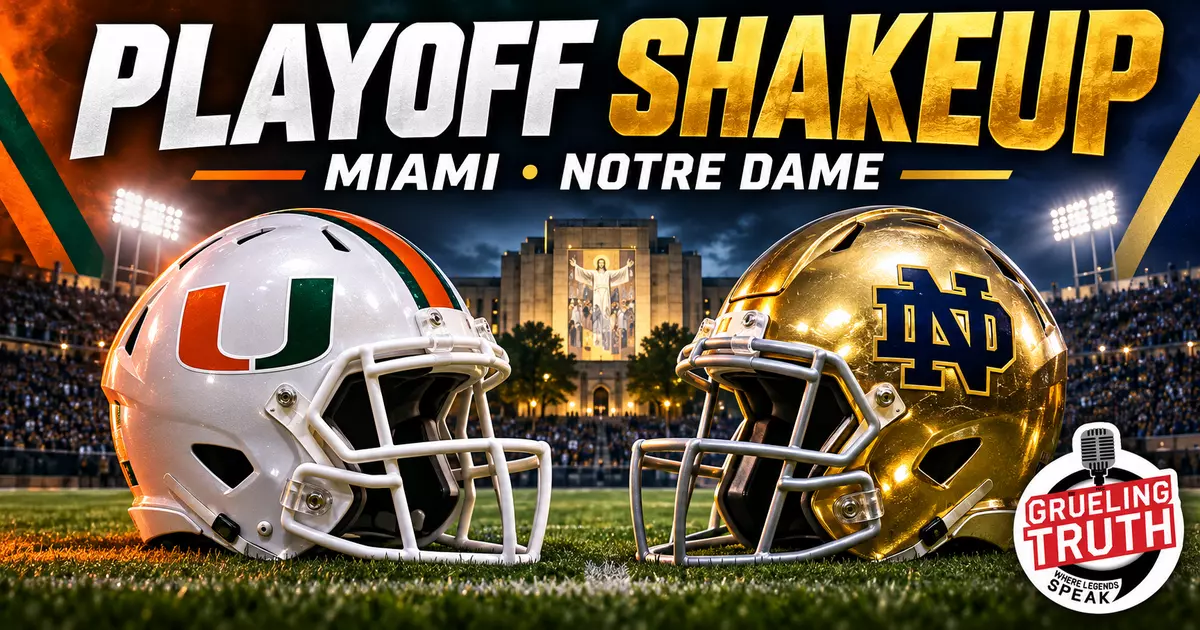
The Hurricanes visit South Bend on November 7 in a matchup between the AP’s No. 1 and No. 4 teams. Miami is 8–0. Notre Dame is 7–1. Kickoff at Notre Dame Stadium is scheduled for 7:30 p.m. Eastern on NBC and Peacock.
The names supply the attention. The circumstances supply the importance.
An unbeaten Miami team can earn a road victory that substantially strengthens its championship argument. Notre Dame can defeat the team currently sitting atop the AP poll and give the committee a new reason to reconsider the order near the top.
Neither outcome should be treated as an automatic playoff berth or elimination. Both would change the conversation.
Miami’s latest escape raises the stakes
Miami survived North Carolina 38–35 on Saturday, scoring twice in the final eight minutes to remain unbeaten.
That finish deserves credit. The Hurricanes had to respond after falling behind in the fourth quarter, and their offense delivered when the season’s margin became painfully narrow.
But the result also leaves a question worth carrying into South Bend: can Miami play with enough control to avoid asking its offense for another late rescue?
Notre Dame offers a different test from winning a shootout against a team trying to spring an upset. The Irish have their own championship ambitions, a home crowd and an opportunity to dictate how the evening develops.
For Miami, protecting possessions and avoiding the stretches that allow an opponent to seize momentum may matter as much as producing explosive plays.
Notre Dame has to make its defense count
The statistical matchup
is compelling. The Associated Press preview lists Miami at 47.6 points and 534.9 yards per game, while Notre Dame is allowing 13.4 points and 236.1 yards.
Those averages describe the challenge. They do not guarantee what will happen when the teams meet.
Notre Dame must make Miami work through possessions rather than allowing easy scoring opportunities. That means tackling cleanly, keeping receivers in front of the defense and forcing the Hurricanes to make repeated good decisions.
Miami’s task is to create enough space and favorable situations that the Irish cannot simply lean on their defensive strengths.
The tension between those objectives is where the game becomes more interesting than its historical branding.
The Irish offense has a responsibility, too
A strong defense cannot be asked to carry every difficult possession against an offense capable of scoring quickly.
Notre Dame needs its offense to produce more than occasional relief. Sustained drives can keep Miami’s attack waiting, but the Irish also need to finish opportunities with touchdowns when they have them.
An overly conservative plan could give Miami too many chances to find the possession that changes the game. An unnecessarily reckless plan could hand the Hurricanes the short fields they want.
The balance is aggressive execution within a disciplined approach.
Tuesday will supply context; Saturday will supply evidence
The opening CFP rankings will tell us how the committee currently compares these teams with the rest of the contenders. They will not settle which team can execute in this matchup.
That is why the game deserves a central place in the week’s coverage. Readers will spend several days arguing about a committee’s judgment before watching a direct opportunity to improve it.
Miami can turn an unbeaten record into a more convincing national statement. Notre Dame can force its way into a stronger position through a victory that requires little explanation.
The committee gets the first word Tuesday. In South Bend, two contenders get a chance to write the next one.
New Users - Get $200 in Bonus Bets when you wager $5 for 4 days
T&Cs apply
4.6/5
Gambling Problem? Call 1-800-GAMBLER or 1-800-MY-RESET. Visit www.mdgamblinghelp.org (MD). 1-888-789-7777 or ccpg.org/chat (CT). Hope is here. GamblingHelpLineMA.org or (800) 327-5050 for 24/7 support (MA). 1-877-8-HOPENY or text HOPENY (467369) (NY). 21+ (18+ D.C., WY) and present in select states (for KS, in affiliation with Kansas Star Casino). First online real money wager only. Min $5 wager required for 4 consecutive days. $5 first deposit required. Bonus issued as nonwithdrawable bonus bets which expire 5 days after receipt. Restrictions apply. See terms at sportsbook.fanduel.com. Call 1-877-770-7867 (LA).
Get Up to $1,000 Back in Bonus Bets Over Your First 10 Days
T&Cs apply
4.5/5
Gambling problem? Call 1-800-GAMBLER or 1-800-MY-RESET (Available in the US) 877-8-HOPENY or text HOPENY (467369) (NY) 1-800-327-5050 (MA), 1-800-BETS-OFF (IA), 21+ only. Please Gamble Responsibly. Visit mdgamblinghelp.org (MD). See BetMGM.com for Terms. New Player Offer for new players only. Subject to eligibility requirements. Bonus bets are non-withdrawable. In partnership with Kansas Crossing Casino and Hotel. This promotional offer is not available in NJ, MA, MI, NV, NY, ON, PA, PR, and WV.
New DraftKings Customers: Bet $5, Get $200 + 3 Months of NBA League Pass
T&Cs apply
4.5/5
GAMBLING PROBLEM? CALL 1-800-GAMBLER or 1-800-MY-RESET, (800) 327-5050 or visit gamblinghelplinema.org (MA). Please Gamble Responsibly. 888-789-7777/visit ccpg.org (CT), or visit www.mdgamblinghelp.org (MD), 1-800-981-0023 (PR). 21+ and present in most states. (18+ DC/NH/PR/WY). Void in CAN. Eligibility restrictions apply. On behalf of Boot Hill Casino (KS). Pass-thru of per wager tax may apply in IL. 1 per new Sportsbook customer. $5+ first-time bet req. Max. $200 issued as non-withdrawable Bonus Bets. Stake removed from payout. Reward issued as $50 in Bonus Bets every 7 days via click-to-claim for 21 days. Bonus Bets and click-to-claims expire 7 days (168hrs) after issuance. Terms: dkng.co/offer. Get 1 promo code to redeem a 3-month NBA League Pass subscription, complimentary of DraftKings. Subscription auto-renews monthly at then-current price (currently $16.99/mo); cancel anytime. Terms, restrictions, and eligibility requirements apply. Redeem League Pass by 12/19/26 at 11:59 PM ET. Addt’l terms: support.watch.nba.com/hc/en-us/articles/9165532876183-League-Pass-Terms-of-Use_. Ends 11/29/26 at 11:59 PM ET. Sponsored by DK.
Must be 21+. GAMBLING PROBLEM? CALL 1-800-GAMBLER OR CALL 1-800-MY-RESET, www.mdgamblinghelp.org (MD), (800)-327-5050 or gamblinghelplinema.org (MA), Call (877)8-HOPENY or text HOPENY (467369) (NY), (888) 789-7777 or ccpg.org (CT), morethanagame.nc.gov (NC), 1800gambler.net (WV)
Bet $1 and get double the winnings up to $25 for your next 10 bets
T&Cs apply
4.4/5
21+ New users only. Must register using eligible promo code. First bet after registration must qualify. Max. Bonus Bet: $1,000. Bonus Bet expires 14 days after receipt. Void where prohibited. See Caesars.com/promos for full terms. Gambling Problem? 1-800-GAMBLER (1-800-426-2537)
21+ and present in OH. Gambling Problem? Call 1-800-GAMBLER.
This site is using
Cloudflare
and adheres to the
Google Safe Browsing Program. We adapted
Google's Privacy Guidelines
to keep your data safe at all times.
Close
Ready to Win Big? Join the Elite with Our Sports Betting Deals!
FanDuel Promo
New Users - Get $200 in Bonus Bets when you wager $5 for 4 days
Our Favorite
T&Cs and 21+ apply
Gambling Problem? Call 1-800-GAMBLER or 1-800-MY-RESET. Visit www.mdgamblinghelp.org (MD). 1-888-789-7777 or ccpg.org/chat (CT). Hope is here. GamblingHelpLineMA.org or (800) 327-5050 for 24/7 support (MA). 1-877-8-HOPENY or text HOPENY (467369) (NY). 21+ (18+ D.C., WY) and present in select states (for KS, in affiliation with Kansas Star Casino). First online real money wager only. Min $5 wager required for 4 consecutive days. $5 first deposit required. Bonus issued as nonwithdrawable bonus bets which expire 5 days after receipt. Restrictions apply. See terms at sportsbook.fanduel.com. Call 1-877-770-7867 (LA).
Code:
Open FanDuel
Get Bonus
BetMGM Promo
Get Up to $1,000 Back in Bonus Bets Over Your First 10 Days
Best Slots
T&Cs and 21+ apply
Gambling problem? Call 1-800-GAMBLER or 1-800-MY-RESET (Available in the US) 877-8-HOPENY or text HOPENY (467369) (NY) 1-800-327-5050 (MA), 1-800-BETS-OFF (IA), 21+ only. Please Gamble Responsibly. Visit mdgamblinghelp.org (MD). See BetMGM.com for Terms. New Player Offer for new players only. Subject to eligibility requirements. Bonus bets are non-withdrawable. In partnership with Kansas Crossing Casino and Hotel. This promotional offer is not available in NJ, MA, MI, NV, NY, ON, PA, PR, and WV.
Code:
Open BetMGM
Get Bonus
DraftKings Promo
New DraftKings Customers: Bet $5, Get $200 + 3 Months of NBA League Pass
Newcomer
T&Cs and 21+ apply
GAMBLING PROBLEM? CALL 1-800-GAMBLER or 1-800-MY-RESET, (800) 327-5050 or visit gamblinghelplinema.org (MA). Please Gamble Responsibly. 888-789-7777/visit ccpg.org (CT), or visit www.mdgamblinghelp.org (MD), 1-800-981-0023 (PR). 21+ and present in most states. (18+ DC/NH/PR/WY). Void in CAN. Eligibility restrictions apply. On behalf of Boot Hill Casino (KS). Pass-thru of per wager tax may apply in IL. 1 per new Sportsbook customer. $5+ first-time bet req. Max. $200 issued as non-withdrawable Bonus Bets. Stake removed from payout. Reward issued as $50 in Bonus Bets every 7 days via click-to-claim for 21 days. Bonus Bets and click-to-claims expire 7 days (168hrs) after issuance. Terms: dkng.co/offer. Get 1 promo code to redeem a 3-month NBA League Pass subscription, complimentary of DraftKings. Subscription auto-renews monthly at then-current price (currently $16.99/mo); cancel anytime. Terms, restrictions, and eligibility requirements apply. Redeem League Pass by 12/19/26 at 11:59 PM ET. Addt’l terms: support.watch.nba.com/hc/en-us/articles/9165532876183-League-Pass-Terms-of-Use_. Ends 11/29/26 at 11:59 PM ET. Sponsored by DK.
Code:
Open DraftKings
Get Bonus
Find out what the legends have to say about sports this week....
New Users - Get $200 in Bonus Bets when you wager $5 for 4 days
Gambling Problem? Call 1-800-GAMBLER or 1-800-MY-RESET. Visit www.mdgamblinghelp.org (MD). 1-888-789-7777 or ccpg.org/chat (CT). Hope is here. GamblingHelpLineMA.org or (800) 327-5050 for 24/7 support (MA). 1-877-8-HOPENY or text HOPENY (467369) (NY). 21+ (18+ D.C., WY) and present in select states (for KS, in affiliation with Kansas Star Casino). First online real money wager only. Min $5 wager required for 4 consecutive days. $5 first deposit required. Bonus issued as nonwithdrawable bonus bets which expire 5 days after receipt. Restrictions apply. See terms at sportsbook.fanduel.com. Call 1-877-770-7867 (LA).