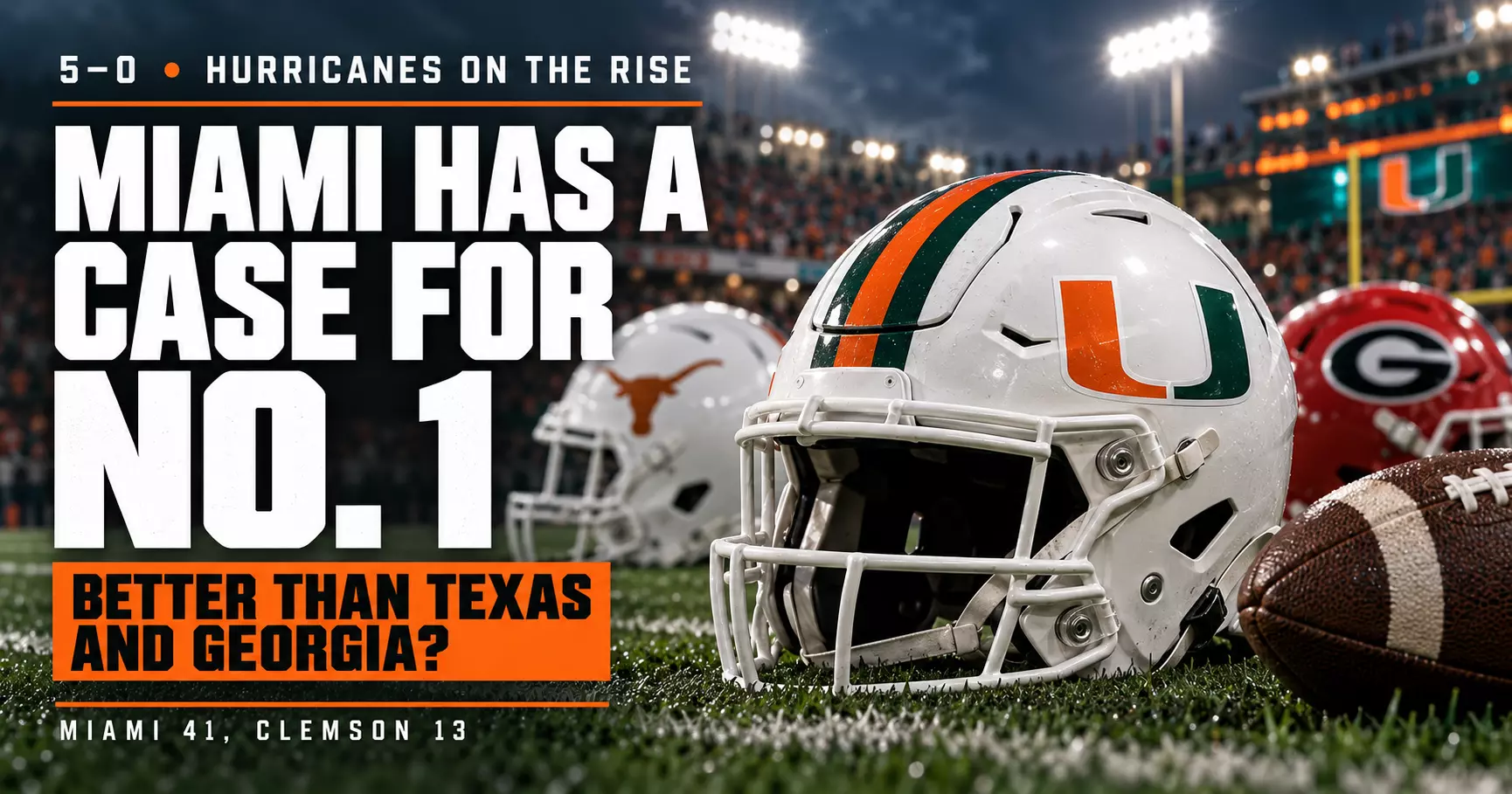
The Hurricanes remained No. 4 behind Texas, Georgia and Notre Dame, although two voters placed Miami first on their ballots.
Miami went into Clemson, won by four touchdowns and stayed exactly where it was in the AP poll.
The Hurricanes remained No. 4 behind Texas, Georgia and Notre Dame, although two voters placed Miami first on their ballots. Texas retained the top spot with 61 first-place votes, while Georgia received six.
That distribution makes the national consensus clear. It does not make the debate closed.
Miami’s 41–13 victory at Clemson strengthened an argument that deserves serious consideration: the Hurricanes belong in the discussion about the best team in college football, and their case involves more than an unbeaten record.
Mario Cristobal’s team is showing it can win away from home, pressure the quarterback and finish games with its running attack. Those are qualities that matter when evaluating championship potential.
Texas has a legitimate claim to No. 1. Georgia does, too. But Miami should be part of that comparison, with its performances examined as closely as those of the teams above it.
Clemson Was a Meaningful Step Forward
The Hurricanes improved to 5–0 overall and 3–0 in ACC play by beating Clemson at Memorial Stadium. The Tigers fell to 3–2.
Clemson’s record prevents anyone from presenting this as a victory over an undefeated powerhouse. That qualification matters.
Still, Miami won a
conference road game
convincingly in an environment where the Hurricanes had not won since 2010. They took the lead early and maintained control through the finish.
There is value in how a contender handles that assignment.
Miami did not need a frantic final possession to escape. It did not spend the evening allowing the crowd to pull Clemson back into the game. The Hurricanes produced enough offense and defensive disruption to make the outcome increasingly clear.
That is the kind of performance that should strengthen a team’s ranking argument, even when the opponent is having an uneven season.
Miami’s Defense Makes the Case More Convincing
The most encouraging part of the Clemson win may have been Miami’s defensive front.
The Hurricanes recorded six sacks and nine tackles for loss while holding Clemson to 55 rushing yards.
Those numbers suggest a team capable of influencing a game without needing its offense to score on every possession.
Against championship contenders, that ability becomes essential. An offense will eventually face a difficult stretch. A quarterback will miss a throw. A promising drive will stall.
A defense that can disrupt protection and limit the running game gives its team another route to victory.
Miami demonstrated that strength Saturday. Clemson produced passing yardage, but the Hurricanes made it difficult for the Tigers to turn possessions into touchdowns.
That distinction matters. Defensive control is measured by more than whether an opponent completes passes. Miami kept Clemson from generating enough points to threaten its advantage seriously.
Darian Mensah Gives the Offense Flexibility
Darian Mensah completed 18 of 27 passes for 227 yards and a touchdown against Clemson, adding another score on the ground. Mark Fletcher Jr. returned to the lineup and rushed for two touchdowns.
Miami therefore did not depend on one form of production.
The Hurricanes could create an explosive passing play, get a contribution from their quarterback’s mobility and finish possessions through their running back.
That flexibility is important against better defenses. An offense that needs everything to work perfectly in the passing game can become vulnerable when protection breaks down or coverage improves.
Miami showed it could keep scoring without producing an overwhelming passing total. Its offense had enough alternatives to maintain control.
The stronger the opponent, the more valuable those alternatives become.
Texas Has the Strongest Résumé Argument
Anyone making Miami’s case needs to acknowledge what Texas has accomplished.
The Longhorns beat Ohio State 24–23 and won 20–17 at Tennessee. Those victories anchor a 4–0 start and give Texas a persuasive argument for remaining first.
Miami does not currently have a victory that matches beating Ohio State.
That is the clearest reason to keep Texas ahead. If the ranking prioritizes the quality of a team’s best wins, the Longhorns have an advantage.
But winning close games and winning decisively reveal different things.
Texas has demonstrated it can finish tight matchups against quality opposition. Miami’s Clemson performance demonstrated its ability to take control and extend an advantage on the road.
Both deserve consideration. Texas’s résumé makes its position defensible, but it should not prevent voters from reassessing the order as new evidence arrives.
Georgia Has Earned Its Position, Too
Georgia is 5–0 after victories that include a 45–17 road win at Arkansas, a 41–13 defeat of Oklahoma and a 38–14 victory over Vanderbilt. The Bulldogs visit Alabama on October 10.
There is nothing flimsy about that start.
Georgia has won comfortably and established a strong current-season case. Miami’s argument should not require dismissing those accomplishments.
The question is how much separation exists between the teams.
Georgia’s upcoming game at Alabama will provide a major new piece of evidence. A convincing victory would strengthen its claim considerably. A difficult performance could make the discussion more open.
Miami should be evaluated within that changing picture. Rankings should reflect what teams have demonstrated, rather than treating the early order as something that can change only after a loss.
The Hurricanes’ first five victories came against Stanford, Florida A&M, Wake Forest, Central Michigan and Clemson. Three of those wins were away from home.
Miami has handled the schedule well, but it has not yet collected the signature win that would make its argument substantially stronger.
That limitation should be acknowledged directly.
Dominating opponents provides evidence of quality. Beating the nation’s best teams provides a different and more demanding kind of evidence. Miami still needs more of the latter.
However, the Hurricanes should receive credit for the performances they have delivered. Their schedule can explain why they remain behind Texas without becoming a reason to ignore everything they do well.
What More Must Miami Accomplish?
The answer begins with continuing to win and maintaining the same balance against stronger competition.
After an open week, Miami hosts Florida State on October 17 and Pittsburgh on October 24. A November 7 trip to Notre Dame stands out as an opportunity to produce a major national statement.
Those games will test whether the Hurricanes’ current strengths travel across different matchups.
Can the defensive front remain disruptive? Can Mensah keep the offense efficient when easy throws disappear? Can the running game finish possessions against opponents better equipped to resist it?
Miami does not need a different identity to move higher. It needs to show that the identity already taking shape holds up against tougher challenges.
The Hurricanes Belong in the Debate
I would not argue that Miami has clearly surpassed Texas on résumé. The Longhorns’ victories over Ohio State and Tennessee deserve substantial weight.
I would argue that Miami’s case is stronger than its distant position in the first-place voting suggests.
The Hurricanes are unbeaten, have won three conference road games and just delivered a convincing performance at Clemson. Their combination of offensive flexibility and defensive pressure gives them a credible championship foundation.
No. 4 is a defensible ranking. It should also be a position Miami can improve through excellent football, rather than a place it must occupy until someone above it loses.
The Hurricanes have more to prove. So does every contender in early October.
Miami has done enough to make the No. 1 discussion a serious football argument—and the coming weeks will give the Hurricanes opportunities to make it stronger.
New Users – Get $350 in Bonus Bets when you wager $5 for 7 days
T&Cs apply
4.6/5
Gambling Problem? Call 1-800-GAMBLER or 1-800-MY-RESET. Call 1-888-789-7777 or visit ccpgg.org/chat (CT). Hope is here. GamblingHelpLineMA.org or call (800) 327-5050 for 24/7 support (MA). Visit www.mdgamblinghelp.org (MD). Call 1-877-8HOPE-NY or text HOPENY (NY). 21+ (18+ DC, WY) and present in select states (for KS, in affiliation with Kansas Star Casino). Find online real money wagering only. Min $5 wager required for 7 consecutive days. $5 free play credit. Bonus issued as non-withdrawable bonus with cash withdrawable bonus with cash withdrawable. Bonus bets which expire 7 days after receipt. Restrictions apply. See terms at sportsbook.fanduel.com. Call 1-877-770-7867 (LA).
Up To $1500 in Bonus Bets Paid Back if your First Bet Does Not Win
T&Cs apply
4.5/5
Gambling problem? Call 1-800-GAMBLER or 1-800-MY-RESET (Available in the US) 877-8-HOPENY or text HOPENY (467369) (NY) 1-800-327-5050 (MA), 1-800-BETS-OFF (IA), 1-800-981-0023 (PR). 21+ only. Please Gamble Responsibly. See BetMGM.com for Terms. First Bet Offer for new customers only (if applicable). Subject to eligibility requirements. Bonus bets are non-withdrawable. In partnership with Kansas Crossing Casino and Hotel. Promotional offers not available in Mississippi, Massachusetts, New York, Ontario, or Puerto Rico.
New DraftKings Customers: Bet $5, Get $200 + 3 Months of NBA League Pass!
T&Cs apply
4.5/5
GAMBLING PROBLEM? CALL 1-800-GAMBLER or 1-800-MY-RESET, (800) 327-5050 or visit gamblinghelplinema.org (MA). Please Gamble Responsibly. 888-789-7777/visit ccpg.org (CT), or visit www.mdgamblinghelp.org (MD), 1-800-981-0023 (PR). 21+ and present in most states. (18+ DC/NH/PR/WY). Void in CAN. Eligibility restrictions apply. On behalf of Boot Hill Casino (KS). Pass-thru of per wager tax may apply in IL. 1 per new Sportsbook customer. $5+ first-time bet req. Max. $200 issued as non-withdrawable Bonus Bets. Stake removed from payout. Reward issued as $50 in Bonus Bets every 7 days via click-to-claim for 21 days. Bonus Bets and click-to-claims expire 7 days (168hrs) after issuance. Terms: dkng.co/offer. Get 1 promo code to redeem a 3-month NBA League Pass subscription, complimentary of DraftKings. Subscription auto-renews monthly at then-current price (currently $16.99/mo); cancel anytime. Terms, restrictions, and eligibility requirements apply. Redeem League Pass by 12/19/26 at 11:59 PM ET. Addt’l terms: support.watch.nba.com/hc/en-us/articles/9165532876183-League-Pass-Terms-of-Use_. Ends 11/29/26 at 11:59 PM ET. Sponsored by DK.
Must be 21+. GAMBLING PROBLEM? CALL 1-800-GAMBLER OR CALL 1-800-MY-RESET, www.mdgamblinghelp.org (MD), (800)-327-5050 or gamblinghelplinema.org (MA), Call (877)8-HOPENY or text HOPENY (467369) (NY), (888) 789-7777 or ccpg.org (CT), morethanagame.nc.gov (NC), 1800gambler.net (WV)
Bet $1 and get double the winnings up to $25 for your next 10 bets
T&Cs apply
4.4/5
21+ New users only. Must register using eligible promo code. First bet after registration must qualify. Max. Bonus Bet: $1,000. Bonus Bet expires 14 days after receipt. Void where prohibited. See Caesars.com/promos for full terms. Gambling Problem? 1-800-GAMBLER (1-800-426-2537)
21+ and present in OH. Gambling Problem? Call 1-800-GAMBLER.
This site is using
Cloudflare
and adheres to the
Google Safe Browsing Program. We adapted
Google's Privacy Guidelines
to keep your data safe at all times.
Close
Ready to Win Big? Join the Elite with Our Sports Betting Deals!
FanDuel Promo
New Users – Get $350 in Bonus Bets when you wager $5 for 7 days
Our Favorite
T&Cs and 21+ apply
Gambling Problem? Call 1-800-GAMBLER or 1-800-MY-RESET. Call 1-888-789-7777 or visit ccpgg.org/chat (CT). Hope is here. GamblingHelpLineMA.org or call (800) 327-5050 for 24/7 support (MA). Visit www.mdgamblinghelp.org (MD). Call 1-877-8HOPE-NY or text HOPENY (NY). 21+ (18+ DC, WY) and present in select states (for KS, in affiliation with Kansas Star Casino). Find online real money wagering only. Min $5 wager required for 7 consecutive days. $5 free play credit. Bonus issued as non-withdrawable bonus with cash withdrawable bonus with cash withdrawable. Bonus bets which expire 7 days after receipt. Restrictions apply. See terms at sportsbook.fanduel.com. Call 1-877-770-7867 (LA).
Code:
Open FanDuel
Get Bonus
BetMGM Promo
Up To $1500 in Bonus Bets Paid Back if your First Bet Does Not Win
Best Slots
T&Cs and 21+ apply
Gambling problem? Call 1-800-GAMBLER or 1-800-MY-RESET (Available in the US) 877-8-HOPENY or text HOPENY (467369) (NY) 1-800-327-5050 (MA), 1-800-BETS-OFF (IA), 1-800-981-0023 (PR). 21+ only. Please Gamble Responsibly. See BetMGM.com for Terms. First Bet Offer for new customers only (if applicable). Subject to eligibility requirements. Bonus bets are non-withdrawable. In partnership with Kansas Crossing Casino and Hotel. Promotional offers not available in Mississippi, Massachusetts, New York, Ontario, or Puerto Rico.
Code:
Open BetMGM
Get Bonus
DraftKings Promo
New DraftKings Customers: Bet $5, Get $200 + 3 Months of NBA League Pass!
Newcomer
T&Cs and 21+ apply
GAMBLING PROBLEM? CALL 1-800-GAMBLER or 1-800-MY-RESET, (800) 327-5050 or visit gamblinghelplinema.org (MA). Please Gamble Responsibly. 888-789-7777/visit ccpg.org (CT), or visit www.mdgamblinghelp.org (MD), 1-800-981-0023 (PR). 21+ and present in most states. (18+ DC/NH/PR/WY). Void in CAN. Eligibility restrictions apply. On behalf of Boot Hill Casino (KS). Pass-thru of per wager tax may apply in IL. 1 per new Sportsbook customer. $5+ first-time bet req. Max. $200 issued as non-withdrawable Bonus Bets. Stake removed from payout. Reward issued as $50 in Bonus Bets every 7 days via click-to-claim for 21 days. Bonus Bets and click-to-claims expire 7 days (168hrs) after issuance. Terms: dkng.co/offer. Get 1 promo code to redeem a 3-month NBA League Pass subscription, complimentary of DraftKings. Subscription auto-renews monthly at then-current price (currently $16.99/mo); cancel anytime. Terms, restrictions, and eligibility requirements apply. Redeem League Pass by 12/19/26 at 11:59 PM ET. Addt’l terms: support.watch.nba.com/hc/en-us/articles/9165532876183-League-Pass-Terms-of-Use_. Ends 11/29/26 at 11:59 PM ET. Sponsored by DK.
Code:
Open DraftKings
Get Bonus
Find out what the legends have to say about sports this week....
New Users – Get $350 in Bonus Bets when you wager $5 for 7 days
Gambling Problem? Call 1-800-GAMBLER or 1-800-MY-RESET. Call 1-888-789-7777 or visit ccpgg.org/chat (CT). Hope is here. GamblingHelpLineMA.org or call (800) 327-5050 for 24/7 support (MA). Visit www.mdgamblinghelp.org (MD). Call 1-877-8HOPE-NY or text HOPENY (NY). 21+ (18+ DC, WY) and present in select states (for KS, in affiliation with Kansas Star Casino). Find online real money wagering only. Min $5 wager required for 7 consecutive days. $5 free play credit. Bonus issued as non-withdrawable bonus with cash withdrawable bonus with cash withdrawable. Bonus bets which expire 7 days after receipt. Restrictions apply. See terms at sportsbook.fanduel.com. Call 1-877-770-7867 (LA).