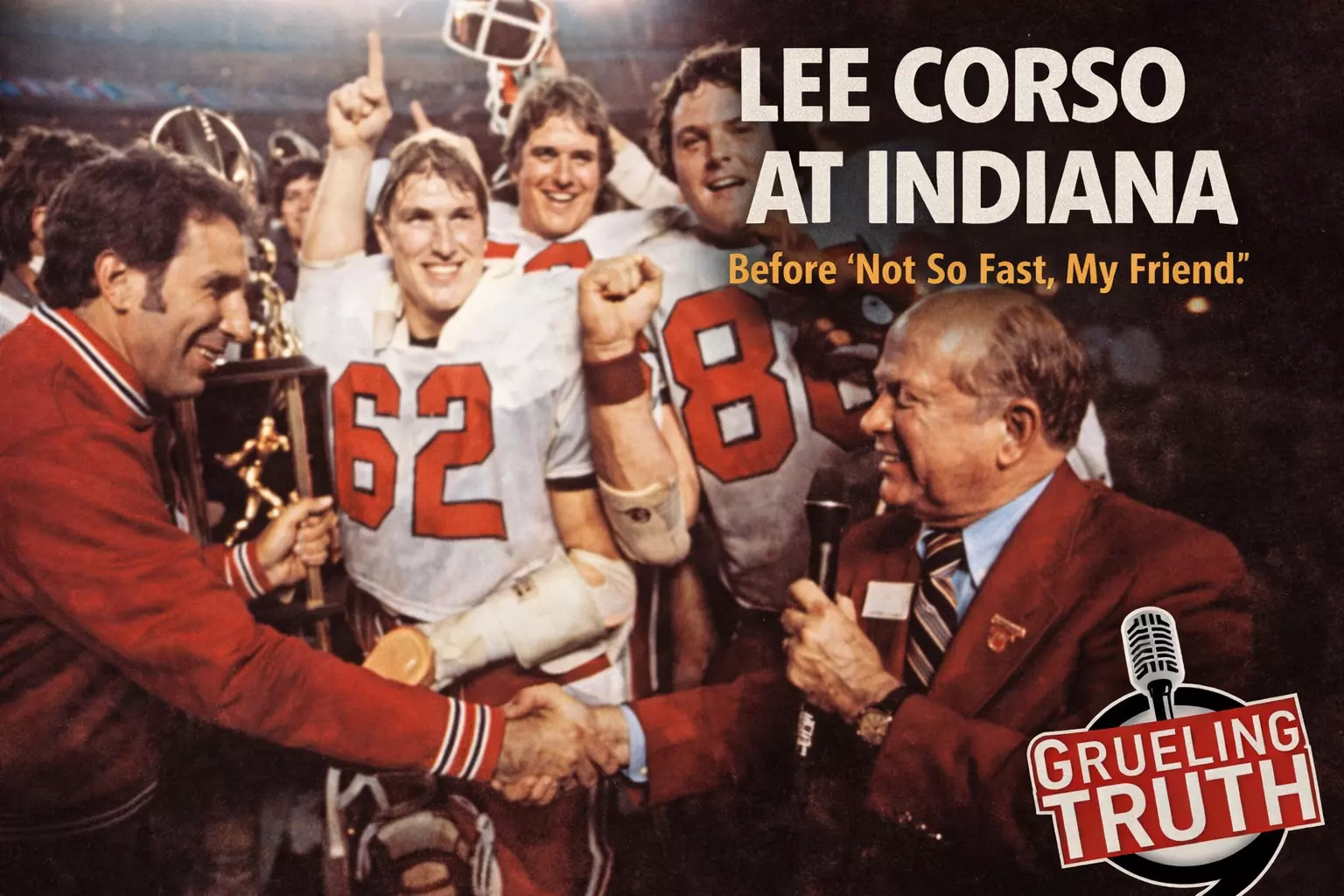
Before Lee Corso became America’s college-football grandpa—before the mascot heads, the one-liners, and the TV legend status—he was
Indiana’s head football coach
from 1973 to 1982, a decade-long stretch that’s way more important (and way weirder) than people remember.
Corso’s Indiana tenure wasn’t a story of sustained dominance. It was a story of
dragging a program out of the basement, occasionally punching above its weight, and doing it with a personality that was already unmistakably
Corso: bold, theatrical, chaotic, and always recruiting like his life depended on it.
And yes—he absolutely did some “only Lee Corso would do that” stuff in Bloomington.
The Context: Indiana Football Was a Grind When Corso Got There
When Corso arrived in Bloomington (hired for the 1973 season), Indiana was not a place you casually turned into a winner. The Big Ten was brutally physical, and IU’s margin for error was basically nonexistent.
Corso’s first three seasons were rough:
1973: 2–9
1974: 1–10
1975: 2–8–1
That start matters because it explains everything that followed: Corso didn’t inherit momentum—he inherited a job where you had to
manufacture belief
any way you could. Sometimes that meant X’s and O’s. Sometimes that meant showmanship.
The Build: 1976–1977 Was the Real Turning Point
Corso’s first real breakthrough came in
1976, when Indiana went
5–6
and, more importantly,
4–4 in the Big Ten—a legitimate step forward.
Then in
1977, Indiana went
5–5–1
with another winning Big Ten mark (4–3–1).
These weren’t “banner” seasons, but in that era at Indiana, they were proof the program could scrap, fight, and scare people.
And this is where Corso’s reputation as a
moment-maker
really showed up.
The Most Famous “Only Corso” Moment: The Scoreboard Photo Timeout
The most infamous Corso story from his IU coaching days is the one that sounds made up—until you realize it fits his personality perfectly.
In a 1976 game against Ohio State, Indiana briefly took a
7–6 lead, and Corso called a timeout so the Hoosiers could
pose for a photo in front of the scoreboard, celebrating the moment. The story has been widely circulated for years, and later retellings note it was done because it was such a rare moment for Indiana to be ahead of OSU.
Whether you view it as hilarious or insane, it tells you exactly who Corso was as a coach:
he understood emotion and momentum as tools.
He wasn’t just coaching a game—he was selling a program.
One version of the story that’s persisted is that the photo was later used for recruiting material—again, totally on-brand for Corso: turn one fleeting moment into a marketing weapon.
1979: The Peak — And a Win That Still Matters in Bloomington
Corso’s signature season at Indiana was
1979.
That team went
8–4
(including
5–3 in the Big Ten) and earned a trip to the
1979 Holiday Bowl.
The opponent was
BYU, undefeated
11–0, ranked in the Top 10, and coached by LaVell Edwards. Indiana was the underdog in a way that would feel familiar to IU fans even today.
Then Indiana won
38–37—a wild, back-and-forth classic that ended with a late Hoosier go-ahead punt-return touchdown and a final BYU field goal attempt that was blocked.
That victory is historically massive for a simple reason:
It was Indiana’s first bowl win in school history.
Indiana finished the season
ranked 16th
in a final national poll (a rarity for the program at the time), and that 1979 team became the central “what if?” touchstone of Corso’s era.
Corso the Coach Was Already Corso the Entertainer
One of the easiest mistakes people make is assuming Corso’s personality was something ESPN created.
Nope.
The coaching version of Corso was already:
a salesman
a promoter
a vibe-setter
a quote machine
and an energy conductor
A perfect example comes right out of the Holiday Bowl coverage. One account describes Corso heading to the postgame press conference, then suddenly turning back and yelling that he needed to go say a prayer with his team first. That’s pure Corso: heartfelt, dramatic, and very “coach-first.”
And if you’ve ever wondered why he became the face of College GameDay, it’s because he wasn’t performing a character—he was just being the same guy who coached Indiana.
The Recruiting Hustle: How Corso Tried to Win at a Place That Didn’t Recruit Itself
Indiana wasn’t going to out-muscle the Big Ten powers with tradition. Corso’s path was to
out-hustle them.
His 1979 bowl team is often described as a product of his “dogged recruiting,” built over years, not overnight.
This is the underappreciated piece of his IU tenure: he wasn’t just coaching Saturdays. He was trying to change what Indiana football could plausibly be Monday through Friday.
Even Indiana University’s own honors biography notes Corso’s significance in program history—highlighting the Holiday Bowl breakthrough, the ranking, and his place among IU’s winningest coaches.
The Full Indiana Record: The Truth and the Legacy
Corso’s decade at IU ended with a cumulative record of
41–68–2.
Because Indiana coaches are judged differently than coaches at built-in power programs. For IU, the legacy isn’t “Did you stack ten-win seasons?” It’s:
Did you create belief?
Did you produce landmark moments?
Did you elevate what the program thought was possible?
Corso did.
He led Indiana to:
Two winning seasons (1979 and 1980)
Its second-ever bowl appearance and first-ever bowl win
A season-ending ranking and a signature upset that still resonates
And he did it with a personality that made Indiana football feel
alive—sometimes ridiculous, sometimes brilliant, always unforgettable.
Why the “Crazy Stuff” Was the Point
The scoreboard photo timeout wasn’t just a gag. It was a window into Corso’s method.
At a program like Indiana in the 1970s, you couldn’t rely on:
blue-chip pipelines
automatic credibility
or national attention
So Corso manufactured moments.
He made the program feel bigger than it was, because that’s how you recruit, build confidence, and get players to believe they belong on the same field as the giants.
Up To $1500 in Bonus Bets Paid Back if your First Bet Does Not Win
T&Cs apply
4.5/5
Gambling problem? Call 1-800-GAMBLER or 1-800-MY-RESET (Available in the US) 877-8-HOPENY or text HOPENY (467369) (NY) 1-800-327-5050 (MA), 1-800-BETS-OFF (IA), 1-800-981-0023 (PR). 21+ only. Please Gamble Responsibly. See BetMGM.com for Terms. First Bet Offer for new customers only (if applicable). Subject to eligibility requirements. Bonus bets are non-withdrawable. In partnership with Kansas Crossing Casino and Hotel. Promotional offers not available in Mississippi, Massachusetts, New York, Ontario, or Puerto Rico.
New DraftKings Customer: SPEND $5, GET $200 IN BONUSES
T&Cs apply
4.5/5
To be eligible for DraftKings Sportsbook and the Promotion, you must be physically located in AR, AZ, CO, CT, DC, IA, IL, IN, KS, KY, LA (select parishes), MA, MD, ME, MI, MO, NC, NJ, NH, NY, OH, OR, PA, PR (residents only), TN, VA, VT, WY, WV, CA-ONT or CA-AB (each an “Eligible Jurisdiction” or, collectively, the “Eligible Jurisdictions”). Must be 21+ years of age or older (18+ if in DC/NH/PR/WY/CA-AB) (19+ in CA-ONT). GAMBLING PROBLEM? CALL 1-800-GAMBLER or 1-800-MY-RESET, (800) 327-5050 or visit gamblinghelplinema.org (MA) Please Gamble Responsibly. 888-789-7777/visit ccpg.org (CT), or visit www.mdgamblinghelp.org (MD), 1-800-981-0023 (PR). 21+ and present in most states. (18+ DC/NH/PR/WY). Void in CAN. Eligibility restrictions apply. On behalf of Boot Hill Casino (KS). Pass-thru of per wager tax may apply in IL. 1 per new DraftKings customer. $5+ first-time bet req. Max. $200 issued as non-withdrawable Bonus Bets. Stake removed from payout. Reward issued as $50 in Bonus Bets every 7 days via click-to-claim for 21 days. Bonus Bets and click-to-claims expire 7 days (168hrs) after issuance. Terms: Promos | DraftKings Sportsbook . Ends 9/20/26 at 11:59 PM ET. Sponsored by DK.
Must be 21+. GAMBLING PROBLEM? CALL 1-800-GAMBLER OR CALL 1-800-MY-RESET, www.mdgamblinghelp.org (MD), (800)-327-5050 or gamblinghelplinema.org (MA), Call (877)8-HOPENY or text HOPENY (467369) (NY), (888) 789-7777 or ccpg.org (CT), morethanagame.nc.gov (NC), 1800gambler.net (WV)
Bet $1 and get double the winnings up to $25 for your next 10 bets
T&Cs apply
4.4/5
21+ New users only. Must register using eligible promo code. First bet after registration must qualify. Max. Bonus Bet: $1,000. Bonus Bet expires 14 days after receipt. Void where prohibited. See Caesars.com/promos for full terms. Gambling Problem? 1-800-GAMBLER (1-800-426-2537)
21+ and present in OH. Gambling Problem? Call 1-800-GAMBLER.
This site is using
Cloudflare
and adheres to the
Google Safe Browsing Program. We adapted
Google's Privacy Guidelines
to keep your data safe at all times.
Close
Ready to Win Big? Join the Elite with Our Sports Betting Deals!
FanDuel Promo
New Users – Get $350 in Bonus Bets when you wager $5 for 7 days
Up To $1500 in Bonus Bets Paid Back if your First Bet Does Not Win
Best Slots
T&Cs and 21+ apply
Gambling problem? Call 1-800-GAMBLER or 1-800-MY-RESET (Available in the US) 877-8-HOPENY or text HOPENY (467369) (NY) 1-800-327-5050 (MA), 1-800-BETS-OFF (IA), 1-800-981-0023 (PR). 21+ only. Please Gamble Responsibly. See BetMGM.com for Terms. First Bet Offer for new customers only (if applicable). Subject to eligibility requirements. Bonus bets are non-withdrawable. In partnership with Kansas Crossing Casino and Hotel. Promotional offers not available in Mississippi, Massachusetts, New York, Ontario, or Puerto Rico.
Code:
Open BetMGM
Get Bonus
DraftKings Promo
New DraftKings Customer: SPEND $5, GET $200 IN BONUSES
Newcomer
T&Cs and 21+ apply
To be eligible for DraftKings Sportsbook and the Promotion, you must be physically located in AR, AZ, CO, CT, DC, IA, IL, IN, KS, KY, LA (select parishes), MA, MD, ME, MI, MO, NC, NJ, NH, NY, OH, OR, PA, PR (residents only), TN, VA, VT, WY, WV, CA-ONT or CA-AB (each an “Eligible Jurisdiction” or, collectively, the “Eligible Jurisdictions”). Must be 21+ years of age or older (18+ if in DC/NH/PR/WY/CA-AB) (19+ in CA-ONT). GAMBLING PROBLEM? CALL 1-800-GAMBLER or 1-800-MY-RESET, (800) 327-5050 or visit gamblinghelplinema.org (MA) Please Gamble Responsibly. 888-789-7777/visit ccpg.org (CT), or visit www.mdgamblinghelp.org (MD), 1-800-981-0023 (PR). 21+ and present in most states. (18+ DC/NH/PR/WY). Void in CAN. Eligibility restrictions apply. On behalf of Boot Hill Casino (KS). Pass-thru of per wager tax may apply in IL. 1 per new DraftKings customer. $5+ first-time bet req. Max. $200 issued as non-withdrawable Bonus Bets. Stake removed from payout. Reward issued as $50 in Bonus Bets every 7 days via click-to-claim for 21 days. Bonus Bets and click-to-claims expire 7 days (168hrs) after issuance. Terms: Promos | DraftKings Sportsbook . Ends 9/20/26 at 11:59 PM ET. Sponsored by DK.
Code:
Open DraftKings
Get Bonus
Find out what the legends have to say about sports this week....