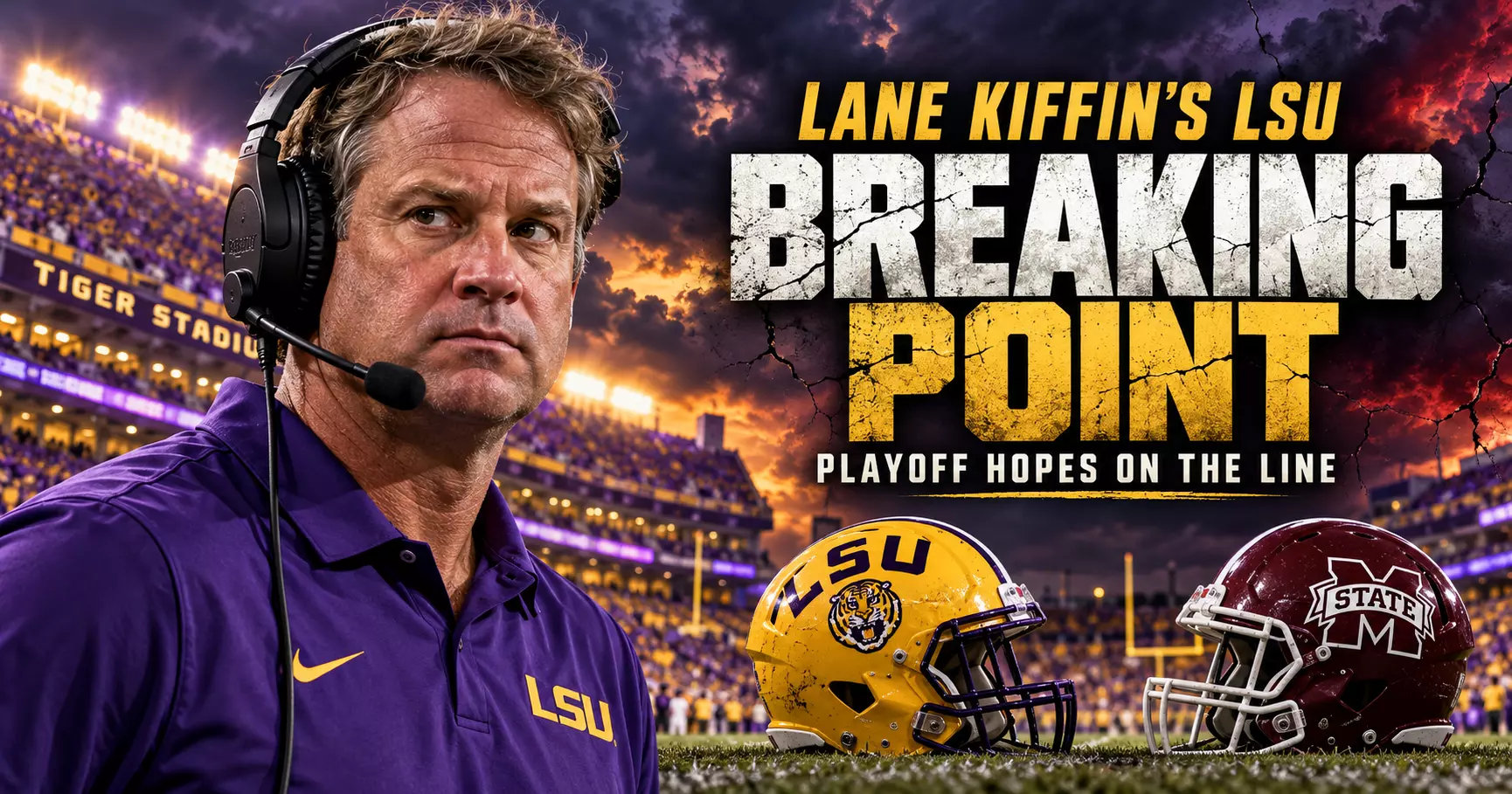
Lane Kiffin arrived at LSU with expectations that extend well beyond making the Tigers entertaining. He will be judged on wins and losses.
Lane Kiffin arrived at LSU with expectations that extend well beyond making the Tigers entertaining. His first season would ultimately be judged by whether offensive firepower could translate into championship contention.
Halfway through the regular season, that question has become considerably more uncomfortable.
LSU is 4–2 after its 35–34 overtime loss at Kentucky, and the Tigers have fallen from No. 10 to No. 22 in the Associated Press poll. No. 16 Mississippi State visits Tiger Stadium on Saturday, October 17, with kickoff scheduled for noon Eastern. Alabama, Texas and a trip to Tennessee still await later in the season.
That makes this more than a chance to recover from an upset. It is a test of whether Kiffin can correct the mistakes threatening to turn a promising debut into a season of missed opportunities.
LSU Has Used Up Much of Its Margin for Error
Two losses do not automatically eliminate a team from
College Football Playoff
consideration. LSU still has opportunities to strengthen its résumé.
But opportunity and flexibility are different things.
The Tigers already lost at Ole Miss before falling in Lexington. A third defeat would make the remaining schedule feel considerably less like an opportunity and considerably more like an obstacle course. Beating highly ranked opponents later would become essential to repairing the damage.
There is also a conference problem. LSU has lost two of its first three SEC games. Falling further behind would increase its dependence on results elsewhere while reducing its own ability to shape the race.
Mississippi State therefore represents an urgent checkpoint. LSU needs to demonstrate that it can play a complete conference game before asking anyone to believe it can survive the more demanding stretch ahead.
The Offense Must Stop Undermining Its Own Work
The Kentucky loss was not evidence that LSU lacks offensive ability. It was evidence that ability alone cannot compensate for wasted possessions.
Kentucky’s official postgame notes show LSU finished with 410 yards, including just 94 net rushing yards. The Wildcats forced two turnovers while committing none. LSU entered averaging 547.8 yards and 43.6 points per game, so Kentucky significantly reduced its usual production.
The most damaging mistake came with LSU protecting a 27–24 fourth-quarter lead. Sam Leavitt lost a fumble while being sacked, returning possession to Kentucky with 4:11 remaining. Earlier, a tipped pass had produced an interception.
Those plays deserve different evaluations. A tipped interception does not necessarily reflect the same decision-making failure as forcing a reckless throw. A sack-fumble involves protection, pocket awareness and ball security.
The staff’s responsibility is to identify what actually failed and make the appropriate correction.
Against Mississippi State, LSU needs dependable early-down production and answers when pressure arrives. An offense that regularly falls into obvious passing situations gives defenders more freedom to attack the quarterback.
Explosive plays remain valuable. But the Tigers also need possessions that end with points, field position or meaningful time removed from the clock.
Defensive Consistency Matters More Than Occasional Stops
LSU’s defense did produce resistance in Lexington. It stopped Kentucky on fourth down after the interception and kept the Tigers within reach.
The trouble was sustaining that resistance.
Kentucky had 401 yards of offense against a defense that entered allowing 220.6 per game. LSU’s own recap documents both a 77-yard CJ Baxter run and a 15-play, 75-yard Kentucky touchdown drive before halftime.
That combination is difficult to survive. Giving up an explosive run allows an opponent to score quickly. Allowing a long touchdown drive lets it control the game without taking comparable risks.
The corrections must begin with sound run fits, tackling and disciplined pursuit. A defender chasing a spectacular play can create the opening that turns an ordinary gain into a decisive one.
LSU also needs cleaner communication near the goal line. Reporting on Kiffin’s postgame review identified a defensive communication error on Kenny Minchey’s winning two-point conversion.
Preparation matters most when everyone in the stadium knows the next snap could decide the game. Getting players aligned and certain of their assignments is a coaching obligation.
That is the kind of concession that changes the entire calculation of a close game. The offense must score again simply to replace points surrendered outside the normal defensive sequence.
Coverage requires coordinated lanes, leverage and secure tackling. A strong punt is not enough if the coverage unit fails to finish the play.
For Kiffin, this is part of the larger challenge of running LSU. The program cannot be assessed only through the offense. Special teams preparation, defensive execution and situational football are all part of the head coach’s responsibility.
Kiffin’s Late Decisions Deserve Scrutiny
Kiffin’s review also included his decision to punt on fourth-and-one from LSU’s 43 with 1:46 remaining. Kentucky subsequently drove for the tying field goal.
The outcome alone does not prove that punting was the wrong decision. Field position and the consequences of a failed conversion matter.
But the choice deserves examination in context. How confident was LSU in gaining one yard? How likely was the defense to prevent Kentucky from reaching field-goal range? What had the game already revealed about both units?
A head coach must weigh those questions before the snap. Once the game is over, describing the decisive moments is useful only if that review improves the next decision.
Mississippi State Is an Opponent LSU Must Respect
The Bulldogs arrive 4–1, with victories over South Carolina and Missouri, after an open week following their loss to Alabama.
Quarterback Kamario Taylor’s availability remains a significant variable. WWL reported Tuesday that a foot injury left his status uncertain ahead of Wednesday’s initial SEC availability report. LSU must prepare for the possibilities rather than assume it will face a weakened offense.
The broader requirement is unchanged: protect the ball, limit explosive gains and execute when the game tightens.
Kiffin’s first LSU season
is still recoverable. A ranked victory would give the Tigers something concrete to build on.
But another performance defined by preventable mistakes would deepen the concern that LSU has the talent to compete without the consistency to finish.
Saturday is the Tigers’ chance to begin closing that gap.
New Users – Get $350 in Bonus Bets when you wager $5 for 7 days
T&Cs apply
4.6/5
Gambling Problem? Call 1-800-GAMBLER or 1-800-MY-RESET. Call 1-888-789-7777 or visit ccpgg.org/chat (CT). Hope is here. GamblingHelpLineMA.org or call (800) 327-5050 for 24/7 support (MA). Visit www.mdgamblinghelp.org (MD). Call 1-877-8HOPE-NY or text HOPENY (NY). 21+ (18+ DC, WY) and present in select states (for KS, in affiliation with Kansas Star Casino). Find online real money wagering only. Min $5 wager required for 7 consecutive days. $5 free play credit. Bonus issued as non-withdrawable bonus with cash withdrawable bonus with cash withdrawable. Bonus bets which expire 7 days after receipt. Restrictions apply. See terms at sportsbook.fanduel.com. Call 1-877-770-7867 (LA).
Up To $1500 in Bonus Bets Paid Back if your First Bet Does Not Win
T&Cs apply
4.5/5
Gambling problem? Call 1-800-GAMBLER or 1-800-MY-RESET (Available in the US) 877-8-HOPENY or text HOPENY (467369) (NY) 1-800-327-5050 (MA), 1-800-BETS-OFF (IA), 1-800-981-0023 (PR). 21+ only. Please Gamble Responsibly. See BetMGM.com for Terms. First Bet Offer for new customers only (if applicable). Subject to eligibility requirements. Bonus bets are non-withdrawable. In partnership with Kansas Crossing Casino and Hotel. Promotional offers not available in Mississippi, Massachusetts, New York, Ontario, or Puerto Rico.
New DraftKings Customers: Bet $5, Get $200 + 3 Months of NBA League Pass!
T&Cs apply
4.5/5
GAMBLING PROBLEM? CALL 1-800-GAMBLER or 1-800-MY-RESET, (800) 327-5050 or visit gamblinghelplinema.org (MA). Please Gamble Responsibly. 888-789-7777/visit ccpg.org (CT), or visit www.mdgamblinghelp.org (MD), 1-800-981-0023 (PR). 21+ and present in most states. (18+ DC/NH/PR/WY). Void in CAN. Eligibility restrictions apply. On behalf of Boot Hill Casino (KS). Pass-thru of per wager tax may apply in IL. 1 per new Sportsbook customer. $5+ first-time bet req. Max. $200 issued as non-withdrawable Bonus Bets. Stake removed from payout. Reward issued as $50 in Bonus Bets every 7 days via click-to-claim for 21 days. Bonus Bets and click-to-claims expire 7 days (168hrs) after issuance. Terms: dkng.co/offer. Get 1 promo code to redeem a 3-month NBA League Pass subscription, complimentary of DraftKings. Subscription auto-renews monthly at then-current price (currently $16.99/mo); cancel anytime. Terms, restrictions, and eligibility requirements apply. Redeem League Pass by 12/19/26 at 11:59 PM ET. Addt’l terms: support.watch.nba.com/hc/en-us/articles/9165532876183-League-Pass-Terms-of-Use_. Ends 11/29/26 at 11:59 PM ET. Sponsored by DK.
Must be 21+. GAMBLING PROBLEM? CALL 1-800-GAMBLER OR CALL 1-800-MY-RESET, www.mdgamblinghelp.org (MD), (800)-327-5050 or gamblinghelplinema.org (MA), Call (877)8-HOPENY or text HOPENY (467369) (NY), (888) 789-7777 or ccpg.org (CT), morethanagame.nc.gov (NC), 1800gambler.net (WV)
Bet $1 and get double the winnings up to $25 for your next 10 bets
T&Cs apply
4.4/5
21+ New users only. Must register using eligible promo code. First bet after registration must qualify. Max. Bonus Bet: $1,000. Bonus Bet expires 14 days after receipt. Void where prohibited. See Caesars.com/promos for full terms. Gambling Problem? 1-800-GAMBLER (1-800-426-2537)
21+ and present in OH. Gambling Problem? Call 1-800-GAMBLER.
This site is using
Cloudflare
and adheres to the
Google Safe Browsing Program. We adapted
Google's Privacy Guidelines
to keep your data safe at all times.
Close
Ready to Win Big? Join the Elite with Our Sports Betting Deals!
FanDuel Promo
New Users – Get $350 in Bonus Bets when you wager $5 for 7 days
Our Favorite
T&Cs and 21+ apply
Gambling Problem? Call 1-800-GAMBLER or 1-800-MY-RESET. Call 1-888-789-7777 or visit ccpgg.org/chat (CT). Hope is here. GamblingHelpLineMA.org or call (800) 327-5050 for 24/7 support (MA). Visit www.mdgamblinghelp.org (MD). Call 1-877-8HOPE-NY or text HOPENY (NY). 21+ (18+ DC, WY) and present in select states (for KS, in affiliation with Kansas Star Casino). Find online real money wagering only. Min $5 wager required for 7 consecutive days. $5 free play credit. Bonus issued as non-withdrawable bonus with cash withdrawable bonus with cash withdrawable. Bonus bets which expire 7 days after receipt. Restrictions apply. See terms at sportsbook.fanduel.com. Call 1-877-770-7867 (LA).
Code:
Open FanDuel
Get Bonus
BetMGM Promo
Up To $1500 in Bonus Bets Paid Back if your First Bet Does Not Win
Best Slots
T&Cs and 21+ apply
Gambling problem? Call 1-800-GAMBLER or 1-800-MY-RESET (Available in the US) 877-8-HOPENY or text HOPENY (467369) (NY) 1-800-327-5050 (MA), 1-800-BETS-OFF (IA), 1-800-981-0023 (PR). 21+ only. Please Gamble Responsibly. See BetMGM.com for Terms. First Bet Offer for new customers only (if applicable). Subject to eligibility requirements. Bonus bets are non-withdrawable. In partnership with Kansas Crossing Casino and Hotel. Promotional offers not available in Mississippi, Massachusetts, New York, Ontario, or Puerto Rico.
Code:
Open BetMGM
Get Bonus
DraftKings Promo
New DraftKings Customers: Bet $5, Get $200 + 3 Months of NBA League Pass!
Newcomer
T&Cs and 21+ apply
GAMBLING PROBLEM? CALL 1-800-GAMBLER or 1-800-MY-RESET, (800) 327-5050 or visit gamblinghelplinema.org (MA). Please Gamble Responsibly. 888-789-7777/visit ccpg.org (CT), or visit www.mdgamblinghelp.org (MD), 1-800-981-0023 (PR). 21+ and present in most states. (18+ DC/NH/PR/WY). Void in CAN. Eligibility restrictions apply. On behalf of Boot Hill Casino (KS). Pass-thru of per wager tax may apply in IL. 1 per new Sportsbook customer. $5+ first-time bet req. Max. $200 issued as non-withdrawable Bonus Bets. Stake removed from payout. Reward issued as $50 in Bonus Bets every 7 days via click-to-claim for 21 days. Bonus Bets and click-to-claims expire 7 days (168hrs) after issuance. Terms: dkng.co/offer. Get 1 promo code to redeem a 3-month NBA League Pass subscription, complimentary of DraftKings. Subscription auto-renews monthly at then-current price (currently $16.99/mo); cancel anytime. Terms, restrictions, and eligibility requirements apply. Redeem League Pass by 12/19/26 at 11:59 PM ET. Addt’l terms: support.watch.nba.com/hc/en-us/articles/9165532876183-League-Pass-Terms-of-Use_. Ends 11/29/26 at 11:59 PM ET. Sponsored by DK.
Code:
Open DraftKings
Get Bonus
Find out what the legends have to say about sports this week....
New Users – Get $350 in Bonus Bets when you wager $5 for 7 days
Gambling Problem? Call 1-800-GAMBLER or 1-800-MY-RESET. Call 1-888-789-7777 or visit ccpgg.org/chat (CT). Hope is here. GamblingHelpLineMA.org or call (800) 327-5050 for 24/7 support (MA). Visit www.mdgamblinghelp.org (MD). Call 1-877-8HOPE-NY or text HOPENY (NY). 21+ (18+ DC, WY) and present in select states (for KS, in affiliation with Kansas Star Casino). Find online real money wagering only. Min $5 wager required for 7 consecutive days. $5 free play credit. Bonus issued as non-withdrawable bonus with cash withdrawable bonus with cash withdrawable. Bonus bets which expire 7 days after receipt. Restrictions apply. See terms at sportsbook.fanduel.com. Call 1-877-770-7867 (LA).