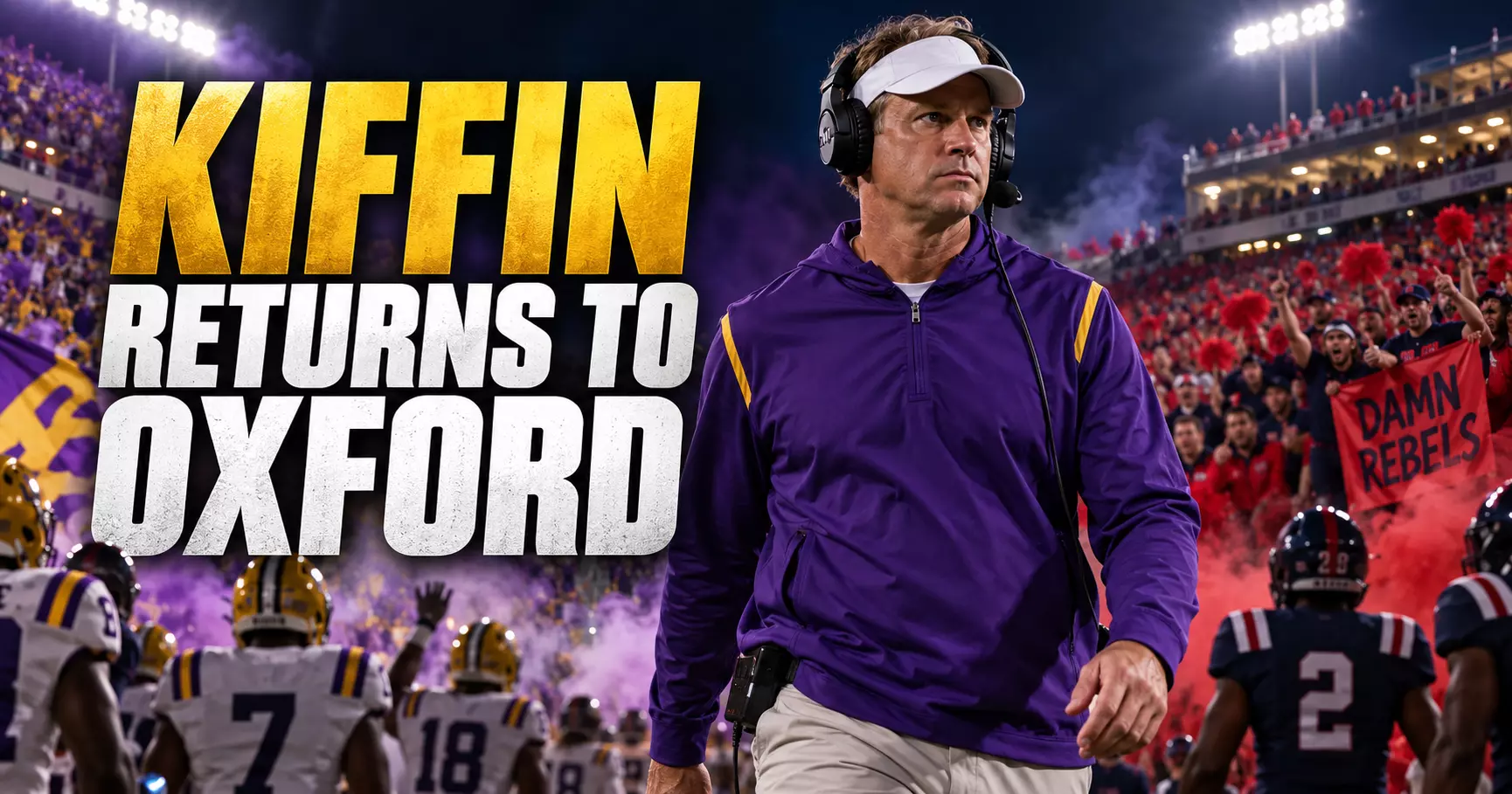
Lane Kiffin knew this day was coming when he walked away from Ole Miss. He knew there would eventually be a Saturday when he had to return
Lane Kiffin knew this day was coming when he walked away from Ole Miss.
He knew there would eventually be a Saturday when he had to return to Oxford wearing the colors of another SEC program. He knew the fan base that once embraced his personality, defended his antics and celebrated his success would be waiting for him.
What Kiffin probably could not have predicted was just how enormous the occasion would become.
No. 7 LSU travels to face No. 8 Ole Miss on Saturday night in one of the most emotionally charged regular-season games college football has seen in years. Both teams are undefeated. ESPN’s College GameDay will be in Oxford. The winner will emerge as a serious SEC championship
and College Football Playoff contender.
The loser will carry much more than a single defeat.
This is Lane Kiffin returning to the program he helped rebuild. It is Pete Golding attempting to protect what Kiffin left behind. It is an Ole Miss fan base receiving its first opportunity to express exactly how it feels about the coach who took the Rebels to the playoff and then departed for a conference rival before the postseason began.
The Magnolia Bowl has always been personal.
This year, it feels combustible.
Kiffin Built Ole Miss—and Then Left Before the Finish
Kiffin coached Ole Miss from 2020 through the 2025 regular season, transforming the Rebels from an inconsistent SEC program into a legitimate national contender.
He modernized the offense, elevated recruiting, embraced the transfer portal and gave Ole Miss an identity that extended well beyond Mississippi. The Rebels became relevant nationally because Kiffin made them aggressive, entertaining and unpredictable.
Then came the opportunity at LSU.
Kiffin left Oxford after guiding Ole Miss to the 2025 College Football Playoff. He did not remain with the Rebels for their postseason run, choosing instead to begin building his new program in Baton Rouge.
That detail matters.
Coaches leave programs every year. College football stopped pretending loyalty was permanent a long time ago. But abandoning a team before the most important postseason in school history created a different level of anger.
Ole Miss was no longer waiting for Kiffin to deliver a breakthrough. The breakthrough had arrived, and he left before the program could finish it.
Golding, Kiffin’s defensive coordinator, inherited the team and guided the Rebels into the playoff semifinals. The players proved the program was larger than the coach who had assembled it.
Now Kiffin must walk back into Vaught-Hemingway Stadium and face the consequences of his decision.
Oxford Is Preparing for More Than a Football Game
Ole Miss officials understand the level of emotion surrounding Kiffin’s return.
The school has increased its security presence for Saturday, bringing in reinforcements and mounted patrols from Mobile and New Orleans to assist local authorities. The additional officers will monitor downtown Oxford, the areas surrounding the stadium and the expected overflow of visitors.
Athletic director Keith Carter called it the biggest game of the year and acknowledged that Ole Miss must be prepared for every possible scenario.
That does not mean officials expect violence. It means they understand that this is not a typical conference game.
Ole Miss has encouraged fans to remain respectful while still creating the kind of hostile environment that can affect LSU’s offense. Golding wants the stadium loud and intimidating without allowing the anger toward Kiffin to damage the reputation of the university.
That will be a difficult balance.
Kiffin did not leave for the NFL or a program in another conference. He left for LSU, an annual opponent with greater resources, more national championships and the ability to recruit many of the same players Ole Miss wants.
To Rebels fans, this was not simply a coach accepting another job. It was Kiffin taking everything he learned and built in Oxford and attempting to use it against them.
Saturday is their first opportunity to answer.
Pete Golding Knows Kiffin Better Than Anyone
The coaching matchup may be just as fascinating as the personal drama.
Golding spent more than three seasons working beside Kiffin. He knows Kiffin’s offensive philosophy, his tendencies and the defensive looks that create the most frustration for him.
Kiffin understands that familiarity could benefit Ole Miss.
Head coaches frequently tell their defensive coordinators which schemes and coverages cause problems for their offenses. Golding spent years listening to Kiffin identify the pressures, fronts and adjustments he did not want to face.
Now he can use that information against him.
Kiffin also knows Golding’s defensive system. He understands how Golding disguises pressure, changes coverages and attempts to create negative plays. There will be very few genuine strategic surprises between the two staffs.
The decisive factor may be which coach can break from familiar tendencies.
Golding cannot simply call the defense Kiffin watched throughout their years together. Kiffin cannot expect the concepts that worked at Ole Miss to succeed automatically against a coach who helped design many of them.
Their relationship remains friendly away from football, but Saturday will test how much professional separation exists between them.
Golding inherited Kiffin’s office. He even purchased Kiffin’s former Oxford house. Now he has an opportunity to claim full ownership of the program Kiffin left behind.
LSU Has Looked Dominant—and Vulnerable
Kiffin’s LSU tenure began with a statement.
The Tigers demolished Clemson 51–10, accumulating 644 yards while holding the Tigers to just 72. LSU rushed for 248 yards and controlled the game in every phase. It was precisely the kind of debut that justified the excitement surrounding Kiffin’s arrival.
LSU followed that performance with a 45–14 victory over Louisiana Tech, but the game exposed problems Ole Miss can exploit.
Quarterback Sam Leavitt threw three first-quarter interceptions before recovering to finish with 344 passing yards, one passing touchdown and three rushing scores. LSU committed four turnovers, allowed five sacks and accumulated more than 100 penalty yards.
Those mistakes did not matter against Louisiana Tech. They will matter in Oxford.
LSU cannot begin slowly and allow Ole Miss to turn the crowd into a participant. An early turnover, protection breakdown or unnecessary penalty could create the emotional avalanche the Tigers must avoid.
Kiffin’s team has been powerful once it settles into games. The concern is how long that settling process has taken.
Against Ole Miss, LSU may not receive enough time to recover.
Ole Miss Has Its Own Offensive Weapons
The Rebels are not merely a motivated team playing at home. They are talented enough to beat LSU without relying on emotion.
Quarterback Trinidad Chambliss returned after leading Ole Miss through its playoff run. At 24 years old, he plays with the maturity and patience expected from a veteran who has experienced major postseason games.
Chambliss completed 23 of 26 passes for 225 yards and two touchdowns in Ole Miss’ 41–9 victory over Charlotte.
Running back Kewan Lacy
added 87 rushing yards and two scores, extending his touchdown streak to 11 consecutive games.
The Rebels accumulated 420 yards and built a 27–0 halftime advantage.
Chambliss and Lacy present a particularly uncomfortable challenge for Kiffin because he helped bring both players to Ole Miss. He understands their strengths, but they also understand the expectations and tendencies of his offense.
Chambliss rarely puts the ball in danger. Lacy’s footwork prevents defenders from consistently creating negative plays. Together, they give Ole Miss a backfield capable of controlling the game and keeping LSU’s offense on the sideline.
Kiffin has attempted to place the pressure on the Rebels by pointing to their 13 victories last season, returning stars and lengthy home winning streak.
That is vintage Kiffin: redirect the expectations, create an underdog mentality and allow the hostility toward him to become a source of energy for his new team.
Ole Miss cannot allow itself to play the emotional game Kiffin wants.
Golding Must Keep Emotion From Becoming Recklessness
There is an obvious danger for Ole Miss.
The Rebels will enter the game desperate to punish their former coach. The crowd will react to every tackle, penalty and sideline camera shot of Kiffin. Players who remained at Ole Miss may feel responsible for delivering a victory to the fans who supported them.
That energy can be valuable. It can also become destructive.
Ole Miss cannot afford personal fouls, late hits or emotional mistakes. The Rebels cannot spend the opening quarter chasing one spectacular play when disciplined football would be enough.
Golding’s most important responsibility may be convincing his players that revenge does not require recklessness.
The best response to Kiffin’s departure is not a confrontation before the game or an unnecessary penalty after the whistle. It is executing assignments, forcing turnovers and sending LSU back to Baton Rouge with a conference loss.
Nothing Ole Miss says about Kiffin will carry as much force as the final score.
The SEC and Playoff Stakes Are Enormous
The drama surrounding Kiffin may dominate the coverage, but the football stakes are just as significant.
This is the first time in 64 years that LSU and Ole Miss have met with both teams ranked inside the top 10. The winner will improve to 3–0 and secure one of the strongest victories of the young season.
For LSU, winning would validate Kiffin’s immediate rebuilding job and prove the Tigers can survive an elite opponent in a hostile environment. It would also give Kiffin something he desperately wants: evidence that leaving Ole Miss was the correct decision.
For the Rebels, a victory would establish Golding as more than the caretaker of Kiffin’s program. It would prove that Ole Miss can remain a national contender without the coach who led its rise.
The expanded playoff provides both teams some protection. A loss will not automatically eliminate either program.
But the emotional damage could linger.
If LSU loses, Kiffin will face questions about whether he underestimated the program he left behind. If Ole Miss loses, the Rebels will have to watch their former coach celebrate on the field they once believed belonged to him.
That is what makes Saturday different.
Ole Miss Has Been Waiting for This
Kiffin has attempted to make the game about preparation, execution and players rather than coaches. He is correct in the most literal sense. He will not throw a touchdown, make a tackle or chase Chambliss out of the pocket.
But pretending this is just another game would be dishonest.
Kiffin made Ole Miss nationally relevant. He also left the Rebels at the moment they needed him most. Both realities can exist at the same time.
Saturday night is not about erasing what Kiffin accomplished in Oxford. It is about determining whether Ole Miss can take the next step without him.
Golding has the team. Kiffin has the LSU resources he wanted. Both programs are undefeated, ranked in the top 10 and positioned to chase the playoff.
There will be mounted police outside the stadium, more than 60,000 angry fans inside it and two coaches who know almost everything about the other.
Up To $1500 in Bonus Bets Paid Back if your First Bet Does Not Win
T&Cs apply
4.5/5
Gambling problem? Call 1-800-GAMBLER or 1-800-MY-RESET (Available in the US) 877-8-HOPENY or text HOPENY (467369) (NY) 1-800-327-5050 (MA), 1-800-BETS-OFF (IA), 1-800-981-0023 (PR). 21+ only. Please Gamble Responsibly. See BetMGM.com for Terms. First Bet Offer for new customers only (if applicable). Subject to eligibility requirements. Bonus bets are non-withdrawable. In partnership with Kansas Crossing Casino and Hotel. Promotional offers not available in Mississippi, Massachusetts, New York, Ontario, or Puerto Rico.
New DraftKings Customers: Spend $5+ Get $150 in Bonuses
T&Cs apply
4.5/5
GAMBLING PROBLEM? CALL 1-800-GAMBLER or 1-800-MY-RESET, (800) 327-5050 or visit gamblinghelplinema.org (MA). Please Gamble Responsibly. 888-789-7777/visit ccpg.org (CT), or visit www.mdgamblinghelp.org (MD), 1-800-981-0023 (PR). 21+ and present in most states. (18+ DC/NH/PR/WY). Void in CAN. Eligibility restrictions apply. On behalf of Boot Hill Casino (KS). Pass-thru of per wager tax may apply in IL. 1 per new DraftKings customer. $5+ first-time bet req. Max. $150 issued as non-withdrawable Bonus Bets. Stake removed from payout. Reward issued as $50 in Bonus Bets every 7 days via click-to-claim for 14 days. Bonus Bets and click-to-claims expire 7 days (168hrs) after issuance. Terms: sportsbook.draftkings.com/promos. Ends 10/11/26 at 11:59 PM ET. Sponsored by DK.
Must be 21+. GAMBLING PROBLEM? CALL 1-800-GAMBLER OR CALL 1-800-MY-RESET, www.mdgamblinghelp.org (MD), (800)-327-5050 or gamblinghelplinema.org (MA), Call (877)8-HOPENY or text HOPENY (467369) (NY), (888) 789-7777 or ccpg.org (CT), morethanagame.nc.gov (NC), 1800gambler.net (WV)
Bet $1 and get double the winnings up to $25 for your next 10 bets
T&Cs apply
4.4/5
21+ New users only. Must register using eligible promo code. First bet after registration must qualify. Max. Bonus Bet: $1,000. Bonus Bet expires 14 days after receipt. Void where prohibited. See Caesars.com/promos for full terms. Gambling Problem? 1-800-GAMBLER (1-800-426-2537)
21+ and present in OH. Gambling Problem? Call 1-800-GAMBLER.
This site is using
Cloudflare
and adheres to the
Google Safe Browsing Program. We adapted
Google's Privacy Guidelines
to keep your data safe at all times.
Close
Ready to Win Big? Join the Elite with Our Sports Betting Deals!
FanDuel Promo
New Users – Get $250 in Bonus Bets when you wager $5 for 5 days
Up To $1500 in Bonus Bets Paid Back if your First Bet Does Not Win
Best Slots
T&Cs and 21+ apply
Gambling problem? Call 1-800-GAMBLER or 1-800-MY-RESET (Available in the US) 877-8-HOPENY or text HOPENY (467369) (NY) 1-800-327-5050 (MA), 1-800-BETS-OFF (IA), 1-800-981-0023 (PR). 21+ only. Please Gamble Responsibly. See BetMGM.com for Terms. First Bet Offer for new customers only (if applicable). Subject to eligibility requirements. Bonus bets are non-withdrawable. In partnership with Kansas Crossing Casino and Hotel. Promotional offers not available in Mississippi, Massachusetts, New York, Ontario, or Puerto Rico.
Code:
Open BetMGM
Get Bonus
DraftKings Promo
New DraftKings Customers: Spend $5+ Get $150 in Bonuses
Newcomer
T&Cs and 21+ apply
GAMBLING PROBLEM? CALL 1-800-GAMBLER or 1-800-MY-RESET, (800) 327-5050 or visit gamblinghelplinema.org (MA). Please Gamble Responsibly. 888-789-7777/visit ccpg.org (CT), or visit www.mdgamblinghelp.org (MD), 1-800-981-0023 (PR). 21+ and present in most states. (18+ DC/NH/PR/WY). Void in CAN. Eligibility restrictions apply. On behalf of Boot Hill Casino (KS). Pass-thru of per wager tax may apply in IL. 1 per new DraftKings customer. $5+ first-time bet req. Max. $150 issued as non-withdrawable Bonus Bets. Stake removed from payout. Reward issued as $50 in Bonus Bets every 7 days via click-to-claim for 14 days. Bonus Bets and click-to-claims expire 7 days (168hrs) after issuance. Terms: sportsbook.draftkings.com/promos. Ends 10/11/26 at 11:59 PM ET. Sponsored by DK.
Code:
Open DraftKings
Get Bonus
Find out what the legends have to say about sports this week....