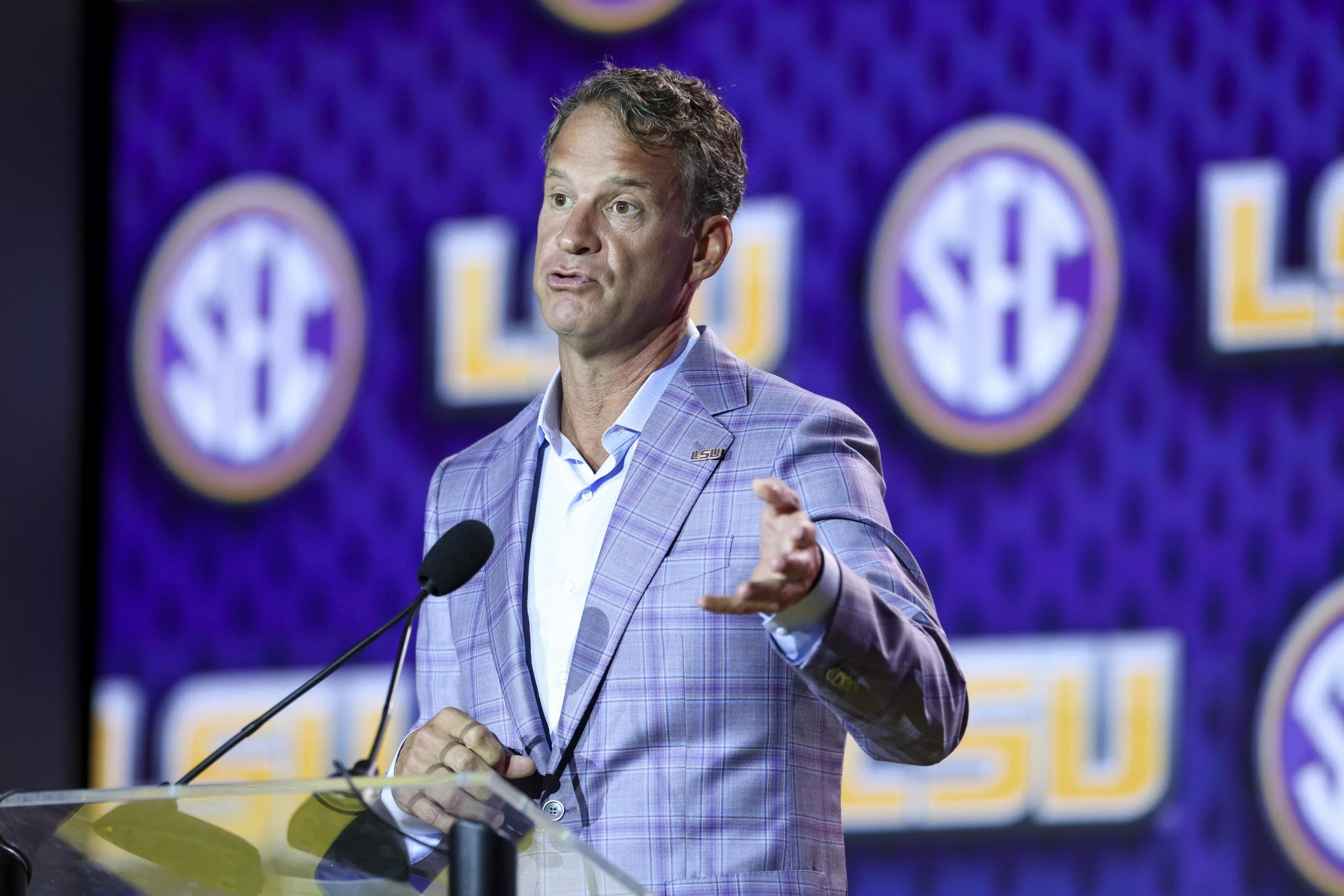
Jul 23, 2026; Tampa, FL, USA; LSU Tigers head coach Lane Kiffin speaks to the press during SEC Football Kickoff Media Day at the Tampa Marriott. Mandatory Credit: Nathan Ray Seebeck-Imagn Images
Lane Kiffin has spent his entire coaching career searching for an edge. If a rule provides flexibility, Kiffin will test its limits. If the transfer portal presents an opportunity, he will move faster than everyone else. If college football creates a loophole, he will drive an equipment truck through it.
Now, in his first season at LSU, Kiffin is attempting something that would have been unimaginable only a few years ago: adding players to his college roster after they signed NFL contracts and participated in professional training camps.
The SEC does not like it. Other coaches do not like it. Conference administrators are fighting it in court.
Kiffin does not appear particularly concerned.
He was hired to win football games, and if a Louisiana judge says recently released NFL players are eligible to return to college, Kiffin intends to recruit them.
“All of a sudden, there’s some players in a new portal,” Kiffin said when discussing the extraordinary development.
That sentence perfectly summarizes the current state of college football. The transfer portal was already being used like professional free agency. Kiffin has simply expanded it to include actual NFL free agents.
Dae’Quan Wright Could Make College Football History
The player at the center of the controversy is tight end
Dae’Quan Wright, who played for Kiffin at Ole Miss before pursuing an NFL opportunity.
Wright caught 39 passes for 635 yards and five touchdowns for Ole Miss in 2025. He scored in the Rebels’ College Football Playoff semifinal loss to Miami and earned second-team All-SEC recognition. He finished his college career with 113 receptions for 1,603 yards after playing at Virginia Tech and Ole Miss.
After the season, Wright signed with the Philadelphia Eagles as an undrafted free agent. The Cleveland Browns later claimed him off waivers before releasing him in August.
Under the traditional understanding of NCAA eligibility, that should have ended Wright’s college career. He signed an NFL contract, joined professional organizations and participated in the NFL roster process.
But traditional NCAA rules are being challenged—and frequently defeated—in courtrooms across the country.
Wright joined litigation arguing that he should receive another season of college eligibility. A Louisiana judge granted temporary protection to Wright and other athletes, opening a path for them to return. Wright then agreed to join LSU, where he would reunite with Kiffin.
He participated in LSU’s Monday walk-through, although the NCAA’s seven-day acclimatization requirement prevents him from playing in the season opener against Clemson. If his eligibility survives the legal fight, Wright could become the first player to leave an NFL roster and return to college football during the same season.
That would not merely represent another change to college football. It would erase another remaining boundary between college and professional sports.
Wright May Not Be the Only Former NFL Player Headed to LSU
Kiffin’s ambitions extend beyond one tight end.
Former Ole Miss defensive tackle Zxavian Harris is another plaintiff seeking to continue his college career. The 6-foot-8 defensive lineman started all 15 games for Ole Miss last season before signing with the New Orleans Saints.
Like Wright, Harris has professional experience but is pursuing an additional college season through the courts. If the legal order remains in place and LSU completes the move before its roster deadline, Harris could follow Kiffin from Oxford to Baton Rouge after spending time in the NFL.
Kiffin also explored bringing back LSU edge rusher Jack Pyburn.
Pyburn played three seasons at Florida before transferring to LSU for the 2025 season. He then signed with Tampa Bay as an undrafted free agent and recorded four preseason sacks, tying for the lead among NFL edge defenders. Tampa Bay waived him, and Kiffin reportedly hoped to return him to LSU.
That possibility ended when the Kansas City Chiefs claimed Pyburn off waivers. The NFL, not the SEC, ultimately stopped that potential addition.
LSU has also added former Notre Dame pass rusher Junior Tuihalamaka, who received another year of eligibility but did not sign a professional contract. His situation is legally different from Wright’s and Harris’, but it reflects the same philosophy: if a talented player becomes eligible, Kiffin will pursue him immediately.
The message is obvious.
Kiffin is not waiting for college football to decide what it wants to become. He is constructing his roster according to what the rules and courts currently permit.
The SEC Tried to Close the Door
The SEC responded quickly once it became clear that LSU could place former
NFL players
on its 2026 roster.
The conference adopted a rule prohibiting athletes from competing in the SEC after signing professional contracts, appearing on professional rosters or declaring for a professional draft without properly withdrawing.
The SEC’s presidents and chancellors approved the measure 15–0. LSU abstained.
Interestingly, the conference’s athletic directors had previously approved the restriction unanimously, including LSU athletic director Verge Ausberry. That means LSU’s administration initially supported stopping former professionals from returning before Kiffin began assembling a roster that could benefit from the court order.
The SEC rule also covered former NBA and WNBA players, making it a broader effort to preserve a clear separation between college and professional sports. The Big Ten adopted a similar restriction.
The SEC threatened penalties against schools and coaches who used players with professional experience. That gave the conference a potential mechanism to punish LSU even if the NCAA or a court declared the players eligible.
Then the court intervened again.
Judge William Jorden of Louisiana’s 19th Judicial District Court issued a temporary restraining order preventing the SEC and commissioner Greg Sankey from enforcing the new rule. The judge also ordered the SEC and NCAA to appear in court and explain why the conference’s penalties should not be considered a violation of the existing order.
The SEC has emphasized that the restraining order is temporary and does not represent a final ruling on the merits. The conference plans to defend its authority as a voluntary association and its ability to establish competitive standards for member institutions.
A hearing is scheduled for Thursday. LSU must finalize its roster Friday. The Tigers open against Clemson on Saturday.
College football’s newest eligibility battle could not have produced a more dramatic timeline.
Kiffin Says LSU’s Players Support the Additions
One of the strongest arguments against adding former NFL players concerns the athletes already on the roster.
Players participated in winter workouts, spring practice and fall camp believing they were competing for established roles. A former professional player arriving days before the opener could immediately take snaps—or even a roster position—away from someone who spent months inside the program.
Kiffin says he considered that issue.
According to the LSU coach, the program consulted its player leadership group about pursuing players released by NFL teams. Kiffin said the response was unanimous: if the additions could help LSU win, the players supported bringing them in.
That reaction should not be surprising.
College football players understand the environment better than anyone. They have watched programs recruit over them through the transfer portal. They have seen teammates leave for better financial opportunities. They know coaches can be fired or leave for another job without warning.
LSU players want to win a national championship. If adding an experienced tight end or defensive lineman improves their chances, many will accept the increased competition.
Kiffin’s responsibility is not to protect feelings. It is to construct the strongest legal roster possible.
That does not mean every player will be happy. It means Kiffin is behaving like the general manager of a professional organization—which is effectively what modern college football requires.
The SEC’s Competitive-Fairness Argument Is Understandable
Kiffin’s actions
may be legal under the temporary court order, but the SEC’s concerns are legitimate.
Allowing players to move from college to the NFL and back again could create complete roster chaos. A player could participate in NFL training camp, receive professional coaching, collect compensation and return to college immediately after being released.
If the most powerful programs can offer attractive NIL packages, players might view NFL camp as a risk-free tryout. Make the team, and they begin a professional career. Get released, and they return to college with additional experience and potentially more earning power.
That arrangement would provide wealthy programs another method for adding experienced talent late in the offseason. It could also reduce opportunities for younger players and make roster management nearly impossible.
There is also the question of where eligibility should finally end.
If signing an NFL contract no longer closes a player’s college career, what does? Could a player spend time on an NFL practice squad and return? What about appearing in a regular-season game? Could a professional player return several years later if he can prove that an NCAA rule improperly restricted an earlier season?
College football needs enforceable answers.
The problem for the SEC is that the NCAA spent decades applying eligibility rules inconsistently. College programs have recruited international athletes who competed against professionals or received compensation overseas. Courts are increasingly skeptical of rules that deny American athletes similar opportunities.
The NCAA created the vulnerability. Kiffin is exploiting it.
Kiffin Is Not Breaking the System—He Is Revealing It
Critics will accuse Kiffin of destroying college football, but that gives him too much credit.
College football was already functioning as a professional sport. Players receive direct revenue-sharing payments and NIL compensation. Coaches earn more than NFL coaches. Programs operate multimillion-dollar payrolls. The transfer portal allows athletes to change teams, and schools aggressively recruit players from one another.
The sport wants professional money while maintaining selective portions of amateur eligibility.
That contradiction was always going to collapse.
Kiffin’s pursuit of former NFL players makes the situation look ridiculous because it removes the final layer of disguise. The LSU roster is being assembled like an NFL roster because that is what elite college football rosters have already become.
Kiffin is simply more willing than most coaches to acknowledge it.
His history proves that he will adapt faster than his competitors. At Ole Miss, he became one of the first coaches to build elite teams primarily through the portal. Critics mocked the strategy before copying it. Now he has identified another talent pool that other programs ignored because the legal and public-relations questions appeared too messy.
Kiffin saw available players. He recruited them.
That is what LSU is paying him to do.
The Risk Belongs to LSU
There is still considerable danger in Kiffin’s approach.
The temporary order could be dissolved. The SEC could eventually regain the authority to impose penalties. LSU could find itself using players whose eligibility becomes the subject of months—or years—of litigation.
The conference might consider fines, suspensions, forfeitures or other sanctions if it ultimately wins the legal battle. Even if LSU prevails in court, the Tigers will become the program blamed for accelerating another radical change to college athletics.
Kiffin is clearly willing to accept that criticism.
LSU did not hire him to protect tradition. It hired him to win championships. The Tigers gave him an enormous contract, access to one of the nation’s strongest recruiting territories and the resources necessary to build an elite roster immediately.
He is using every advantage available.
Whether LSU’s strategy is brilliant or reckless will depend on what happens in court and, eventually, on the field. Wright cannot play against Clemson because of the acclimatization rule, and Harris’ situation remains unresolved. The roster Kiffin ultimately fields may look different from the one he is currently pursuing.
But the larger point has already been established.
Lane Kiffin is not treating LSU like an old-fashioned college program. He is treating it like a professional franchise with a 105-player roster, a massive payroll and a championship mandate.
The SEC can pass rules. Greg Sankey can fight in court. Rival coaches can complain about competitive fairness.
Unless someone with legal authority stops him, Kiffin will continue recruiting the best players he can find—even if they arrive directly from the NFL.
Will Kiffin win with them? I do not know, but if history tells us anything it’s that
Kiffin is a scumbag
and will never live up to his star billing.
Up To $1500 in Bonus Bets Paid Back if your First Bet Does Not Win
T&Cs apply
4.5/5
Gambling problem? Call 1-800-GAMBLER or 1-800-MY-RESET (Available in the US) 877-8-HOPENY or text HOPENY (467369) (NY) 1-800-327-5050 (MA), 1-800-BETS-OFF (IA), 1-800-981-0023 (PR). 21+ only. Please Gamble Responsibly. See BetMGM.com for Terms. First Bet Offer for new customers only (if applicable). Subject to eligibility requirements. Bonus bets are non-withdrawable. In partnership with Kansas Crossing Casino and Hotel. Promotional offers not available in Mississippi, Massachusetts, New York, Ontario, or Puerto Rico.
New DraftKings Customers: Spend $5+ Get $150 in Bonuses
T&Cs apply
4.5/5
GAMBLING PROBLEM? CALL 1-800-GAMBLER or 1-800-MY-RESET, (800) 327-5050 or visit gamblinghelplinema.org (MA). Please Gamble Responsibly. 888-789-7777/visit ccpg.org (CT), or visit www.mdgamblinghelp.org (MD), 1-800-981-0023 (PR). 21+ and present in most states. (18+ DC/NH/PR/WY). Void in CAN. Eligibility restrictions apply. On behalf of Boot Hill Casino (KS). Pass-thru of per wager tax may apply in IL. 1 per new DraftKings customer. $5+ first-time bet req. Max. $150 issued as non-withdrawable Bonus Bets. Stake removed from payout. Reward issued as $50 in Bonus Bets every 7 days via click-to-claim for 14 days. Bonus Bets and click-to-claims expire 7 days (168hrs) after issuance. Terms: sportsbook.draftkings.com/promos. Ends 10/11/26 at 11:59 PM ET. Sponsored by DK.
Must be 21+. GAMBLING PROBLEM? CALL 1-800-GAMBLER OR CALL 1-800-MY-RESET, www.mdgamblinghelp.org (MD), (800)-327-5050 or gamblinghelplinema.org (MA), Call (877)8-HOPENY or text HOPENY (467369) (NY), (888) 789-7777 or ccpg.org (CT), morethanagame.nc.gov (NC), 1800gambler.net (WV)
Bet $1 and get double the winnings up to $25 for your next 10 bets
T&Cs apply
4.4/5
21+ New users only. Must register using eligible promo code. First bet after registration must qualify. Max. Bonus Bet: $1,000. Bonus Bet expires 14 days after receipt. Void where prohibited. See Caesars.com/promos for full terms. Gambling Problem? 1-800-GAMBLER (1-800-426-2537)
21+ and present in OH. Gambling Problem? Call 1-800-GAMBLER.
This site is using
Cloudflare
and adheres to the
Google Safe Browsing Program. We adapted
Google's Privacy Guidelines
to keep your data safe at all times.
Close
Ready to Win Big? Join the Elite with Our Sports Betting Deals!
FanDuel Promo
New Users – Get $250 in Bonus Bets when you wager $5 for 5 days
Up To $1500 in Bonus Bets Paid Back if your First Bet Does Not Win
Best Slots
T&Cs and 21+ apply
Gambling problem? Call 1-800-GAMBLER or 1-800-MY-RESET (Available in the US) 877-8-HOPENY or text HOPENY (467369) (NY) 1-800-327-5050 (MA), 1-800-BETS-OFF (IA), 1-800-981-0023 (PR). 21+ only. Please Gamble Responsibly. See BetMGM.com for Terms. First Bet Offer for new customers only (if applicable). Subject to eligibility requirements. Bonus bets are non-withdrawable. In partnership with Kansas Crossing Casino and Hotel. Promotional offers not available in Mississippi, Massachusetts, New York, Ontario, or Puerto Rico.
Code:
Open BetMGM
Get Bonus
DraftKings Promo
New DraftKings Customers: Spend $5+ Get $150 in Bonuses
Newcomer
T&Cs and 21+ apply
GAMBLING PROBLEM? CALL 1-800-GAMBLER or 1-800-MY-RESET, (800) 327-5050 or visit gamblinghelplinema.org (MA). Please Gamble Responsibly. 888-789-7777/visit ccpg.org (CT), or visit www.mdgamblinghelp.org (MD), 1-800-981-0023 (PR). 21+ and present in most states. (18+ DC/NH/PR/WY). Void in CAN. Eligibility restrictions apply. On behalf of Boot Hill Casino (KS). Pass-thru of per wager tax may apply in IL. 1 per new DraftKings customer. $5+ first-time bet req. Max. $150 issued as non-withdrawable Bonus Bets. Stake removed from payout. Reward issued as $50 in Bonus Bets every 7 days via click-to-claim for 14 days. Bonus Bets and click-to-claims expire 7 days (168hrs) after issuance. Terms: sportsbook.draftkings.com/promos. Ends 10/11/26 at 11:59 PM ET. Sponsored by DK.
Code:
Open DraftKings
Get Bonus
Find out what the legends have to say about sports this week....