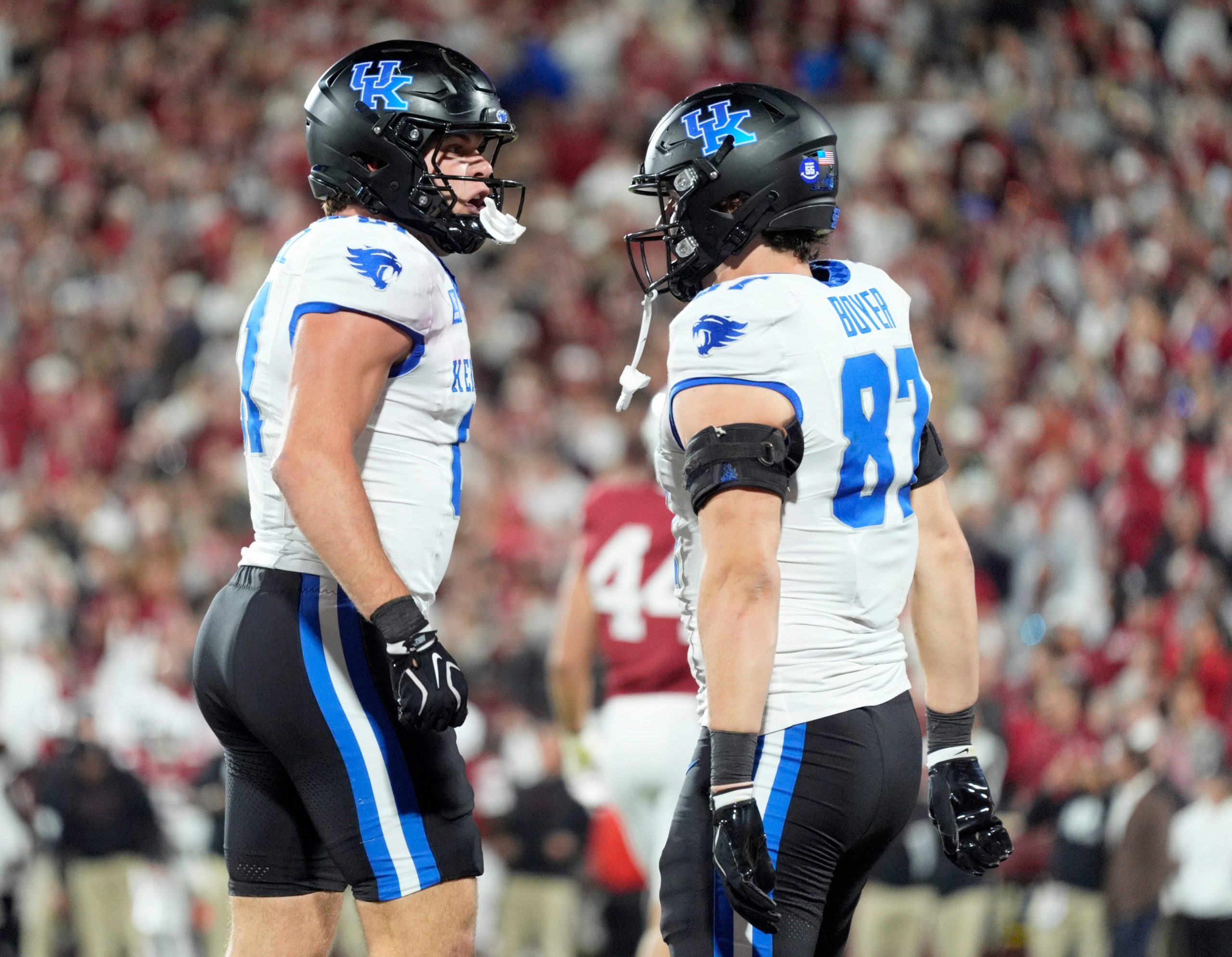
Kentucky's Henry Boyer (87) celebrates with Kentucky's Willie Rodriguez (81) in the second half of the college football game between the University of Oklahoma Sooners (OU) and the Kentucky Wildcats at Gaylord Family Oklahoma Memorial Stadium in Norman, Okla., Saturday, Oct., 17, 2026.
Kentucky’s playoff argument has moved beyond a promising start. Seven games into Will Stein’s first season, the Wildcats have assembled a résumé that deserves serious consideration: a 6–1 record, victories over Texas A&M, LSU and Oklahoma, and three SEC road wins.
Now ranked No. 12 in the AP poll, Kentucky has won five consecutive games since its September loss to Alabama. Its latest victory, 21–13 at Oklahoma, added another road result to a season increasingly defined by composure under pressure.
That does not make Kentucky a finished product. The Wildcats have needed overtime twice, have repeatedly played from behind and still carry a decisive loss against their strongest early opponent.
But a serious playoff assessment must account for what a team has accomplished. Kentucky has earned the right to be evaluated as a contender. The question now is whether its narrow escapes represent the foundation of a dangerous team—or reveal limitations that a demanding finish will expose.
Kentucky Has Built Its Case Away From Home
The strongest part of
Kentucky’s résumé
is its ability to win conference games on the road.
The Wildcats defeated Texas A&M 31–21 in College Station, survived South Carolina 35–34 in overtime and then beat Oklahoma in Norman. Alongside a 35–34 overtime victory over LSU in Lexington, those results have pushed Kentucky to 4–1 in SEC play.
Those victories require some perspective. A recognizable opponent does not automatically equal an elite win, and the eventual quality of Kentucky’s résumé will depend partly on how those teams finish.
Nevertheless, winning three SEC road games establishes something meaningful. Kentucky has handled different environments, survived momentum swings and repeatedly found the plays necessary to leave with a victory.
For a program trying to move from an encouraging season into national contention, that distinction matters. The Wildcats have demonstrated that their success can travel.
They also have avoided the immediate retreat that sometimes follows a breakthrough victory. The Texas A&M result became the beginning of a winning streak. The emotional overtime victory over LSU was followed by another conference road win.
Kentucky keeps giving its best results additional value by winning the next game.
The Oklahoma Win Revealed Both the Strength and the Concern
Kentucky’s victory over Oklahoma provided a useful snapshot of its playoff case.
Quarterback Kenny Minchey completed 21 of 28 passes for 158 yards, threw two touchdown passes to Willie Rodriguez and avoided an interception. Kentucky’s defense supplied four interceptions and five sacks, producing a 4–0 advantage in turnovers.
Those numbers explain how the Wildcats can beat capable opponents without producing an overwhelming offensive performance.
Minchey protected possession. The defense created opportunities. Kentucky made enough plays at the decisive moments.
Jordan Castell’s 41-yard interception return for a touchdown with 1:17 remaining stretched the lead to 21–13. Ty Bryant intercepted another pass with 21 seconds left to end Oklahoma’s final threat.
That is excellent closing football.
It also leaves a reasonable question: How comfortable should Kentucky feel about needing so much from its defense?
Four interceptions are a major accomplishment, but they are an aggressive expectation to carry into another week. A playoff contender needs ways to win when an opponent protects the ball, when a tipped pass falls incomplete or when the defense cannot supply a late touchdown.
Kentucky’s offense did enough in Norman. The next step is making victories less dependent on extraordinary defensive finishes.
Minchey’s Ball Security Gives Kentucky a Repeatable Strength
There is an important difference between benefiting from an opponent’s mistakes and consistently avoiding your own.
Kentucky has done both.
Through the Oklahoma game, the Wildcats led the SEC with a plus-11 turnover margin. Minchey had thrown only one interception in 206 attempts and had gone 160 consecutive attempts without being intercepted.
Those figures give the Wildcats’ success a firmer foundation than a collection of fortunate bounces.
An offense that protects the football gives its defense a chance to dictate games. It limits possessions that end with an opponent inheriting favorable field position and reduces the number of mistakes a team must overcome.
That does not eliminate the need for more offensive production. Kentucky will eventually face situations in which protecting possession must be paired with creating explosive plays and sustaining scoring drives.
But Minchey’s restraint is an asset. Kentucky has a quarterback who is giving it opportunities to win close games instead of repeatedly forcing it to recover from costly errors.
The Close Wins Count—and They Leave Questions
Kentucky’s consecutive 35–34 overtime victories against South Carolina and LSU should be evaluated honestly.
They count fully as wins. They also show how little separation existed between Kentucky and those opponents.
Stein chose to attempt a winning two-point conversion in both games. Against South Carolina, Minchey connected with Rodriguez. Against LSU, Minchey recognized the defensive alignment and ran in the deciding conversion.
Those finishes demonstrate preparation, execution and a coach willing to trust his players with the outcome.
They also illustrate the risk of living at the edge of defeat. Change one conversion, one protection assignment or one defensive stop, and Kentucky’s national standing looks different.
The appropriate conclusion is that the Wildcats have proved their composure more convincingly than their superiority.
A team can possess both resilience and vulnerabilities. Kentucky’s playoff case becomes stronger when the discussion acknowledges both.
Alabama Remains the Clearest Objection
Any honest assessment must include Kentucky’s 45–17 home loss to Alabama.
It remains the Wildcats’ only defeat, and its margin matters. Kentucky has recovered impressively, but five consecutive victories do not erase the most unfavorable evidence on its schedule.
For skeptical evaluators, that game supplies the central question: Can Kentucky compete with the strongest teams it might encounter in the postseason?
The Wildcats have time to strengthen their answer. Teams develop during a season, particularly under a new head coach. October Kentucky does not have to be judged as identical to September Kentucky.
Still, the argument must be supported by subsequent performances. Continued wins would help. More complete wins would help even more.
The Remaining Schedule Offers Opportunity—and Little Room for Carelessness
Kentucky still has Vanderbilt and Florida at home, Tennessee and Missouri on the road, and a home rivalry game against Louisville. A bye follows the Vanderbilt game.
That schedule gives the Wildcats enough work to
improve their résumé
substantially.
It also makes looking past the next opponent particularly dangerous. Kentucky has earned attention through a sequence of demanding victories. It cannot afford to treat maintaining that position as automatic.
An 11–1 finish would create an exceptionally strong playoff argument. At 10–2, Kentucky would remain a serious candidate, with the quality of its remaining results and the wider national field becoming crucial. Additional losses would make the debate considerably harder.
Those are assessments, not guarantees of selection. The No. 12 AP ranking is recognition of Kentucky’s season so far; it is not a playoff invitation.
The Wildcats’ task is straightforward: keep winning, protect the football and produce more consistent offense so that every fourth quarter does not demand another escape.
Kentucky has already established that it can handle pressure. To turn a credible playoff case into a compelling one, it must now show how much control it can exert before that pressure arrives.
New Users – Get $350 in Bonus Bets when you wager $5 for 7 days
T&Cs apply
4.6/5
Gambling Problem? Call 1-800-GAMBLER or 1-800-MY-RESET. Call 1-888-789-7777 or visit ccpgg.org/chat (CT). Hope is here. GamblingHelpLineMA.org or call (800) 327-5050 for 24/7 support (MA). Visit www.mdgamblinghelp.org (MD). Call 1-877-8HOPE-NY or text HOPENY (NY). 21+ (18+ DC, WY) and present in select states (for KS, in affiliation with Kansas Star Casino). Find online real money wagering only. Min $5 wager required for 7 consecutive days. $5 free play credit. Bonus issued as non-withdrawable bonus with cash withdrawable bonus with cash withdrawable. Bonus bets which expire 7 days after receipt. Restrictions apply. See terms at sportsbook.fanduel.com. Call 1-877-770-7867 (LA).
Up To $1500 in Bonus Bets Paid Back if your First Bet Does Not Win
T&Cs apply
4.5/5
Gambling problem? Call 1-800-GAMBLER or 1-800-MY-RESET (Available in the US) 877-8-HOPENY or text HOPENY (467369) (NY) 1-800-327-5050 (MA), 1-800-BETS-OFF (IA), 1-800-981-0023 (PR). 21+ only. Please Gamble Responsibly. See BetMGM.com for Terms. First Bet Offer for new customers only (if applicable). Subject to eligibility requirements. Bonus bets are non-withdrawable. In partnership with Kansas Crossing Casino and Hotel. Promotional offers not available in Mississippi, Massachusetts, New York, Ontario, or Puerto Rico.
New DraftKings Customers: Bet $5, Get $200 + 3 Months of NBA League Pass!
T&Cs apply
4.5/5
GAMBLING PROBLEM? CALL 1-800-GAMBLER or 1-800-MY-RESET, (800) 327-5050 or visit gamblinghelplinema.org (MA). Please Gamble Responsibly. 888-789-7777/visit ccpg.org (CT), or visit www.mdgamblinghelp.org (MD), 1-800-981-0023 (PR). 21+ and present in most states. (18+ DC/NH/PR/WY). Void in CAN. Eligibility restrictions apply. On behalf of Boot Hill Casino (KS). Pass-thru of per wager tax may apply in IL. 1 per new Sportsbook customer. $5+ first-time bet req. Max. $200 issued as non-withdrawable Bonus Bets. Stake removed from payout. Reward issued as $50 in Bonus Bets every 7 days via click-to-claim for 21 days. Bonus Bets and click-to-claims expire 7 days (168hrs) after issuance. Terms: dkng.co/offer. Get 1 promo code to redeem a 3-month NBA League Pass subscription, complimentary of DraftKings. Subscription auto-renews monthly at then-current price (currently $16.99/mo); cancel anytime. Terms, restrictions, and eligibility requirements apply. Redeem League Pass by 12/19/26 at 11:59 PM ET. Addt’l terms: support.watch.nba.com/hc/en-us/articles/9165532876183-League-Pass-Terms-of-Use_. Ends 11/29/26 at 11:59 PM ET. Sponsored by DK.
Must be 21+. GAMBLING PROBLEM? CALL 1-800-GAMBLER OR CALL 1-800-MY-RESET, www.mdgamblinghelp.org (MD), (800)-327-5050 or gamblinghelplinema.org (MA), Call (877)8-HOPENY or text HOPENY (467369) (NY), (888) 789-7777 or ccpg.org (CT), morethanagame.nc.gov (NC), 1800gambler.net (WV)
Bet $1 and get double the winnings up to $25 for your next 10 bets
T&Cs apply
4.4/5
21+ New users only. Must register using eligible promo code. First bet after registration must qualify. Max. Bonus Bet: $1,000. Bonus Bet expires 14 days after receipt. Void where prohibited. See Caesars.com/promos for full terms. Gambling Problem? 1-800-GAMBLER (1-800-426-2537)
21+ and present in OH. Gambling Problem? Call 1-800-GAMBLER.
This site is using
Cloudflare
and adheres to the
Google Safe Browsing Program. We adapted
Google's Privacy Guidelines
to keep your data safe at all times.
Close
Ready to Win Big? Join the Elite with Our Sports Betting Deals!
FanDuel Promo
New Users – Get $350 in Bonus Bets when you wager $5 for 7 days
Our Favorite
T&Cs and 21+ apply
Gambling Problem? Call 1-800-GAMBLER or 1-800-MY-RESET. Call 1-888-789-7777 or visit ccpgg.org/chat (CT). Hope is here. GamblingHelpLineMA.org or call (800) 327-5050 for 24/7 support (MA). Visit www.mdgamblinghelp.org (MD). Call 1-877-8HOPE-NY or text HOPENY (NY). 21+ (18+ DC, WY) and present in select states (for KS, in affiliation with Kansas Star Casino). Find online real money wagering only. Min $5 wager required for 7 consecutive days. $5 free play credit. Bonus issued as non-withdrawable bonus with cash withdrawable bonus with cash withdrawable. Bonus bets which expire 7 days after receipt. Restrictions apply. See terms at sportsbook.fanduel.com. Call 1-877-770-7867 (LA).
Code:
Open FanDuel
Get Bonus
BetMGM Promo
Up To $1500 in Bonus Bets Paid Back if your First Bet Does Not Win
Best Slots
T&Cs and 21+ apply
Gambling problem? Call 1-800-GAMBLER or 1-800-MY-RESET (Available in the US) 877-8-HOPENY or text HOPENY (467369) (NY) 1-800-327-5050 (MA), 1-800-BETS-OFF (IA), 1-800-981-0023 (PR). 21+ only. Please Gamble Responsibly. See BetMGM.com for Terms. First Bet Offer for new customers only (if applicable). Subject to eligibility requirements. Bonus bets are non-withdrawable. In partnership with Kansas Crossing Casino and Hotel. Promotional offers not available in Mississippi, Massachusetts, New York, Ontario, or Puerto Rico.
Code:
Open BetMGM
Get Bonus
DraftKings Promo
New DraftKings Customers: Bet $5, Get $200 + 3 Months of NBA League Pass!
Newcomer
T&Cs and 21+ apply
GAMBLING PROBLEM? CALL 1-800-GAMBLER or 1-800-MY-RESET, (800) 327-5050 or visit gamblinghelplinema.org (MA). Please Gamble Responsibly. 888-789-7777/visit ccpg.org (CT), or visit www.mdgamblinghelp.org (MD), 1-800-981-0023 (PR). 21+ and present in most states. (18+ DC/NH/PR/WY). Void in CAN. Eligibility restrictions apply. On behalf of Boot Hill Casino (KS). Pass-thru of per wager tax may apply in IL. 1 per new Sportsbook customer. $5+ first-time bet req. Max. $200 issued as non-withdrawable Bonus Bets. Stake removed from payout. Reward issued as $50 in Bonus Bets every 7 days via click-to-claim for 21 days. Bonus Bets and click-to-claims expire 7 days (168hrs) after issuance. Terms: dkng.co/offer. Get 1 promo code to redeem a 3-month NBA League Pass subscription, complimentary of DraftKings. Subscription auto-renews monthly at then-current price (currently $16.99/mo); cancel anytime. Terms, restrictions, and eligibility requirements apply. Redeem League Pass by 12/19/26 at 11:59 PM ET. Addt’l terms: support.watch.nba.com/hc/en-us/articles/9165532876183-League-Pass-Terms-of-Use_. Ends 11/29/26 at 11:59 PM ET. Sponsored by DK.
Code:
Open DraftKings
Get Bonus
Find out what the legends have to say about sports this week....
New Users – Get $350 in Bonus Bets when you wager $5 for 7 days
Gambling Problem? Call 1-800-GAMBLER or 1-800-MY-RESET. Call 1-888-789-7777 or visit ccpgg.org/chat (CT). Hope is here. GamblingHelpLineMA.org or call (800) 327-5050 for 24/7 support (MA). Visit www.mdgamblinghelp.org (MD). Call 1-877-8HOPE-NY or text HOPENY (NY). 21+ (18+ DC, WY) and present in select states (for KS, in affiliation with Kansas Star Casino). Find online real money wagering only. Min $5 wager required for 7 consecutive days. $5 free play credit. Bonus issued as non-withdrawable bonus with cash withdrawable bonus with cash withdrawable. Bonus bets which expire 7 days after receipt. Restrictions apply. See terms at sportsbook.fanduel.com. Call 1-877-770-7867 (LA).