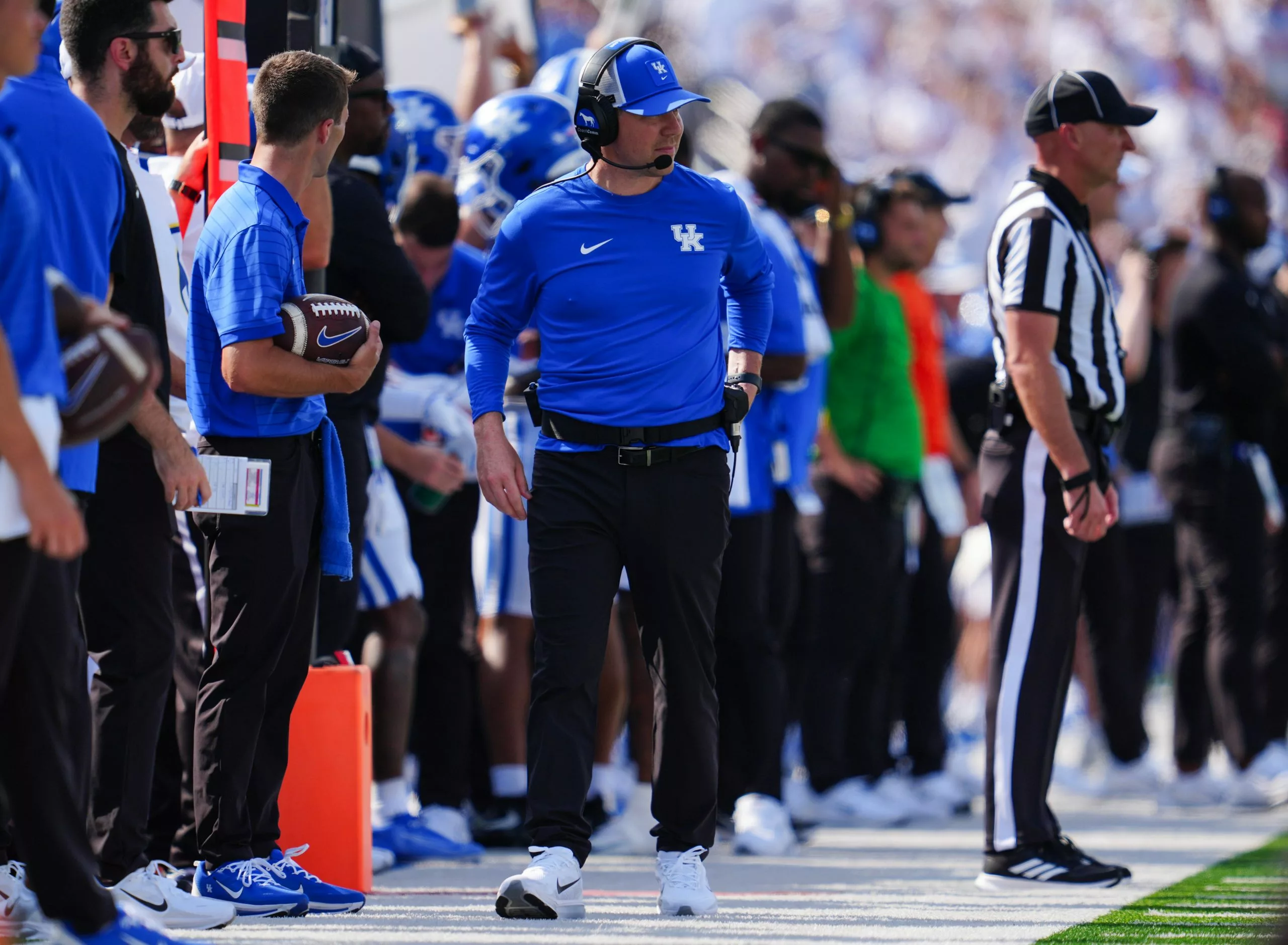
Kentucky head coach Will Stein couldnt find a second half gameplan to stop Alabama as the Tide rolled past the Cats 45-17 Saturday, Sept. 12, 2026 in Lexington, Kentucky.
Kentucky football did not need more snaps than Texas A&M to pull off the biggest surprise of its young season. The Wildcats needed better ones. They ran 54 offensive plays at Kyle Field, 30 fewer than the No. 9 Aggies, yet left College Station with a 31-21 win because they squeezed far more from each chance.
Texas A&M actually finished with more total yards (423 to 408) and held the ball slightly longer. Those numbers normally point toward the team that controlled the afternoon. Kentucky changed the math by averaging 7.6 yards per play, protecting the ball and making Texas A&M pay when drives reached the part of the field where decisions become expensive.
The first sign came before Kentucky scored a point. Texas A&M drove 76 yards on its opening possession, reached the Kentucky 11 and went for fourth-and-1. Linebacker Sam Greene met Rueben Owens II behind the line and stopped the drive. On the Aggies’ next possession, Greene dropped into coverage and intercepted Marcel Reed in Kentucky territory.
Kentucky had survived two long Texas A&M possessions without giving up a point. The Wildcats did not immediately turn that work into a lead, but they had kept the game where a few clean offensive drives could change it.
Kentucky football found the second-half answer
The score was tied 7-7 at halftime, which made the situation uncomfortably familiar for Will Stein’s team. Seven days earlier,
Kentucky’s 45-17 loss to Alabama
had gone the opposite way. The Wildcats led 17-13 at halftime before their offense stalled and Alabama scored 32 unanswered points.
Stein came out of the Alabama loss talking about adjustments and the need to stop leaving his defense in bad situations. Three days later, as Kentucky prepared for Texas A&M, he reduced the assignment to something simpler.
“It’s still about us. It’s our ability to play one snap at a time for four quarters,”
Stein said.
Kentucky finally played the second half he had been asking for. Kenny Minchey opened the third quarter by hitting true freshman Kenny Darby for a 42-yard touchdown. The next two Kentucky possessions ended with short C.J. Baxter touchdown runs. In less than 15 minutes, a 7-7 game became 28-7.
Minchey finished 14 of 18 for 252 yards and two touchdowns, completing his final 11 passes. The stat says efficiency, but the game showed why it was useful. Kentucky rarely asked him to rescue a bad down with a desperate throw. When Texas A&M crowded the run, Minchey found space behind it. When the Wildcats reached scoring range, Baxter finished drives.
Texas A&M had more snaps but fewer useful ones.
The Aggies ran 84 plays and still found themselves chasing the game because too many possessions ended without points. Kentucky intercepted Reed twice and stopped Texas A&M on fourth down three times. Those empty trips carried more weight than the Aggies’ edge in raw yardage.
Mike Elko did not soften his description afterward.
“They came in here and beat our ass. Not good enough from us on any level,”
Elko said.
His assessment fits the tape better than a complicated explanation. Texas A&M had enough offense to move the ball, but Kentucky won the downs that decided whether those yards became points. Reed completed 26 of 49 passes for 236 yards and threw two interceptions. He also ran for 80 yards, yet the Aggies spent much of the second half trying to recover from Kentucky’s three-touchdown burst.
Kentucky football also played without a turnover. For a team that gave Alabama short fields one week earlier, that change carried as much weight as any new play Stein or offensive coordinator Joe Sloan called.
One upset changed the early read on both teams
The result produced an immediate correction in the national picture. Texas A&M fell 14 spots to No. 23 in the new AP Top 25. Kentucky remained outside the poll but received votes after winning on the road against a top-10 opponent.
The ranking change is useful, but Stein’s first weeks tell a better story. Kentucky opened by handling Youngstown State, looked competitive with Alabama for a half, and then failed badly after halftime. College Station offered the same kind of pressure, except this time the Wildcats adjusted and became more efficient as the game tightened.
Kentucky should carry that part forward. Upsets can disappear quickly if a team treats them as proof that every problem has been solved. Stein has three games of evidence now, and the cleanest version of his team showed up when the opponent had more plays, more home-field noise, and a top-10 ranking.
Afterward, Stein said the performance matched the standard he wants every week.
“That’s how I expect us to play,”
Stein said. Kentucky finally has a result strong enough to make that expectation feel real.
Up To $1500 in Bonus Bets Paid Back if your First Bet Does Not Win
T&Cs apply
4.5/5
Gambling problem? Call 1-800-GAMBLER or 1-800-MY-RESET (Available in the US) 877-8-HOPENY or text HOPENY (467369) (NY) 1-800-327-5050 (MA), 1-800-BETS-OFF (IA), 1-800-981-0023 (PR). 21+ only. Please Gamble Responsibly. See BetMGM.com for Terms. First Bet Offer for new customers only (if applicable). Subject to eligibility requirements. Bonus bets are non-withdrawable. In partnership with Kansas Crossing Casino and Hotel. Promotional offers not available in Mississippi, Massachusetts, New York, Ontario, or Puerto Rico.
New DraftKings Customers: Spend $5+ Get $150 in Bonuses
T&Cs apply
4.5/5
GAMBLING PROBLEM? CALL 1-800-GAMBLER or 1-800-MY-RESET, (800) 327-5050 or visit gamblinghelplinema.org (MA). Please Gamble Responsibly. 888-789-7777/visit ccpg.org (CT), or visit www.mdgamblinghelp.org (MD), 1-800-981-0023 (PR). 21+ and present in most states. (18+ DC/NH/PR/WY). Void in CAN. Eligibility restrictions apply. On behalf of Boot Hill Casino (KS). Pass-thru of per wager tax may apply in IL. 1 per new DraftKings customer. $5+ first-time bet req. Max. $150 issued as non-withdrawable Bonus Bets. Stake removed from payout. Reward issued as $50 in Bonus Bets every 7 days via click-to-claim for 14 days. Bonus Bets and click-to-claims expire 7 days (168hrs) after issuance. Terms: sportsbook.draftkings.com/promos. Ends 10/11/26 at 11:59 PM ET. Sponsored by DK.
Must be 21+. GAMBLING PROBLEM? CALL 1-800-GAMBLER OR CALL 1-800-MY-RESET, www.mdgamblinghelp.org (MD), (800)-327-5050 or gamblinghelplinema.org (MA), Call (877)8-HOPENY or text HOPENY (467369) (NY), (888) 789-7777 or ccpg.org (CT), morethanagame.nc.gov (NC), 1800gambler.net (WV)
Bet $1 and get double the winnings up to $25 for your next 10 bets
T&Cs apply
4.4/5
21+ New users only. Must register using eligible promo code. First bet after registration must qualify. Max. Bonus Bet: $1,000. Bonus Bet expires 14 days after receipt. Void where prohibited. See Caesars.com/promos for full terms. Gambling Problem? 1-800-GAMBLER (1-800-426-2537)
21+ and present in OH. Gambling Problem? Call 1-800-GAMBLER.
This site is using
Cloudflare
and adheres to the
Google Safe Browsing Program. We adapted
Google's Privacy Guidelines
to keep your data safe at all times.
Close
Ready to Win Big? Join the Elite with Our Sports Betting Deals!
FanDuel Promo
New Users – Get $250 in Bonus Bets when you wager $5 for 5 days
Up To $1500 in Bonus Bets Paid Back if your First Bet Does Not Win
Best Slots
T&Cs and 21+ apply
Gambling problem? Call 1-800-GAMBLER or 1-800-MY-RESET (Available in the US) 877-8-HOPENY or text HOPENY (467369) (NY) 1-800-327-5050 (MA), 1-800-BETS-OFF (IA), 1-800-981-0023 (PR). 21+ only. Please Gamble Responsibly. See BetMGM.com for Terms. First Bet Offer for new customers only (if applicable). Subject to eligibility requirements. Bonus bets are non-withdrawable. In partnership with Kansas Crossing Casino and Hotel. Promotional offers not available in Mississippi, Massachusetts, New York, Ontario, or Puerto Rico.
Code:
Open BetMGM
Get Bonus
DraftKings Promo
New DraftKings Customers: Spend $5+ Get $150 in Bonuses
Newcomer
T&Cs and 21+ apply
GAMBLING PROBLEM? CALL 1-800-GAMBLER or 1-800-MY-RESET, (800) 327-5050 or visit gamblinghelplinema.org (MA). Please Gamble Responsibly. 888-789-7777/visit ccpg.org (CT), or visit www.mdgamblinghelp.org (MD), 1-800-981-0023 (PR). 21+ and present in most states. (18+ DC/NH/PR/WY). Void in CAN. Eligibility restrictions apply. On behalf of Boot Hill Casino (KS). Pass-thru of per wager tax may apply in IL. 1 per new DraftKings customer. $5+ first-time bet req. Max. $150 issued as non-withdrawable Bonus Bets. Stake removed from payout. Reward issued as $50 in Bonus Bets every 7 days via click-to-claim for 14 days. Bonus Bets and click-to-claims expire 7 days (168hrs) after issuance. Terms: sportsbook.draftkings.com/promos. Ends 10/11/26 at 11:59 PM ET. Sponsored by DK.
Code:
Open DraftKings
Get Bonus
Find out what the legends have to say about sports this week....