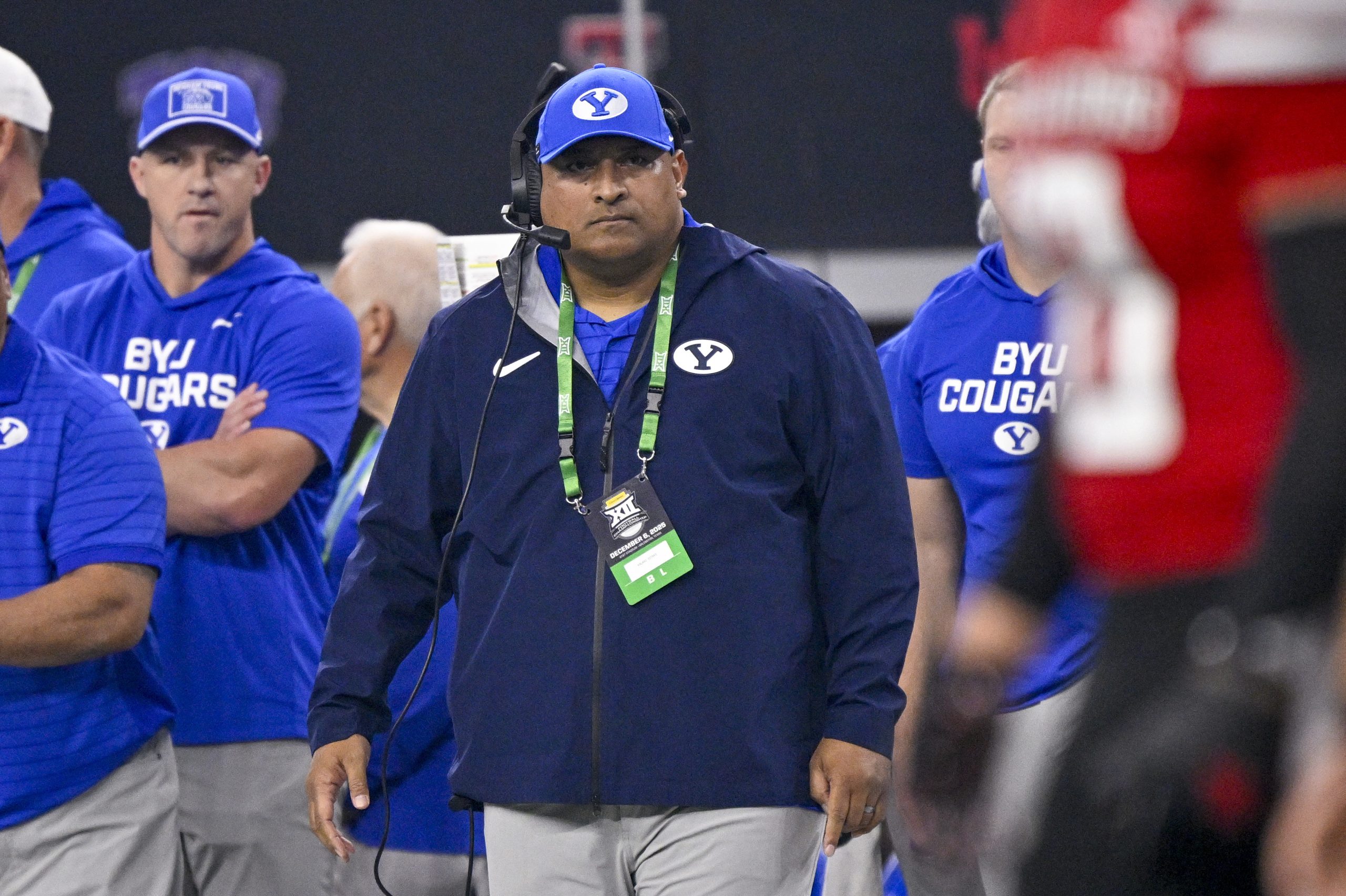
Dec 6, 2025; Arlington, TX, USA; BYU Cougars head coach Kalani Sitake looks on during the game between the Red Raiders and the Cougars at AT&T Stadium. Mandatory Credit: Jerome Miron-Imagn Images
A Big 12 athletic department should not need a Saturday-night message board post to confirm that its athletic director still has a job, but BYU used one on August 8. Associate athletic director Jon McBride told fans through a CougarBoard account that Brian Santiago remained in charge. Four days later, Kalani Sitake faced a question about resources. The episodes do not prove an internal feud, but they show just how much pressure now follows a program ranked No. 14.
Eight months earlier, Penn State pursued Sitake before BYU announced a long-term extension. Outside reporting said keeping him required commitments beyond salary, including staff pay and support. BYU was headed to the Big 12 Championship Game. Retaining the coach settled one problem, but the harder question now is whether the institution will keep funding what his recent results have created.
Kalani Sitake Stayed Because BYU Promised More Than Salary
Sitake has separated his contract from the program. Looking back on the Penn State decisions, he told the Salt Lake Tribune, “I wanted them to show me they want me to be here for the time.” he said the decision was not mainly about his money. A coach can be paid well while assistants, recruiting operations, facilities and player support still trail the teams he is expected to beat.
At BYU’s team photo day on August 12, reporters pressed him after his “doing the most with the least” comment gained traction. Sitake said his agent would handle the resource conversation. Asked about Santiago, he answered, “I’m easy to get along with, as long as you just take care of our football team and take care of the boys.” The line did not accuse anyone, but it tells us where his priority is at the moment.
BYU’s Success Has Changed What Sitake Can Demand
BYU has evidence the investment is working. The Cougars won 23 games across 2024 and 2025, finished last season 12-2, and begin this year tied for No. 14 in the AP poll (the second-highest preseason ranking BYU has achieved). If you want a better context for why the resource argument feels larger,
BYU’s Big 12 title case
is worth revisiting. This is a contender asking how it stays one.
Bear Bachmeier makes the window tangible. He threw for 3,033 yards with 15 touchdowns as a true freshman, rushed for 527 yards and 11 scores, and won Big 12 Offensive Freshman of the Year (he is still only a sophomore). BYU added nine transfers, including Cal linebacker Cade Uluave and USC tight end Walker Lyons, while signing its highest-ranked high school class, evidence that the school has begun investing differently.
Still, more money cannot solve every roster problem. Former guard Weylin Lapuaho unexpectedly regained a legal path toward another college season after BYU built its camp roster, then entered the portal(BYU actually opened camp with 117 names on its public roster). Sitake had stressed limited flexibility and BYU’s responsibility to players holding current spots. The episode complicates any claim that administrators can fix every football problem by writing a bigger check.
BYU Cannot Let the Resource Debate Become the Season
You can now understand why BYU wanted the Santiago rumor dead. An athletic director supposedly losing his job before a Top 15 season is not harmless chatter. McBride went directly to CougarBoard and wrote, “I just want to officially confirm that Brian Santiago’s employment status with the university has not changed. He is still the AD.” BYU entered the same public online room where the rumor was spreading, giving the discussion more oxygen.
Santiago deserves credit too because BYU retained Sitake, added support, signed its best-rated recruiting class, and promoted Kelly Poppinga after Jay Hill left for Michigan. When BYU announced the extension, Santiago said, “We are excited to continue to ride the wave of positive momentum with him.” (BYU went 23-4 over the past two seasons). Sitake’s public posture suggests he wants that movement to continue, and results give him a stronger case here.
Kalani Sitake made his choice when Penn State called. BYU made one too when it extended him and committed resources to football. Success keeps raising the cost of staying successful, and this roster is built to chase the Big 12. Sitake no longer needs the university to imagine what his program could become. BYU is living inside the version he built, leaving leadership with the harder job of deciding what maintaining it requires.
New Users – Get $350 in Bonus Bets when you wager $5 for 7 days
T&Cs apply
4.6/5
Gambling Problem? Call 1-800-GAMBLER or 1-800-MY-RESET. Call 1-888-789-7777 or visit ccpgg.org/chat (CT). Hope is here. GamblingHelpLineMA.org or call (800) 327-5050 for 24/7 support (MA). Visit www.mdgamblinghelp.org (MD). Call 1-877-8HOPE-NY or text HOPENY (NY). 21+ (18+ DC, WY) and present in select states (for KS, in affiliation with Kansas Star Casino). Find online real money wagering only. Min $5 wager required for 7 consecutive days. $5 free play credit. Bonus issued as non-withdrawable bonus with cash withdrawable bonus with cash withdrawable. Bonus bets which expire 7 days after receipt. Restrictions apply. See terms at sportsbook.fanduel.com. Call 1-877-770-7867 (LA).
Up To $1500 in Bonus Bets Paid Back if your First Bet Does Not Win
T&Cs apply
4.5/5
Gambling problem? Call 1-800-GAMBLER or 1-800-MY-RESET (Available in the US) 877-8-HOPENY or text HOPENY (467369) (NY) 1-800-327-5050 (MA), 1-800-BETS-OFF (IA), 1-800-981-0023 (PR). 21+ only. Please Gamble Responsibly. See BetMGM.com for Terms. First Bet Offer for new customers only (if applicable). Subject to eligibility requirements. Bonus bets are non-withdrawable. In partnership with Kansas Crossing Casino and Hotel. Promotional offers not available in Mississippi, Massachusetts, New York, Ontario, or Puerto Rico.
New DraftKings Customers: Bet $5, Get $200 + 3 Months of NBA League Pass!
T&Cs apply
4.5/5
GAMBLING PROBLEM? CALL 1-800-GAMBLER or 1-800-MY-RESET, (800) 327-5050 or visit gamblinghelplinema.org (MA). Please Gamble Responsibly. 888-789-7777/visit ccpg.org (CT), or visit www.mdgamblinghelp.org (MD), 1-800-981-0023 (PR). 21+ and present in most states. (18+ DC/NH/PR/WY). Void in CAN. Eligibility restrictions apply. On behalf of Boot Hill Casino (KS). Pass-thru of per wager tax may apply in IL. 1 per new Sportsbook customer. $5+ first-time bet req. Max. $200 issued as non-withdrawable Bonus Bets. Stake removed from payout. Reward issued as $50 in Bonus Bets every 7 days via click-to-claim for 21 days. Bonus Bets and click-to-claims expire 7 days (168hrs) after issuance. Terms: dkng.co/offer. Get 1 promo code to redeem a 3-month NBA League Pass subscription, complimentary of DraftKings. Subscription auto-renews monthly at then-current price (currently $16.99/mo); cancel anytime. Terms, restrictions, and eligibility requirements apply. Redeem League Pass by 12/19/26 at 11:59 PM ET. Addt’l terms: support.watch.nba.com/hc/en-us/articles/9165532876183-League-Pass-Terms-of-Use_. Ends 11/29/26 at 11:59 PM ET. Sponsored by DK.
Must be 21+. GAMBLING PROBLEM? CALL 1-800-GAMBLER OR CALL 1-800-MY-RESET, www.mdgamblinghelp.org (MD), (800)-327-5050 or gamblinghelplinema.org (MA), Call (877)8-HOPENY or text HOPENY (467369) (NY), (888) 789-7777 or ccpg.org (CT), morethanagame.nc.gov (NC), 1800gambler.net (WV)
Bet $1 and get double the winnings up to $25 for your next 10 bets
T&Cs apply
4.4/5
21+ New users only. Must register using eligible promo code. First bet after registration must qualify. Max. Bonus Bet: $1,000. Bonus Bet expires 14 days after receipt. Void where prohibited. See Caesars.com/promos for full terms. Gambling Problem? 1-800-GAMBLER (1-800-426-2537)
21+ and present in OH. Gambling Problem? Call 1-800-GAMBLER.
This site is using
Cloudflare
and adheres to the
Google Safe Browsing Program. We adapted
Google's Privacy Guidelines
to keep your data safe at all times.
Close
Ready to Win Big? Join the Elite with Our Sports Betting Deals!
FanDuel Promo
New Users – Get $350 in Bonus Bets when you wager $5 for 7 days
Our Favorite
T&Cs and 21+ apply
Gambling Problem? Call 1-800-GAMBLER or 1-800-MY-RESET. Call 1-888-789-7777 or visit ccpgg.org/chat (CT). Hope is here. GamblingHelpLineMA.org or call (800) 327-5050 for 24/7 support (MA). Visit www.mdgamblinghelp.org (MD). Call 1-877-8HOPE-NY or text HOPENY (NY). 21+ (18+ DC, WY) and present in select states (for KS, in affiliation with Kansas Star Casino). Find online real money wagering only. Min $5 wager required for 7 consecutive days. $5 free play credit. Bonus issued as non-withdrawable bonus with cash withdrawable bonus with cash withdrawable. Bonus bets which expire 7 days after receipt. Restrictions apply. See terms at sportsbook.fanduel.com. Call 1-877-770-7867 (LA).
Code:
Open FanDuel
Get Bonus
BetMGM Promo
Up To $1500 in Bonus Bets Paid Back if your First Bet Does Not Win
Best Slots
T&Cs and 21+ apply
Gambling problem? Call 1-800-GAMBLER or 1-800-MY-RESET (Available in the US) 877-8-HOPENY or text HOPENY (467369) (NY) 1-800-327-5050 (MA), 1-800-BETS-OFF (IA), 1-800-981-0023 (PR). 21+ only. Please Gamble Responsibly. See BetMGM.com for Terms. First Bet Offer for new customers only (if applicable). Subject to eligibility requirements. Bonus bets are non-withdrawable. In partnership with Kansas Crossing Casino and Hotel. Promotional offers not available in Mississippi, Massachusetts, New York, Ontario, or Puerto Rico.
Code:
Open BetMGM
Get Bonus
DraftKings Promo
New DraftKings Customers: Bet $5, Get $200 + 3 Months of NBA League Pass!
Newcomer
T&Cs and 21+ apply
GAMBLING PROBLEM? CALL 1-800-GAMBLER or 1-800-MY-RESET, (800) 327-5050 or visit gamblinghelplinema.org (MA). Please Gamble Responsibly. 888-789-7777/visit ccpg.org (CT), or visit www.mdgamblinghelp.org (MD), 1-800-981-0023 (PR). 21+ and present in most states. (18+ DC/NH/PR/WY). Void in CAN. Eligibility restrictions apply. On behalf of Boot Hill Casino (KS). Pass-thru of per wager tax may apply in IL. 1 per new Sportsbook customer. $5+ first-time bet req. Max. $200 issued as non-withdrawable Bonus Bets. Stake removed from payout. Reward issued as $50 in Bonus Bets every 7 days via click-to-claim for 21 days. Bonus Bets and click-to-claims expire 7 days (168hrs) after issuance. Terms: dkng.co/offer. Get 1 promo code to redeem a 3-month NBA League Pass subscription, complimentary of DraftKings. Subscription auto-renews monthly at then-current price (currently $16.99/mo); cancel anytime. Terms, restrictions, and eligibility requirements apply. Redeem League Pass by 12/19/26 at 11:59 PM ET. Addt’l terms: support.watch.nba.com/hc/en-us/articles/9165532876183-League-Pass-Terms-of-Use_. Ends 11/29/26 at 11:59 PM ET. Sponsored by DK.
Code:
Open DraftKings
Get Bonus
Find out what the legends have to say about sports this week....
New Users – Get $350 in Bonus Bets when you wager $5 for 7 days
Gambling Problem? Call 1-800-GAMBLER or 1-800-MY-RESET. Call 1-888-789-7777 or visit ccpgg.org/chat (CT). Hope is here. GamblingHelpLineMA.org or call (800) 327-5050 for 24/7 support (MA). Visit www.mdgamblinghelp.org (MD). Call 1-877-8HOPE-NY or text HOPENY (NY). 21+ (18+ DC, WY) and present in select states (for KS, in affiliation with Kansas Star Casino). Find online real money wagering only. Min $5 wager required for 7 consecutive days. $5 free play credit. Bonus issued as non-withdrawable bonus with cash withdrawable bonus with cash withdrawable. Bonus bets which expire 7 days after receipt. Restrictions apply. See terms at sportsbook.fanduel.com. Call 1-877-770-7867 (LA).