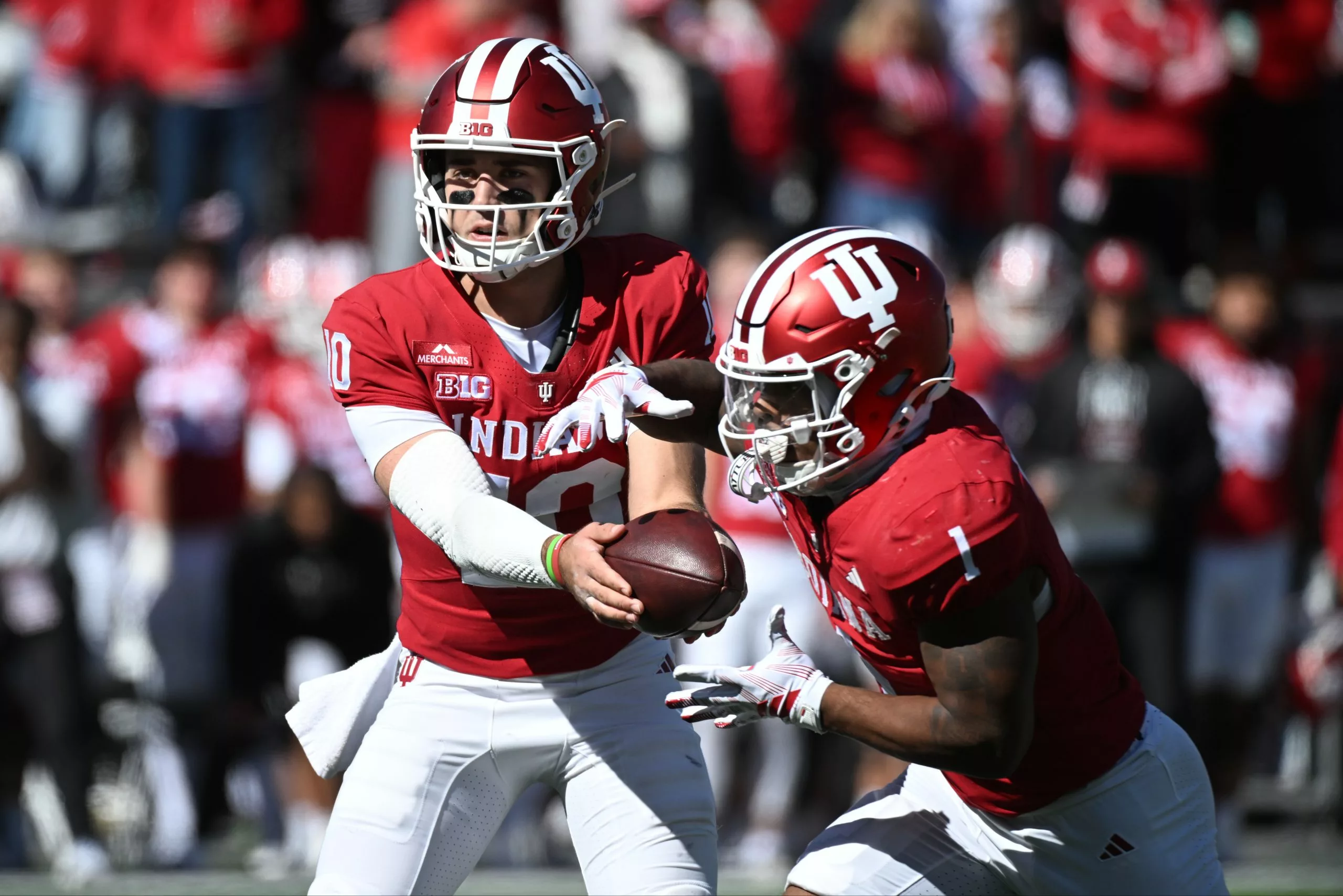
Oct 17, 2026; Bloomington, Indiana, USA; Indiana Hoosiers quarterback Josh Hoover (10) hands off to running back Turbo Richard (1) during the first half against the Ohio State Buckeyes at Merchants Bank Field at Memorial Stadium. Mandatory Credit: Robert Goddin-Imagn Images
Josh Hoover does not need to rescue Indiana’s season Saturday. He needs to help the Hoosiers finish the opportunities their offense creates.
That distinction matters after Indiana’s 19–15 loss to Ohio State. The Hoosiers head to Michigan ranked No. 6 with a 6–1 record, and Hoover enters the matchup with 18 touchdown passes and no interceptions. His season provides ample reason for confidence, even as Indiana examines the throws that escaped him against the Buckeyes.
The next step requires more than demanding a better performance from the quarterback. Indiana must connect protection, footwork, route timing and early-down execution so that Hoover can deliver accurately when a receiver becomes available.
Michigan will test every part of that process.
Michigan Makes Timing Essential
Curt Cignetti’s assessment
of Michigan offered little suggestion that Indiana would find a comfortable recovery game in Ann Arbor. He praised the Wolverines’ speed, persistence and pursuit, describing a defense that sustains its effort throughout a play. His evaluation of Hoover was equally direct: there were good plays against Ohio State, alongside overthrows he wanted back.
Against a defense that closes quickly, the moment a receiver becomes available can disappear before a quarterback finishes an unnecessary hitch.
That makes anticipation especially important. Hoover must be ready to release the ball as a route develops, with his feet positioned to support the throw. Waiting until a receiver looks unmistakably open can give a defender time to recover.
Indiana can help by building combinations that give Hoover a clear answer against the coverage he identifies. That does not require stripping the offense down to predictable short throws. It requires making the relationship between his drop, his read and the receiver’s break as precise as possible.
A deep completion still has a place in that plan. So does an immediate throw underneath when Michigan takes the deeper option away.
Protection Must Include the Quarterback
It would be easy to attribute Indiana’s offensive disappointment entirely to blocking. Cignetti did not. He said the protection against Ohio State was generally good, while identifying a missed adjustment against a defensive look that produced a sack and fumble. He also described a missed opportunity involving pressure, Hoover’s drop and a delayed release.
Those observations point toward a shared responsibility.
The offensive line must recognize movement and communicate assignments. Backs and tight ends must execute their protection responsibilities when called upon. Hoover must understand where pressure can arrive and how quickly the play requires him to respond.
A clean pocket cannot guarantee an accurate throw. Similarly, an offensive line cannot always protect a play that takes longer to develop than its design allows.
Indiana’s preparation should therefore emphasize the entire sequence: identify the front, establish the protection, take the correct drop and deliver on schedule.
Selective extra protection could help on deeper attempts. But keeping another blocker in also removes a receiving option. The Hoosiers must choose those situations carefully, particularly if Michigan can cover the remaining routes without committing additional rushers.
The most useful protection adjustment may sometimes be a faster decision.
Make Third Down More Manageable
Indiana can improve Hoover’s circumstances before third down arrives.
A modest gain on first down keeps more of the playbook available. A failed first-down play followed by another unsuccessful snap allows a defense to anticipate the pass and attack accordingly.
That is why the running game matters even if Indiana does not produce a dominant rushing total.
Cignetti said the Hoosiers called 46 passes and 26 runs against Ohio State, an unusual distribution for his offense. He also noted the absence of explosive rushing plays over the previous two games.
The answer should be productive balance rather than a predetermined number of handoffs.
If Michigan crowds the line and leaves a favorable passing matchup, Indiana should use it. If a run offers a reasonable chance to stay ahead of the chains, taking those yards can make Hoover’s next assignment easier.
On third-and-short, the defense must respect multiple possibilities. On third-and-long, it can devote far more attention to the quarterback.
Indiana should also avoid treating every completion short of the marker as a failure. An early-down checkdown that gains useful yardage can be a good decision. Its value depends on the situation and what it leaves available next.
Use the Receivers Without Forcing the Ball
Indiana has evidence that its receivers can create production against strong opposition. Charlie Becker caught nine passes for a career-high 165 yards against Ohio State.
That gives Michigan something substantial to account for.
The tactical opportunity is to make the Wolverines’ response useful to Hoover. If coverage leans toward Becker, another route must provide a credible answer. If Michigan leaves an advantageous individual matchup, Indiana needs the protection and timing to exploit it.
Motion, formation changes and complementary routes can help clarify those decisions. Their purpose should be to reveal coverage or influence defenders in ways Hoover can recognize.
There is a difference between designing opportunities for a productive receiver and deciding before the snap that the ball must go to him. Hoover needs the freedom—and discipline—to take the answer the defense presents.
Accuracy Will Be the Clearest Measure
The strongest response Saturday may look relatively ordinary.
It could be an accurately placed first-down throw that lets a receiver keep running. It could be a third-down completion delivered before pressure arrives. It could be Hoover moving promptly to his next option instead of waiting for a covered route.
Ball placement matters beyond completion percentage. A receiver who must stop or reach backward gives pursuing defenders time to close. An accurate throw can preserve the space the play created.
Indiana should still attack downfield when the opportunity is there. The aim is an offense in which the routine throws support the ambitious ones.
Hoover has already demonstrated that he can produce without throwing interceptions.
Michigan
presents a different question: can Indiana consistently turn available opportunities into completed plays?
The answer will depend on Hoover’s execution and the structure around him. Better timing coordinated protection and manageable third downs would give him a practical path to the response the Hoosiers need.
New Users – Get $350 in Bonus Bets when you wager $5 for 7 days
T&Cs apply
4.6/5
Gambling Problem? Call 1-800-GAMBLER or 1-800-MY-RESET. Call 1-888-789-7777 or visit ccpgg.org/chat (CT). Hope is here. GamblingHelpLineMA.org or call (800) 327-5050 for 24/7 support (MA). Visit www.mdgamblinghelp.org (MD). Call 1-877-8HOPE-NY or text HOPENY (NY). 21+ (18+ DC, WY) and present in select states (for KS, in affiliation with Kansas Star Casino). Find online real money wagering only. Min $5 wager required for 7 consecutive days. $5 free play credit. Bonus issued as non-withdrawable bonus with cash withdrawable bonus with cash withdrawable. Bonus bets which expire 7 days after receipt. Restrictions apply. See terms at sportsbook.fanduel.com. Call 1-877-770-7867 (LA).
Up To $1500 in Bonus Bets Paid Back if your First Bet Does Not Win
T&Cs apply
4.5/5
Gambling problem? Call 1-800-GAMBLER or 1-800-MY-RESET (Available in the US) 877-8-HOPENY or text HOPENY (467369) (NY) 1-800-327-5050 (MA), 1-800-BETS-OFF (IA), 1-800-981-0023 (PR). 21+ only. Please Gamble Responsibly. See BetMGM.com for Terms. First Bet Offer for new customers only (if applicable). Subject to eligibility requirements. Bonus bets are non-withdrawable. In partnership with Kansas Crossing Casino and Hotel. Promotional offers not available in Mississippi, Massachusetts, New York, Ontario, or Puerto Rico.
New DraftKings Customers: Bet $5, Get $200 + 3 Months of NBA League Pass!
T&Cs apply
4.5/5
GAMBLING PROBLEM? CALL 1-800-GAMBLER or 1-800-MY-RESET, (800) 327-5050 or visit gamblinghelplinema.org (MA). Please Gamble Responsibly. 888-789-7777/visit ccpg.org (CT), or visit www.mdgamblinghelp.org (MD), 1-800-981-0023 (PR). 21+ and present in most states. (18+ DC/NH/PR/WY). Void in CAN. Eligibility restrictions apply. On behalf of Boot Hill Casino (KS). Pass-thru of per wager tax may apply in IL. 1 per new Sportsbook customer. $5+ first-time bet req. Max. $200 issued as non-withdrawable Bonus Bets. Stake removed from payout. Reward issued as $50 in Bonus Bets every 7 days via click-to-claim for 21 days. Bonus Bets and click-to-claims expire 7 days (168hrs) after issuance. Terms: dkng.co/offer. Get 1 promo code to redeem a 3-month NBA League Pass subscription, complimentary of DraftKings. Subscription auto-renews monthly at then-current price (currently $16.99/mo); cancel anytime. Terms, restrictions, and eligibility requirements apply. Redeem League Pass by 12/19/26 at 11:59 PM ET. Addt’l terms: support.watch.nba.com/hc/en-us/articles/9165532876183-League-Pass-Terms-of-Use_. Ends 11/29/26 at 11:59 PM ET. Sponsored by DK.
Must be 21+. GAMBLING PROBLEM? CALL 1-800-GAMBLER OR CALL 1-800-MY-RESET, www.mdgamblinghelp.org (MD), (800)-327-5050 or gamblinghelplinema.org (MA), Call (877)8-HOPENY or text HOPENY (467369) (NY), (888) 789-7777 or ccpg.org (CT), morethanagame.nc.gov (NC), 1800gambler.net (WV)
Bet $1 and get double the winnings up to $25 for your next 10 bets
T&Cs apply
4.4/5
21+ New users only. Must register using eligible promo code. First bet after registration must qualify. Max. Bonus Bet: $1,000. Bonus Bet expires 14 days after receipt. Void where prohibited. See Caesars.com/promos for full terms. Gambling Problem? 1-800-GAMBLER (1-800-426-2537)
21+ and present in OH. Gambling Problem? Call 1-800-GAMBLER.
This site is using
Cloudflare
and adheres to the
Google Safe Browsing Program. We adapted
Google's Privacy Guidelines
to keep your data safe at all times.
Close
Ready to Win Big? Join the Elite with Our Sports Betting Deals!
FanDuel Promo
New Users – Get $350 in Bonus Bets when you wager $5 for 7 days
Our Favorite
T&Cs and 21+ apply
Gambling Problem? Call 1-800-GAMBLER or 1-800-MY-RESET. Call 1-888-789-7777 or visit ccpgg.org/chat (CT). Hope is here. GamblingHelpLineMA.org or call (800) 327-5050 for 24/7 support (MA). Visit www.mdgamblinghelp.org (MD). Call 1-877-8HOPE-NY or text HOPENY (NY). 21+ (18+ DC, WY) and present in select states (for KS, in affiliation with Kansas Star Casino). Find online real money wagering only. Min $5 wager required for 7 consecutive days. $5 free play credit. Bonus issued as non-withdrawable bonus with cash withdrawable bonus with cash withdrawable. Bonus bets which expire 7 days after receipt. Restrictions apply. See terms at sportsbook.fanduel.com. Call 1-877-770-7867 (LA).
Code:
Open FanDuel
Get Bonus
BetMGM Promo
Up To $1500 in Bonus Bets Paid Back if your First Bet Does Not Win
Best Slots
T&Cs and 21+ apply
Gambling problem? Call 1-800-GAMBLER or 1-800-MY-RESET (Available in the US) 877-8-HOPENY or text HOPENY (467369) (NY) 1-800-327-5050 (MA), 1-800-BETS-OFF (IA), 1-800-981-0023 (PR). 21+ only. Please Gamble Responsibly. See BetMGM.com for Terms. First Bet Offer for new customers only (if applicable). Subject to eligibility requirements. Bonus bets are non-withdrawable. In partnership with Kansas Crossing Casino and Hotel. Promotional offers not available in Mississippi, Massachusetts, New York, Ontario, or Puerto Rico.
Code:
Open BetMGM
Get Bonus
DraftKings Promo
New DraftKings Customers: Bet $5, Get $200 + 3 Months of NBA League Pass!
Newcomer
T&Cs and 21+ apply
GAMBLING PROBLEM? CALL 1-800-GAMBLER or 1-800-MY-RESET, (800) 327-5050 or visit gamblinghelplinema.org (MA). Please Gamble Responsibly. 888-789-7777/visit ccpg.org (CT), or visit www.mdgamblinghelp.org (MD), 1-800-981-0023 (PR). 21+ and present in most states. (18+ DC/NH/PR/WY). Void in CAN. Eligibility restrictions apply. On behalf of Boot Hill Casino (KS). Pass-thru of per wager tax may apply in IL. 1 per new Sportsbook customer. $5+ first-time bet req. Max. $200 issued as non-withdrawable Bonus Bets. Stake removed from payout. Reward issued as $50 in Bonus Bets every 7 days via click-to-claim for 21 days. Bonus Bets and click-to-claims expire 7 days (168hrs) after issuance. Terms: dkng.co/offer. Get 1 promo code to redeem a 3-month NBA League Pass subscription, complimentary of DraftKings. Subscription auto-renews monthly at then-current price (currently $16.99/mo); cancel anytime. Terms, restrictions, and eligibility requirements apply. Redeem League Pass by 12/19/26 at 11:59 PM ET. Addt’l terms: support.watch.nba.com/hc/en-us/articles/9165532876183-League-Pass-Terms-of-Use_. Ends 11/29/26 at 11:59 PM ET. Sponsored by DK.
Code:
Open DraftKings
Get Bonus
Find out what the legends have to say about sports this week....
New Users – Get $350 in Bonus Bets when you wager $5 for 7 days
Gambling Problem? Call 1-800-GAMBLER or 1-800-MY-RESET. Call 1-888-789-7777 or visit ccpgg.org/chat (CT). Hope is here. GamblingHelpLineMA.org or call (800) 327-5050 for 24/7 support (MA). Visit www.mdgamblinghelp.org (MD). Call 1-877-8HOPE-NY or text HOPENY (NY). 21+ (18+ DC, WY) and present in select states (for KS, in affiliation with Kansas Star Casino). Find online real money wagering only. Min $5 wager required for 7 consecutive days. $5 free play credit. Bonus issued as non-withdrawable bonus with cash withdrawable bonus with cash withdrawable. Bonus bets which expire 7 days after receipt. Restrictions apply. See terms at sportsbook.fanduel.com. Call 1-877-770-7867 (LA).