The Gamecocks’ first 10-win season ended short of a national championship. Its place in South Carolina history was secure long before Joe Morrison’s sudden death
The Gamecocks’ first 10-win season ended short of a national championship. Its place in South Carolina history was secure long before Joe Morrison’s sudden death made those memories even more precious.
On February 5, 1989, Joe Morrison went to Williams-Brice Stadium to play racquetball. He was 51, still coaching South Carolina, and only weeks away from taking the Gamecocks to the Liberty Bowl. After playing, he felt unwell and went to the shower, where he collapsed. He was taken to Providence Hospital alive but unconscious and pronounced dead at 9:03 that night. The reported cause was a heart attack.
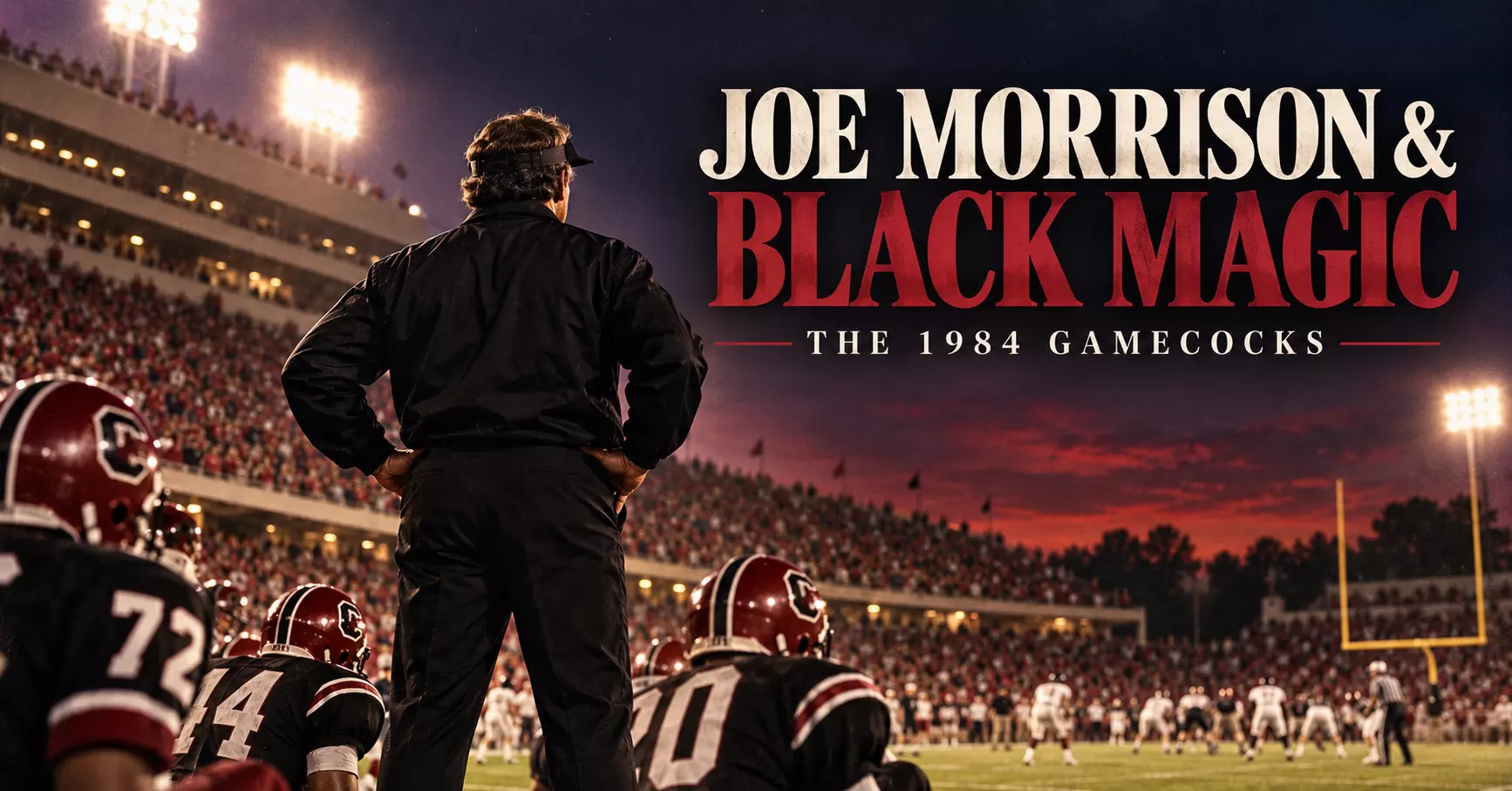
For South Carolina fans, the news was difficult to square with the man they knew. Morrison was the coach in black who had stood on the sideline while the Gamecocks climbed higher than anyone thought possible. Five seasons earlier, his 1984 team had won its first nine games, reached No. 2 in the country, and finished with the first 10-win season in school history. They called that season
Black Magic.
The phrase can make 1984 sound effortless. It was anything but. That team had to earn its place in a state where South Carolina fans knew what it felt like to watch somebody else celebrate. It survived close games, won in South Bend, beat ranked opponents, and recovered from a crushing upset to defeat Clemson in Death Valley. To understand why Morrison still matters so much, you have to understand what that team gave its fans while he was alive.
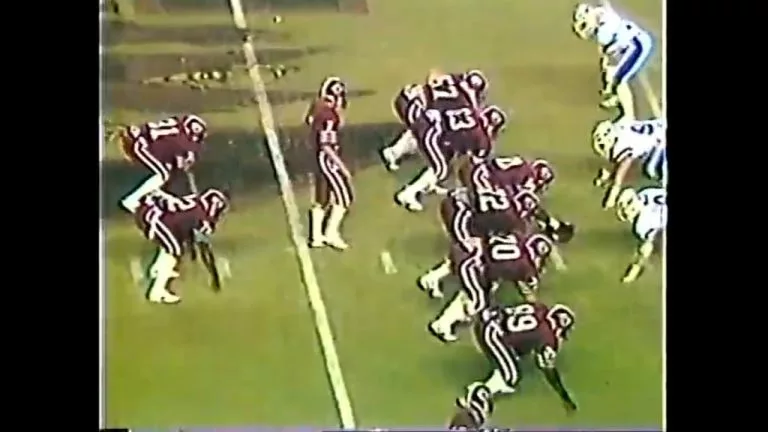
1984 South Carolina Gamecocks Football Season Review
Before the magic, there was doubt
Morrison arrived at South Carolina after coaching at New Mexico. He had already spent 14 seasons with the New York Giants as a player, building a reputation for dependability, but his first Gamecock team went 5–6 in 1983. Entering 1984, South Carolina was an independent program without a recent winning season or bowl trip to build on. There was little reason outside Columbia to expect a national contender.
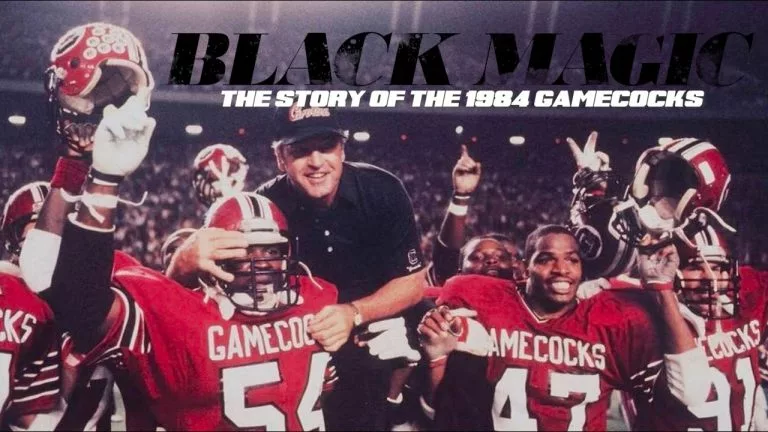
Morrison gave the program a recognizable presence. He wore black on the sideline, week after week, and fans began dressing like him as the victories mounted. The defense earned its own name, the Fire Ants, for the way players swarmed to the ball in their garnet uniforms. The team’s entrance to the music associated with
2001: A Space Odyssey
also took hold during Morrison’s tenure. These details mattered because South Carolina was developing an identity its fans could see and hear, as well as measure on the scoreboard.
It would be easy to credit the coach’s clothes for the nickname and leave it there. Former Gamecock Carl Hill gave a better explanation years later: the season felt magical because what the team accomplished was so unexpected. That sense of surprise ran through Columbia. The Gamecocks were winning games they had spent years hoping merely to compete in.
The wins became impossible to dismiss
South Carolina’s opener offered no sign of an easy ride. The Gamecocks held on to beat The Citadel 31–24. Then the Fire Ants shut out Duke 21–0. On September 29, South Carolina beat No. 12 Georgia 17–10, its first result that demanded national attention. A 49–17 win over Kansas State followed, and the Gamecocks entered the AP rankings at No. 17.
Morrison’s team kept moving. It beat Pittsburgh 45–21 and went to Notre Dame at 5–0. In South Bend, South Carolina trailed 26–14 before coming back to win 36–32. Quarterback Mike Hold, one of the faces of that season, later spoke about the Notre Dame victory as a game that stood out even in a year that also included a dramatic win over Clemson. For a program seeking national respect, winning at Notre Dame meant more than adding another number to the record.
The Gamecocks beat East Carolina 42–20, then escaped North Carolina State 35–28 to reach 8–0. Next came No. 11 Florida State at Williams-Brice Stadium on November 10. With a national television audience watching, South Carolina forced seven turnovers. Raynard Brown returned the opening kickoff of the second half for a touchdown, and the Gamecocks won 38–26. They rose to No. 2 in the AP poll, the highest ranking in program history.
That Florida State night captures why 1984 remains bigger than its final record. Fans threw oranges onto the field, imagining an Orange Bowl invitation and a possible chance to play for the national title. This was before the College Football Playoff, when rankings and bowl arrangements shaped the championship race. South Carolina was suddenly part of a conversation that had once seemed to belong to other schools.
Navy broke the dream
The Gamecocks went to Navy on November 17 with a 9–0 record. Navy entered 3–5–1 and had lost star running back Napoleon McCallum to injury. Morrison warned that the Midshipmen would be ready. South Carolina still faced the hardest problem a rising team can have: playing the game directly in front of it while everyone discussed what might come next.
Navy led 14–7 at halftime, took control in the third quarter and built a 38–7 advantage before South Carolina scored twice late. The final was 38–21. On the same day, top-ranked Nebraska lost to Oklahoma. Had the Gamecocks won, they would have had a powerful claim to the No. 1 ranking. That possibility is why the Navy loss still hurts. The national title was never guaranteed; a chance to keep pursuing it was lost in Annapolis.
What happened afterward says as much about South Carolina as the defeat itself. An estimated 5,000 fans greeted the team at the Columbia airport. Morrison, whose players had just suffered their most painful loss, told the crowd that its welcome meant a great deal to him. The season had connected the team and its supporters deeply enough to survive a devastating Saturday.
Clemson gave them one more chance to define the season
The next game was at Clemson. South Carolina had not beaten its rival since 1979, and the Tigers carried a 25-game home winning streak into the matchup. The Gamecocks could no longer reach the finish they had pictured after Florida State. They could still become the first South Carolina team to win 10 games, and they could do it against the opponent their fans most wanted to beat.
Clemson built a 21–3 lead. South Carolina fought back, with its defense helping turn the game and Hold guiding the late comeback. The Gamecocks won 22–21 in Death Valley. Morrison and athletic director Bob Marcum accepted a Gator Bowl invitation afterward, and thousands of supporters welcomed the team home.
Hold later suggested the Clemson win was essential to how the season would be remembered. He had a point. Without it, the story might have ended with Navy’s upset. With it, the Gamecocks showed that their nine-game start had left them something sturdier than a ranking. They had taken a blow, walked into their rival’s stadium and made history anyway.
South Carolina lost 21–14 to Oklahoma State in the
Gator Bowl
and finished 10–2, No. 11 in the final AP poll. The bowl loss was disappointing. The achievement was real: no South Carolina team before Morrison’s had won 10 games in a season. The seniors had helped establish a standard that once seemed out of reach.
Free Sneak Peek | Black Magic: The 1984 Gamecocks | Full Episode 1
Morrison’s final years and his sudden death
The 1984 run did not turn every following season into another Black Magic year. South Carolina had losing records in 1985 and 1986, then returned to bowl games in 1987 and 1988. Morrison’s six-season record at the school was 39–28–2. He was still the Gamecocks’ head coach when he died in February 1989. His death did not close a long retirement; it interrupted a career and a relationship with the university that were still active.
Contemporary reports said Morrison had a history of heart problems. After his death, his widow, JeVena Morrison, filed a workers’ compensation claim asserting that coaching stress had caused his fatal heart attack. She later withdrew the claim without a public explanation. That claim should be described for what it was—an assertion made in the aftermath of his death—rather than treated as an established medical finding. The documented event is that Morrison suffered a fatal heart attack after playing racquetball.
The university’s grief was immediate. Students and staff wore Black Magic sweatshirts; Gamecock flags appeared on cars. At a South Carolina basketball game against Southern Mississippi, the crowd observed a moment of prayer, and the players wore black patches. Alumni called the university to express their sorrow. A public memorial was planned for Williams-Brice Stadium—the place where Morrison had led the team onto the field and where he had collapsed days earlier.
His life at South Carolina also had difficult chapters. In 1988, allegations about steroid use within the football program became a national story and prompted investigations. A full account of Morrison’s tenure should acknowledge that controversy. It does not erase what the 1984 players accomplished, and the 1984 victories do not erase the later questions. Both belong in an honest telling of the era.
Why Black Magic still belongs to South Carolina
The easiest way to tell the story of 1984 is to ask what might have happened if South Carolina had beaten Navy. That question will always exist. But letting one loss define the team overlooks what Gamecock fans actually experienced: a win over Georgia, a comeback at Notre Dame, a nationally watched triumph over Florida State, a climb to No. 2 and, after the deepest disappointment of the year, a victory at Clemson for the program’s first 10-win season.
Morrison did not live to grow old with those memories. His death at 51 changed the way many fans looked back on the man in black and the autumn when South Carolina felt capable of anything. Yet the team deserves to be remembered in the present tense of its own achievement, too. In 1984, those players were not merely foreshadowing a loss or a tragedy five years away. They were giving their school something it had never had before.
Black Magic was special because South Carolina believed—and because, for nine straight games and then once more at Clemson, Joe Morrison’s Gamecocks gave everyone a reason to.
New Users – Get $350 in Bonus Bets when you wager $5 for 7 days
T&Cs apply
4.6/5
Gambling Problem? Call 1-800-GAMBLER or 1-800-MY-RESET. Call 1-888-789-7777 or visit ccpgg.org/chat (CT). Hope is here. GamblingHelpLineMA.org or call (800) 327-5050 for 24/7 support (MA). Visit www.mdgamblinghelp.org (MD). Call 1-877-8HOPE-NY or text HOPENY (NY). 21+ (18+ DC, WY) and present in select states (for KS, in affiliation with Kansas Star Casino). Find online real money wagering only. Min $5 wager required for 7 consecutive days. $5 free play credit. Bonus issued as non-withdrawable bonus with cash withdrawable bonus with cash withdrawable. Bonus bets which expire 7 days after receipt. Restrictions apply. See terms at sportsbook.fanduel.com. Call 1-877-770-7867 (LA).
Up To $1500 in Bonus Bets Paid Back if your First Bet Does Not Win
T&Cs apply
4.5/5
Gambling problem? Call 1-800-GAMBLER or 1-800-MY-RESET (Available in the US) 877-8-HOPENY or text HOPENY (467369) (NY) 1-800-327-5050 (MA), 1-800-BETS-OFF (IA), 1-800-981-0023 (PR). 21+ only. Please Gamble Responsibly. See BetMGM.com for Terms. First Bet Offer for new customers only (if applicable). Subject to eligibility requirements. Bonus bets are non-withdrawable. In partnership with Kansas Crossing Casino and Hotel. Promotional offers not available in Mississippi, Massachusetts, New York, Ontario, or Puerto Rico.
New DraftKings Customers: Bet $5, Get $200 + 3 Months of NBA League Pass!
T&Cs apply
4.5/5
GAMBLING PROBLEM? CALL 1-800-GAMBLER or 1-800-MY-RESET, (800) 327-5050 or visit gamblinghelplinema.org (MA). Please Gamble Responsibly. 888-789-7777/visit ccpg.org (CT), or visit www.mdgamblinghelp.org (MD), 1-800-981-0023 (PR). 21+ and present in most states. (18+ DC/NH/PR/WY). Void in CAN. Eligibility restrictions apply. On behalf of Boot Hill Casino (KS). Pass-thru of per wager tax may apply in IL. 1 per new Sportsbook customer. $5+ first-time bet req. Max. $200 issued as non-withdrawable Bonus Bets. Stake removed from payout. Reward issued as $50 in Bonus Bets every 7 days via click-to-claim for 21 days. Bonus Bets and click-to-claims expire 7 days (168hrs) after issuance. Terms: dkng.co/offer. Get 1 promo code to redeem a 3-month NBA League Pass subscription, complimentary of DraftKings. Subscription auto-renews monthly at then-current price (currently $16.99/mo); cancel anytime. Terms, restrictions, and eligibility requirements apply. Redeem League Pass by 12/19/26 at 11:59 PM ET. Addt’l terms: support.watch.nba.com/hc/en-us/articles/9165532876183-League-Pass-Terms-of-Use_. Ends 11/29/26 at 11:59 PM ET. Sponsored by DK.
Must be 21+. GAMBLING PROBLEM? CALL 1-800-GAMBLER OR CALL 1-800-MY-RESET, www.mdgamblinghelp.org (MD), (800)-327-5050 or gamblinghelplinema.org (MA), Call (877)8-HOPENY or text HOPENY (467369) (NY), (888) 789-7777 or ccpg.org (CT), morethanagame.nc.gov (NC), 1800gambler.net (WV)
Bet $1 and get double the winnings up to $25 for your next 10 bets
T&Cs apply
4.4/5
21+ New users only. Must register using eligible promo code. First bet after registration must qualify. Max. Bonus Bet: $1,000. Bonus Bet expires 14 days after receipt. Void where prohibited. See Caesars.com/promos for full terms. Gambling Problem? 1-800-GAMBLER (1-800-426-2537)
21+ and present in OH. Gambling Problem? Call 1-800-GAMBLER.
This site is using
Cloudflare
and adheres to the
Google Safe Browsing Program. We adapted
Google's Privacy Guidelines
to keep your data safe at all times.
Close
Ready to Win Big? Join the Elite with Our Sports Betting Deals!
FanDuel Promo
New Users – Get $350 in Bonus Bets when you wager $5 for 7 days
Our Favorite
T&Cs and 21+ apply
Gambling Problem? Call 1-800-GAMBLER or 1-800-MY-RESET. Call 1-888-789-7777 or visit ccpgg.org/chat (CT). Hope is here. GamblingHelpLineMA.org or call (800) 327-5050 for 24/7 support (MA). Visit www.mdgamblinghelp.org (MD). Call 1-877-8HOPE-NY or text HOPENY (NY). 21+ (18+ DC, WY) and present in select states (for KS, in affiliation with Kansas Star Casino). Find online real money wagering only. Min $5 wager required for 7 consecutive days. $5 free play credit. Bonus issued as non-withdrawable bonus with cash withdrawable bonus with cash withdrawable. Bonus bets which expire 7 days after receipt. Restrictions apply. See terms at sportsbook.fanduel.com. Call 1-877-770-7867 (LA).
Code:
Open FanDuel
Get Bonus
BetMGM Promo
Up To $1500 in Bonus Bets Paid Back if your First Bet Does Not Win
Best Slots
T&Cs and 21+ apply
Gambling problem? Call 1-800-GAMBLER or 1-800-MY-RESET (Available in the US) 877-8-HOPENY or text HOPENY (467369) (NY) 1-800-327-5050 (MA), 1-800-BETS-OFF (IA), 1-800-981-0023 (PR). 21+ only. Please Gamble Responsibly. See BetMGM.com for Terms. First Bet Offer for new customers only (if applicable). Subject to eligibility requirements. Bonus bets are non-withdrawable. In partnership with Kansas Crossing Casino and Hotel. Promotional offers not available in Mississippi, Massachusetts, New York, Ontario, or Puerto Rico.
Code:
Open BetMGM
Get Bonus
DraftKings Promo
New DraftKings Customers: Bet $5, Get $200 + 3 Months of NBA League Pass!
Newcomer
T&Cs and 21+ apply
GAMBLING PROBLEM? CALL 1-800-GAMBLER or 1-800-MY-RESET, (800) 327-5050 or visit gamblinghelplinema.org (MA). Please Gamble Responsibly. 888-789-7777/visit ccpg.org (CT), or visit www.mdgamblinghelp.org (MD), 1-800-981-0023 (PR). 21+ and present in most states. (18+ DC/NH/PR/WY). Void in CAN. Eligibility restrictions apply. On behalf of Boot Hill Casino (KS). Pass-thru of per wager tax may apply in IL. 1 per new Sportsbook customer. $5+ first-time bet req. Max. $200 issued as non-withdrawable Bonus Bets. Stake removed from payout. Reward issued as $50 in Bonus Bets every 7 days via click-to-claim for 21 days. Bonus Bets and click-to-claims expire 7 days (168hrs) after issuance. Terms: dkng.co/offer. Get 1 promo code to redeem a 3-month NBA League Pass subscription, complimentary of DraftKings. Subscription auto-renews monthly at then-current price (currently $16.99/mo); cancel anytime. Terms, restrictions, and eligibility requirements apply. Redeem League Pass by 12/19/26 at 11:59 PM ET. Addt’l terms: support.watch.nba.com/hc/en-us/articles/9165532876183-League-Pass-Terms-of-Use_. Ends 11/29/26 at 11:59 PM ET. Sponsored by DK.
Code:
Open DraftKings
Get Bonus
Find out what the legends have to say about sports this week....
New Users – Get $350 in Bonus Bets when you wager $5 for 7 days
Gambling Problem? Call 1-800-GAMBLER or 1-800-MY-RESET. Call 1-888-789-7777 or visit ccpgg.org/chat (CT). Hope is here. GamblingHelpLineMA.org or call (800) 327-5050 for 24/7 support (MA). Visit www.mdgamblinghelp.org (MD). Call 1-877-8HOPE-NY or text HOPENY (NY). 21+ (18+ DC, WY) and present in select states (for KS, in affiliation with Kansas Star Casino). Find online real money wagering only. Min $5 wager required for 7 consecutive days. $5 free play credit. Bonus issued as non-withdrawable bonus with cash withdrawable bonus with cash withdrawable. Bonus bets which expire 7 days after receipt. Restrictions apply. See terms at sportsbook.fanduel.com. Call 1-877-770-7867 (LA).