eremiah Smith deserves every bit of attention he receives. Ohio State’s star combines explosive production with an ability to turn important possessions into touchdowns.
Jeremiah Smith deserves every bit of attention he receives. Ohio State’s star combines explosive production with an ability to turn important possessions into touchdowns.
But the discussion about college football’s best receiver should no longer begin and end with him.
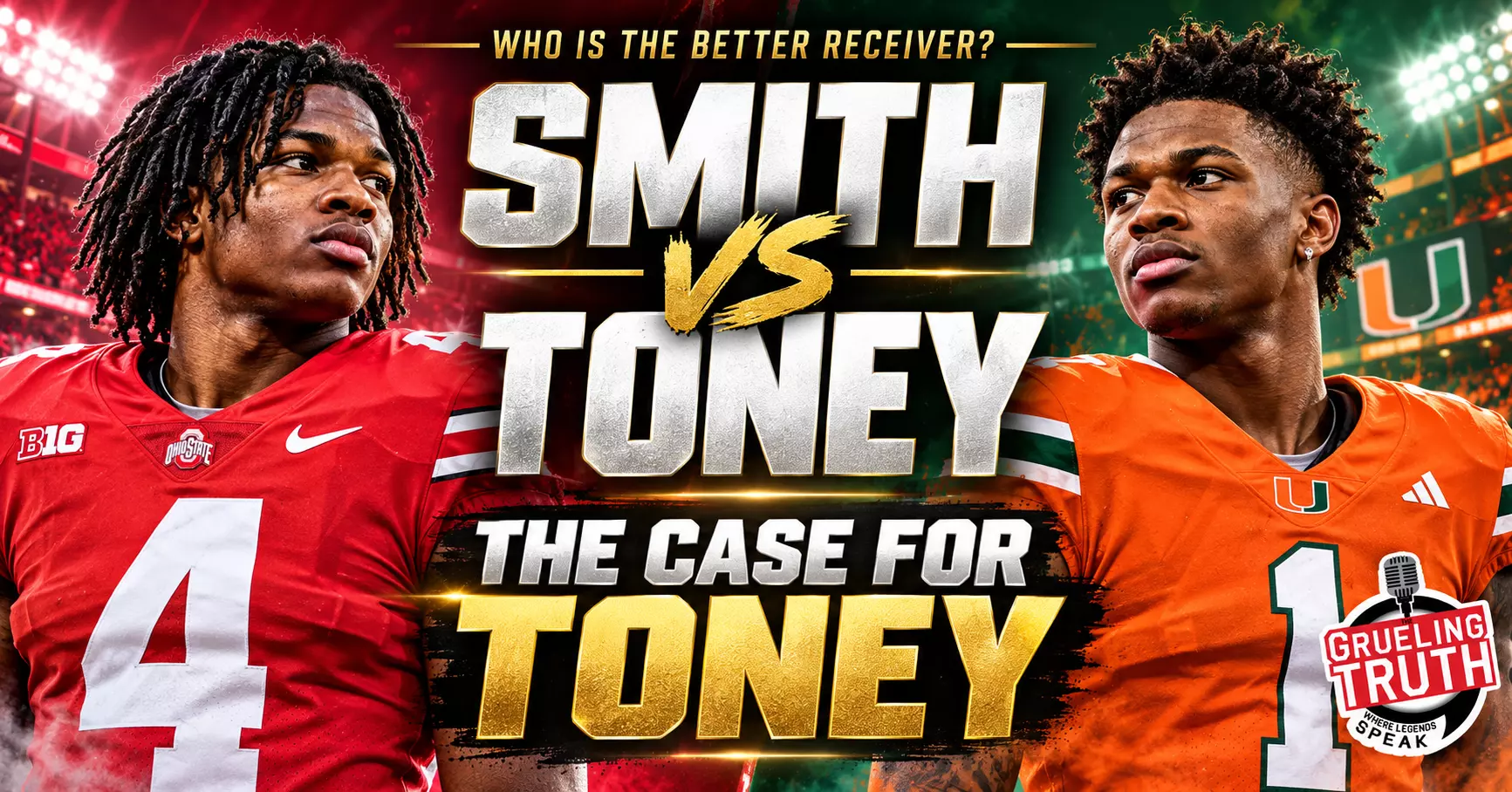
Miami’s Malachi Toney has built a compelling argument of his own. Through seven games, he has nearly matched Smith’s receiving yardage while catching considerably more passes. His latest performance—a school-record afternoon against Pittsburgh—demonstrated how thoroughly an offense can run through him.
My choice is Toney, narrowly, when evaluating the receiver I would want at the center of a college passing offense right now.
Smith has the stronger argument for explosive production per reception. Toney’s case rests on the volume of successful plays he provides without sacrificing substantial yardage or touchdown production.
That distinction makes this a legitimate debate.
The Numbers Show How Close They Are
Through games played October 24, both receivers have appeared in seven games:
Smith’s totals are supported by his receiving statistics, while Toney’s season line reflects Miami’s completed game against Pittsburgh.
The comparison supplies a strong argument for each player.
Smith has produced slightly more yardage and one additional touchdown on 14 fewer receptions. That is an impressive efficiency advantage.
Toney has supplied more completed connections while finishing just 32 yards behind him. That suggests a receiver whose involvement can help an offense operate repeatedly, rather than depending primarily on a smaller number of substantial gains.
Neither statistical profile automatically establishes the better player. They show two different forms of exceptional production.
The Case for Toney Starts With Sustained Involvement
Catching more passes does not automatically make a receiver better. An offense can manufacture receptions that accomplish little.
His 66 catches have generated 952 yards and 11 touchdowns. Miami is getting meaningful returns from repeatedly involving him.
That is the foundation of the argument for Toney.
A receiver who can remain heavily involved gives a quarterback somewhere to return as a game develops. He can help maintain rhythm, supply opportunities when a defense changes its approach and turn repeated targets into productive possessions.
The qualification is important: reception totals alone do not prove route-running superiority, better hands or greater success against particular coverages. Those judgments require detailed film and assignment information.
What the numbers do establish is that Toney has handled a larger reception workload while remaining close to Smith in the categories that most directly damage a defense.
That deserves substantial weight.
Pittsburgh Showed How Much Toney Can Carry
Against Pittsburgh, Toney caught
16 passes for 194 yards and three touchdowns, setting Miami’s single-game receptions record.
The performance was remarkable for its combination of volume and finishing production.
Sixteen receptions mean repeated involvement across an afternoon. Three touchdowns mean that involvement extended to the scoreboard.
For Miami, Toney was a dependable source of offense and a player capable of delivering decisive gains. Pittsburgh could not prevent his repeated opportunities from becoming an overwhelming contribution.
One game should not decide this comparison. It should, however, change how seriously Toney’s argument is treated.
This was evidence that he can be the central receiving figure in a dominant offensive performance, even when the opponent has every reason to account for him.
Smith’s Explosive Advantage Must Be Respected
The strongest argument against choosing Toney is Smith’s production per catch.
At
18.9 yards per reception, Smith has generated substantially more yardage each time he completes a catch. His season also includes a
12-catch, 217-yard, four-touchdown performance against Illinois.
That kind of output can change a game quickly.
An explosive receiver creates pressure beyond the plays on which he receives the ball. Defenses must consider what happens if they leave him isolated or allow a coverage mistake.
Smith’s touchdown total also prevents this from becoming a simple argument about possession receiving versus empty deep yardage. He is finishing drives and scoring at an exceptional rate.
Anyone choosing Smith has a defensible position. His statistical efficiency is a major reason he remains such a strong Heisman candidate.
The case for Toney must acknowledge that advantage rather than pretend it does not exist.
Quarterback Play Makes Direct Comparisons Difficult
Both receivers benefit from talented quarterbacks and productive offensive structures.
Darian Mensah completed
31 of 37 passes for 387 yards and four touchdowns against Pittsburgh, illustrating the quality of the passing environment around Toney.
Smith has worked with Julian Sayin, whose injury now creates uncertainty around Ohio State’s passing offense. Sayin is sidelined indefinitely, with the Buckeyes preparing their backup quarterbacks for greater responsibility.
Those circumstances matter.
A receiver cannot control the accuracy of every target, the time available in protection or how frequently his number is called. Future production must be evaluated with those limitations in mind.
It would be unfair to downgrade Smith automatically if Ohio State’s passing volume or efficiency changes. It would also be unfair to treat Toney’s partnership with Mensah as a reason to dismiss what he accomplishes.
Great quarterback play and great receiving often reinforce each other. Giving one player credit does not require taking it from the other.
Why I Would Choose Toney Right Now
My preference comes down to the kind of contribution I value most when building a college passing game.
Smith offers the stronger demonstrated return per reception. Toney offers more repeated involvement while producing almost the same receiving yardage and nearly the same touchdown total.
I give Toney a narrow edge because that combination provides a compelling foundation for an offense. He can receive the ball frequently without his production becoming merely a collection of short catches.
That is an assessment of his current value, not proof that he wins every individual skill comparison.
I would not claim the available statistics establish that Toney is a better contested-catch receiver, a more complete blocker or a superior NFL prospect. Those are separate evaluations.
For the question of who deserves consideration as the better college receiver right now, however, his case is strong enough to make the choice.
Toney Has Earned More Than Second Billing
Smith remains an exceptional player with a résumé that can support a No. 1 ranking. His
explosive production
and touchdown frequency make any comparison demanding.
Toney has met that demand.
He has supplied more receptions, nearly identical receiving yardage and substantial scoring production. His record-setting performance against Pittsburgh strengthened an argument already supported by his season totals.
Smith may be the more explosive receiver per catch. Toney gets my narrow vote for the broader, sustained receiving contribution he is giving Miami.
The gap is small enough that November can change the answer. Through seven games, Toney has earned the right to be the answer—not simply the player mentioned after Smith.
New Users – Get $350 in Bonus Bets when you wager $5 for 7 days
T&Cs apply
4.6/5
Gambling Problem? Call 1-800-GAMBLER or 1-800-MY-RESET. Call 1-888-789-7777 or visit ccpgg.org/chat (CT). Hope is here. GamblingHelpLineMA.org or call (800) 327-5050 for 24/7 support (MA). Visit www.mdgamblinghelp.org (MD). Call 1-877-8HOPE-NY or text HOPENY (NY). 21+ (18+ DC, WY) and present in select states (for KS, in affiliation with Kansas Star Casino). Find online real money wagering only. Min $5 wager required for 7 consecutive days. $5 free play credit. Bonus issued as non-withdrawable bonus with cash withdrawable bonus with cash withdrawable. Bonus bets which expire 7 days after receipt. Restrictions apply. See terms at sportsbook.fanduel.com. Call 1-877-770-7867 (LA).
Get Up to $1,000 Back in Bonus Bets Over Your First 10 Days
T&Cs apply
4.5/5
Gambling problem? Call 1-800-GAMBLER or 1-800-MY-RESET (Available in the US) 877-8-HOPENY or text HOPENY (467369) (NY) 1-800-327-5050 (MA), 1-800-BETS-OFF (IA), 21+ only. Please Gamble Responsibly. Visit mdgamblinghelp.org (MD). See BetMGM.com for Terms. New Player Offer for new players only. Subject to eligibility requirements. Bonus bets are non-withdrawable. In partnership with Kansas Crossing Casino and Hotel. This promotional offer is not available in NJ, MA, MI, NV, NY, ON, PA, PR, and WV.
New DraftKings Customers: Bet $5, Get $200 + 3 Months of NBA League Pass!
T&Cs apply
4.5/5
GAMBLING PROBLEM? CALL 1-800-GAMBLER or 1-800-MY-RESET, (800) 327-5050 or visit gamblinghelplinema.org (MA). Please Gamble Responsibly. 888-789-7777/visit ccpg.org (CT), or visit www.mdgamblinghelp.org (MD), 1-800-981-0023 (PR). 21+ and present in most states. (18+ DC/NH/PR/WY). Void in CAN. Eligibility restrictions apply. On behalf of Boot Hill Casino (KS). Pass-thru of per wager tax may apply in IL. 1 per new Sportsbook customer. $5+ first-time bet req. Max. $200 issued as non-withdrawable Bonus Bets. Stake removed from payout. Reward issued as $50 in Bonus Bets every 7 days via click-to-claim for 21 days. Bonus Bets and click-to-claims expire 7 days (168hrs) after issuance. Terms: dkng.co/offer. Get 1 promo code to redeem a 3-month NBA League Pass subscription, complimentary of DraftKings. Subscription auto-renews monthly at then-current price (currently $16.99/mo); cancel anytime. Terms, restrictions, and eligibility requirements apply. Redeem League Pass by 12/19/26 at 11:59 PM ET. Addt’l terms: support.watch.nba.com/hc/en-us/articles/9165532876183-League-Pass-Terms-of-Use_. Ends 11/29/26 at 11:59 PM ET. Sponsored by DK.
Must be 21+. GAMBLING PROBLEM? CALL 1-800-GAMBLER OR CALL 1-800-MY-RESET, www.mdgamblinghelp.org (MD), (800)-327-5050 or gamblinghelplinema.org (MA), Call (877)8-HOPENY or text HOPENY (467369) (NY), (888) 789-7777 or ccpg.org (CT), morethanagame.nc.gov (NC), 1800gambler.net (WV)
Bet $1 and get double the winnings up to $25 for your next 10 bets
T&Cs apply
4.4/5
21+ New users only. Must register using eligible promo code. First bet after registration must qualify. Max. Bonus Bet: $1,000. Bonus Bet expires 14 days after receipt. Void where prohibited. See Caesars.com/promos for full terms. Gambling Problem? 1-800-GAMBLER (1-800-426-2537)
21+ and present in OH. Gambling Problem? Call 1-800-GAMBLER.
This site is using
Cloudflare
and adheres to the
Google Safe Browsing Program. We adapted
Google's Privacy Guidelines
to keep your data safe at all times.
Close
Ready to Win Big? Join the Elite with Our Sports Betting Deals!
FanDuel Promo
New Users – Get $350 in Bonus Bets when you wager $5 for 7 days
Our Favorite
T&Cs and 21+ apply
Gambling Problem? Call 1-800-GAMBLER or 1-800-MY-RESET. Call 1-888-789-7777 or visit ccpgg.org/chat (CT). Hope is here. GamblingHelpLineMA.org or call (800) 327-5050 for 24/7 support (MA). Visit www.mdgamblinghelp.org (MD). Call 1-877-8HOPE-NY or text HOPENY (NY). 21+ (18+ DC, WY) and present in select states (for KS, in affiliation with Kansas Star Casino). Find online real money wagering only. Min $5 wager required for 7 consecutive days. $5 free play credit. Bonus issued as non-withdrawable bonus with cash withdrawable bonus with cash withdrawable. Bonus bets which expire 7 days after receipt. Restrictions apply. See terms at sportsbook.fanduel.com. Call 1-877-770-7867 (LA).
Code:
Open FanDuel
Get Bonus
BetMGM Promo
Get Up to $1,000 Back in Bonus Bets Over Your First 10 Days
Best Slots
T&Cs and 21+ apply
Gambling problem? Call 1-800-GAMBLER or 1-800-MY-RESET (Available in the US) 877-8-HOPENY or text HOPENY (467369) (NY) 1-800-327-5050 (MA), 1-800-BETS-OFF (IA), 21+ only. Please Gamble Responsibly. Visit mdgamblinghelp.org (MD). See BetMGM.com for Terms. New Player Offer for new players only. Subject to eligibility requirements. Bonus bets are non-withdrawable. In partnership with Kansas Crossing Casino and Hotel. This promotional offer is not available in NJ, MA, MI, NV, NY, ON, PA, PR, and WV.
Code:
Open BetMGM
Get Bonus
DraftKings Promo
New DraftKings Customers: Bet $5, Get $200 + 3 Months of NBA League Pass!
Newcomer
T&Cs and 21+ apply
GAMBLING PROBLEM? CALL 1-800-GAMBLER or 1-800-MY-RESET, (800) 327-5050 or visit gamblinghelplinema.org (MA). Please Gamble Responsibly. 888-789-7777/visit ccpg.org (CT), or visit www.mdgamblinghelp.org (MD), 1-800-981-0023 (PR). 21+ and present in most states. (18+ DC/NH/PR/WY). Void in CAN. Eligibility restrictions apply. On behalf of Boot Hill Casino (KS). Pass-thru of per wager tax may apply in IL. 1 per new Sportsbook customer. $5+ first-time bet req. Max. $200 issued as non-withdrawable Bonus Bets. Stake removed from payout. Reward issued as $50 in Bonus Bets every 7 days via click-to-claim for 21 days. Bonus Bets and click-to-claims expire 7 days (168hrs) after issuance. Terms: dkng.co/offer. Get 1 promo code to redeem a 3-month NBA League Pass subscription, complimentary of DraftKings. Subscription auto-renews monthly at then-current price (currently $16.99/mo); cancel anytime. Terms, restrictions, and eligibility requirements apply. Redeem League Pass by 12/19/26 at 11:59 PM ET. Addt’l terms: support.watch.nba.com/hc/en-us/articles/9165532876183-League-Pass-Terms-of-Use_. Ends 11/29/26 at 11:59 PM ET. Sponsored by DK.
Code:
Open DraftKings
Get Bonus
Find out what the legends have to say about sports this week....
New Users – Get $350 in Bonus Bets when you wager $5 for 7 days
Gambling Problem? Call 1-800-GAMBLER or 1-800-MY-RESET. Call 1-888-789-7777 or visit ccpgg.org/chat (CT). Hope is here. GamblingHelpLineMA.org or call (800) 327-5050 for 24/7 support (MA). Visit www.mdgamblinghelp.org (MD). Call 1-877-8HOPE-NY or text HOPENY (NY). 21+ (18+ DC, WY) and present in select states (for KS, in affiliation with Kansas Star Casino). Find online real money wagering only. Min $5 wager required for 7 consecutive days. $5 free play credit. Bonus issued as non-withdrawable bonus with cash withdrawable bonus with cash withdrawable. Bonus bets which expire 7 days after receipt. Restrictions apply. See terms at sportsbook.fanduel.com. Call 1-877-770-7867 (LA).