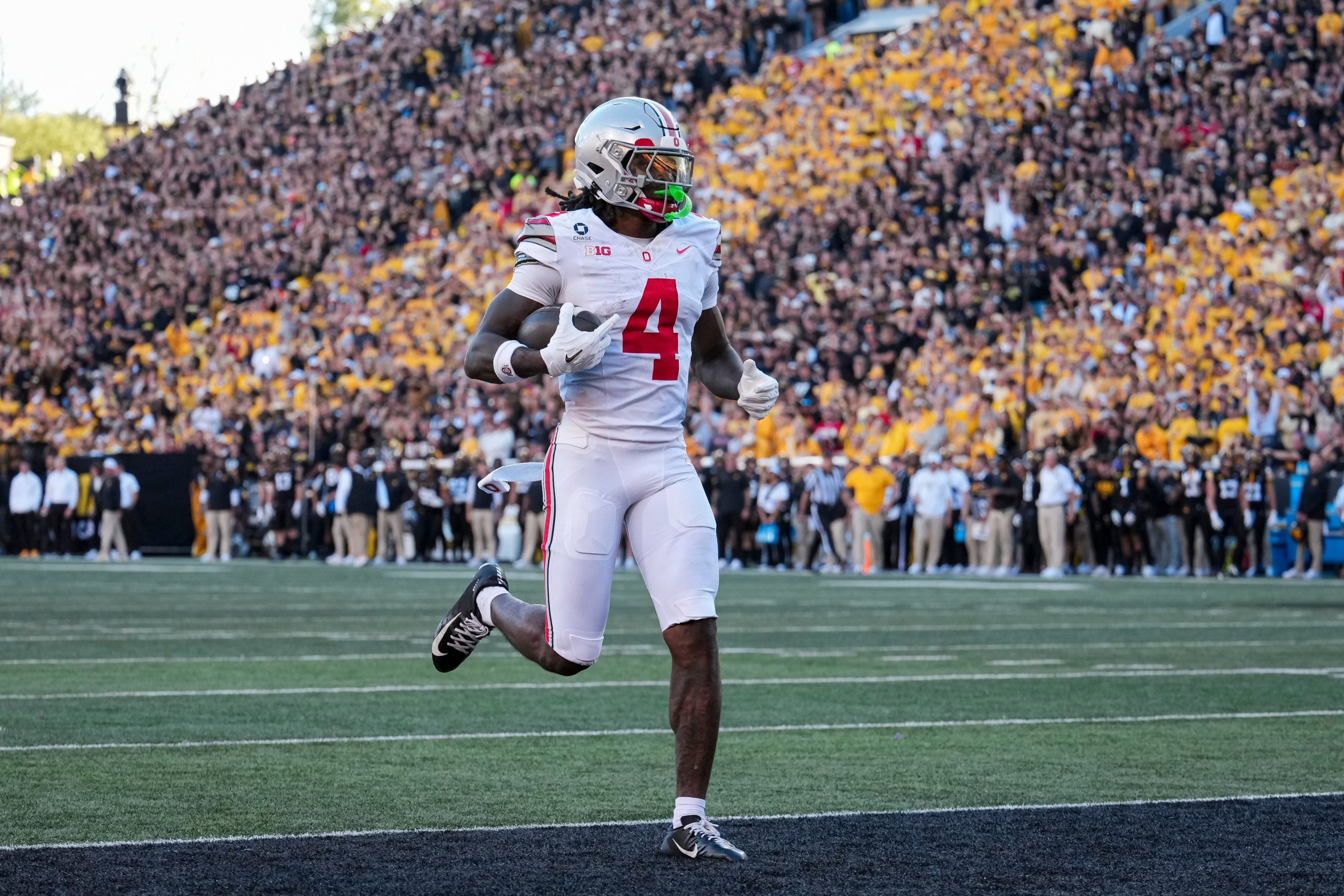
Ohio State wide receiver Jeremiah Smith (4) scores a touchdown against Iowa during the second half at Kinnick Stadium in Iowa City on Oct. 3, 2026.
Jeremiah Smith went into Iowa City and produced 11 catches, 206 receiving yards and two touchdowns in Ohio State’s 31–14 victory over Iowa.
That came one week after he caught 12 passes for 217 yards and four touchdowns against Illinois.
Through five games, Smith has 44 receptions, 823 receiving yards and nine touchdown catches. Ohio State’s Monday announcement listed him as the national leader in all three categories.
Those numbers demand more than a place on a Heisman watch list. They demand a serious discussion about whether Smith should be leading the race.
The Heisman recognizes college football’s outstanding player. Its stated purpose does not reserve the award for quarterbacks.
If Smith continues playing at this level, voters should have to explain why another candidate has been better. His position should never become the explanation.
The Iowa Performance Was a Heisman-Level Statement
Smith accounted for 206 of Julian Sayin’s 324 passing yards against Iowa—nearly 64 percent—and caught two of Ohio State’s three touchdown passes.
That is an enormous share of the passing offense in a ranked road victory.
Sayin deserves credit for delivering the football. The
offensive line
deserves credit for giving him opportunities to throw. Football production is collaborative.
But Smith was the player repeatedly turning those opportunities into major gains and touchdowns.
His performance should be assessed in the same spirit as a quarterback’s signature game. When a passer throws for 400 yards, we discuss how thoroughly he influenced the outcome. A receiver producing this much offense deserves comparable consideration.
Smith did not merely contribute to Ohio State’s victory. He supplied much of its passing-game production.
The Season Is Stronger Than One Highlight Reel
The most persuasive argument for Smith is that Iowa was another installment in a sustained run.
His 44 catches have produced an average of 18.7 yards per reception. He is averaging 164.6 receiving yards per game.
High volume and explosive efficiency are difficult to combine. Some receivers accumulate catches close to the line of scrimmage. Others generate spectacular gains on relatively few opportunities.
Smith is producing both frequent involvement and substantial yardage per catch.
The two games against Illinois and Iowa alone yielded 23 receptions, 423 yards and six touchdowns. That is the kind of production that can carry an offense through conference play.
He also caught eight passes for 164 yards and a touchdown in Ohio State’s one-point loss at Texas. His individual case includes a strong performance even when the team result went against him.
The résumé is already broader than one memorable Saturday.
The Quarterback Argument Is Legitimate—but It Has Limits
Quarterbacks handle the ball on virtually every offensive play. They identify coverages, manage protections, distribute passes and frequently contribute as runners.
Those responsibilities explain why quarterbacks receive so much attention.
They do not automatically establish that the best quarterback has been more outstanding than the best player at another position.
The Heisman is an individual award. Team success matters, but playing quarterback for a highly ranked team should not function as a shortcut past evaluating the performance itself.
Voters should ask what a candidate has actually accomplished within his role. How consistently has he excelled? How much has he influenced important games? How clearly has he separated himself from other players at his position?
Smith has compelling answers to those questions.
His candidacy should begin there.
Darian Mensah Provides the Strongest Counterargument
A fair case for Smith must acknowledge how well Miami quarterback Darian Mensah is playing.
Through five games, Mensah has thrown for 1,438 yards and 15 touchdowns without an interception, completing 84.2 percent of his passes.
That is exceptional production and ball security.
Mensah deserves serious Heisman consideration on performance alone. His candidacy does not require positional favoritism.
The comparison with Smith is therefore an interesting one: an extraordinarily efficient quarterback against a receiver producing dominant volume and explosive plays.
Passing yards and receiving yards cannot be compared as if they measure identical responsibilities. A quarterback’s total includes the work of several receivers. A receiver’s production depends partly on the quarterback and protection.
The right approach is to evaluate both players’ execution and contribution.
Smith can be the best candidate without pretending Mensah lacks a substantial case.
Sayin’s Success Should Also Strengthen Smith’s Argument
Sayin’s 324-yard, three-touchdown game at Iowa belongs in his own Heisman résumé. He completed 20 of 27 passes in an important road victory.
But when evaluating Ohio State’s offense, voters must examine how that production was distributed.
Smith supplied nearly two-thirds of the passing yardage. That does not make Sayin a passenger. It makes Smith’s role impossible to overlook.
The relationship works in both directions. Accurate throws help a receiver succeed. A receiver who wins consistently gives his quarterback better opportunities.
Both players can deserve credit. The quarterback should not automatically receive the larger share simply because passing statistics are the familiar starting point for an awards discussion.
Watch who creates separation. Watch who finishes difficult catches. Watch what happens when the defense knows where the ball is likely to go.
Those details help distinguish individual excellence within a successful partnership.
Carr and Manning Must Meet the Same Standard
Notre Dame’s CJ Carr strengthened his candidacy by throwing four touchdown passes and running for another in a 37–26 victory at North Carolina.
That is meaningful production. Carr deserves to be evaluated on what he delivers, just as Smith does.
Arch Manning’s candidacy benefits from Texas’ unbeaten start and No. 1 ranking. The Longhorns enter the Oklahoma game at 4–0.
Team success belongs in the discussion, but it cannot replace individual evaluation.
Manning should receive credit for the plays he makes and the victories he helps produce. His name and Texas’ ranking should not place him ahead of a player whose individual performance is stronger.
The standard should remain consistent across every contender: show why your season has been more outstanding.
Smith’s numbers and important-game production make that a demanding comparison.
Smith must remain productive as opponents adjust. More difficult games await, and the quarterback contenders have opportunities to strengthen their cases.
There will be Saturdays when the coverage limits his targets or the offense takes another route. A receiver’s candidacy must account for those circumstances without assuming every quiet game is somebody else’s fault.
The strongest version of Smith’s argument will come from sustained excellence through the remainder of the schedule.
But uncertainty about December does not justify minimizing what he has already accomplished.
He has earned a place at the front of the current discussion.
Make the Quarterbacks Beat His Résumé
Smith does not deserve the Heisman as a gesture toward receivers.
He deserves consideration because he is producing at an extraordinary level and delivering against significant opponents.
The quarterback candidates have legitimate strengths. Mensah’s efficiency is remarkable. Sayin and Carr have supplied major performances. Manning has further opportunities to build his case.
They should be compared with Smith directly, without an assumption that the award naturally belongs to one of them.
If another player finishes with the stronger season, that player should win.
Right now, however, Jeremiah Smith has given voters a serious challenge: identify a more outstanding player, and support the choice with more than the position printed beside his name.
New Users – Get $350 in Bonus Bets when you wager $5 for 7 days
T&Cs apply
4.6/5
Gambling Problem? Call 1-800-GAMBLER or 1-800-MY-RESET. Call 1-888-789-7777 or visit ccpgg.org/chat (CT). Hope is here. GamblingHelpLineMA.org or call (800) 327-5050 for 24/7 support (MA). Visit www.mdgamblinghelp.org (MD). Call 1-877-8HOPE-NY or text HOPENY (NY). 21+ (18+ DC, WY) and present in select states (for KS, in affiliation with Kansas Star Casino). Find online real money wagering only. Min $5 wager required for 7 consecutive days. $5 free play credit. Bonus issued as non-withdrawable bonus with cash withdrawable bonus with cash withdrawable. Bonus bets which expire 7 days after receipt. Restrictions apply. See terms at sportsbook.fanduel.com. Call 1-877-770-7867 (LA).
Up To $1500 in Bonus Bets Paid Back if your First Bet Does Not Win
T&Cs apply
4.5/5
Gambling problem? Call 1-800-GAMBLER or 1-800-MY-RESET (Available in the US) 877-8-HOPENY or text HOPENY (467369) (NY) 1-800-327-5050 (MA), 1-800-BETS-OFF (IA), 1-800-981-0023 (PR). 21+ only. Please Gamble Responsibly. See BetMGM.com for Terms. First Bet Offer for new customers only (if applicable). Subject to eligibility requirements. Bonus bets are non-withdrawable. In partnership with Kansas Crossing Casino and Hotel. Promotional offers not available in Mississippi, Massachusetts, New York, Ontario, or Puerto Rico.
New DraftKings Customers: Bet $5, Get $200 + 3 Months of NBA League Pass!
T&Cs apply
4.5/5
GAMBLING PROBLEM? CALL 1-800-GAMBLER or 1-800-MY-RESET, (800) 327-5050 or visit gamblinghelplinema.org (MA). Please Gamble Responsibly. 888-789-7777/visit ccpg.org (CT), or visit www.mdgamblinghelp.org (MD), 1-800-981-0023 (PR). 21+ and present in most states. (18+ DC/NH/PR/WY). Void in CAN. Eligibility restrictions apply. On behalf of Boot Hill Casino (KS). Pass-thru of per wager tax may apply in IL. 1 per new Sportsbook customer. $5+ first-time bet req. Max. $200 issued as non-withdrawable Bonus Bets. Stake removed from payout. Reward issued as $50 in Bonus Bets every 7 days via click-to-claim for 21 days. Bonus Bets and click-to-claims expire 7 days (168hrs) after issuance. Terms: dkng.co/offer. Get 1 promo code to redeem a 3-month NBA League Pass subscription, complimentary of DraftKings. Subscription auto-renews monthly at then-current price (currently $16.99/mo); cancel anytime. Terms, restrictions, and eligibility requirements apply. Redeem League Pass by 12/19/26 at 11:59 PM ET. Addt’l terms: support.watch.nba.com/hc/en-us/articles/9165532876183-League-Pass-Terms-of-Use_. Ends 11/29/26 at 11:59 PM ET. Sponsored by DK.
Must be 21+. GAMBLING PROBLEM? CALL 1-800-GAMBLER OR CALL 1-800-MY-RESET, www.mdgamblinghelp.org (MD), (800)-327-5050 or gamblinghelplinema.org (MA), Call (877)8-HOPENY or text HOPENY (467369) (NY), (888) 789-7777 or ccpg.org (CT), morethanagame.nc.gov (NC), 1800gambler.net (WV)
Bet $1 and get double the winnings up to $25 for your next 10 bets
T&Cs apply
4.4/5
21+ New users only. Must register using eligible promo code. First bet after registration must qualify. Max. Bonus Bet: $1,000. Bonus Bet expires 14 days after receipt. Void where prohibited. See Caesars.com/promos for full terms. Gambling Problem? 1-800-GAMBLER (1-800-426-2537)
21+ and present in OH. Gambling Problem? Call 1-800-GAMBLER.
This site is using
Cloudflare
and adheres to the
Google Safe Browsing Program. We adapted
Google's Privacy Guidelines
to keep your data safe at all times.
Close
Ready to Win Big? Join the Elite with Our Sports Betting Deals!
FanDuel Promo
New Users – Get $350 in Bonus Bets when you wager $5 for 7 days
Our Favorite
T&Cs and 21+ apply
Gambling Problem? Call 1-800-GAMBLER or 1-800-MY-RESET. Call 1-888-789-7777 or visit ccpgg.org/chat (CT). Hope is here. GamblingHelpLineMA.org or call (800) 327-5050 for 24/7 support (MA). Visit www.mdgamblinghelp.org (MD). Call 1-877-8HOPE-NY or text HOPENY (NY). 21+ (18+ DC, WY) and present in select states (for KS, in affiliation with Kansas Star Casino). Find online real money wagering only. Min $5 wager required for 7 consecutive days. $5 free play credit. Bonus issued as non-withdrawable bonus with cash withdrawable bonus with cash withdrawable. Bonus bets which expire 7 days after receipt. Restrictions apply. See terms at sportsbook.fanduel.com. Call 1-877-770-7867 (LA).
Code:
Open FanDuel
Get Bonus
BetMGM Promo
Up To $1500 in Bonus Bets Paid Back if your First Bet Does Not Win
Best Slots
T&Cs and 21+ apply
Gambling problem? Call 1-800-GAMBLER or 1-800-MY-RESET (Available in the US) 877-8-HOPENY or text HOPENY (467369) (NY) 1-800-327-5050 (MA), 1-800-BETS-OFF (IA), 1-800-981-0023 (PR). 21+ only. Please Gamble Responsibly. See BetMGM.com for Terms. First Bet Offer for new customers only (if applicable). Subject to eligibility requirements. Bonus bets are non-withdrawable. In partnership with Kansas Crossing Casino and Hotel. Promotional offers not available in Mississippi, Massachusetts, New York, Ontario, or Puerto Rico.
Code:
Open BetMGM
Get Bonus
DraftKings Promo
New DraftKings Customers: Bet $5, Get $200 + 3 Months of NBA League Pass!
Newcomer
T&Cs and 21+ apply
GAMBLING PROBLEM? CALL 1-800-GAMBLER or 1-800-MY-RESET, (800) 327-5050 or visit gamblinghelplinema.org (MA). Please Gamble Responsibly. 888-789-7777/visit ccpg.org (CT), or visit www.mdgamblinghelp.org (MD), 1-800-981-0023 (PR). 21+ and present in most states. (18+ DC/NH/PR/WY). Void in CAN. Eligibility restrictions apply. On behalf of Boot Hill Casino (KS). Pass-thru of per wager tax may apply in IL. 1 per new Sportsbook customer. $5+ first-time bet req. Max. $200 issued as non-withdrawable Bonus Bets. Stake removed from payout. Reward issued as $50 in Bonus Bets every 7 days via click-to-claim for 21 days. Bonus Bets and click-to-claims expire 7 days (168hrs) after issuance. Terms: dkng.co/offer. Get 1 promo code to redeem a 3-month NBA League Pass subscription, complimentary of DraftKings. Subscription auto-renews monthly at then-current price (currently $16.99/mo); cancel anytime. Terms, restrictions, and eligibility requirements apply. Redeem League Pass by 12/19/26 at 11:59 PM ET. Addt’l terms: support.watch.nba.com/hc/en-us/articles/9165532876183-League-Pass-Terms-of-Use_. Ends 11/29/26 at 11:59 PM ET. Sponsored by DK.
Code:
Open DraftKings
Get Bonus
Find out what the legends have to say about sports this week....
New Users – Get $350 in Bonus Bets when you wager $5 for 7 days
Gambling Problem? Call 1-800-GAMBLER or 1-800-MY-RESET. Call 1-888-789-7777 or visit ccpgg.org/chat (CT). Hope is here. GamblingHelpLineMA.org or call (800) 327-5050 for 24/7 support (MA). Visit www.mdgamblinghelp.org (MD). Call 1-877-8HOPE-NY or text HOPENY (NY). 21+ (18+ DC, WY) and present in select states (for KS, in affiliation with Kansas Star Casino). Find online real money wagering only. Min $5 wager required for 7 consecutive days. $5 free play credit. Bonus issued as non-withdrawable bonus with cash withdrawable bonus with cash withdrawable. Bonus bets which expire 7 days after receipt. Restrictions apply. See terms at sportsbook.fanduel.com. Call 1-877-770-7867 (LA).