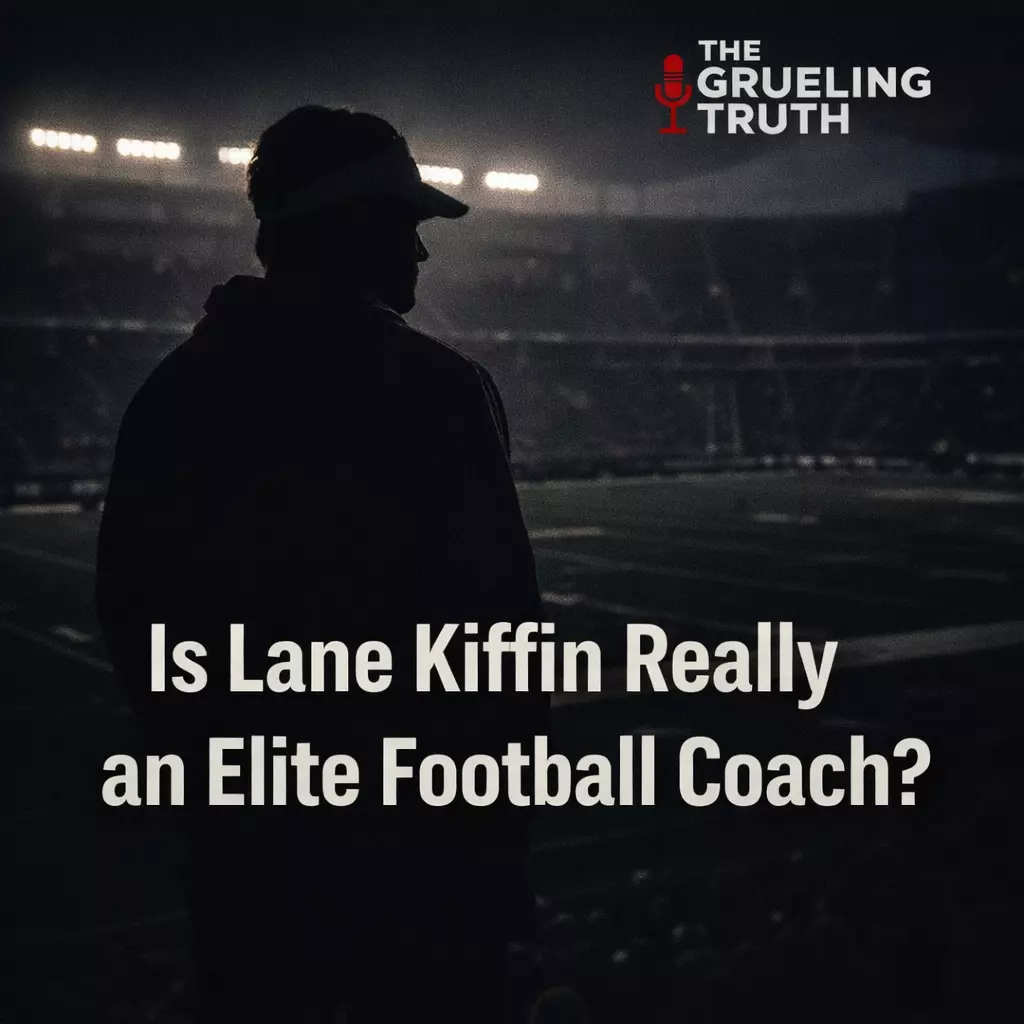
Yes, the Ole Miss Rebels won their first College Football Playoff game this season.
No, that fact does
not
suddenly make Lane Kiffin an elite football coach.
In modern college football discourse, success is often misattributed. A logo appears in the playoff bracket, a program earns a milestone win, and the head coach is immediately elevated into rarefied air. That shortcut thinking ignores accountability, context, and — most importantly — history.
When Lane Kiffin’s career is examined in full, the gap between perception and reality becomes impossible to ignore.
The Playoff Win That Wasn’t His
Start with the most uncomfortable truth:
Lane Kiffin
did not coach Ole Miss’s playoff win.
He didn’t design the game plan. He didn’t manage the sideline. He didn’t make the critical decisions under pressure.
The Rebels won that game without him.
That matters. Elite coaches are defined by moments they personally command. Nick Saban, Kirby Smart, Urban Meyer, Dabo Swinney — their legacies are inseparable from the games where everything was on the line and they were the ones holding the headset.
If the biggest win in your program’s history occurs with you
absent, that is not validation. That is circumstantial success. At best, it shows the roster had talent. At worst, it suggests the program did not depend on your leadership to achieve it.
Expanded Playoffs Lower the Bar
Ole Miss also benefited from a
12-team playoff, not the ruthless four-team system that defined the sport for a decade.
Under the old format, Ole Miss almost certainly does not qualify. Their résumé — solid but flawed — would have been filtered out by the same standards that eliminated many good-but-not-great teams year after year.
Expansion changes access, not excellence. Making a larger playoff is not the same achievement as forcing your way into a system designed to admit only the sport’s absolute elite. When coaches are evaluated historically, that distinction matters.
A Résumé Inflated by Polls and Cupcakes
Kiffin’s win totals look impressive on the surface, but context reveals familiar padding.
His résumé leans heavily on:
FCS opponents
Weak non-conference scheduling
Early-season “Top 10” wins against teams that did not finish Top 25
Poll inflation matters. A September ranking is often speculation, not proof. Elite coaches stack wins against teams that remain elite when the season ends, not opponents whose rankings dissolve under scrutiny.
Ole Miss under Kiffin has been competitive, exciting, and talented — but rarely dominant against verified elite competition.
Struggles Against the SEC’s Real Powers
Against the SEC’s true standard-bearers —
Georgia, Alabama, and peak LSU
— Kiffin’s teams usually lose. And often not close.
Elite coaches don’t merely spring clever upsets. They change the balance of power. They win divisions. They take titles. They sustain pressure.
Kiffin has:
No SEC championships
No playoff wins he personally coached
No sustained dominance over elite opponents
Those are not nitpicks. Those are defining benchmarks.
A Pattern That Predates Ole Miss
This isn’t a new discussion. Lane Kiffin’s career has followed this same arc repeatedly.
USC: Collapse, Not Contention
At USC, Kiffin inherited one of the sport’s premier brands. Instead of stabilizing the program, he presided over uneven results, internal frustration, and diminishing discipline. His tenure ended unceremoniously with a
midseason firing on an airport tarmac
— a moment that symbolized not bad luck, but eroded trust.
Elite coaches don’t get fired on tarmacs. They don’t lose institutional support that completely.
Oakland Raiders: Overmatched
In the NFL, Kiffin’s time with the Raiders was brief and disastrous. He went
4–12
before being fired midseason. Players tuned him out. Ownership lost confidence. The transition from coordinator to leader exposed limitations in authority and adaptability.
Tennessee: Chaos and Departure
At Tennessee, Kiffin’s lone season produced excitement — and turmoil. He recruited well, talked loudly, antagonized rivals, and then abruptly left for USC after one year. The program was left destabilized, and the reputation followed him.
Perhaps most revealing is Kiffin’s time under
Nick Saban at Alabama.
Yes, Kiffin helped modernize Alabama’s offense. But his departure was not mourned. In fact, Saban asked him to leave
before the national championship game, a stunning decision that spoke volumes about trust and professionalism. Kiffin had taken another job but wanted to stay on for the National Championship game, Saban told him to go.
Saban — the gold standard — decided he was better off without Kiffin in the building during the biggest game of the season.
That detail matters.
Talent Is Not the Same as Legacy
The playoff win proves one thing conclusively:
Ole Miss
has talent.
It does not prove that Lane Kiffin is an elite, championship-level coach.
Elite coaches:
Win conference titles
Author their biggest victories personally
Sustain dominance
Leave programs stronger, not fractured
Lane Kiffin is a gifted offensive mind. He is a recruiter. He is a marketer. He is entertaining.
But elite?
Until he wins championships, defeats elite opponents consistently, and personally commands the moments that define a legacy, the label does not apply.
If the biggest win in your program’s history happens without you on the sideline, that isn’t affirmation.
Up To $1500 in Bonus Bets Paid Back if your First Bet Does Not Win
T&Cs apply
4.5/5
Gambling problem? Call 1-800-GAMBLER or 1-800-MY-RESET (Available in the US) 877-8-HOPENY or text HOPENY (467369) (NY) 1-800-327-5050 (MA), 1-800-BETS-OFF (IA), 1-800-981-0023 (PR). 21+ only. Please Gamble Responsibly. See BetMGM.com for Terms. First Bet Offer for new customers only (if applicable). Subject to eligibility requirements. Bonus bets are non-withdrawable. In partnership with Kansas Crossing Casino and Hotel. Promotional offers not available in Mississippi, Massachusetts, New York, Ontario, or Puerto Rico.
New DraftKings Customers: Spend $5+ Get $150 in Bonuses
T&Cs apply
4.5/5
GAMBLING PROBLEM? CALL 1-800-GAMBLER or 1-800-MY-RESET, (800) 327-5050 or visit gamblinghelplinema.org (MA). Please Gamble Responsibly. 888-789-7777/visit ccpg.org (CT), or visit www.mdgamblinghelp.org (MD), 1-800-981-0023 (PR). 21+ and present in most states. (18+ DC/NH/PR/WY). Void in CAN. Eligibility restrictions apply. On behalf of Boot Hill Casino (KS). Pass-thru of per wager tax may apply in IL. 1 per new DraftKings customer. $5+ first-time bet req. Max. $150 issued as non-withdrawable Bonus Bets. Stake removed from payout. Reward issued as $50 in Bonus Bets every 7 days via click-to-claim for 14 days. Bonus Bets and click-to-claims expire 7 days (168hrs) after issuance. Terms: sportsbook.draftkings.com/promos. Ends 10/11/26 at 11:59 PM ET. Sponsored by DK.
Must be 21+. GAMBLING PROBLEM? CALL 1-800-GAMBLER OR CALL 1-800-MY-RESET, www.mdgamblinghelp.org (MD), (800)-327-5050 or gamblinghelplinema.org (MA), Call (877)8-HOPENY or text HOPENY (467369) (NY), (888) 789-7777 or ccpg.org (CT), morethanagame.nc.gov (NC), 1800gambler.net (WV)
Bet $1 and get double the winnings up to $25 for your next 10 bets
T&Cs apply
4.4/5
21+ New users only. Must register using eligible promo code. First bet after registration must qualify. Max. Bonus Bet: $1,000. Bonus Bet expires 14 days after receipt. Void where prohibited. See Caesars.com/promos for full terms. Gambling Problem? 1-800-GAMBLER (1-800-426-2537)
21+ and present in OH. Gambling Problem? Call 1-800-GAMBLER.
This site is using
Cloudflare
and adheres to the
Google Safe Browsing Program. We adapted
Google's Privacy Guidelines
to keep your data safe at all times.
Close
Ready to Win Big? Join the Elite with Our Sports Betting Deals!
FanDuel Promo
New Users – Get $250 in Bonus Bets when you wager $5 for 5 days
Up To $1500 in Bonus Bets Paid Back if your First Bet Does Not Win
Best Slots
T&Cs and 21+ apply
Gambling problem? Call 1-800-GAMBLER or 1-800-MY-RESET (Available in the US) 877-8-HOPENY or text HOPENY (467369) (NY) 1-800-327-5050 (MA), 1-800-BETS-OFF (IA), 1-800-981-0023 (PR). 21+ only. Please Gamble Responsibly. See BetMGM.com for Terms. First Bet Offer for new customers only (if applicable). Subject to eligibility requirements. Bonus bets are non-withdrawable. In partnership with Kansas Crossing Casino and Hotel. Promotional offers not available in Mississippi, Massachusetts, New York, Ontario, or Puerto Rico.
Code:
Open BetMGM
Get Bonus
DraftKings Promo
New DraftKings Customers: Spend $5+ Get $150 in Bonuses
Newcomer
T&Cs and 21+ apply
GAMBLING PROBLEM? CALL 1-800-GAMBLER or 1-800-MY-RESET, (800) 327-5050 or visit gamblinghelplinema.org (MA). Please Gamble Responsibly. 888-789-7777/visit ccpg.org (CT), or visit www.mdgamblinghelp.org (MD), 1-800-981-0023 (PR). 21+ and present in most states. (18+ DC/NH/PR/WY). Void in CAN. Eligibility restrictions apply. On behalf of Boot Hill Casino (KS). Pass-thru of per wager tax may apply in IL. 1 per new DraftKings customer. $5+ first-time bet req. Max. $150 issued as non-withdrawable Bonus Bets. Stake removed from payout. Reward issued as $50 in Bonus Bets every 7 days via click-to-claim for 14 days. Bonus Bets and click-to-claims expire 7 days (168hrs) after issuance. Terms: sportsbook.draftkings.com/promos. Ends 10/11/26 at 11:59 PM ET. Sponsored by DK.
Code:
Open DraftKings
Get Bonus
Find out what the legends have to say about sports this week....