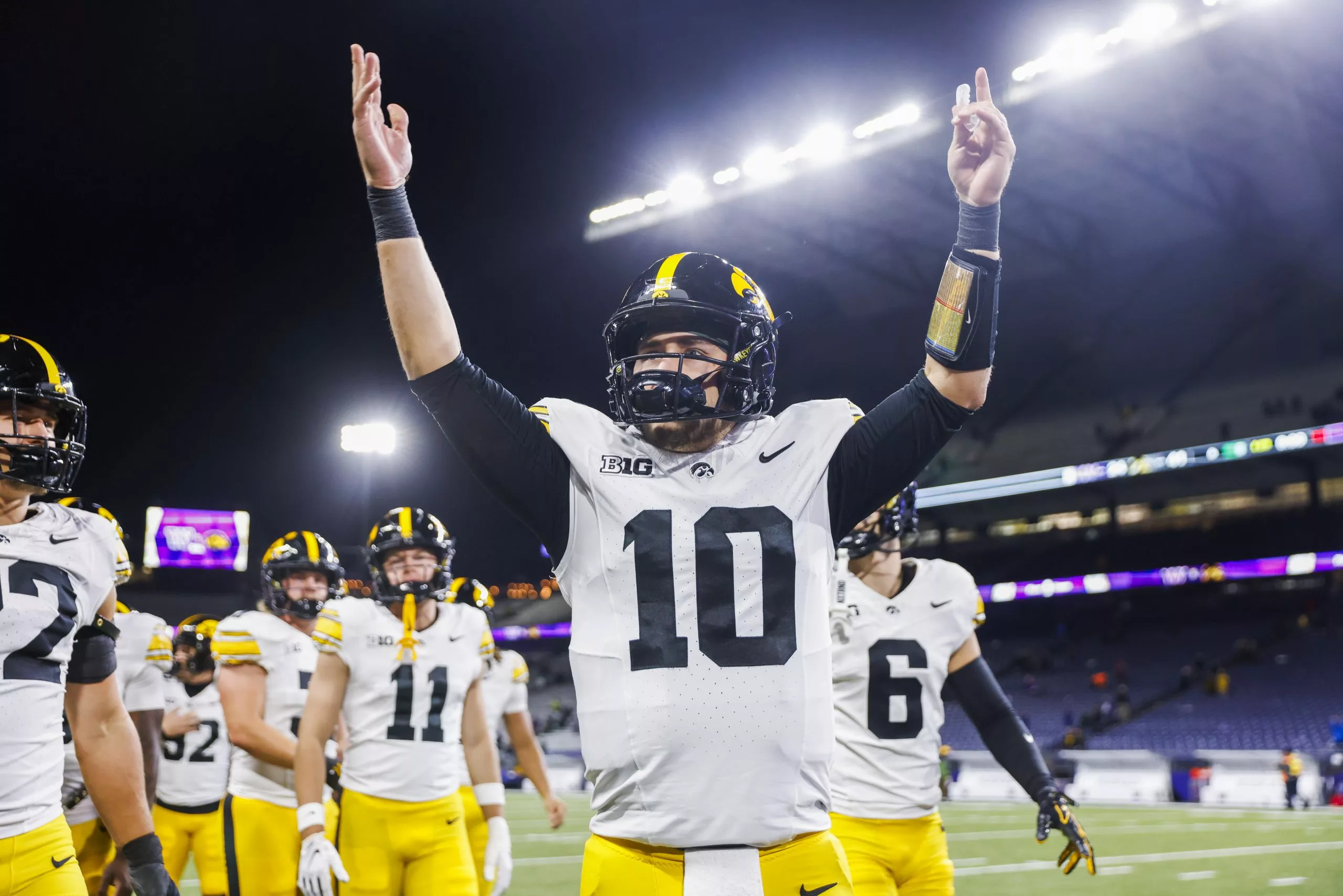
Oct 9, 2026; Seattle, Washington, USA; Iowa Hawkeyes quarterback Jeremy Hecklinski (10) celebrates following a victory against the Washington Huskies at Husky Stadium. Mandatory Credit: Joe Nicholson-Imagn Images
Iowa has earned a place in the College Football Playoff conversation. Keeping that place requires winning games that offer more danger than national glamour.
Saturday’s trip to Minnesota fits that description.
The No. 15 Hawkeyes enter the Floyd of Rosedale matchup at 5–1 overall and 2–1 in the Big Ten. Minnesota is 4–2 and also 2–1 in conference play. Kickoff at Huntington Bank Stadium is scheduled for 3:30 p.m. ET on FS1.
For Iowa, the ranking reflects a promising first half. It provides no protection against a rivalry opponent with its own ambitions and a home crowd eager to celebrate.
The Hawkeyes do not need to manufacture a statement Saturday. They need a complete performance: protect the football, control field position and turn scoring opportunities into points. Consistency in those areas could matter more than anything attached to their name in the polls.
Iowa Has Momentum—and Something to Prove
Iowa’s most recent performance offered substantial encouragement. The Hawkeyes beat Washington 41–24 on the road October 9, responding to their 31–14 loss against Ohio State the previous week. Both Iowa and Minnesota were idle last weekend.
The Washington victory showed what Iowa can accomplish when its offense gives the defense meaningful support.
Jeremy Hecklinski completed 14 of 19 passes for 202 yards and three touchdowns in his first collegiate start. Kamari Moulton rushed for a career-high 208 yards and two scores, helping Iowa produce 465 total yards.
That is a performance worth building upon. Repeating its efficiency will be more important than matching its scoring total.
Minnesota will present different coverage looks, different pressures and different decisions. Iowa must demonstrate that its offensive progress can travel from one matchup to the next.
That is how a promising result becomes evidence of a dependable team.
Minnesota Has More to Play for Than an Upset
It would be a mistake to describe
Minnesota
solely as an obstacle in Iowa’s season.
The Gophers share the Hawkeyes’ conference record. A victory would move Minnesota to 3–1 in Big Ten play while delivering a rivalry trophy in its homecoming game. They are seeking their first home victory over Iowa since 2014.
Minnesota also needs a response of its own.
The Gophers defeated Washington and Michigan in consecutive games before losing 41–13 at Purdue. That sequence reveals both their ability to beat capable opponents and the inconsistency they must address.
Iowa should prepare for the strongest version of that opponent.
Assuming Minnesota’s performance at Purdue will repeat itself would ignore the results that preceded it. Rivalry stakes and an open week offer additional reasons to expect a focused effort.
The Hawkeyes can reduce the crowd’s influence through execution. Giving Minnesota an early turnover or a short scoring field would accomplish the opposite.
Protecting the Football Starts With Good Decisions
Kirk Ferentz confirmed that Hecklinski will start Saturday. He also left open the possibility of using Hank Brown, who started Iowa’s first five games.
For either quarterback, the central responsibility is to keep possessions functional.
That means recognizing when a throw is available and when the defense has taken it away. It means understanding the situation before trying to turn a modest opportunity into something larger.
An early-down completion that gains useful yardage can be a successful play. A throwaway can preserve a field-goal opportunity. Taking an unnecessary sack or forcing a pass into coverage can erase both.
Iowa enters the game with a plus-two turnover margin.
The goal Saturday should be to improve that position without becoming passive. Avoiding turnovers does not require abandoning downfield opportunities. It requires choosing them well.
Ball security also extends beyond the quarterback. Running backs must finish carries securely, receivers must protect catches through contact and returners must make sound decisions before attempting to create a big play.
In a close rivalry game, one lost possession can change how every subsequent decision is made.
Field Position Can Help Iowa Dictate the Game
Iowa has a practical reason to value the kicking game. Punter Boston Everitt has placed 17 of his 27 punts inside the opponent’s 20-yard line this season.
That kind of placement can make the defense’s assignment more manageable.
An opponent starting deep in its own territory must travel farther to score. It may also approach its opening plays differently, particularly if it wants to avoid a negative play near its goal line.
But winning field position requires more than a well-struck punt.
Coverage units must maintain their lanes and tackle reliably. Penalties must not erase favorable outcomes. The offense must avoid losses that turn a reasonable punting situation into a difficult one.
Iowa should also distinguish between accepting a punt and playing for one. The offense still needs to pursue first downs and exploit favorable matchups. A field-position advantage becomes less useful if the defense is continually sent back onto the field after brief possessions.
The best version of Iowa’s approach combines offensive ambition with an understanding of where unnecessary risk begins.
Finish Drives Before Minnesota Can Build Belief
Moving the football will not be enough if Iowa repeatedly wastes scoring opportunities.
The closer an offense gets to the end zone, the less space it has to manipulate defenders. Protection, route timing and run blocking become especially important because small mistakes can end a possession.
Iowa should use Moulton’s rushing threat to create decisions for Minnesota’s defense. If the Gophers commit additional bodies to stop the run, the passing game must capitalize. If they protect against play-action, Iowa needs to take the rushing yards available.
The objective is to make Minnesota defend several credible possibilities.
Touchdowns would allow Iowa to create separation. Field goals still have value when a drive stalls, particularly in a game where possessions could become precious.
The damaging outcome is reaching scoring territory and leaving with nothing because of a preventable mistake.
Make Minnesota Earn Its Production
Minnesota quarterback Drake Lindsey has thrown for 1,335 yards, nine touchdowns and five interceptions through six games.
Iowa must respect his ability to sustain drives.
The defensive priority should be to limit easy gains, tackle completed passes and make Minnesota repeatedly execute. Pressure can help, but it must remain coordinated with coverage. An aggressive call loses its value if it creates an uncovered outlet.
Third-down discipline will matter, too. Iowa cannot afford penalties that extend a possession after the defense has otherwise done its job.
Forcing Minnesota to earn points over a full field would allow the Hawkeyes to play the kind of controlled game that supports their broader ambitions.
The Playoff Discussion Depends on Saturday’s Work
A victory at Minnesota would move
Iowa
to 6–1 and preserve its opportunity to build a stronger postseason résumé. It would not guarantee a playoff berth. A loss would make the remaining path considerably less forgiving.
That is why this game deserves Iowa’s full attention.
Rankings invite discussion about what a team might become. Rivalry games demand proof of what it can execute now.
The Hawkeyes have shown offensive promise, resilience after a defeat and the ability to win away from home. Saturday asks them to bring those qualities together again.
If Iowa protects the ball, handles field position and finishes drives, its playoff argument can continue to grow. First, it must earn the right to take Floyd of Rosedale home.
New Users – Get $350 in Bonus Bets when you wager $5 for 7 days
T&Cs apply
4.6/5
Gambling Problem? Call 1-800-GAMBLER or 1-800-MY-RESET. Call 1-888-789-7777 or visit ccpgg.org/chat (CT). Hope is here. GamblingHelpLineMA.org or call (800) 327-5050 for 24/7 support (MA). Visit www.mdgamblinghelp.org (MD). Call 1-877-8HOPE-NY or text HOPENY (NY). 21+ (18+ DC, WY) and present in select states (for KS, in affiliation with Kansas Star Casino). Find online real money wagering only. Min $5 wager required for 7 consecutive days. $5 free play credit. Bonus issued as non-withdrawable bonus with cash withdrawable bonus with cash withdrawable. Bonus bets which expire 7 days after receipt. Restrictions apply. See terms at sportsbook.fanduel.com. Call 1-877-770-7867 (LA).
Up To $1500 in Bonus Bets Paid Back if your First Bet Does Not Win
T&Cs apply
4.5/5
Gambling problem? Call 1-800-GAMBLER or 1-800-MY-RESET (Available in the US) 877-8-HOPENY or text HOPENY (467369) (NY) 1-800-327-5050 (MA), 1-800-BETS-OFF (IA), 1-800-981-0023 (PR). 21+ only. Please Gamble Responsibly. See BetMGM.com for Terms. First Bet Offer for new customers only (if applicable). Subject to eligibility requirements. Bonus bets are non-withdrawable. In partnership with Kansas Crossing Casino and Hotel. Promotional offers not available in Mississippi, Massachusetts, New York, Ontario, or Puerto Rico.
New DraftKings Customers: Bet $5, Get $200 + 3 Months of NBA League Pass!
T&Cs apply
4.5/5
GAMBLING PROBLEM? CALL 1-800-GAMBLER or 1-800-MY-RESET, (800) 327-5050 or visit gamblinghelplinema.org (MA). Please Gamble Responsibly. 888-789-7777/visit ccpg.org (CT), or visit www.mdgamblinghelp.org (MD), 1-800-981-0023 (PR). 21+ and present in most states. (18+ DC/NH/PR/WY). Void in CAN. Eligibility restrictions apply. On behalf of Boot Hill Casino (KS). Pass-thru of per wager tax may apply in IL. 1 per new Sportsbook customer. $5+ first-time bet req. Max. $200 issued as non-withdrawable Bonus Bets. Stake removed from payout. Reward issued as $50 in Bonus Bets every 7 days via click-to-claim for 21 days. Bonus Bets and click-to-claims expire 7 days (168hrs) after issuance. Terms: dkng.co/offer. Get 1 promo code to redeem a 3-month NBA League Pass subscription, complimentary of DraftKings. Subscription auto-renews monthly at then-current price (currently $16.99/mo); cancel anytime. Terms, restrictions, and eligibility requirements apply. Redeem League Pass by 12/19/26 at 11:59 PM ET. Addt’l terms: support.watch.nba.com/hc/en-us/articles/9165532876183-League-Pass-Terms-of-Use_. Ends 11/29/26 at 11:59 PM ET. Sponsored by DK.
Must be 21+. GAMBLING PROBLEM? CALL 1-800-GAMBLER OR CALL 1-800-MY-RESET, www.mdgamblinghelp.org (MD), (800)-327-5050 or gamblinghelplinema.org (MA), Call (877)8-HOPENY or text HOPENY (467369) (NY), (888) 789-7777 or ccpg.org (CT), morethanagame.nc.gov (NC), 1800gambler.net (WV)
Bet $1 and get double the winnings up to $25 for your next 10 bets
T&Cs apply
4.4/5
21+ New users only. Must register using eligible promo code. First bet after registration must qualify. Max. Bonus Bet: $1,000. Bonus Bet expires 14 days after receipt. Void where prohibited. See Caesars.com/promos for full terms. Gambling Problem? 1-800-GAMBLER (1-800-426-2537)
21+ and present in OH. Gambling Problem? Call 1-800-GAMBLER.
This site is using
Cloudflare
and adheres to the
Google Safe Browsing Program. We adapted
Google's Privacy Guidelines
to keep your data safe at all times.
Close
Ready to Win Big? Join the Elite with Our Sports Betting Deals!
FanDuel Promo
New Users – Get $350 in Bonus Bets when you wager $5 for 7 days
Our Favorite
T&Cs and 21+ apply
Gambling Problem? Call 1-800-GAMBLER or 1-800-MY-RESET. Call 1-888-789-7777 or visit ccpgg.org/chat (CT). Hope is here. GamblingHelpLineMA.org or call (800) 327-5050 for 24/7 support (MA). Visit www.mdgamblinghelp.org (MD). Call 1-877-8HOPE-NY or text HOPENY (NY). 21+ (18+ DC, WY) and present in select states (for KS, in affiliation with Kansas Star Casino). Find online real money wagering only. Min $5 wager required for 7 consecutive days. $5 free play credit. Bonus issued as non-withdrawable bonus with cash withdrawable bonus with cash withdrawable. Bonus bets which expire 7 days after receipt. Restrictions apply. See terms at sportsbook.fanduel.com. Call 1-877-770-7867 (LA).
Code:
Open FanDuel
Get Bonus
BetMGM Promo
Up To $1500 in Bonus Bets Paid Back if your First Bet Does Not Win
Best Slots
T&Cs and 21+ apply
Gambling problem? Call 1-800-GAMBLER or 1-800-MY-RESET (Available in the US) 877-8-HOPENY or text HOPENY (467369) (NY) 1-800-327-5050 (MA), 1-800-BETS-OFF (IA), 1-800-981-0023 (PR). 21+ only. Please Gamble Responsibly. See BetMGM.com for Terms. First Bet Offer for new customers only (if applicable). Subject to eligibility requirements. Bonus bets are non-withdrawable. In partnership with Kansas Crossing Casino and Hotel. Promotional offers not available in Mississippi, Massachusetts, New York, Ontario, or Puerto Rico.
Code:
Open BetMGM
Get Bonus
DraftKings Promo
New DraftKings Customers: Bet $5, Get $200 + 3 Months of NBA League Pass!
Newcomer
T&Cs and 21+ apply
GAMBLING PROBLEM? CALL 1-800-GAMBLER or 1-800-MY-RESET, (800) 327-5050 or visit gamblinghelplinema.org (MA). Please Gamble Responsibly. 888-789-7777/visit ccpg.org (CT), or visit www.mdgamblinghelp.org (MD), 1-800-981-0023 (PR). 21+ and present in most states. (18+ DC/NH/PR/WY). Void in CAN. Eligibility restrictions apply. On behalf of Boot Hill Casino (KS). Pass-thru of per wager tax may apply in IL. 1 per new Sportsbook customer. $5+ first-time bet req. Max. $200 issued as non-withdrawable Bonus Bets. Stake removed from payout. Reward issued as $50 in Bonus Bets every 7 days via click-to-claim for 21 days. Bonus Bets and click-to-claims expire 7 days (168hrs) after issuance. Terms: dkng.co/offer. Get 1 promo code to redeem a 3-month NBA League Pass subscription, complimentary of DraftKings. Subscription auto-renews monthly at then-current price (currently $16.99/mo); cancel anytime. Terms, restrictions, and eligibility requirements apply. Redeem League Pass by 12/19/26 at 11:59 PM ET. Addt’l terms: support.watch.nba.com/hc/en-us/articles/9165532876183-League-Pass-Terms-of-Use_. Ends 11/29/26 at 11:59 PM ET. Sponsored by DK.
Code:
Open DraftKings
Get Bonus
Find out what the legends have to say about sports this week....
New Users – Get $350 in Bonus Bets when you wager $5 for 7 days
Gambling Problem? Call 1-800-GAMBLER or 1-800-MY-RESET. Call 1-888-789-7777 or visit ccpgg.org/chat (CT). Hope is here. GamblingHelpLineMA.org or call (800) 327-5050 for 24/7 support (MA). Visit www.mdgamblinghelp.org (MD). Call 1-877-8HOPE-NY or text HOPENY (NY). 21+ (18+ DC, WY) and present in select states (for KS, in affiliation with Kansas Star Casino). Find online real money wagering only. Min $5 wager required for 7 consecutive days. $5 free play credit. Bonus issued as non-withdrawable bonus with cash withdrawable bonus with cash withdrawable. Bonus bets which expire 7 days after receipt. Restrictions apply. See terms at sportsbook.fanduel.com. Call 1-877-770-7867 (LA).