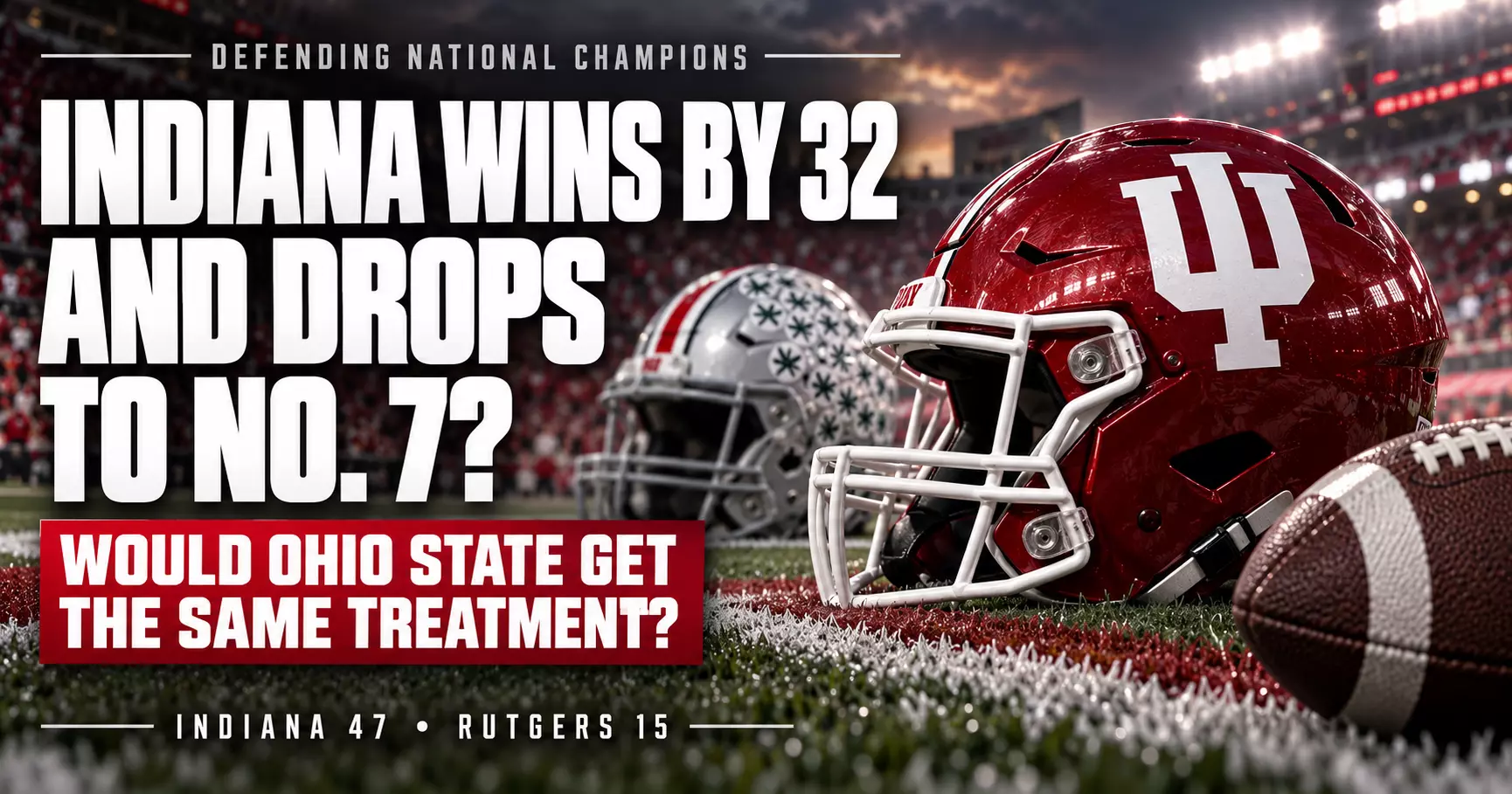
The defending national champions slipped from No. 6 to No. 7 on Sunday as Alabama moved ahead following its 56–23 victory.
Indiana went on the road, beat Rutgers 47–15 and returned home undefeated.
Then the Hoosiers dropped in the AP poll.
The defending national champions slipped from No. 6 to No. 7 on Sunday as Alabama moved ahead following its 56–23 victory at Mississippi State. Indiana did nothing to damage its record, yet lost ground in the national rankings.
That deserves a question that goes beyond whether Alabama had the better win this particular weekend:
If Ohio State had Indiana’s exact résumé—coming off a 16–0 national championship season and opening the next year 5–0—would the Buckeyes be ranked seventh?
My answer is no.
That is an opinion about how college football evaluates familiar powers, not something a hypothetical can prove. But it is a fair question, and Indiana has accomplished enough to make voters answer it.
Indiana Has Already Earned the Benefit of the Doubt
Indiana’s championship season was not a feel-good story that ended before the biggest games arrived.
The Hoosiers finished 16–0 and won the
national championship
by defeating Miami 27–21. Curt Cignetti’s team completed the entire climb, delivering the first national title in program history.
That should change the starting point of the conversation.
Indiana should be evaluated as an established championship program under its current coaching staff. Its older history should carry less weight than what Cignetti has actually built.
Nobody is arguing that last season’s trophy guarantees this season’s No. 1 ranking. Rosters change. Quarterbacks leave. Every team has to demonstrate that it can win again.
But when the defending champion keeps winning, why does it feel as though Indiana must repeatedly establish its legitimacy?
A traditional power would likely receive considerable patience while replacing important players. Indiana deserves the same consideration when its replacements are helping it remain unbeaten.
Would the Same Results Look Different in Ohio State Uniforms?
Imagine replacing the name Indiana with Ohio State.
Keep the undefeated championship season. Keep the current unbeaten start. Keep the same opponents, scores and performances.
Would the discussion center on whether seventh was appropriate? Or would it center on whether the defending champions should still be first?
I believe it would be the latter.
Ohio State has earned its national reputation over decades. That reputation is understandable. The problem comes when reputation becomes an advantage that a newer contender cannot earn through current results.
Indiana has done the hardest thing in the sport: win the championship. It has followed that achievement by continuing to win.
At some point, the evaluation must catch up with the accomplishment.
The Hoosiers should not need several championships before receiving the confidence that established brands enjoy after one.
Rutgers Was a Convincing Win
Saturday’s performance gave voters little reason to downgrade their assessment of Indiana.
The Hoosiers outgained Rutgers 593–254 and rushed for 329 yards. Their defense held the Scarlet Knights to 59 rushing yards. Indiana led 23–0 at halftime and extended that advantage to 37–0 before Rutgers scored.
That was a convincing road victory with production on both sides of the ball.
It does not prove Indiana is the best team in the country. Rutgers is not the opponent that can settle that argument. But it does show the Hoosiers handling a game they were expected to win with authority.
That is normally described as taking care of business.
Indiana should receive that straightforward assessment, without every victory immediately becoming another debate about what remains unproven.
Alabama Has a Legitimate Argument
There is a reasonable case for Alabama moving ahead.
The Crimson Tide beat a Mississippi State team that entered the weekend ranked No. 16. Indiana defeated an unranked Rutgers team. Alabama’s victory came against the stronger opponent, and the 56–23 margin was substantial.
Rankings are comparisons. A team can play well and drop because another team strengthens its case.
That principle is sound.
The question is whether it is applied consistently—and whether the full body of evidence supports the confidence given to each program.
Alabama deserves credit for its performance. Indiana deserves credit for its own. Moving the Tide ahead can be defended on the strength of Saturday’s opponent.
What should not go unchallenged is the broader assumption that Indiana must keep proving it belongs while more familiar programs begin with that status already granted.
A persuasive explanation should identify the football evidence, not simply rely on which program feels more natural near the top.
Ohio State’s Position Makes the Question More Relevant
Ohio State
remained No. 5 after beating Iowa 31–14. The Buckeyes are 4–1, while Indiana is 5–0.
Ohio State’s victory at Iowa was impressive. Its ranking deserves a serious football discussion, and an undefeated record does not automatically make one team better than every team with a loss.
Still, this is why the comparison matters.
The Hoosiers are the defending champions and have yet to lose this season. The Buckeyes have already lost, yet remain ahead of them.
Voters may have legitimate reasons for that order. But Indiana fans are justified in asking whether Ohio State would receive the same treatment if those circumstances were reversed.
The standard should travel with the résumé.
If a 16–0 championship season followed by an unbeaten start would command greater respect in Columbus, then the difference deserves scrutiny.
Indiana Can Improve and Still Deserve More Respect
Cignetti has reasons to keep demanding better football.
Rutgers produced two second-half touchdown drives, and Indiana’s defensive lapses provided material for the coaching staff to address. A comfortable victory does not eliminate the need for corrections.
That does not weaken the argument for respecting the Hoosiers.
Championship teams can have imperfect stretches. A coach identifying mistakes after a 32-point road victory is part of maintaining a high standard.
Indiana does not have to be flawless to deserve a fair evaluation. Neither does Alabama, Ohio State or anyone else.
The discussion should distinguish between acknowledging areas for improvement and treating those areas as evidence that an unbeaten defending champion remains somehow suspect.
Nebraska Gives Indiana Another Opportunity
Indiana visits unbeaten Nebraska on October 10. The Huskers are 5–0 and coming off a 48–23 victory over Maryland.
That matchup will give the Hoosiers another opportunity to strengthen their current-season case.
They should welcome it. Winning a championship does not remove the responsibility to perform, and a road game against an unbeaten conference opponent demands preparation and execution.
But Indiana’s standing should not depend on constantly reaching the next checkpoint before receiving recognition for the ones it has already passed.
The Hoosiers have earned the right to be discussed as champions defending their position.
The Question Voters Should Answer
The Hoosiers completed a perfect championship season. They remain undefeated. They just won a conference road game by 32 points.
Would Ohio State, with that exact résumé, be sitting at No. 7?
I do believe it would. Actually, we have seen this all the time in the case of the Big Team Pedigree. Ohio State playing the same schedule as OU would probably be ranked number one now.
Indiana should keep winning, correcting mistakes and letting its performance speak. That is the part Cignetti and his players control.
The people evaluating them have a responsibility, too: make sure the standard is based on the team playing now, rather than the reputation attached to its name.
New Users – Get $350 in Bonus Bets when you wager $5 for 7 days
T&Cs apply
4.6/5
Gambling Problem? Call 1-800-GAMBLER or 1-800-MY-RESET. Call 1-888-789-7777 or visit ccpgg.org/chat (CT). Hope is here. GamblingHelpLineMA.org or call (800) 327-5050 for 24/7 support (MA). Visit www.mdgamblinghelp.org (MD). Call 1-877-8HOPE-NY or text HOPENY (NY). 21+ (18+ DC, WY) and present in select states (for KS, in affiliation with Kansas Star Casino). Find online real money wagering only. Min $5 wager required for 7 consecutive days. $5 free play credit. Bonus issued as non-withdrawable bonus with cash withdrawable bonus with cash withdrawable. Bonus bets which expire 7 days after receipt. Restrictions apply. See terms at sportsbook.fanduel.com. Call 1-877-770-7867 (LA).
Up To $1500 in Bonus Bets Paid Back if your First Bet Does Not Win
T&Cs apply
4.5/5
Gambling problem? Call 1-800-GAMBLER or 1-800-MY-RESET (Available in the US) 877-8-HOPENY or text HOPENY (467369) (NY) 1-800-327-5050 (MA), 1-800-BETS-OFF (IA), 1-800-981-0023 (PR). 21+ only. Please Gamble Responsibly. See BetMGM.com for Terms. First Bet Offer for new customers only (if applicable). Subject to eligibility requirements. Bonus bets are non-withdrawable. In partnership with Kansas Crossing Casino and Hotel. Promotional offers not available in Mississippi, Massachusetts, New York, Ontario, or Puerto Rico.
New DraftKings Customers: Bet $5, Get $200 + 3 Months of NBA League Pass!
T&Cs apply
4.5/5
GAMBLING PROBLEM? CALL 1-800-GAMBLER or 1-800-MY-RESET, (800) 327-5050 or visit gamblinghelplinema.org (MA). Please Gamble Responsibly. 888-789-7777/visit ccpg.org (CT), or visit www.mdgamblinghelp.org (MD), 1-800-981-0023 (PR). 21+ and present in most states. (18+ DC/NH/PR/WY). Void in CAN. Eligibility restrictions apply. On behalf of Boot Hill Casino (KS). Pass-thru of per wager tax may apply in IL. 1 per new Sportsbook customer. $5+ first-time bet req. Max. $200 issued as non-withdrawable Bonus Bets. Stake removed from payout. Reward issued as $50 in Bonus Bets every 7 days via click-to-claim for 21 days. Bonus Bets and click-to-claims expire 7 days (168hrs) after issuance. Terms: dkng.co/offer. Get 1 promo code to redeem a 3-month NBA League Pass subscription, complimentary of DraftKings. Subscription auto-renews monthly at then-current price (currently $16.99/mo); cancel anytime. Terms, restrictions, and eligibility requirements apply. Redeem League Pass by 12/19/26 at 11:59 PM ET. Addt’l terms: support.watch.nba.com/hc/en-us/articles/9165532876183-League-Pass-Terms-of-Use_. Ends 11/29/26 at 11:59 PM ET. Sponsored by DK.
Must be 21+. GAMBLING PROBLEM? CALL 1-800-GAMBLER OR CALL 1-800-MY-RESET, www.mdgamblinghelp.org (MD), (800)-327-5050 or gamblinghelplinema.org (MA), Call (877)8-HOPENY or text HOPENY (467369) (NY), (888) 789-7777 or ccpg.org (CT), morethanagame.nc.gov (NC), 1800gambler.net (WV)
Bet $1 and get double the winnings up to $25 for your next 10 bets
T&Cs apply
4.4/5
21+ New users only. Must register using eligible promo code. First bet after registration must qualify. Max. Bonus Bet: $1,000. Bonus Bet expires 14 days after receipt. Void where prohibited. See Caesars.com/promos for full terms. Gambling Problem? 1-800-GAMBLER (1-800-426-2537)
21+ and present in OH. Gambling Problem? Call 1-800-GAMBLER.
This site is using
Cloudflare
and adheres to the
Google Safe Browsing Program. We adapted
Google's Privacy Guidelines
to keep your data safe at all times.
Close
Ready to Win Big? Join the Elite with Our Sports Betting Deals!
FanDuel Promo
New Users – Get $350 in Bonus Bets when you wager $5 for 7 days
Our Favorite
T&Cs and 21+ apply
Gambling Problem? Call 1-800-GAMBLER or 1-800-MY-RESET. Call 1-888-789-7777 or visit ccpgg.org/chat (CT). Hope is here. GamblingHelpLineMA.org or call (800) 327-5050 for 24/7 support (MA). Visit www.mdgamblinghelp.org (MD). Call 1-877-8HOPE-NY or text HOPENY (NY). 21+ (18+ DC, WY) and present in select states (for KS, in affiliation with Kansas Star Casino). Find online real money wagering only. Min $5 wager required for 7 consecutive days. $5 free play credit. Bonus issued as non-withdrawable bonus with cash withdrawable bonus with cash withdrawable. Bonus bets which expire 7 days after receipt. Restrictions apply. See terms at sportsbook.fanduel.com. Call 1-877-770-7867 (LA).
Code:
Open FanDuel
Get Bonus
BetMGM Promo
Up To $1500 in Bonus Bets Paid Back if your First Bet Does Not Win
Best Slots
T&Cs and 21+ apply
Gambling problem? Call 1-800-GAMBLER or 1-800-MY-RESET (Available in the US) 877-8-HOPENY or text HOPENY (467369) (NY) 1-800-327-5050 (MA), 1-800-BETS-OFF (IA), 1-800-981-0023 (PR). 21+ only. Please Gamble Responsibly. See BetMGM.com for Terms. First Bet Offer for new customers only (if applicable). Subject to eligibility requirements. Bonus bets are non-withdrawable. In partnership with Kansas Crossing Casino and Hotel. Promotional offers not available in Mississippi, Massachusetts, New York, Ontario, or Puerto Rico.
Code:
Open BetMGM
Get Bonus
DraftKings Promo
New DraftKings Customers: Bet $5, Get $200 + 3 Months of NBA League Pass!
Newcomer
T&Cs and 21+ apply
GAMBLING PROBLEM? CALL 1-800-GAMBLER or 1-800-MY-RESET, (800) 327-5050 or visit gamblinghelplinema.org (MA). Please Gamble Responsibly. 888-789-7777/visit ccpg.org (CT), or visit www.mdgamblinghelp.org (MD), 1-800-981-0023 (PR). 21+ and present in most states. (18+ DC/NH/PR/WY). Void in CAN. Eligibility restrictions apply. On behalf of Boot Hill Casino (KS). Pass-thru of per wager tax may apply in IL. 1 per new Sportsbook customer. $5+ first-time bet req. Max. $200 issued as non-withdrawable Bonus Bets. Stake removed from payout. Reward issued as $50 in Bonus Bets every 7 days via click-to-claim for 21 days. Bonus Bets and click-to-claims expire 7 days (168hrs) after issuance. Terms: dkng.co/offer. Get 1 promo code to redeem a 3-month NBA League Pass subscription, complimentary of DraftKings. Subscription auto-renews monthly at then-current price (currently $16.99/mo); cancel anytime. Terms, restrictions, and eligibility requirements apply. Redeem League Pass by 12/19/26 at 11:59 PM ET. Addt’l terms: support.watch.nba.com/hc/en-us/articles/9165532876183-League-Pass-Terms-of-Use_. Ends 11/29/26 at 11:59 PM ET. Sponsored by DK.
Code:
Open DraftKings
Get Bonus
Find out what the legends have to say about sports this week....
New Users – Get $350 in Bonus Bets when you wager $5 for 7 days
Gambling Problem? Call 1-800-GAMBLER or 1-800-MY-RESET. Call 1-888-789-7777 or visit ccpgg.org/chat (CT). Hope is here. GamblingHelpLineMA.org or call (800) 327-5050 for 24/7 support (MA). Visit www.mdgamblinghelp.org (MD). Call 1-877-8HOPE-NY or text HOPENY (NY). 21+ (18+ DC, WY) and present in select states (for KS, in affiliation with Kansas Star Casino). Find online real money wagering only. Min $5 wager required for 7 consecutive days. $5 free play credit. Bonus issued as non-withdrawable bonus with cash withdrawable bonus with cash withdrawable. Bonus bets which expire 7 days after receipt. Restrictions apply. See terms at sportsbook.fanduel.com. Call 1-877-770-7867 (LA).