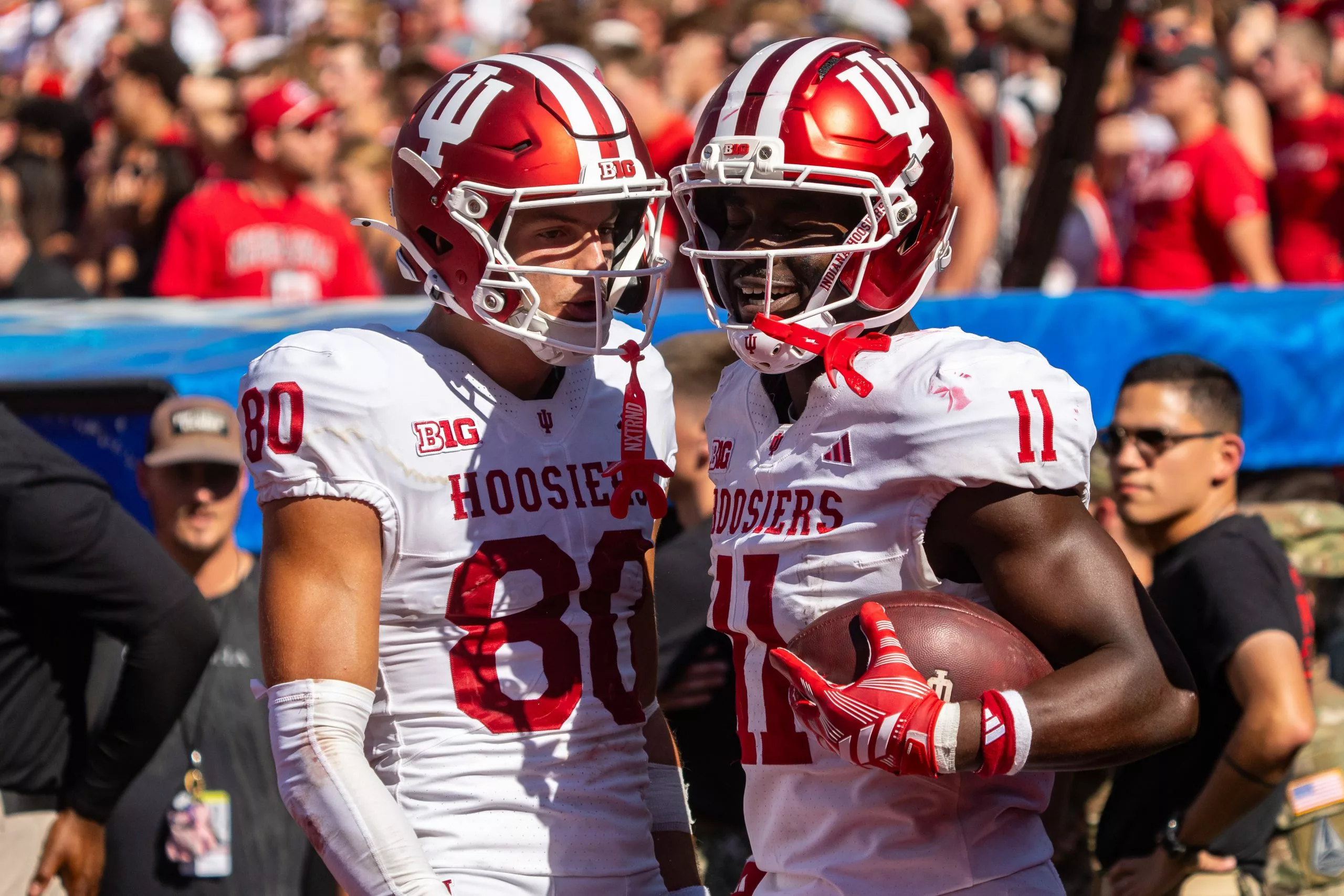
Oct 10, 2026; Lincoln, Nebraska, USA; Indiana Hoosiers wide receiver Nick Marsh (11) and wide receiver Charlie Becker (80) celebrate after a touchdown against the Nebraska Cornhuskers during the fourth quarter at Memorial Stadium. Mandatory Credit: Dylan Widger-Imagn Images
With 12:01 remaining in Lincoln, Indiana’s unbeaten season was in serious danger.
Nebraska quarterback Anthony Colandrea had just broken free for a 39-yard touchdown run. The Huskers led 17–6, the crowd had every reason to believe an upset was coming, and Indiana had yet to score a touchdown.
Ten seconds later, the game looked different.
Josh Hoover found Nick Marsh, who turned a crossing route into a 75-yard touchdown. Less than five minutes after that, the same combination produced a 44-yard score on fourth down, giving Indiana the lead with 7:13 remaining. The Hoosiers held on to win 20–17.
It was an uncomfortable afternoon that ended with a familiar result: Indiana winning.
The Hoosiers
improved to 6–0 and extended their winning streak to 22 games.
That response strengthens Indiana’s championship case. The performance that made the comeback necessary also gives Curt Cignetti plenty to address before Ohio State arrives.
Nick Marsh Changed the Game When Indiana Needed It Most
Marsh finished with six catches for 187 yards and two touchdowns.
The numbers were outstanding. The timing made them decisive.
After Nebraska established a two-possession lead, Indiana needed an immediate answer. A prolonged scoring drive could have helped, but it would also have consumed precious time. Marsh’s first touchdown erased most of the deficit in one play and forced the Huskers to confront a different finish.
That is the value of an explosive receiver.
A defense can control stretches of a game and still lose its advantage when one player turns a completion into a touchdown. Marsh gave Indiana that possibility even when its offense was struggling to sustain momentum.
His second score completed the reversal. Nebraska prepared to defend a short-yardage run, and Indiana exploited the opening through the air.
The Hoosiers needed a player to make the difference. Marsh supplied it twice.
Josh Hoover Passed a Test That Statistics Alone Cannot Explain
Hoover completed 12 of 22 passes for 263 yards and two touchdowns.
This was not a smooth afternoon from start to finish. Indiana spent much of the game searching for offensive rhythm, and the quarterback had limited opportunities to establish it.
But when the game demanded decisive throws, Hoover delivered.
That matters when evaluating a quarterback leading a championship contender. Some games allow an offense to follow its preferred plan. Others require the quarterback to remain composed while that plan becomes harder to execute.
Hoover did enough to keep Indiana within reach, then helped produce the plays that won it.
He does not need every performance to resemble a showcase. He does need to make sound decisions when the margin becomes thin. Saturday provided encouraging evidence that he can do that in a hostile road environment.
Cignetti Trusted His Offense at the Defining Moment
The fourth-down touchdown deserves attention beyond its result.
Indiana needed to convert, and the defense was positioned to challenge a short run. The Hoosiers used that expectation against Nebraska and found Marsh in space.
The broader coaching lesson is the willingness to pursue a winning opportunity when the situation becomes uncomfortable.
Aggression is useful when it is connected to a clear football advantage. Calling something adventurous simply to demonstrate courage accomplishes little. Identifying how an opponent is defending the situation and choosing an answer is what matters.
Indiana executed that answer.
The play reinforced why confidence in a coach extends beyond preparation during the week. A tight game eventually demands a decision, and the team must believe in both the call and its ability to carry it out.
The Defense Finished Better Than It Started
Indiana’s defense
had difficulty getting off the field for much of the afternoon. Late in the game, however, it produced the fourth-down stops needed to protect the lead.
Those stops belong in the evaluation.
A defense should not be judged only by its worst series, particularly when it makes the plays that secure a victory. Indiana showed that it could respond after being stretched and challenged.
But finishing well does not erase the earlier problems.
The Hoosiers need to examine why Nebraska repeatedly extended possessions and how they can put opponents behind schedule more consistently. Getting a team into third down is useful only if the defense can complete the possession.
Ohio State will test those details. Indiana needs its late-game resistance to become a more consistent feature of the entire afternoon.
The Running Game Must Offer More Against Ohio State
Indiana rushed for just 65 yards on 22 attempts against Nebraska.
That is the offensive concern I would place near the top of the preparation list.
The Hoosiers proved that explosive passing plays can rescue a game. They should still want an approach that gives them more dependable options before a rescue becomes necessary.
A productive rushing attack helps maintain manageable down-and-distance situations. It also forces defenders to respect more than the quarterback and receivers.
Against Ohio State, Indiana needs enough success on the ground to prevent the passing game from carrying every difficult assignment.
That does not require stubbornly repeating unsuccessful runs. It requires identifying which concepts fit the matchup, executing the blocks and finding ways to keep the defense from anticipating the next call.
Possession Problems Require a Response From Both Units
Nebraska held the ball for 39:33, compared with Indiana’s 20:27.
Time of possession does not award victories, as Saturday demonstrated. The imbalance still helps explain how much control Nebraska exercised.
Some of Indiana’s shorter possession time came from its quick touchdown strikes. Those are opportunities any offense should welcome. The concern is the combination of offensive difficulty and defensive possessions that kept extending.
The correction belongs to both units.
The offense needs more productive early-down plays and sustained drives. The defense needs stops that return the ball before an opponent settles into another lengthy possession.
Indiana cannot assume that explosive touchdowns will always compensate for limited opportunities.
Winning Under Pressure Strengthens the Championship Case
A narrow victory should invite scrutiny. It should also receive appropriate credit.
Nebraska made Indiana uncomfortable, and the Hoosiers still produced the throws, catches and defensive stops required to leave with a win.
That is meaningful evidence about this team’s composure.
Championship contenders need the ability to win through different circumstances. Saturday asked Indiana to recover from a late deficit, and the response demonstrated that the season does not depend entirely on establishing early control.
The danger would be treating that resilience as a reason to overlook the problems. Cignetti’s challenge is to preserve the confidence while demanding better execution.
Ohio State Will Require a More Complete Indiana Performance
The Buckeyes visit Bloomington next Saturday, giving Indiana an immediate opportunity to measure itself against another leading Big Ten contender.
The Hoosiers should enter that week encouraged by their response in Lincoln and dissatisfied with how long they needed to find it.
They must run more effectively, end defensive possessions more consistently and give Hoover a game that does not depend on two extraordinary touchdowns.
Indiana reminded everyone that it knows how to win under pressure. Against Ohio State, the next task is to combine that composure with a more complete performance.
Up To $1500 in Bonus Bets Paid Back if your First Bet Does Not Win
T&Cs apply
4.5/5
Gambling problem? Call 1-800-GAMBLER or 1-800-MY-RESET (Available in the US) 877-8-HOPENY or text HOPENY (467369) (NY) 1-800-327-5050 (MA), 1-800-BETS-OFF (IA), 1-800-981-0023 (PR). 21+ only. Please Gamble Responsibly. See BetMGM.com for Terms. First Bet Offer for new customers only (if applicable). Subject to eligibility requirements. Bonus bets are non-withdrawable. In partnership with Kansas Crossing Casino and Hotel. Promotional offers not available in Mississippi, Massachusetts, New York, Ontario, or Puerto Rico.
New DraftKings Customers: Spend $5+ Get $150 in Bonuses
T&Cs apply
4.5/5
GAMBLING PROBLEM? CALL 1-800-GAMBLER or 1-800-MY-RESET, (800) 327-5050 or visit gamblinghelplinema.org (MA). Please Gamble Responsibly. 888-789-7777/visit ccpg.org (CT), or visit www.mdgamblinghelp.org (MD), 1-800-981-0023 (PR). 21+ and present in most states. (18+ DC/NH/PR/WY). Void in CAN. Eligibility restrictions apply. On behalf of Boot Hill Casino (KS). Pass-thru of per wager tax may apply in IL. 1 per new DraftKings customer. $5+ first-time bet req. Max. $150 issued as non-withdrawable Bonus Bets. Stake removed from payout. Reward issued as $50 in Bonus Bets every 7 days via click-to-claim for 14 days. Bonus Bets and click-to-claims expire 7 days (168hrs) after issuance. Terms: sportsbook.draftkings.com/promos. Ends 10/11/26 at 11:59 PM ET. Sponsored by DK.
Must be 21+. GAMBLING PROBLEM? CALL 1-800-GAMBLER OR CALL 1-800-MY-RESET, www.mdgamblinghelp.org (MD), (800)-327-5050 or gamblinghelplinema.org (MA), Call (877)8-HOPENY or text HOPENY (467369) (NY), (888) 789-7777 or ccpg.org (CT), morethanagame.nc.gov (NC), 1800gambler.net (WV)
Bet $1 and get double the winnings up to $25 for your next 10 bets
T&Cs apply
4.4/5
21+ New users only. Must register using eligible promo code. First bet after registration must qualify. Max. Bonus Bet: $1,000. Bonus Bet expires 14 days after receipt. Void where prohibited. See Caesars.com/promos for full terms. Gambling Problem? 1-800-GAMBLER (1-800-426-2537)
21+ and present in OH. Gambling Problem? Call 1-800-GAMBLER.
This site is using
Cloudflare
and adheres to the
Google Safe Browsing Program. We adapted
Google's Privacy Guidelines
to keep your data safe at all times.
Close
Ready to Win Big? Join the Elite with Our Sports Betting Deals!
FanDuel Promo
New Users – Get $250 in Bonus Bets when you wager $5 for 5 days
Up To $1500 in Bonus Bets Paid Back if your First Bet Does Not Win
Best Slots
T&Cs and 21+ apply
Gambling problem? Call 1-800-GAMBLER or 1-800-MY-RESET (Available in the US) 877-8-HOPENY or text HOPENY (467369) (NY) 1-800-327-5050 (MA), 1-800-BETS-OFF (IA), 1-800-981-0023 (PR). 21+ only. Please Gamble Responsibly. See BetMGM.com for Terms. First Bet Offer for new customers only (if applicable). Subject to eligibility requirements. Bonus bets are non-withdrawable. In partnership with Kansas Crossing Casino and Hotel. Promotional offers not available in Mississippi, Massachusetts, New York, Ontario, or Puerto Rico.
Code:
Open BetMGM
Get Bonus
DraftKings Promo
New DraftKings Customers: Spend $5+ Get $150 in Bonuses
Newcomer
T&Cs and 21+ apply
GAMBLING PROBLEM? CALL 1-800-GAMBLER or 1-800-MY-RESET, (800) 327-5050 or visit gamblinghelplinema.org (MA). Please Gamble Responsibly. 888-789-7777/visit ccpg.org (CT), or visit www.mdgamblinghelp.org (MD), 1-800-981-0023 (PR). 21+ and present in most states. (18+ DC/NH/PR/WY). Void in CAN. Eligibility restrictions apply. On behalf of Boot Hill Casino (KS). Pass-thru of per wager tax may apply in IL. 1 per new DraftKings customer. $5+ first-time bet req. Max. $150 issued as non-withdrawable Bonus Bets. Stake removed from payout. Reward issued as $50 in Bonus Bets every 7 days via click-to-claim for 14 days. Bonus Bets and click-to-claims expire 7 days (168hrs) after issuance. Terms: sportsbook.draftkings.com/promos. Ends 10/11/26 at 11:59 PM ET. Sponsored by DK.
Code:
Open DraftKings
Get Bonus
Find out what the legends have to say about sports this week....