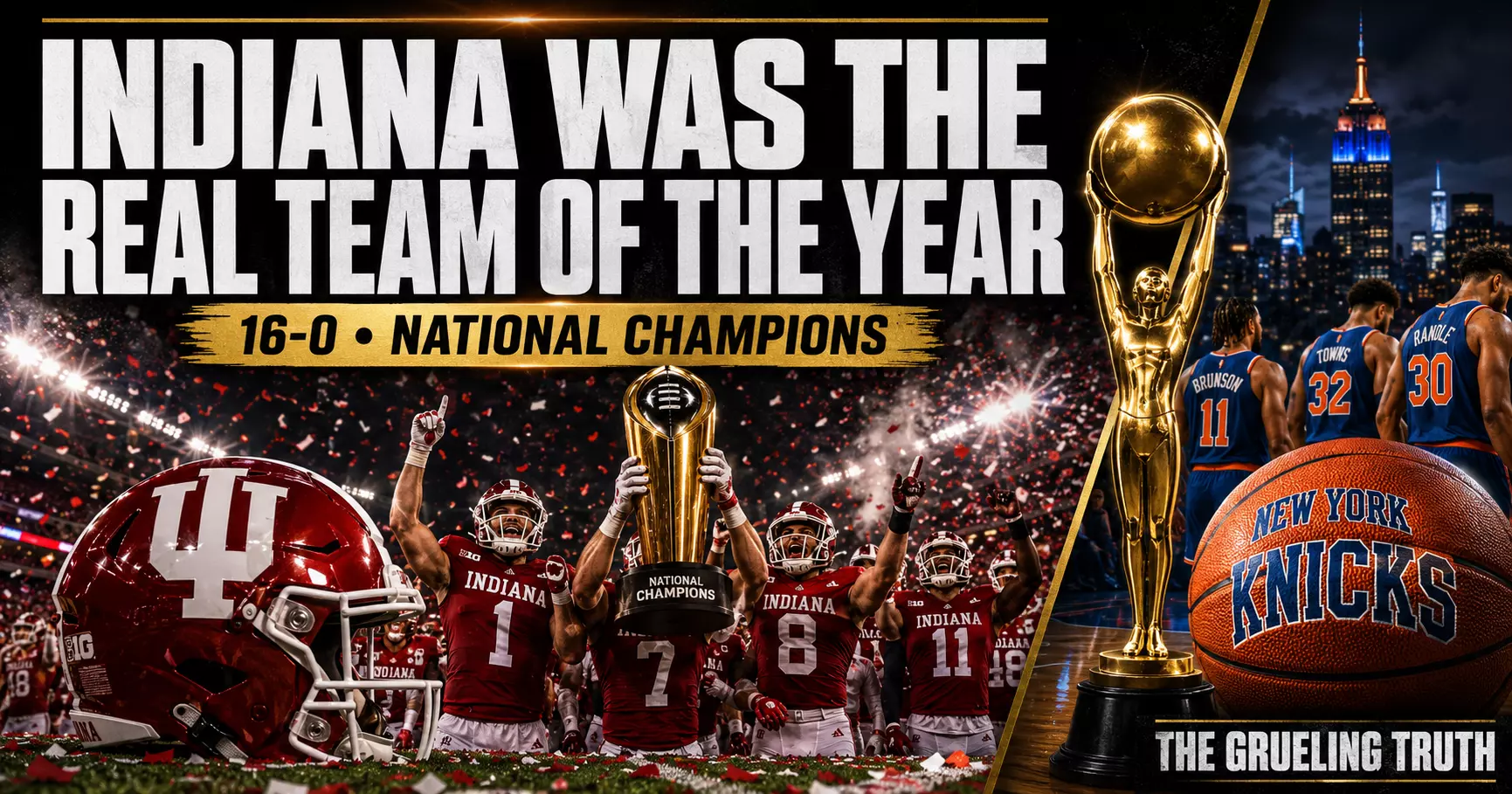
At the 2026 ESPY Awards—held, perhaps fittingly, in New York City—the Knicks received the award for Best Team.
The New York Knicks authored a tremendous championship story. They ended a 53-year title drought, restored pride to one of professional basketball’s most recognizable franchises and gave Madison Square Garden the celebration it had awaited since 1973. Nobody can reasonably argue that the Knicks were unworthy of recognition.
But they were not the best team in American sports.
That distinction belonged to the
Indiana Hoosiers football team, and it should not have been a particularly difficult decision.
At the 2026 ESPY Awards—held, perhaps fittingly, in New York City—the Knicks received the award for Best Team. Indiana was among the eight other nominated teams left watching. ESPN celebrated the Knicks throughout the evening, with Jalen Brunson also winning Best Male Athlete, Best NBA Player and Best Championship Performance.
The Knicks had a remarkable year. Indiana had a season that bordered on impossible.
The Hoosiers Did Something College Football Had Not Seen in 131 Years
Indiana finished 16–0, won the Big Ten championship and captured the first national championship in program history. The Hoosiers became the first major college football team since Yale in 1894 to complete a season with 16 victories and no losses.
Think about the magnitude of that accomplishment. The sport changed beyond recognition between Yale’s achievement and Indiana’s. The forward pass became legal, the NFL was created, conferences expanded across the country, television transformed the game and the College Football Playoff grew into a multi-round championship tournament.
Through all those changes, no team matched that 16–0 record until Indiana.
That alone should have settled the ESPY debate.
“Sixteen-and-oh hadn’t happened in 136 years,” Indiana coach Curt Cignetti said during an appearance on
The Pat McAfee Show. “Now, how that team doesn’t win a certain award as the team of the year—but some networks are consistent at getting it wrong.”
Cignetti was slightly off on the number of years, but his larger point was indisputable. Indiana produced a historically perfect season while navigating a schedule that required it to win more games than any previous national champion from the modern era.
The Hoosiers did not merely win a championship. They changed what people believed was possible at Indiana.
Indiana Conquered a Brutal Championship Road
The Knicks deserve credit for surviving four playoff rounds and defeating the San Antonio Spurs in the NBA Finals. But Indiana’s path through the College Football Playoff was every bit as impressive—and arguably more dominant.
First, the Hoosiers defeated Ohio State 13–10 to win their first outright Big Ten championship since 1945 and their first conference title of any kind since 1967. Indiana then entered the expanded playoff as the No. 1 seed and dismantled Alabama 38–3 in the Rose Bowl.
That was not a fortunate escape or an upset decided by one strange bounce. Indiana overwhelmed one of college football’s most accomplished programs by 35 points on one of the sport’s grandest stages.
The Hoosiers followed that performance by crushing Oregon 56–22 in the Peach Bowl. Indiana then completed its perfect season by defeating Miami 27–21 in the national championship game at Miami’s home stadium.
Look at that postseason journey again: Ohio State, Alabama, Oregon and Miami.
Those are four of the biggest and most talented programs in the country, and Indiana beat all of them. The Hoosiers outscored their three College Football Playoff opponents 121–46. They did not stumble into a championship through favorable pairings. They seized it by defeating elite opponents from three different conferences.
The Knicks won an NBA championship. Indiana went unbeaten, won its conference, dominated the playoff and made history.
There is a difference.
Context Makes Indiana’s Achievement Even Greater
The Knicks’ championship ended a long drought, but New York has always possessed the resources necessary to compete at the highest level. The Knicks play in the country’s largest media market, operate one of basketball’s most valuable franchises and can attract established stars such as Brunson, Karl-Anthony Towns, Mikal Bridges and OG Anunoby.
Indiana football
entered the season carrying a much different history.
For decades, the Hoosiers were associated with losing. Before Cignetti’s arrival, Indiana had never won 10 games in a season. It had not won the Big Ten since 1967 and had never reached the College Football Playoff. The program spent years near the top of the list for the most losses in major college football history.
Cignetti needed only two seasons to transform that program into an undefeated national champion.
That is what makes Indiana’s season one of the greatest turnarounds in the history of American sports. This was not Alabama, Ohio State or Georgia adding another trophy to an already crowded case. It was Indiana climbing from the bottom of the sport to the absolute summit.
The Knicks awakened a dormant giant. The Hoosiers created a giant where one had never previously existed.
Indiana Had the Nation’s Best Player and Best Coach
The individual achievements supporting Indiana’s championship résumé were equally overwhelming.
Quarterback Fernando Mendoza became the first Heisman Trophy winner in Indiana history. He also won the Maxwell Award, Walter Camp Player of the Year Award and Davey O’Brien Award while being named the Big Ten Offensive Player of the Year.
Mendoza completed 72 percent of his passes for 3,535 yards and 41 touchdowns against only six interceptions. He was not simply the face of a great story. He was the best player in college football and delivered when Indiana faced the strongest opponents on its schedule.
Cignetti also swept the country’s major coaching honors, earning recognition from the Associated Press, Walter Camp Football Foundation, American Football Coaches Association and other organizations. He became the first coach to win several of those awards in consecutive seasons.
The ESPYs themselves acknowledged Indiana’s individual greatness by naming Mendoza the Best College Athlete in Men’s Sports. Somehow, however, the voters concluded that the team led by the country’s best college athlete—after going 16–0 and winning the national championship—was not the year’s best team.
That logic does not hold together.
The Knicks’ Popularity Should Not Have Decided the Award
The ESPYs are partly a popularity contest, and no franchise benefits from that reality more than the Knicks. New York possesses an enormous fan base, receives constant national coverage and had the advantage of being honored in its own city.
A Knicks championship generates television ratings, celebrity appearances and endless debate. Indiana football cannot match New York’s media reach, but Best Team should recognize athletic achievement rather than market size.
The ceremony felt more like a celebration of New York basketball than a fair comparison of the nominees. The Knicks collected five major awards, including three for Brunson. Their season became the central story of an event staged at Lincoln Center.
That made for effective television in the country’s largest market. It did not make the Knicks the correct choice.
The Knicks finished the regular season as the No. 3 seed in the Eastern Conference. They deserve enormous credit for raising their game during the playoffs and winning the championship, but they were not perfect. They were not even the best NBA team across the entire regular season.
Indiana was perfect from the opening game through the national championship.
Indiana’s Season May Never Be Duplicated
Another NBA team will eventually end a long championship drought. Another major-market franchise will assemble a talented roster and make a postseason run. The Knicks’ title will always be meaningful, especially to generations of New Yorkers who waited decades to experience it.
But we may never again see a traditional college football underdog produce what Indiana accomplished.
The Hoosiers went 16–0. They won their first national championship. They captured their first outright
Big Ten title
in 80 years. They produced their first Heisman Trophy winner. They defeated Ohio State, Alabama, Oregon and Miami when the pressure was greatest.
They did all of it two years after hiring a coach to take over one of the least successful programs in the sport’s history.
Indiana’s season was not merely a great championship run. It was a once-in-a-century achievement that shattered nearly every assumption surrounding the program.
The New York Knicks were a worthy champion and a compelling story. But if the ESPY for Best Team was supposed to honor the most accomplished, historically significant and dominant team of the year, the choice should have been obvious.
The award belonged in Bloomington.
The Knicks won the vote. The Indiana Hoosiers earned the honor. Sources:
New Users – Get $350 in Bonus Bets when you wager $5 for 7 days
T&Cs apply
4.6/5
Gambling Problem? Call 1-800-GAMBLER or 1-800-MY-RESET. Call 1-888-789-7777 or visit ccpgg.org/chat (CT). Hope is here. GamblingHelpLineMA.org or call (800) 327-5050 for 24/7 support (MA). Visit www.mdgamblinghelp.org (MD). Call 1-877-8HOPE-NY or text HOPENY (NY). 21+ (18+ DC, WY) and present in select states (for KS, in affiliation with Kansas Star Casino). Find online real money wagering only. Min $5 wager required for 7 consecutive days. $5 free play credit. Bonus issued as non-withdrawable bonus with cash withdrawable bonus with cash withdrawable. Bonus bets which expire 7 days after receipt. Restrictions apply. See terms at sportsbook.fanduel.com. Call 1-877-770-7867 (LA).
Up To $1500 in Bonus Bets Paid Back if your First Bet Does Not Win
T&Cs apply
4.5/5
Gambling problem? Call 1-800-GAMBLER or 1-800-MY-RESET (Available in the US) 877-8-HOPENY or text HOPENY (467369) (NY) 1-800-327-5050 (MA), 1-800-BETS-OFF (IA), 1-800-981-0023 (PR). 21+ only. Please Gamble Responsibly. See BetMGM.com for Terms. First Bet Offer for new customers only (if applicable). Subject to eligibility requirements. Bonus bets are non-withdrawable. In partnership with Kansas Crossing Casino and Hotel. Promotional offers not available in Mississippi, Massachusetts, New York, Ontario, or Puerto Rico.
New DraftKings Customers: Bet $5, Get $200 + 3 Months of NBA League Pass!
T&Cs apply
4.5/5
GAMBLING PROBLEM? CALL 1-800-GAMBLER or 1-800-MY-RESET, (800) 327-5050 or visit gamblinghelplinema.org (MA). Please Gamble Responsibly. 888-789-7777/visit ccpg.org (CT), or visit www.mdgamblinghelp.org (MD), 1-800-981-0023 (PR). 21+ and present in most states. (18+ DC/NH/PR/WY). Void in CAN. Eligibility restrictions apply. On behalf of Boot Hill Casino (KS). Pass-thru of per wager tax may apply in IL. 1 per new Sportsbook customer. $5+ first-time bet req. Max. $200 issued as non-withdrawable Bonus Bets. Stake removed from payout. Reward issued as $50 in Bonus Bets every 7 days via click-to-claim for 21 days. Bonus Bets and click-to-claims expire 7 days (168hrs) after issuance. Terms: dkng.co/offer. Get 1 promo code to redeem a 3-month NBA League Pass subscription, complimentary of DraftKings. Subscription auto-renews monthly at then-current price (currently $16.99/mo); cancel anytime. Terms, restrictions, and eligibility requirements apply. Redeem League Pass by 12/19/26 at 11:59 PM ET. Addt’l terms: support.watch.nba.com/hc/en-us/articles/9165532876183-League-Pass-Terms-of-Use_. Ends 11/29/26 at 11:59 PM ET. Sponsored by DK.
Must be 21+. GAMBLING PROBLEM? CALL 1-800-GAMBLER OR CALL 1-800-MY-RESET, www.mdgamblinghelp.org (MD), (800)-327-5050 or gamblinghelplinema.org (MA), Call (877)8-HOPENY or text HOPENY (467369) (NY), (888) 789-7777 or ccpg.org (CT), morethanagame.nc.gov (NC), 1800gambler.net (WV)
Bet $1 and get double the winnings up to $25 for your next 10 bets
T&Cs apply
4.4/5
21+ New users only. Must register using eligible promo code. First bet after registration must qualify. Max. Bonus Bet: $1,000. Bonus Bet expires 14 days after receipt. Void where prohibited. See Caesars.com/promos for full terms. Gambling Problem? 1-800-GAMBLER (1-800-426-2537)
21+ and present in OH. Gambling Problem? Call 1-800-GAMBLER.
This site is using
Cloudflare
and adheres to the
Google Safe Browsing Program. We adapted
Google's Privacy Guidelines
to keep your data safe at all times.
Close
Ready to Win Big? Join the Elite with Our Sports Betting Deals!
FanDuel Promo
New Users – Get $350 in Bonus Bets when you wager $5 for 7 days
Our Favorite
T&Cs and 21+ apply
Gambling Problem? Call 1-800-GAMBLER or 1-800-MY-RESET. Call 1-888-789-7777 or visit ccpgg.org/chat (CT). Hope is here. GamblingHelpLineMA.org or call (800) 327-5050 for 24/7 support (MA). Visit www.mdgamblinghelp.org (MD). Call 1-877-8HOPE-NY or text HOPENY (NY). 21+ (18+ DC, WY) and present in select states (for KS, in affiliation with Kansas Star Casino). Find online real money wagering only. Min $5 wager required for 7 consecutive days. $5 free play credit. Bonus issued as non-withdrawable bonus with cash withdrawable bonus with cash withdrawable. Bonus bets which expire 7 days after receipt. Restrictions apply. See terms at sportsbook.fanduel.com. Call 1-877-770-7867 (LA).
Code:
Open FanDuel
Get Bonus
BetMGM Promo
Up To $1500 in Bonus Bets Paid Back if your First Bet Does Not Win
Best Slots
T&Cs and 21+ apply
Gambling problem? Call 1-800-GAMBLER or 1-800-MY-RESET (Available in the US) 877-8-HOPENY or text HOPENY (467369) (NY) 1-800-327-5050 (MA), 1-800-BETS-OFF (IA), 1-800-981-0023 (PR). 21+ only. Please Gamble Responsibly. See BetMGM.com for Terms. First Bet Offer for new customers only (if applicable). Subject to eligibility requirements. Bonus bets are non-withdrawable. In partnership with Kansas Crossing Casino and Hotel. Promotional offers not available in Mississippi, Massachusetts, New York, Ontario, or Puerto Rico.
Code:
Open BetMGM
Get Bonus
DraftKings Promo
New DraftKings Customers: Bet $5, Get $200 + 3 Months of NBA League Pass!
Newcomer
T&Cs and 21+ apply
GAMBLING PROBLEM? CALL 1-800-GAMBLER or 1-800-MY-RESET, (800) 327-5050 or visit gamblinghelplinema.org (MA). Please Gamble Responsibly. 888-789-7777/visit ccpg.org (CT), or visit www.mdgamblinghelp.org (MD), 1-800-981-0023 (PR). 21+ and present in most states. (18+ DC/NH/PR/WY). Void in CAN. Eligibility restrictions apply. On behalf of Boot Hill Casino (KS). Pass-thru of per wager tax may apply in IL. 1 per new Sportsbook customer. $5+ first-time bet req. Max. $200 issued as non-withdrawable Bonus Bets. Stake removed from payout. Reward issued as $50 in Bonus Bets every 7 days via click-to-claim for 21 days. Bonus Bets and click-to-claims expire 7 days (168hrs) after issuance. Terms: dkng.co/offer. Get 1 promo code to redeem a 3-month NBA League Pass subscription, complimentary of DraftKings. Subscription auto-renews monthly at then-current price (currently $16.99/mo); cancel anytime. Terms, restrictions, and eligibility requirements apply. Redeem League Pass by 12/19/26 at 11:59 PM ET. Addt’l terms: support.watch.nba.com/hc/en-us/articles/9165532876183-League-Pass-Terms-of-Use_. Ends 11/29/26 at 11:59 PM ET. Sponsored by DK.
Code:
Open DraftKings
Get Bonus
Find out what the legends have to say about sports this week....
New Users – Get $350 in Bonus Bets when you wager $5 for 7 days
Gambling Problem? Call 1-800-GAMBLER or 1-800-MY-RESET. Call 1-888-789-7777 or visit ccpgg.org/chat (CT). Hope is here. GamblingHelpLineMA.org or call (800) 327-5050 for 24/7 support (MA). Visit www.mdgamblinghelp.org (MD). Call 1-877-8HOPE-NY or text HOPENY (NY). 21+ (18+ DC, WY) and present in select states (for KS, in affiliation with Kansas Star Casino). Find online real money wagering only. Min $5 wager required for 7 consecutive days. $5 free play credit. Bonus issued as non-withdrawable bonus with cash withdrawable bonus with cash withdrawable. Bonus bets which expire 7 days after receipt. Restrictions apply. See terms at sportsbook.fanduel.com. Call 1-877-770-7867 (LA).