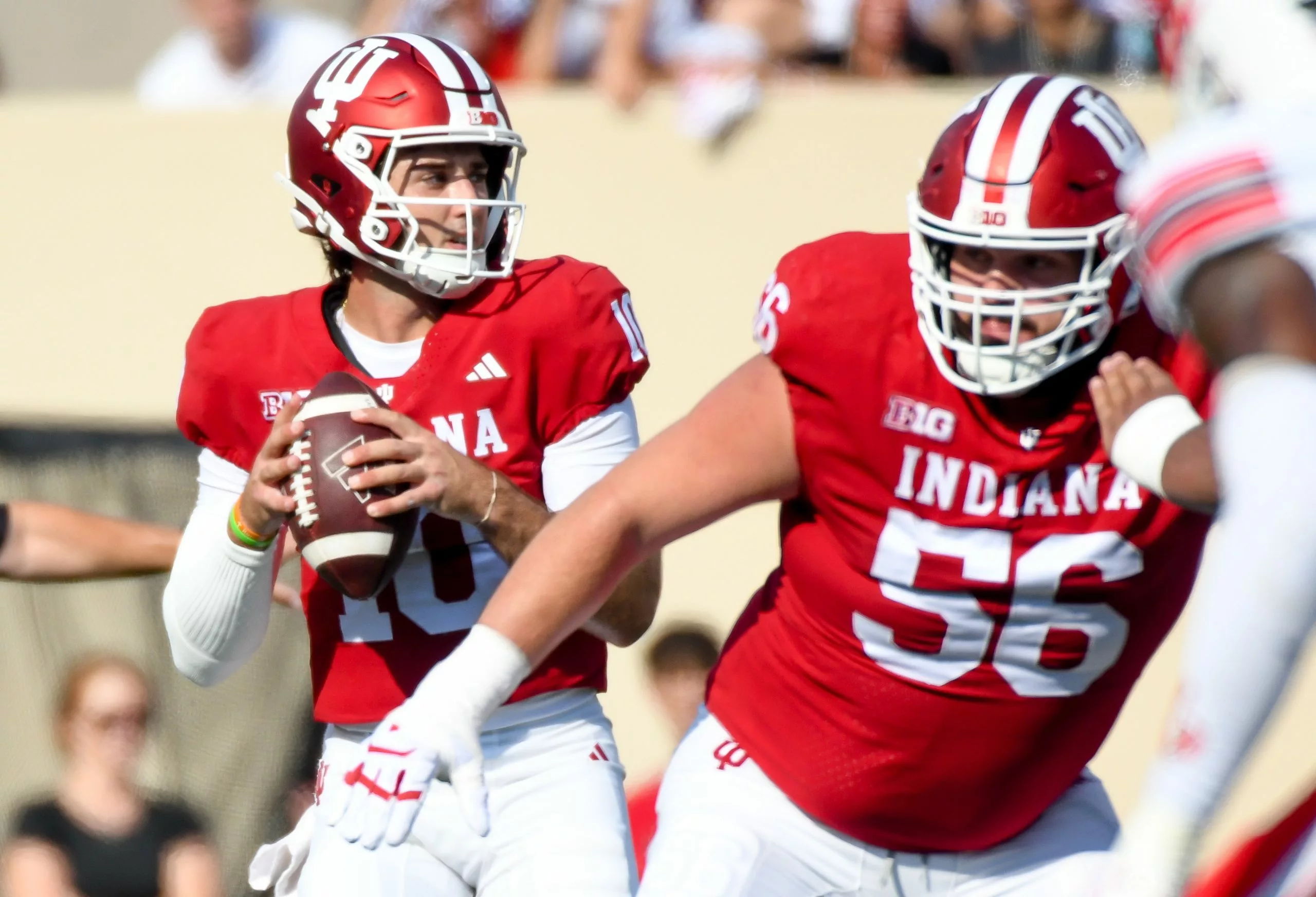
Sep 19, 2026; Bloomington, Indiana, USA; Indiana Hoosiers quarterback Josh Hoover (10) surveys the field against the Western Kentucky Hilltoppers during the first half at Merchants Bank Field at Memorial Stadium. Mandatory Credit: Robert Goddin-Imagn Images
Indiana has a clear path to beating Ohio State again, and it begins with the players responsible for giving Josh Hoover time to throw.
The championship banners will draw attention. So will the crowd in Bloomington, the national television audience and the opportunity to extend the nation’s longest winning streak. But when the ball is snapped Saturday, Indiana’s strongest argument will be its ability to protect its quarterback.
That is where the Hoosiers can take control of this matchup.
No. 5 Indiana enters at 6–0, while No. 4 Ohio State arrives at 5–1. Both are unbeaten in Big Ten play. Indiana won their last meeting 13–10 in the 2025 conference championship game, and Saturday brings the first matchup between top-five teams in Memorial Stadium history.
The setting is enormous. The football case for another Indiana victory is straightforward:
If Ohio State cannot consistently disrupt Hoover without sending extra defenders, the Hoosiers can make the Buckeyes defend the entire field.
Indiana’s Protection Gives Hoover a Chance to Control the Game
The most revealing numbers entering this game concern the matchup between Indiana’s pass protection and Ohio State’s ability to generate pressure.
According to PFF’s Week 7 preview, Indiana ranks third nationally in team pass-blocking grade at 86.5. Its 11% pressure rate allowed also ranks among the country’s five best. Left tackle Carter Smith anchors a unit that has helped limit Hoover to 15 combined sacks and knockdowns.
Ohio State, meanwhile, ranks 50th in PFF pass-rush grade and 85th in pressure rate. Kenyatta Jackson Jr. is its only defender with more than 10 pressures. Those figures suggest a meaningful opportunity for Indiana, although they do not guarantee how Saturday’s individual matchups will unfold.
Protection affects every part of an offense.
When a quarterback can complete his drop, set his feet and work through his reads, the playbook stays open. Receivers have time to finish their routes. The offense can attack beyond the first available completion.
For Hoover, that means opportunities to make Ohio State cover for an extra moment—and against capable receivers, an extra moment can decide a possession.
Ohio State Could Face a Difficult Choice
The
central question
is whether the Buckeyes can create enough pressure with four rushers.
If they can, Ohio State can devote more defenders to coverage and force Hoover to fit passes into smaller windows. That would make Indiana work much harder to sustain drives.
If those four rushers cannot get home, the defensive choices become more uncomfortable.
Sending a linebacker or defensive back creates another potential threat to the protection. It also removes someone from coverage. Depending on the call, that can leave space underneath, expose a matchup outside or place a safety in conflict.
Indiana’s task would be to recognize the pressure, account for the extra rusher and deliver the ball where the defense has become vulnerable.
That requires coordination across the offense. The center and quarterback must identify threats. Backs must understand their assignments. Receivers must recognize when the ball needs to come out quickly.
Winning up front includes all of those details. Five strong individual blocks accomplish little if an unaccounted defender comes through untouched.
Hoover Has Already Shown He Can Deliver Under Pressure
Indiana’s escape at Nebraska offered evidence of what Hoover can produce when a game tightens.
Trailing 17–6, the Hoosiers rallied to win 20–17 behind touchdown passes of 75 and 44 yards from Hoover to Nick Marsh in the final 12:01. Hoover enters the Ohio State game as one of only two quarterbacks nationally with at least 15 touchdown passes and no interceptions, according to Indiana’s game notes.
That combination matters: the ability to create explosive plays while protecting possession.
Against Ohio State, Indiana cannot afford to waste clean pockets. Hoover must turn successful protection into accurate throws, timely decisions and first downs.
He also must accept the ordinary completion when the defense takes away the big play. A short gain that keeps the offense ahead of the chains can be valuable against an opponent capable of punishing a single mistake.
Indiana should trust Hoover to attack. It should also give him enough manageable situations that every possession does not require a difficult third-down conversion.
The Running Game Must Keep Indiana Out of Trouble
Strong pass protection becomes harder to maintain when a defense knows a throw is coming.
That makes Indiana’s early-down execution essential.
The Hoosiers do not need to spend the afternoon forcing runs into unfavorable looks. They do need enough productive rushing plays—and enough efficient short passes—to avoid repeatedly facing third-and-long.
A four-yard run can preserve several options for the next snap. A penalty followed by a negative play can hand the defense control of the series.
Against a talented opponent, that difference accumulates.
Indiana’s offensive line must create movement when the situation calls for it, avoid preventable penalties and keep the offense on schedule. Physical control is measured partly by how often a team gets to choose its next move.
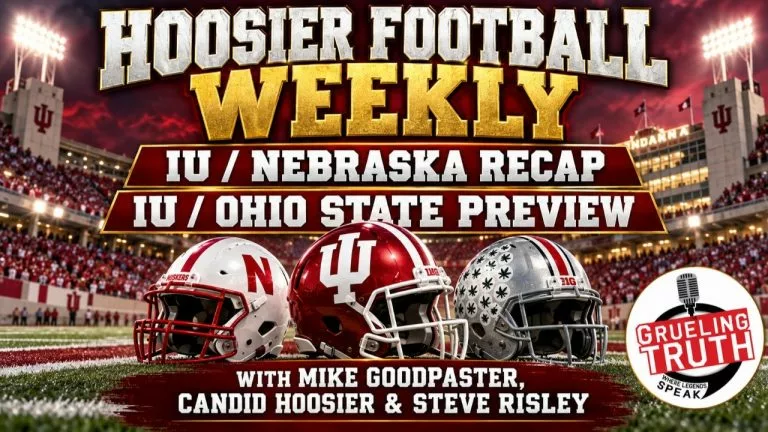
Hoosier Football Weekly
Hoosier Football Weekly: IU/Nebraska recap and IU/Ohio State Preview
Protection Must Produce Touchdowns
There is a limit to what winning the blocking matchup can accomplish by itself.
Indiana still has to finish possessions.
A protected quarterback can miss an open receiver. A promising drive can stall because of a dropped pass or a penalty. An offense can move between the 20-yard lines and leave too many points on the field.
Ohio State has enough offensive firepower to make those missed opportunities expensive. Indiana must approach scoring chances with the understanding that field position and possession only become decisive when they lead to points.
The Hoosiers also cannot expect their offense to solve every defensive problem. Sustaining drives can reduce the number of possessions in a game, but stopping the Buckeyes remains a separate assignment.
Why Indiana Can Win Again
Indiana’s 22-game winning streak establishes the program’s consistency. Last season’s conference championship victory establishes that the Hoosiers can beat Ohio State. Neither accomplishment will block a pass rusher Saturday.
The confidence should come from what this team can execute now.
Indiana has a credible chance to protect Hoover, force Ohio State to adjust its pressure approach and create opportunities downfield. If the Hoosiers pair that protection with disciplined early-down offense and touchdowns at the end of drives, they can dictate important stretches of the game.
My pick is Indiana.
The Hoosiers have the protection to give their quarterback a chance to decide this game. If the offensive line delivers, Hoover can make Bloomington the site of another victory over the Buckeyes.
New Users – Get $350 in Bonus Bets when you wager $5 for 7 days
T&Cs apply
4.6/5
Gambling Problem? Call 1-800-GAMBLER or 1-800-MY-RESET. Call 1-888-789-7777 or visit ccpgg.org/chat (CT). Hope is here. GamblingHelpLineMA.org or call (800) 327-5050 for 24/7 support (MA). Visit www.mdgamblinghelp.org (MD). Call 1-877-8HOPE-NY or text HOPENY (NY). 21+ (18+ DC, WY) and present in select states (for KS, in affiliation with Kansas Star Casino). Find online real money wagering only. Min $5 wager required for 7 consecutive days. $5 free play credit. Bonus issued as non-withdrawable bonus with cash withdrawable bonus with cash withdrawable. Bonus bets which expire 7 days after receipt. Restrictions apply. See terms at sportsbook.fanduel.com. Call 1-877-770-7867 (LA).
Up To $1500 in Bonus Bets Paid Back if your First Bet Does Not Win
T&Cs apply
4.5/5
Gambling problem? Call 1-800-GAMBLER or 1-800-MY-RESET (Available in the US) 877-8-HOPENY or text HOPENY (467369) (NY) 1-800-327-5050 (MA), 1-800-BETS-OFF (IA), 1-800-981-0023 (PR). 21+ only. Please Gamble Responsibly. See BetMGM.com for Terms. First Bet Offer for new customers only (if applicable). Subject to eligibility requirements. Bonus bets are non-withdrawable. In partnership with Kansas Crossing Casino and Hotel. Promotional offers not available in Mississippi, Massachusetts, New York, Ontario, or Puerto Rico.
New DraftKings Customers: Bet $5, Get $200 + 3 Months of NBA League Pass!
T&Cs apply
4.5/5
GAMBLING PROBLEM? CALL 1-800-GAMBLER or 1-800-MY-RESET, (800) 327-5050 or visit gamblinghelplinema.org (MA). Please Gamble Responsibly. 888-789-7777/visit ccpg.org (CT), or visit www.mdgamblinghelp.org (MD), 1-800-981-0023 (PR). 21+ and present in most states. (18+ DC/NH/PR/WY). Void in CAN. Eligibility restrictions apply. On behalf of Boot Hill Casino (KS). Pass-thru of per wager tax may apply in IL. 1 per new Sportsbook customer. $5+ first-time bet req. Max. $200 issued as non-withdrawable Bonus Bets. Stake removed from payout. Reward issued as $50 in Bonus Bets every 7 days via click-to-claim for 21 days. Bonus Bets and click-to-claims expire 7 days (168hrs) after issuance. Terms: dkng.co/offer. Get 1 promo code to redeem a 3-month NBA League Pass subscription, complimentary of DraftKings. Subscription auto-renews monthly at then-current price (currently $16.99/mo); cancel anytime. Terms, restrictions, and eligibility requirements apply. Redeem League Pass by 12/19/26 at 11:59 PM ET. Addt’l terms: support.watch.nba.com/hc/en-us/articles/9165532876183-League-Pass-Terms-of-Use_. Ends 11/29/26 at 11:59 PM ET. Sponsored by DK.
Must be 21+. GAMBLING PROBLEM? CALL 1-800-GAMBLER OR CALL 1-800-MY-RESET, www.mdgamblinghelp.org (MD), (800)-327-5050 or gamblinghelplinema.org (MA), Call (877)8-HOPENY or text HOPENY (467369) (NY), (888) 789-7777 or ccpg.org (CT), morethanagame.nc.gov (NC), 1800gambler.net (WV)
Bet $1 and get double the winnings up to $25 for your next 10 bets
T&Cs apply
4.4/5
21+ New users only. Must register using eligible promo code. First bet after registration must qualify. Max. Bonus Bet: $1,000. Bonus Bet expires 14 days after receipt. Void where prohibited. See Caesars.com/promos for full terms. Gambling Problem? 1-800-GAMBLER (1-800-426-2537)
21+ and present in OH. Gambling Problem? Call 1-800-GAMBLER.
This site is using
Cloudflare
and adheres to the
Google Safe Browsing Program. We adapted
Google's Privacy Guidelines
to keep your data safe at all times.
Close
Ready to Win Big? Join the Elite with Our Sports Betting Deals!
FanDuel Promo
New Users – Get $350 in Bonus Bets when you wager $5 for 7 days
Our Favorite
T&Cs and 21+ apply
Gambling Problem? Call 1-800-GAMBLER or 1-800-MY-RESET. Call 1-888-789-7777 or visit ccpgg.org/chat (CT). Hope is here. GamblingHelpLineMA.org or call (800) 327-5050 for 24/7 support (MA). Visit www.mdgamblinghelp.org (MD). Call 1-877-8HOPE-NY or text HOPENY (NY). 21+ (18+ DC, WY) and present in select states (for KS, in affiliation with Kansas Star Casino). Find online real money wagering only. Min $5 wager required for 7 consecutive days. $5 free play credit. Bonus issued as non-withdrawable bonus with cash withdrawable bonus with cash withdrawable. Bonus bets which expire 7 days after receipt. Restrictions apply. See terms at sportsbook.fanduel.com. Call 1-877-770-7867 (LA).
Code:
Open FanDuel
Get Bonus
BetMGM Promo
Up To $1500 in Bonus Bets Paid Back if your First Bet Does Not Win
Best Slots
T&Cs and 21+ apply
Gambling problem? Call 1-800-GAMBLER or 1-800-MY-RESET (Available in the US) 877-8-HOPENY or text HOPENY (467369) (NY) 1-800-327-5050 (MA), 1-800-BETS-OFF (IA), 1-800-981-0023 (PR). 21+ only. Please Gamble Responsibly. See BetMGM.com for Terms. First Bet Offer for new customers only (if applicable). Subject to eligibility requirements. Bonus bets are non-withdrawable. In partnership with Kansas Crossing Casino and Hotel. Promotional offers not available in Mississippi, Massachusetts, New York, Ontario, or Puerto Rico.
Code:
Open BetMGM
Get Bonus
DraftKings Promo
New DraftKings Customers: Bet $5, Get $200 + 3 Months of NBA League Pass!
Newcomer
T&Cs and 21+ apply
GAMBLING PROBLEM? CALL 1-800-GAMBLER or 1-800-MY-RESET, (800) 327-5050 or visit gamblinghelplinema.org (MA). Please Gamble Responsibly. 888-789-7777/visit ccpg.org (CT), or visit www.mdgamblinghelp.org (MD), 1-800-981-0023 (PR). 21+ and present in most states. (18+ DC/NH/PR/WY). Void in CAN. Eligibility restrictions apply. On behalf of Boot Hill Casino (KS). Pass-thru of per wager tax may apply in IL. 1 per new Sportsbook customer. $5+ first-time bet req. Max. $200 issued as non-withdrawable Bonus Bets. Stake removed from payout. Reward issued as $50 in Bonus Bets every 7 days via click-to-claim for 21 days. Bonus Bets and click-to-claims expire 7 days (168hrs) after issuance. Terms: dkng.co/offer. Get 1 promo code to redeem a 3-month NBA League Pass subscription, complimentary of DraftKings. Subscription auto-renews monthly at then-current price (currently $16.99/mo); cancel anytime. Terms, restrictions, and eligibility requirements apply. Redeem League Pass by 12/19/26 at 11:59 PM ET. Addt’l terms: support.watch.nba.com/hc/en-us/articles/9165532876183-League-Pass-Terms-of-Use_. Ends 11/29/26 at 11:59 PM ET. Sponsored by DK.
Code:
Open DraftKings
Get Bonus
Find out what the legends have to say about sports this week....
New Users – Get $350 in Bonus Bets when you wager $5 for 7 days
Gambling Problem? Call 1-800-GAMBLER or 1-800-MY-RESET. Call 1-888-789-7777 or visit ccpgg.org/chat (CT). Hope is here. GamblingHelpLineMA.org or call (800) 327-5050 for 24/7 support (MA). Visit www.mdgamblinghelp.org (MD). Call 1-877-8HOPE-NY or text HOPENY (NY). 21+ (18+ DC, WY) and present in select states (for KS, in affiliation with Kansas Star Casino). Find online real money wagering only. Min $5 wager required for 7 consecutive days. $5 free play credit. Bonus issued as non-withdrawable bonus with cash withdrawable bonus with cash withdrawable. Bonus bets which expire 7 days after receipt. Restrictions apply. See terms at sportsbook.fanduel.com. Call 1-877-770-7867 (LA).