Indiana deserved to drop after losing at Washington. It did not deserve to fall six spots to No. 14 while Alabama, with the same 9–2 record and zero wins over teams in the current College Football Playoff Top 25
Opinion | November 25, 2026
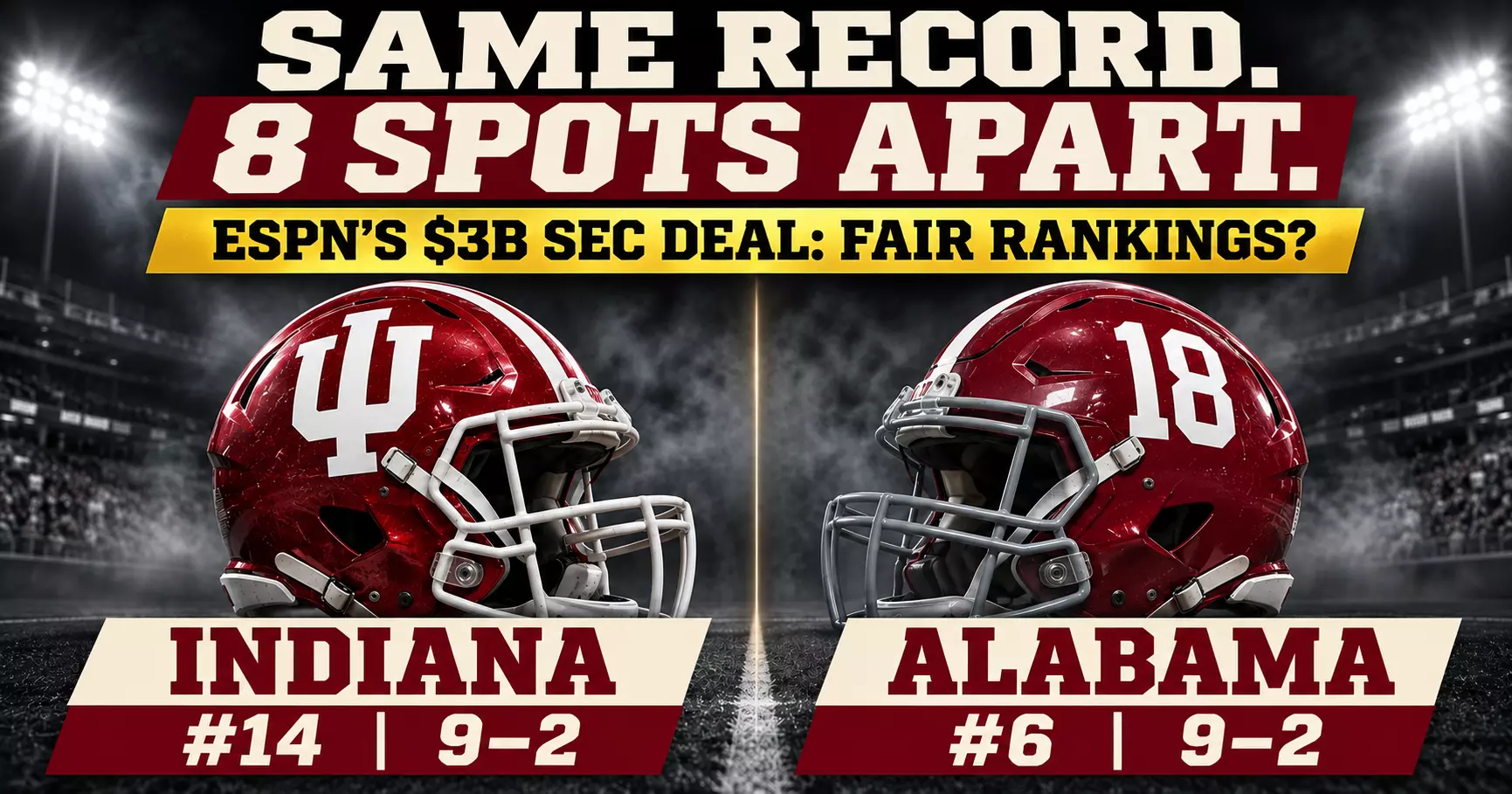
Indiana deserved to drop after losing at Washington. It did not deserve to fall six spots to No. 14 while Alabama, with the same 9–2 record and zero wins over teams in the current College Football Playoff Top 25, remained at No. 6. The Hoosiers beat No. 15 USC by two touchdowns and won on the road against No. 25 Nebraska. Their two losses came by a combined seven points against teams the committee itself ranked this week. If Alabama’s schedule is enough to put eight spots between these teams, the committee owes fans an explanation that goes deeper than saying it considered the full résumé.
The strongest case for SEC bias starts with that comparison. The committee gives Alabama substantial credit for
who it played, even when it lost. When it explains Indiana’s fall, it emphasizes
who the Hoosiers lost to, how close some of their wins were and the limitations of their schedule. All of those factors belong in the discussion. The problem is how readily the emphasis shifts from one team to another.
Indiana Has Two Ranked Wins. Alabama Has None.
Indiana and Alabama are both 9–2. In the
November 24 College Football Playoff rankings, Alabama is No. 6 and Indiana is No. 14. Look at where their opponents stand in that same Top 25 and the eight-spot gap gets harder to explain. Indiana beat No. 15 USC 27–13 and won 20–17 at No. 25 Nebraska. Alabama has yet to beat a team in the current CFP Top 25.
Alabama’s best argument is the quality of its opponents. The Crimson Tide lost 20–17 to No. 1 Georgia and 26–10 at No. 5 Tennessee. Alabama also won decisively on the road against Kentucky and LSU, two teams that appeared in earlier CFP rankings, both have lost multiple games this season as the season has played out. Indiana’s nonconference schedule of North Texas, Howard and Western Kentucky gives the committee a legitimate reason to question its schedule strength.
The question is how much more credit Alabama should get for playing Georgia and Tennessee than Indiana gets for beating USC and Nebraska.
Indiana lost 19–15 at home to No. 21 Ohio State and 27–24 in overtime at No. 24 Washington. The Huskies outgained the Hoosiers and earned the win. Indiana let a seven-point fourth-quarter lead slip away and had its overtime field goal attempt blocked. That should cost the Hoosiers in the rankings. It was also a three-point road loss to a team the committee considered good enough to put in its Top 25 that same week.
Nebraska entered the rankings at No. 25 after beating Ohio State, giving Indiana a second win over a team on the committee’s own board. Washington’s rise and Nebraska’s rise both matters. The committee can give Alabama the edge in schedule strength, but eight spots is a lot of ground to put between two teams with identical records when the team ranked lower has two ranked wins and the team ranked higher has zero.
The committee changes which argument carries the most weight
The rankings since November 10 show how much more room Alabama had. Indiana went from No. 4 to No. 9 in the second rankings
without playing that weekend. It beat then-No. 18 USC 27–13 and moved up one place. Then it lost in overtime at Washington and fell to No. 14. Alabama held No. 3 in consecutive rankings with two losses, then dropped to No. 6 after beating FCS Chattanooga 47–0. In its November 17 release, the CFP said Alabama was the highest-ranked two-loss team ever in the third rankings of a season. That starting position gave the Tide room to fall and still stay near the top.
Alabama’s three-spot drop is evidence that the committee did hold the Chattanooga game against its schedule. It also makes the Tennessee explanation worth examining. Tennessee beat Alabama
26–10 on October 17. Both teams were 8–2 in last week’s rankings, yet Alabama was No. 3 and Tennessee was No. 9. The committee said their profiles were closer this week, so head-to-head came into play and Tennessee moved ahead. That follows the published protocol, which gives head-to-head extra weight when teams are deemed comparable. The discretion is in deciding when they’re comparable. A 16-point result sat there for more than a month before carrying enough weight to settle the order. Fans deserve to know what made the other evidence so decisive before Tuesday.
The committee had a defensible reason to put Iowa ahead of Indiana. The Hawkeyes went to Seattle and beat Washington 41–24. They also lost to Minnesota, a team Indiana beat. If Washington settled that comparison, why did it carry more weight than Minnesota, and how much credit did Indiana get for beating USC and Nebraska? Oregon has a case, too. The Ducks are 8–3, but the CFP credited them with three current Top 25 wins and highlighted their recent offensive play. These are legitimate arguments. They would be easier to accept if the committee told us what made each one decisive instead of offering a different emphasis for every comparison.
The SEC deserves credit. Its ranking advantage still deserves scrutiny.
The SEC has four of the top six teams. Texas has four wins over teams in the current CFP Top 25, according to the committee. Tennessee has a convincing win over Alabama and lost its two games by a combined six points. Georgia is 10–1 and just won 34–6 at South Carolina. Those teams have real arguments for their spots. Alabama is the clearest test of how much value the committee assigns to an SEC schedule even when the team in question lacks a current ranked win.
This year, the CFP says it is giving greater emphasis to differences in schedule difficulty
within
conferences. That can be useful. Two teams in the same league can face very different schedules. The danger comes when the committee’s opinion of the league and its opinion of the individual teams keep reinforcing each other. Alabama’s No. 6 ranking gives Tennessee a top-six win. Tennessee’s No. 5 ranking gives Alabama a loss the committee can excuse more readily. That’s a reason to put the teams’ other results under a brighter light. What did each team do beyond the games that make its conference neighbors look stronger?
ESPN’s billions belong in the conversation
In 2020, ESPN and the SEC announced a 10-year deal that brought the conference’s premium football package from CBS to ABC beginning in 2024, including the SEC championship game.
Sports Business Journal
reported that ESPN was paying in the low $300 million range annually for that package, on top of its previous arrangement. That puts the reported value of the premium package alone at roughly
$3 billion over a decade. Separately, the Associated Press reported that ESPN’s six-year CFP extension through the 2031 season is worth
$7.8 billion. The AP said the financial terms were undisclosed in the announcement. Those are separate deals, and the $7.8 billion is for the national playoff.
ESPN has a commercial interest
in promoting the SEC games it bought. It also carries the weekly CFP rankings reveal, where the public first hears the committee explain its decisions. The committee votes on the rankings under its own published process. Its chair, Hunter Yurachek, is Arkansas’s athletic director. Those roles and contracts are public. The available evidence establishes ESPN’s financial stake and its role in broadcasting the debate. It does not establish that ESPN directed a vote or that Yurachek acted on the network’s behalf. The accountability question is straightforward. When the playoff’s television partner also spends billions on one conference’s premium football package, viewers deserve an explanation of the rankings clear enough to evaluate on the football evidence alone.
Indiana should be in the at-large discussion, and No. 14 puts it too far back
I’d put Indiana
inside the top 12 and ahead of Alabama on the results through November 21. I’d give more weight to a two-touchdown win over USC and a road win at Nebraska than to Alabama’s tougher losses. Iowa has a strong argument based on Washington. Oregon has an extra loss and more ranked wins. Those comparisons are close enough for a real debate. The eight-place gap between Alabama and Indiana is the one I can’t justify.
The distinction matters because there are seven at-large spots, and an automatic qualifier can come from outside the top 12. Oregon was No. 12 on Tuesday and still would have been outside the projected field. Indiana hosts Purdue on Saturday, and a win would get the Hoosiers to 10–2. The next rankings come out December 1, with the final bracket on December 6. Indiana has to take care of Purdue. The committee has to explain why two teams with the same record can be eight spots apart when the team at No. 14 has the better wins.
Get $250 in Bonus Bets when you wager $5 for 5 days
T&Cs apply
4.6/5
Gambling Problem? Call 1-800-GAMBLER or 1-800-MY-RESET. Visit www.mdgamblinghelp.org (MD). 1-888-789-7777 or ccpg.org/chat (CT). Hope is here. GamblingHelpLineMA.org or (800) 327-5050 for 24/7 support (MA). 1-877-8-HOPENY or text HOPENY (467369) (NY). 21+ (18+ D.C., WY) and present in select states (for KS, in affiliation with Kansas Star Casino). First online real money wager only. Min $5 wager required for 5 consecutive days. $5 first deposit required. Bonus issued as nonwithdrawable bonus bets which expire 5 days after receipt. Restrictions apply. See terms at sportsbook.fanduel.com. Call 1-877-770-7867 (LA).
Get Up to $1,000 Back in Bonus Bets Over Your First 10 Days
T&Cs apply
4.5/5
Gambling problem? Call 1-800-GAMBLER or 1-800-MY-RESET (Available in the US) 877-8-HOPENY or text HOPENY (467369) (NY) 1-800-327-5050 (MA), 1-800-BETS-OFF (IA), 21+ only. Please Gamble Responsibly. Visit mdgamblinghelp.org (MD). See BetMGM.com for Terms. New Player Offer for new players only. Subject to eligibility requirements. Bonus bets are non-withdrawable. In partnership with Kansas Crossing Casino and Hotel. This promotional offer is not available in NJ, MA, MI, NV, NY, ON, PA, PR, and WV.
GAMBLING PROBLEM? CALL 1-800-GAMBLER or 1-800-MY-RESET, (800) 327-5050 or visit gamblinghelplinema.org (MA). Please Gamble Responsibly. 888-789-7777/visit ccpg.org (CT), or visit www.mdgamblinghelp.org (MD), 1-800-981-0023 (PR). 21+ and present in most states. (18+ DC/NH/PR/WY). Void in CAN. Eligibility restrictions apply. On behalf of Boot Hill Casino (KS). Pass-thru of per wager tax may apply in IL. 1 per new Sportsbook customer. $5+ first-time bet req. Max. $200 issued as non-withdrawable Bonus Bets. Stake removed from payout. Reward issued as $50 in Bonus Bets every 7 days via click-to-claim for 21 days. Bonus Bets and click-to-claims expire 7 days (168hrs) after issuance. Terms: dkng.co/offer. Get 1 promo code to redeem a 3-month NBA League Pass subscription, complimentary of DraftKings. Subscription auto-renews monthly at then-current price (currently $16.99/mo); cancel anytime. Terms, restrictions, and eligibility requirements apply. Redeem League Pass by 12/19/26 at 11:59 PM ET. Addt’l terms: support.watch.nba.com/hc/en-us/articles/9165532876183-League-Pass-Terms-of-Use_. Ends 11/29/26 at 11:59 PM ET. Sponsored by DK.
Must be 21+. GAMBLING PROBLEM? CALL 1-800-GAMBLER OR CALL 1-800-MY-RESET, www.mdgamblinghelp.org (MD), (800)-327-5050 or gamblinghelplinema.org (MA), Call (877)8-HOPENY or text HOPENY (467369) (NY), (888) 789-7777 or ccpg.org (CT), morethanagame.nc.gov (NC), 1800gambler.net (WV)
Bet $1 and get double the winnings up to $25 for your next 10 bets
T&Cs apply
4.4/5
21+ New users only. Must register using eligible promo code. First bet after registration must qualify. Max. Bonus Bet: $1,000. Bonus Bet expires 14 days after receipt. Void where prohibited. See Caesars.com/promos for full terms. Gambling Problem? 1-800-GAMBLER (1-800-426-2537)
21+ and present in OH. Gambling Problem? Call 1-800-GAMBLER.
The sweepstakes and social casinos featured here are for adults aged 18 or over. No purchase is necessary to enter or win, and every operator offers a free way to get Sweeps Coins. Availability in Ohio varies by operator. Offers are subject to each operator's terms. Need a break? Call or text 1-800-MY-RESET (24/7) or visit https://ncpgambling.org. We may earn a commission when you sign up through links on this site. This does not change how we review operators.
This site is using
Cloudflare
and adheres to the
Google Safe Browsing Program. We adapted
Google's Privacy Guidelines
to keep your data safe at all times.
Close
Ready to Win Big? Join the Elite with Our Sports Betting Deals!
FanDuel Promo
Get $250 in Bonus Bets when you wager $5 for 5 days
Our Favorite
T&Cs and 21+ apply
Gambling Problem? Call 1-800-GAMBLER or 1-800-MY-RESET. Visit www.mdgamblinghelp.org (MD). 1-888-789-7777 or ccpg.org/chat (CT). Hope is here. GamblingHelpLineMA.org or (800) 327-5050 for 24/7 support (MA). 1-877-8-HOPENY or text HOPENY (467369) (NY). 21+ (18+ D.C., WY) and present in select states (for KS, in affiliation with Kansas Star Casino). First online real money wager only. Min $5 wager required for 5 consecutive days. $5 first deposit required. Bonus issued as nonwithdrawable bonus bets which expire 5 days after receipt. Restrictions apply. See terms at sportsbook.fanduel.com. Call 1-877-770-7867 (LA).
Code:
Open FanDuel
Get Bonus
BetMGM Promo
Get Up to $1,000 Back in Bonus Bets Over Your First 10 Days
Best Slots
T&Cs and 21+ apply
Gambling problem? Call 1-800-GAMBLER or 1-800-MY-RESET (Available in the US) 877-8-HOPENY or text HOPENY (467369) (NY) 1-800-327-5050 (MA), 1-800-BETS-OFF (IA), 21+ only. Please Gamble Responsibly. Visit mdgamblinghelp.org (MD). See BetMGM.com for Terms. New Player Offer for new players only. Subject to eligibility requirements. Bonus bets are non-withdrawable. In partnership with Kansas Crossing Casino and Hotel. This promotional offer is not available in NJ, MA, MI, NV, NY, ON, PA, PR, and WV.
Code:
Open BetMGM
Get Bonus
DraftKings Promo
Bet $5, Get $200 + 3 Months of NBA League Pass
Newcomer
T&Cs and 21+ apply
GAMBLING PROBLEM? CALL 1-800-GAMBLER or 1-800-MY-RESET, (800) 327-5050 or visit gamblinghelplinema.org (MA). Please Gamble Responsibly. 888-789-7777/visit ccpg.org (CT), or visit www.mdgamblinghelp.org (MD), 1-800-981-0023 (PR). 21+ and present in most states. (18+ DC/NH/PR/WY). Void in CAN. Eligibility restrictions apply. On behalf of Boot Hill Casino (KS). Pass-thru of per wager tax may apply in IL. 1 per new Sportsbook customer. $5+ first-time bet req. Max. $200 issued as non-withdrawable Bonus Bets. Stake removed from payout. Reward issued as $50 in Bonus Bets every 7 days via click-to-claim for 21 days. Bonus Bets and click-to-claims expire 7 days (168hrs) after issuance. Terms: dkng.co/offer. Get 1 promo code to redeem a 3-month NBA League Pass subscription, complimentary of DraftKings. Subscription auto-renews monthly at then-current price (currently $16.99/mo); cancel anytime. Terms, restrictions, and eligibility requirements apply. Redeem League Pass by 12/19/26 at 11:59 PM ET. Addt’l terms: support.watch.nba.com/hc/en-us/articles/9165532876183-League-Pass-Terms-of-Use_. Ends 11/29/26 at 11:59 PM ET. Sponsored by DK.
Code:
Open DraftKings
Get Bonus
Find out what the legends have to say about sports this week....
Get $250 in Bonus Bets when you wager $5 for 5 days
Gambling Problem? Call 1-800-GAMBLER or 1-800-MY-RESET. Visit www.mdgamblinghelp.org (MD). 1-888-789-7777 or ccpg.org/chat (CT). Hope is here. GamblingHelpLineMA.org or (800) 327-5050 for 24/7 support (MA). 1-877-8-HOPENY or text HOPENY (467369) (NY). 21+ (18+ D.C., WY) and present in select states (for KS, in affiliation with Kansas Star Casino). First online real money wager only. Min $5 wager required for 5 consecutive days. $5 first deposit required. Bonus issued as nonwithdrawable bonus bets which expire 5 days after receipt. Restrictions apply. See terms at sportsbook.fanduel.com. Call 1-877-770-7867 (LA).