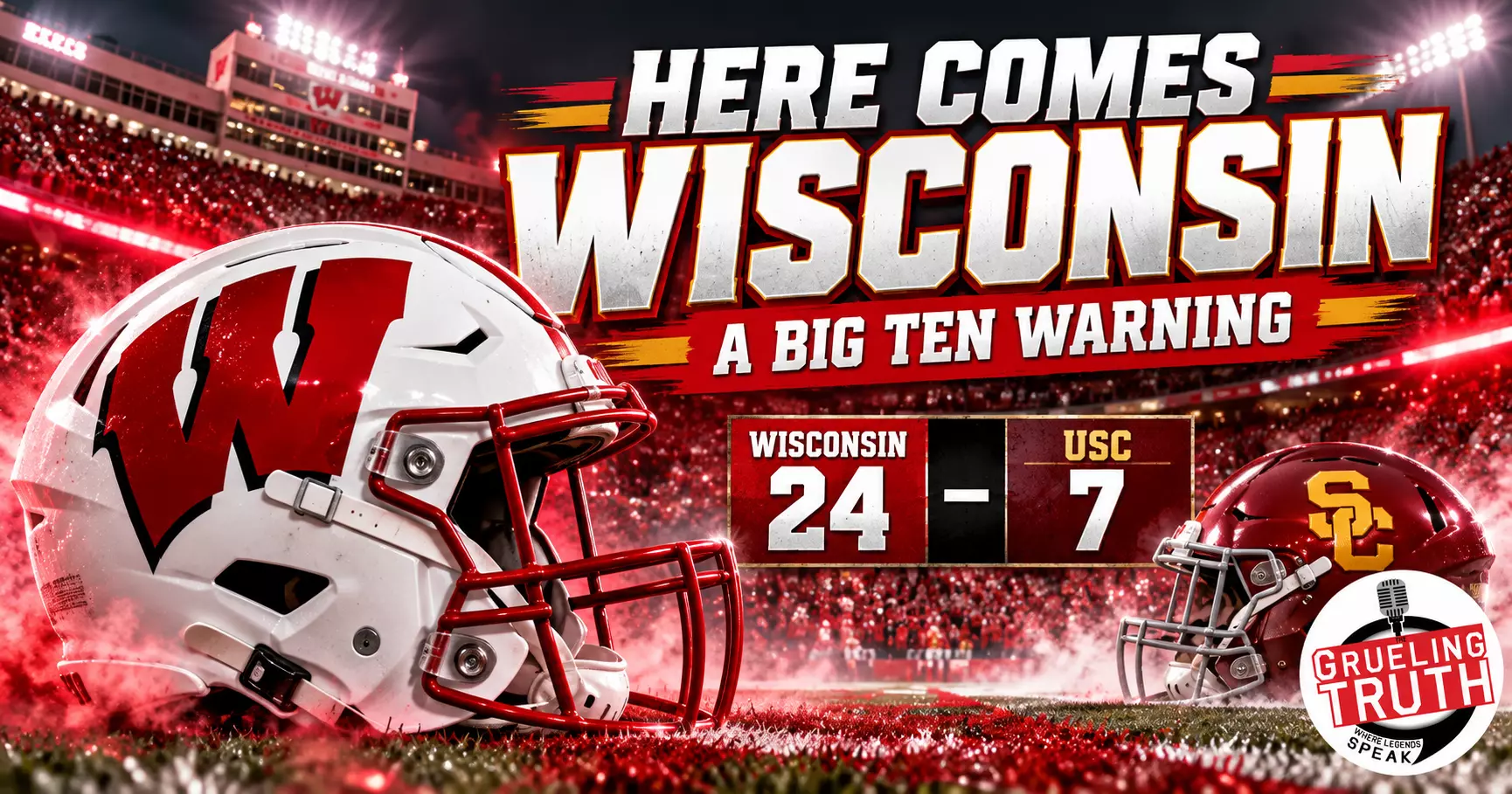
Wisconsin gave the Big Ten a reason to reconsider its ceiling Saturday night. The Badgers defeated No. 16 USC 24–7 at Camp Randall Stadium, improving to 5–2 overall and 3–1 in conference play.
Wisconsin gave the Big Ten a reason to reconsider its ceiling Saturday night.
The Badgers defeated No. 16 USC
24–7 at Camp Randall Stadium, improving to
5–2 overall and 3–1 in conference play. A week after losing at UCLA, Wisconsin answered with a performance that put its defense at the center of the conference conversation.
The result deserves attention because of how Wisconsin achieved it. The Badgers shut out USC after halftime, prevented the Trojans from establishing a running game and supplied enough offense to turn defensive control into a comfortable final margin.
That establishes a meaningful possibility: Wisconsin can make life difficult for opponents with greater national attention.
Whether the Badgers can reproduce that performance will determine how seriously their championship ambitions should be taken.
The Defense Supplied the Strongest Evidence
Wisconsin
held USC to
241 total yards, sacked Jayden Maiava five times and limited the Trojans to their lowest scoring and yardage totals during Lincoln Riley’s five seasons at the school.
Those numbers give the victory substance beyond the opponent’s ranking.
A defense capable of disrupting a passing attack while preventing consistent rushing production can dictate how a game unfolds. It can force longer-yardage situations, reduce the offense’s options and make the quarterback operate under increasingly difficult conditions.
Wisconsin produced that kind of pressure.
USC finished with
minus-17 rushing yards, while Bryce West and Cairo Skanes each recorded an interception.
College rushing totals include yardage lost on sacks, so the negative figure reflects more than the work against handoffs. Even with that distinction, it illustrates how thoroughly Wisconsin disrupted USC’s attempts to move forward.
The Trojans could not establish a dependable alternative when the passing game struggled. That allowed the Badgers to maintain control.
Wisconsin Sustained Its Performance After Halftime
The most convincing part of the defensive effort was its duration.
USC’s only touchdown came in the second quarter. The Trojans did not score again.
A strong opening can energize a home crowd. Maintaining that standard after the opponent has time to adjust provides a more useful measure of a defense.
Wisconsin continued to make USC earn its opportunities. The Trojans never generated the scoring response needed to turn the second half into a different game.
That matters when assessing the Badgers’ ceiling. A defense that needs a large early lead to remain effective offers limited flexibility. One that can preserve a competitive advantage across an entire half gives its offense room to work.
Saturday demonstrated what that relationship can look like.
The defense kept the game manageable. The offense then supplied possessions that made USC’s recovery increasingly difficult.
The Offense Did Enough—and Made Important Plays
Wisconsin’s offensive performance requires a measured assessment.
Colton Joseph completed
12 of 14 passes, including a touchdown to Chris Brooks Jr., but finished with only
58 passing yards.
The completion rate reflects efficient execution of the opportunities attempted. The yardage total also shows why this game cannot establish that Wisconsin has solved every offensive concern.
The Badgers will eventually encounter situations requiring more production through the air. They need to demonstrate that they can respond when the defense cannot hold an opponent to seven points.
Against USC, however, Wisconsin made a crucial passing play when it mattered.
Joseph found Brooks for a
16-yard touchdown on fourth-and-2, extending the lead to 17–7 in the third quarter.
That was a consequential conversion. Wisconsin turned a possession that could have ended without points into a two-score advantage.
The play also illustrates what efficient offense can provide for a strong defense. The Badgers did not need enormous passing numbers to create separation. They needed to execute the right play in an important situation.
A Long Touchdown Drive Turned Control Into Separation
Wisconsin’s final touchdown came at the end of a 13-play, 59-yard possession that consumed 8:12. Ryan Schwendeman finished it with a one-yard scoring run, putting the Badgers ahead 24–7 with 5:02 remaining.
That drive deserves attention alongside the defensive statistics.
An extended possession can protect a lead in several ways. It gives the defense time off the field, reduces the opponent’s remaining opportunities and forces the trailing team to play with greater urgency.
Wisconsin converted its advantage into precisely that kind of situation.
The Badgers still must prove they can sustain drives consistently against different opponents. But Saturday supplied an example of the offense helping finish a game rather than simply asking the defense to survive until the clock expired.
That is an important distinction for a team trying to climb.
The UCLA Loss Still Belongs in the Evaluation
One impressive victory cannot erase Wisconsin’s previous performance.
The Badgers lost
17–7 at UCLA
a week earlier.
Both results belong in an honest assessment.
The UCLA game exposed limitations. The USC victory demonstrated Wisconsin’s ability to respond and its potential when the defense controls the matchup.
Together, they describe a team with a higher ceiling than some observers might have allowed, but with a consistency question still unresolved.
Luke Fickell’s next challenge is to make Saturday’s standard recognizable in another environment. Strong teams carry communication, tackling and situational execution from one week to the next.
Wisconsin has supplied evidence that it can reach that level. It now needs evidence that it can remain there.
The Big Ten Race Offers Opportunity
At 3–1 in conference play, Wisconsin remains involved in the race.
UCLA leads the standings at
5–0, Ohio State is
4–0, and Indiana is
4–1. Wisconsin sits alongside Northwestern and Minnesota at
3–1.
That position gives the Badgers meaningful games ahead. It does not guarantee a championship-game opportunity.
Several contenders remain, and Wisconsin must continue winning before possible tiebreakers or help elsewhere become the central discussion.
The immediate test is a trip to Iowa on October 31. Wisconsin’s remaining schedule also includes Rutgers, Maryland, Purdue and Minnesota.
The Iowa game is particularly useful as an examination of progress. Wisconsin must take the discipline and execution it displayed at home and reproduce them on the road.
Another complete performance would give the USC result greater significance.
Wisconsin Has Earned Attention
The Badgers have not established themselves as the Big Ten’s best team. They have established that their defense can overwhelm a ranked opponent and give them a credible path to an important victory.
That deserves a response from the rest of the conference.
Wisconsin’s ceiling
rises when its defense limits explosive opportunities, creates pressure and supplies takeaways. Its chances improve further when the offense converts critical downs and finishes possessions.
Saturday brought those elements together.
The next step is repeating them—especially when the game becomes less comfortable and the defense receives a harder assignment.
For now, the warning is clear: Wisconsin remains in the race, and the performance against USC provides a substantial reason to pay attention.
New Users – Get $350 in Bonus Bets when you wager $5 for 7 days
T&Cs apply
4.6/5
Gambling Problem? Call 1-800-GAMBLER or 1-800-MY-RESET. Call 1-888-789-7777 or visit ccpgg.org/chat (CT). Hope is here. GamblingHelpLineMA.org or call (800) 327-5050 for 24/7 support (MA). Visit www.mdgamblinghelp.org (MD). Call 1-877-8HOPE-NY or text HOPENY (NY). 21+ (18+ DC, WY) and present in select states (for KS, in affiliation with Kansas Star Casino). Find online real money wagering only. Min $5 wager required for 7 consecutive days. $5 free play credit. Bonus issued as non-withdrawable bonus with cash withdrawable bonus with cash withdrawable. Bonus bets which expire 7 days after receipt. Restrictions apply. See terms at sportsbook.fanduel.com. Call 1-877-770-7867 (LA).
Up To $1500 in Bonus Bets Paid Back if your First Bet Does Not Win
T&Cs apply
4.5/5
Gambling problem? Call 1-800-GAMBLER or 1-800-MY-RESET (Available in the US) 877-8-HOPENY or text HOPENY (467369) (NY) 1-800-327-5050 (MA), 1-800-BETS-OFF (IA), 1-800-981-0023 (PR). 21+ only. Please Gamble Responsibly. See BetMGM.com for Terms. First Bet Offer for new customers only (if applicable). Subject to eligibility requirements. Bonus bets are non-withdrawable. In partnership with Kansas Crossing Casino and Hotel. Promotional offers not available in Mississippi, Massachusetts, New York, Ontario, or Puerto Rico.
New DraftKings Customers: Bet $5, Get $200 + 3 Months of NBA League Pass!
T&Cs apply
4.5/5
GAMBLING PROBLEM? CALL 1-800-GAMBLER or 1-800-MY-RESET, (800) 327-5050 or visit gamblinghelplinema.org (MA). Please Gamble Responsibly. 888-789-7777/visit ccpg.org (CT), or visit www.mdgamblinghelp.org (MD), 1-800-981-0023 (PR). 21+ and present in most states. (18+ DC/NH/PR/WY). Void in CAN. Eligibility restrictions apply. On behalf of Boot Hill Casino (KS). Pass-thru of per wager tax may apply in IL. 1 per new Sportsbook customer. $5+ first-time bet req. Max. $200 issued as non-withdrawable Bonus Bets. Stake removed from payout. Reward issued as $50 in Bonus Bets every 7 days via click-to-claim for 21 days. Bonus Bets and click-to-claims expire 7 days (168hrs) after issuance. Terms: dkng.co/offer. Get 1 promo code to redeem a 3-month NBA League Pass subscription, complimentary of DraftKings. Subscription auto-renews monthly at then-current price (currently $16.99/mo); cancel anytime. Terms, restrictions, and eligibility requirements apply. Redeem League Pass by 12/19/26 at 11:59 PM ET. Addt’l terms: support.watch.nba.com/hc/en-us/articles/9165532876183-League-Pass-Terms-of-Use_. Ends 11/29/26 at 11:59 PM ET. Sponsored by DK.
Must be 21+. GAMBLING PROBLEM? CALL 1-800-GAMBLER OR CALL 1-800-MY-RESET, www.mdgamblinghelp.org (MD), (800)-327-5050 or gamblinghelplinema.org (MA), Call (877)8-HOPENY or text HOPENY (467369) (NY), (888) 789-7777 or ccpg.org (CT), morethanagame.nc.gov (NC), 1800gambler.net (WV)
Bet $1 and get double the winnings up to $25 for your next 10 bets
T&Cs apply
4.4/5
21+ New users only. Must register using eligible promo code. First bet after registration must qualify. Max. Bonus Bet: $1,000. Bonus Bet expires 14 days after receipt. Void where prohibited. See Caesars.com/promos for full terms. Gambling Problem? 1-800-GAMBLER (1-800-426-2537)
21+ and present in OH. Gambling Problem? Call 1-800-GAMBLER.
This site is using
Cloudflare
and adheres to the
Google Safe Browsing Program. We adapted
Google's Privacy Guidelines
to keep your data safe at all times.
Close
Ready to Win Big? Join the Elite with Our Sports Betting Deals!
FanDuel Promo
New Users – Get $350 in Bonus Bets when you wager $5 for 7 days
Our Favorite
T&Cs and 21+ apply
Gambling Problem? Call 1-800-GAMBLER or 1-800-MY-RESET. Call 1-888-789-7777 or visit ccpgg.org/chat (CT). Hope is here. GamblingHelpLineMA.org or call (800) 327-5050 for 24/7 support (MA). Visit www.mdgamblinghelp.org (MD). Call 1-877-8HOPE-NY or text HOPENY (NY). 21+ (18+ DC, WY) and present in select states (for KS, in affiliation with Kansas Star Casino). Find online real money wagering only. Min $5 wager required for 7 consecutive days. $5 free play credit. Bonus issued as non-withdrawable bonus with cash withdrawable bonus with cash withdrawable. Bonus bets which expire 7 days after receipt. Restrictions apply. See terms at sportsbook.fanduel.com. Call 1-877-770-7867 (LA).
Code:
Open FanDuel
Get Bonus
BetMGM Promo
Up To $1500 in Bonus Bets Paid Back if your First Bet Does Not Win
Best Slots
T&Cs and 21+ apply
Gambling problem? Call 1-800-GAMBLER or 1-800-MY-RESET (Available in the US) 877-8-HOPENY or text HOPENY (467369) (NY) 1-800-327-5050 (MA), 1-800-BETS-OFF (IA), 1-800-981-0023 (PR). 21+ only. Please Gamble Responsibly. See BetMGM.com for Terms. First Bet Offer for new customers only (if applicable). Subject to eligibility requirements. Bonus bets are non-withdrawable. In partnership with Kansas Crossing Casino and Hotel. Promotional offers not available in Mississippi, Massachusetts, New York, Ontario, or Puerto Rico.
Code:
Open BetMGM
Get Bonus
DraftKings Promo
New DraftKings Customers: Bet $5, Get $200 + 3 Months of NBA League Pass!
Newcomer
T&Cs and 21+ apply
GAMBLING PROBLEM? CALL 1-800-GAMBLER or 1-800-MY-RESET, (800) 327-5050 or visit gamblinghelplinema.org (MA). Please Gamble Responsibly. 888-789-7777/visit ccpg.org (CT), or visit www.mdgamblinghelp.org (MD), 1-800-981-0023 (PR). 21+ and present in most states. (18+ DC/NH/PR/WY). Void in CAN. Eligibility restrictions apply. On behalf of Boot Hill Casino (KS). Pass-thru of per wager tax may apply in IL. 1 per new Sportsbook customer. $5+ first-time bet req. Max. $200 issued as non-withdrawable Bonus Bets. Stake removed from payout. Reward issued as $50 in Bonus Bets every 7 days via click-to-claim for 21 days. Bonus Bets and click-to-claims expire 7 days (168hrs) after issuance. Terms: dkng.co/offer. Get 1 promo code to redeem a 3-month NBA League Pass subscription, complimentary of DraftKings. Subscription auto-renews monthly at then-current price (currently $16.99/mo); cancel anytime. Terms, restrictions, and eligibility requirements apply. Redeem League Pass by 12/19/26 at 11:59 PM ET. Addt’l terms: support.watch.nba.com/hc/en-us/articles/9165532876183-League-Pass-Terms-of-Use_. Ends 11/29/26 at 11:59 PM ET. Sponsored by DK.
Code:
Open DraftKings
Get Bonus
Find out what the legends have to say about sports this week....
New Users – Get $350 in Bonus Bets when you wager $5 for 7 days
Gambling Problem? Call 1-800-GAMBLER or 1-800-MY-RESET. Call 1-888-789-7777 or visit ccpgg.org/chat (CT). Hope is here. GamblingHelpLineMA.org or call (800) 327-5050 for 24/7 support (MA). Visit www.mdgamblinghelp.org (MD). Call 1-877-8HOPE-NY or text HOPENY (NY). 21+ (18+ DC, WY) and present in select states (for KS, in affiliation with Kansas Star Casino). Find online real money wagering only. Min $5 wager required for 7 consecutive days. $5 free play credit. Bonus issued as non-withdrawable bonus with cash withdrawable bonus with cash withdrawable. Bonus bets which expire 7 days after receipt. Restrictions apply. See terms at sportsbook.fanduel.com. Call 1-877-770-7867 (LA).