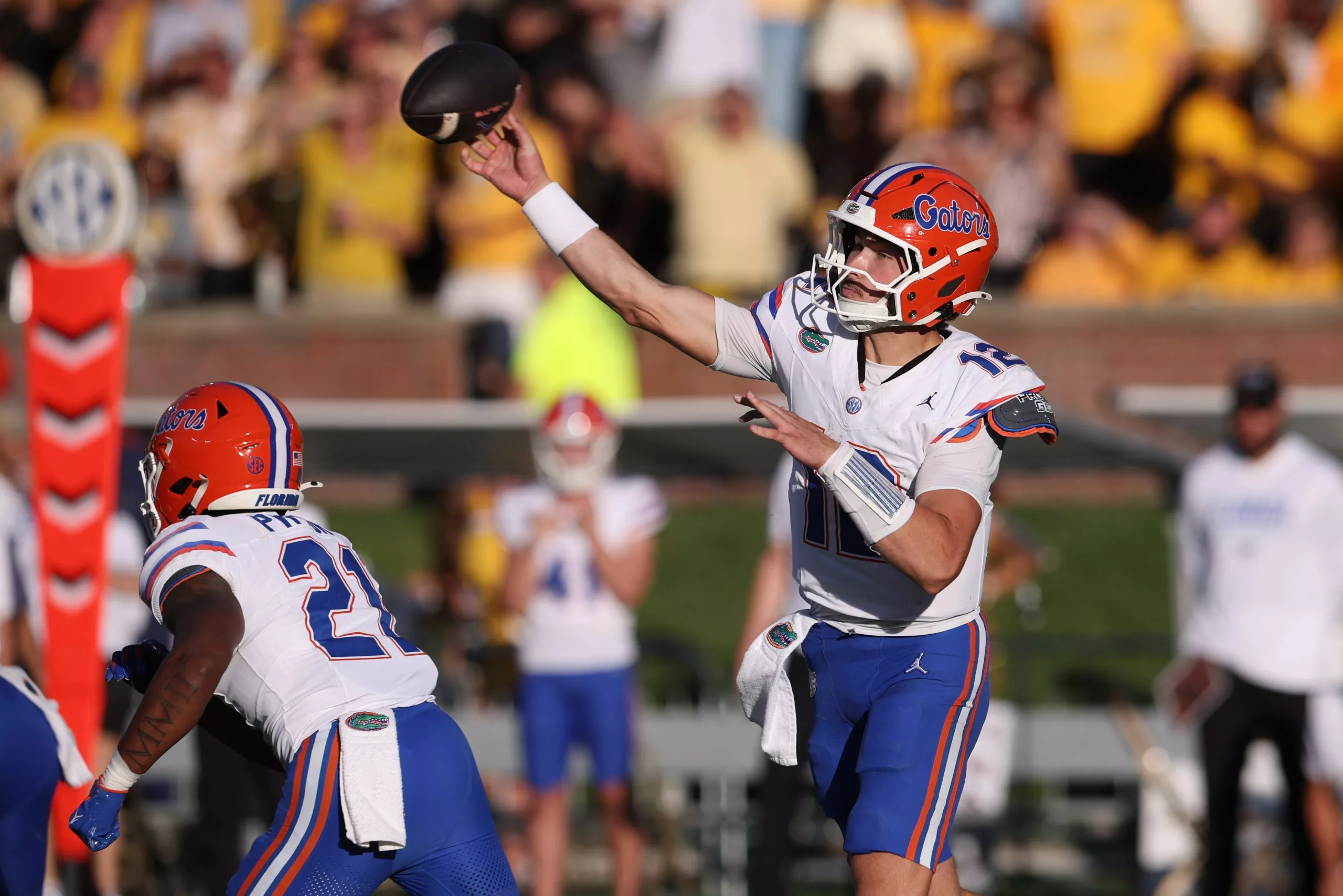
Oct 3, 2026; Columbia, Missouri, USA; Florida Gators quarterback Aaron Philo (12) throws in the fourth quarter against the Missouri Tigers at Faurot Field at Memorial Stadium. Mandatory Credit: William Purnell-Imagn Images
For a month, Florida looked like a program finally moving in the right direction.
Jon Sumrall brought energy, the offense produced points, and victories over Auburn and Ole Miss gave Gators fans something more substantial than promises. Florida’s 52–28 win over the Rebels made the excitement understandable.
Then Missouri delivered a brutal correction.
The Gators lost 45–17 in Columbia and dropped from No. 8 to No. 16 in the Associated Press poll. A team that had been generating national championship conversation suddenly had to explain a performance in which almost nothing worked consistently.
One loss does not erase Florida’s progress. But it changes the assignment.
Sumrall now has to demonstrate that his program can correct exposed weaknesses as effectively as it generated early enthusiasm.
South Carolina’s visit Saturday will offer the first evidence.
Missouri Exposed Problems That Enthusiasm Cannot Fix
Calling the Missouri loss a letdown is convenient. It also risks reducing a football problem to an emotional explanation.
Florida might have been riding too high after beating Ole Miss. But confidence alone does not explain why the running game disappeared, the secondary surrendered explosive completions and the offense struggled to regain control.
The clearest example was
Jadan Baugh. Missouri held Florida’s star running back to 13 yards on 12 carries. The Gators finished with just 42 rushing yards as a team.
That is a failure of the offensive operation, not simply a quiet afternoon for one player.
When a defense shuts down the centerpiece of an offense, the coaching staff must find another way to create favorable situations. That could mean changing formations, altering the blocking approach or using quick passes to make defenders respect more of the field.
Those are possible answers, not a claim that one adjustment would have rescued Florida. The point is that an identity needs flexibility.
The Gators cannot build their entire response around expecting Baugh to produce a different result from the same difficult circumstances.
Aaron Philo Needs an Offense That Helps Him Respond
Aaron Philo completed 21 of 34 passes for 197 yards and a touchdown against Missouri. He was sacked three times.
Those numbers should prompt a broader question than whether the quarterback played well enough.
What happens to Florida’s passing offense when the running game stops creating manageable situations?
A quarterback becomes easier to defend when opponents can anticipate the pass. Protection gets harder, rushers become more aggressive, and every incompletion makes the next down more demanding.
Against South Carolina, I would look for evidence that Florida can give Philo accessible answers early in possessions. Quick completions, clearly defined reads and productive first-down plays can help an offense regain rhythm.
That does not mean abandoning the running game. It means making the passing game useful before desperation requires it.
A promising offense should be able to move the ball when its preferred approach is unavailable. Missouri showed how urgently Florida needs that ability.
The Secondary Requires More Than a Better Attitude
Missouri quarterback Austin Simmons completed 23 of 30 passes for 340 yards and two touchdowns.
Florida’s coverage issues were compounded by personnel problems. Safety Bryce Thornton was injured during warmups, and cornerback Dijon Johnson, already dealing with an ankle injury, left the game.
Those losses matter. They help explain why younger players faced greater responsibility.
They also make the staff’s response more important.
If inexperienced defenders are struggling with assignments, coaches must determine whether the calls are asking too much of them. If receivers are finding space because of poor leverage or communication, those details must be addressed directly.
Sumrall acknowledged that the secondary’s problems involved multiple factors, including coverage discipline, detail and leverage.
That is the right diagnosis to begin with. The next step is making the correction visible.
South Carolina now has recent examples of where Florida’s coverage broke down. The Gators should expect opponents to test those areas until they demonstrate that the problems have been fixed.
The Collapse After 10–10 Deserves Particular Attention
Florida was still in the game when Philo’s touchdown pass to Dallas Wilson tied the score at 10 in the second quarter.
Missouri then scored 35 consecutive points. Florida’s final touchdown came with 47 seconds remaining.
That sequence is more revealing than the final margin alone.
The Gators reached a point where they could have stabilized the afternoon. Instead, the game accelerated away from them.
Good teams do not always prevent an opponent’s surge. They do, however, need a way to interrupt it: a sustained possession, a defensive stop, a field-position advantage or a successful adjustment.
Florida found none of those answers often enough.
Saturday’s response therefore cannot be judged solely by the opening drive. The more useful test may come after South Carolina lands its first meaningful punch.
Can Florida respond without unraveling? Can the staff identify what changed and adjust before one bad sequence becomes three?
Accountability Must Show Up in the Details
Sumrall accepted responsibility after the loss, calling the performance embarrassing and saying the failure began with the coaching.
That is appropriate. It is also only the beginning.
Fans should judge accountability through the next performance. Are assignments clearer? Does the offense have answers when the defense removes its first option? Are substitution and communication problems reduced?
Discipline belongs in that evaluation, too. Florida committed eight penalties for 80 yards against Missouri.
A team trying to recover its rhythm cannot afford to keep making its own job harder.
The standard should be improvement in specific, repeatable actions.
Emotional speeches
may help players refocus, but sound football gives them something dependable when emotion fades.
South Carolina Is a Test of Florida’s Maturity
The Gamecocks enter the matchup 2–3 after losing 35–34 to Kentucky in overtime. Florida returns home at 4–1.
The Gators should approach this as an opportunity to demonstrate control.
Winning matters most, but how Florida wins will help explain whether Missouri was an isolated failure or an opponent exposing problems others can reproduce.
A victory powered by cleaner protection, stronger coverage and sustained offensive execution would provide a better answer than a game rescued by a handful of spectacular plays.
Florida still has reason for optimism. Its earlier victories happened, and one bad afternoon does not make Sumrall’s rebuild an illusion.
But the honeymoon has ended.
Sumrall earned attention by making Florida dangerous. Now he must earn lasting confidence by showing that Florida can learn.
Up To $1500 in Bonus Bets Paid Back if your First Bet Does Not Win
T&Cs apply
4.5/5
Gambling problem? Call 1-800-GAMBLER or 1-800-MY-RESET (Available in the US) 877-8-HOPENY or text HOPENY (467369) (NY) 1-800-327-5050 (MA), 1-800-BETS-OFF (IA), 1-800-981-0023 (PR). 21+ only. Please Gamble Responsibly. See BetMGM.com for Terms. First Bet Offer for new customers only (if applicable). Subject to eligibility requirements. Bonus bets are non-withdrawable. In partnership with Kansas Crossing Casino and Hotel. Promotional offers not available in Mississippi, Massachusetts, New York, Ontario, or Puerto Rico.
New DraftKings Customers: Spend $5+ Get $150 in Bonuses
T&Cs apply
4.5/5
GAMBLING PROBLEM? CALL 1-800-GAMBLER or 1-800-MY-RESET, (800) 327-5050 or visit gamblinghelplinema.org (MA). Please Gamble Responsibly. 888-789-7777/visit ccpg.org (CT), or visit www.mdgamblinghelp.org (MD), 1-800-981-0023 (PR). 21+ and present in most states. (18+ DC/NH/PR/WY). Void in CAN. Eligibility restrictions apply. On behalf of Boot Hill Casino (KS). Pass-thru of per wager tax may apply in IL. 1 per new DraftKings customer. $5+ first-time bet req. Max. $150 issued as non-withdrawable Bonus Bets. Stake removed from payout. Reward issued as $50 in Bonus Bets every 7 days via click-to-claim for 14 days. Bonus Bets and click-to-claims expire 7 days (168hrs) after issuance. Terms: sportsbook.draftkings.com/promos. Ends 10/11/26 at 11:59 PM ET. Sponsored by DK.
Must be 21+. GAMBLING PROBLEM? CALL 1-800-GAMBLER OR CALL 1-800-MY-RESET, www.mdgamblinghelp.org (MD), (800)-327-5050 or gamblinghelplinema.org (MA), Call (877)8-HOPENY or text HOPENY (467369) (NY), (888) 789-7777 or ccpg.org (CT), morethanagame.nc.gov (NC), 1800gambler.net (WV)
Bet $1 and get double the winnings up to $25 for your next 10 bets
T&Cs apply
4.4/5
21+ New users only. Must register using eligible promo code. First bet after registration must qualify. Max. Bonus Bet: $1,000. Bonus Bet expires 14 days after receipt. Void where prohibited. See Caesars.com/promos for full terms. Gambling Problem? 1-800-GAMBLER (1-800-426-2537)
21+ and present in OH. Gambling Problem? Call 1-800-GAMBLER.
This site is using
Cloudflare
and adheres to the
Google Safe Browsing Program. We adapted
Google's Privacy Guidelines
to keep your data safe at all times.
Close
Ready to Win Big? Join the Elite with Our Sports Betting Deals!
FanDuel Promo
New Users – Get $250 in Bonus Bets when you wager $5 for 5 days
Up To $1500 in Bonus Bets Paid Back if your First Bet Does Not Win
Best Slots
T&Cs and 21+ apply
Gambling problem? Call 1-800-GAMBLER or 1-800-MY-RESET (Available in the US) 877-8-HOPENY or text HOPENY (467369) (NY) 1-800-327-5050 (MA), 1-800-BETS-OFF (IA), 1-800-981-0023 (PR). 21+ only. Please Gamble Responsibly. See BetMGM.com for Terms. First Bet Offer for new customers only (if applicable). Subject to eligibility requirements. Bonus bets are non-withdrawable. In partnership with Kansas Crossing Casino and Hotel. Promotional offers not available in Mississippi, Massachusetts, New York, Ontario, or Puerto Rico.
Code:
Open BetMGM
Get Bonus
DraftKings Promo
New DraftKings Customers: Spend $5+ Get $150 in Bonuses
Newcomer
T&Cs and 21+ apply
GAMBLING PROBLEM? CALL 1-800-GAMBLER or 1-800-MY-RESET, (800) 327-5050 or visit gamblinghelplinema.org (MA). Please Gamble Responsibly. 888-789-7777/visit ccpg.org (CT), or visit www.mdgamblinghelp.org (MD), 1-800-981-0023 (PR). 21+ and present in most states. (18+ DC/NH/PR/WY). Void in CAN. Eligibility restrictions apply. On behalf of Boot Hill Casino (KS). Pass-thru of per wager tax may apply in IL. 1 per new DraftKings customer. $5+ first-time bet req. Max. $150 issued as non-withdrawable Bonus Bets. Stake removed from payout. Reward issued as $50 in Bonus Bets every 7 days via click-to-claim for 14 days. Bonus Bets and click-to-claims expire 7 days (168hrs) after issuance. Terms: sportsbook.draftkings.com/promos. Ends 10/11/26 at 11:59 PM ET. Sponsored by DK.
Code:
Open DraftKings
Get Bonus
Find out what the legends have to say about sports this week....