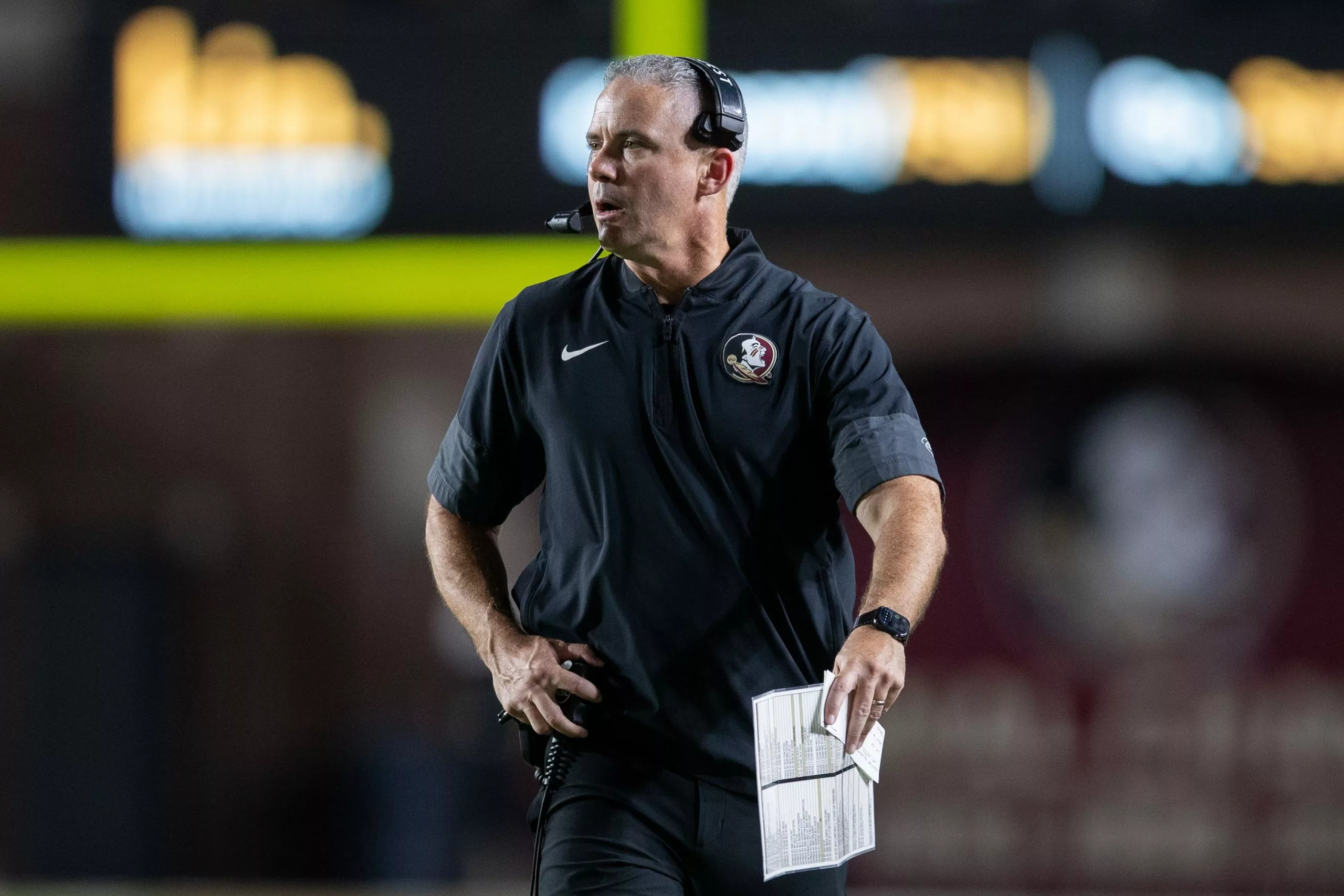
Florida State Seminoles head coach Mike Norvell talks into his headset during a timeout. The Florida State Seminoles defeated the New Mexico State Aggies 34-17 at Doak Campbell Stadium on Saturday, Aug. 29, 2026.
Florida State technically accomplished its first objective of the 2026 season. The Seminoles defeated New Mexico State 34–17, improved to 1–0 and avoided the kind of catastrophic upset that might have immediately ended Mike Norvell’s tenure.
But almost nothing about the performance should make Florida State supporters feel comfortable.
The Seminoles entered the game favored by more than 30 points. They were playing at Doak Campbell Stadium against a New Mexico State program coming off a difficult season. Florida State needed a dominant performance to demonstrate that the failures of the previous two years had finally been corrected.
Instead, New Mexico State twice pulled within three points and remained within 10 during the fourth quarter.
Florida State eventually created separation, but the Seminoles never looked like a team ready to return to national relevance. They looked like the same inconsistent, transfer-dependent and poorly developed program that produced a combined 7–17 record over the previous two seasons.
Norvell got the victory. Somehow, he also left the field under more pressure than when the game began.
Florida State Needed a Statement and Delivered a Warning
Florida State was favored by approximately 31 points and had an entire offseason to prepare. New Mexico State entered Tallahassee with a reconstructed roster, limited depth and considerably less talent at nearly every position.
The Seminoles should have controlled the game from the opening possession, established a large halftime advantage and used the second half to evaluate younger players.
Instead, Florida State led only 17–7 at halftime. The Aggies cut the margin to 17–14 early in the third quarter and later pulled within 27–17 during the fourth.
Florida State finally secured the victory with a 90-yard touchdown drive, but needing a late possession to put away New Mexico State was hardly encouraging.
The final score created the appearance of a reasonably comfortable win. The game itself told a different story.
New Mexico State converted 10 of its 17 third-down opportunities. Quarterback Trey Hedden completed 10 of 13 passes for 158 yards during one particularly effective stretch and finished with 272 passing yards and two touchdowns. The Aggies repeatedly found openings in Florida State’s zone coverage and extended drives that should have ended.
Defensive coordinator Tony White acknowledged that communication problems—especially in third-down packages—contributed to the breakdowns.
That is a major concern because the schedule is about to become much more difficult. If Florida State could not consistently get off the field against New Mexico State, what happens against SMU, Clemson and the stronger offenses on its schedule?
The Seminoles Still Looked Like a Team Searching for an Identity
Florida State produced some encouraging offensive numbers. The Seminoles rushed for 217 yards, with Ousmane Kromah gaining 115 yards on 14 carries. Quarterback Ashton Daniels completed 17 of 27 passes for 202 yards, one touchdown and one interception while adding a rushing score.
Samuel Singleton Jr. was the most dynamic player on the field. He accumulated 164 all-purpose yards, scored as a runner and receiver and earned ACC Receiver of the Week recognition.
Those are legitimate positives.
The problem was that Florida State never established complete control. Daniels made several good decisions, but the interception was another reminder that the quarterback position remains unsettled. The offensive line generated movement in the running game but did not consistently make the offense look overwhelming.
New Mexico State prevented Florida State from scoring on an explosive play. All six of the Seminoles’ scoring possessions ended inside the red zone. Sustaining drives is valuable, but a roster with Florida State’s athletic advantages should have generated more game-breaking moments.
The Seminoles also failed to use the matchup as a meaningful opportunity to develop their depth. Florida State used only 18 players on offense, and many of the program’s younger recruits received little or no meaningful action because the game remained competitive.
That matters.
One of the most persistent criticisms of Norvell’s tenure has been Florida State’s dependence on the transfer portal. Transfers helped produce the 13–1 season in 2023, but the program has struggled to develop enough high-school signees into dependable starters.
Florida State signed a large recruiting class and promised to build a more sustainable foundation. Yet against New Mexico State, the Seminoles again relied heavily on transfers, particularly along the offensive line.
An easy opener should have created an entire second half of developmental snaps. Instead, the coaching staff could not comfortably empty the bench.
That was not merely a missed opportunity. It was another warning about the roster Norvell has assembled.
Florida State’s Recent Record Leaves No Margin for Patience
If Florida State had entered 2026 after consecutive winning seasons, a sloppy opener could be dismissed as an early-season performance. Teams frequently struggle with communication, execution and tackling in their first game.
Norvell does not have that luxury.
Florida State has gone 7–17 over the last two seasons, including a 3–13 record in ACC play. The Seminoles failed to win a road game during that stretch.
That collapse came immediately after the undefeated 2023 regular season, when Florida State won the ACC but was controversially excluded from the College Football Playoff following Jordan Travis’ injury.
The playoff snub was undeniably harsh, but it cannot continue serving as an explanation for everything that followed. Florida State went from a 13-win conference champion to one of the most disappointing programs in the country.
Norvell’s record at Florida State stood at 38–34 through the end of 2025. The victory over New Mexico State moved him to 39–34.
That is not close to acceptable at Florida State.
The Seminoles possess national championship history, access to one of the richest recruiting territories in America and financial resources that most programs cannot match. A Florida State coach should not be fighting to stay comfortably above .500 in his seventh season.
Norvell has already received more patience than many major-program coaches would have been given.
His massive contract is one reason. Florida State would reportedly owe approximately $50 million or more to dismiss him during the 2026 season, depending on the exact timing and contractual calculations. The agreement guarantees Norvell 85 percent of his remaining compensation, making him extremely expensive to remove.
That buyout may have protected Norvell after 2025. It will not protect him forever.
At some point, continuing to employ a coach who is not winning becomes more expensive than firing him.
The SMU Game Has Become Enormous
Florida State’s next game is not another opportunity to work through its problems against an overmatched opponent.
The Seminoles
host No. 19 SMU on Monday night in their ACC opener. Florida State enters the game as a home underdog.
Think about what that says.
Florida State has recruited at a higher level than SMU, plays inside Doak Campbell Stadium and desperately needs a victory. Yet the market and national perception still favor the Mustangs because Florida State has done little to earn anyone’s confidence.
SMU will stress every weakness New Mexico State exposed.
The Mustangs can play with tempo, create explosive passes and force defenses to communicate correctly. If Florida State continues struggling on third down or leaves receivers open in its zone coverage, SMU will produce touchdowns instead of merely threatening to make the game close.
The pressure will also increase on Daniels. Florida State could control New Mexico State with 217 rushing yards. SMU is more likely to force the Seminoles into obvious passing situations and make Daniels prove he can win the game from the pocket.
Norvell cannot afford another performance in which Florida State spends three quarters searching for control.
A victory over SMU would not solve every problem, but it would provide evidence that Florida State can still defeat a ranked conference opponent. It would move the Seminoles to 2–0 and create genuine momentum before the schedule becomes even more demanding.
A loss would drop Florida State to 1–1, 0–1 in the ACC and leave Norvell needing to rescue the season against a schedule that includes Alabama and Clemson.
The New Mexico State game was supposed to reduce the pressure before that challenge. It did the opposite.
Beating New Mexico State Was the Minimum Requirement
Norvell and his staff can point to several positives.
Florida State won. The Seminoles rushed the ball effectively. Kromah and Singleton displayed legitimate playmaking ability. The defense held New Mexico State to 47 rushing yards, and Florida State improved to 23–2 under Norvell when allowing fewer than 20 points.
But those facts cannot be separated from the quality of the opponent or the expectations surrounding the program.
Florida State was not playing Georgia, Ohio State or Indiana. It was playing a New Mexico State team expected to finish near the bottom of Conference USA.
Winning by 17 as a 31-point favorite is not evidence that the Seminoles have returned. Allowing the Aggies to convert nearly 59 percent of their third downs is not evidence that the defense has been repaired. Keeping the starters on the field deep into the fourth quarter is not evidence that Florida State has developed championship depth.
The standard at Florida State cannot become simply surviving games against inferior opponents.
Norvell was not retained to produce moral victories or celebrate results that would be considered disappointing under Bobby Bowden, Jimbo Fisher or even Norvell himself in 2023. He was retained because the administration believed he could correct the collapse and return Florida State to contention.
The opening game provided little proof that those corrections have occurred.
Norvell Must Produce Results Now
Florida State supporters have heard enough about offseason improvement.
They have heard about better chemistry, increased accountability, improved high-school recruiting and a more physical roster. They have heard that the coaching changes will fix the defense and that the new players understand what it means to represent Florida State.
Now they need to see it.
A program under less pressure could treat New Mexico State as a starting point.
Florida State
must treat it as a warning.
The Seminoles escaped Week Zero without disaster, but the performance exposed the same issues that have followed the program for two seasons: inconsistency, communication problems, questionable depth and an inability to dominate teams with substantially less talent.
Norvell still controls his future. He has an opportunity to defeat SMU, compete for the ACC championship and make the buyout conversation irrelevant.
But the standard has changed. Simply winning is no longer enough when the opponent is New Mexico State. Florida State needs to look organized, physical and dangerous. It needs to resemble a program moving toward championship contention rather than one desperately trying to avoid another collapse.
Up To $1500 in Bonus Bets Paid Back if your First Bet Does Not Win
T&Cs apply
4.5/5
Gambling problem? Call 1-800-GAMBLER or 1-800-MY-RESET (Available in the US) 877-8-HOPENY or text HOPENY (467369) (NY) 1-800-327-5050 (MA), 1-800-BETS-OFF (IA), 1-800-981-0023 (PR). 21+ only. Please Gamble Responsibly. See BetMGM.com for Terms. First Bet Offer for new customers only (if applicable). Subject to eligibility requirements. Bonus bets are non-withdrawable. In partnership with Kansas Crossing Casino and Hotel. Promotional offers not available in Mississippi, Massachusetts, New York, Ontario, or Puerto Rico.
New DraftKings Customers: Spend $5+ Get $150 in Bonuses
T&Cs apply
4.5/5
GAMBLING PROBLEM? CALL 1-800-GAMBLER or 1-800-MY-RESET, (800) 327-5050 or visit gamblinghelplinema.org (MA). Please Gamble Responsibly. 888-789-7777/visit ccpg.org (CT), or visit www.mdgamblinghelp.org (MD), 1-800-981-0023 (PR). 21+ and present in most states. (18+ DC/NH/PR/WY). Void in CAN. Eligibility restrictions apply. On behalf of Boot Hill Casino (KS). Pass-thru of per wager tax may apply in IL. 1 per new DraftKings customer. $5+ first-time bet req. Max. $150 issued as non-withdrawable Bonus Bets. Stake removed from payout. Reward issued as $50 in Bonus Bets every 7 days via click-to-claim for 14 days. Bonus Bets and click-to-claims expire 7 days (168hrs) after issuance. Terms: sportsbook.draftkings.com/promos. Ends 10/11/26 at 11:59 PM ET. Sponsored by DK.
Must be 21+. GAMBLING PROBLEM? CALL 1-800-GAMBLER OR CALL 1-800-MY-RESET, www.mdgamblinghelp.org (MD), (800)-327-5050 or gamblinghelplinema.org (MA), Call (877)8-HOPENY or text HOPENY (467369) (NY), (888) 789-7777 or ccpg.org (CT), morethanagame.nc.gov (NC), 1800gambler.net (WV)
Bet $1 and get double the winnings up to $25 for your next 10 bets
T&Cs apply
4.4/5
21+ New users only. Must register using eligible promo code. First bet after registration must qualify. Max. Bonus Bet: $1,000. Bonus Bet expires 14 days after receipt. Void where prohibited. See Caesars.com/promos for full terms. Gambling Problem? 1-800-GAMBLER (1-800-426-2537)
21+ and present in OH. Gambling Problem? Call 1-800-GAMBLER.
This site is using
Cloudflare
and adheres to the
Google Safe Browsing Program. We adapted
Google's Privacy Guidelines
to keep your data safe at all times.
Close
Ready to Win Big? Join the Elite with Our Sports Betting Deals!
FanDuel Promo
New Users – Get $250 in Bonus Bets when you wager $5 for 5 days
Up To $1500 in Bonus Bets Paid Back if your First Bet Does Not Win
Best Slots
T&Cs and 21+ apply
Gambling problem? Call 1-800-GAMBLER or 1-800-MY-RESET (Available in the US) 877-8-HOPENY or text HOPENY (467369) (NY) 1-800-327-5050 (MA), 1-800-BETS-OFF (IA), 1-800-981-0023 (PR). 21+ only. Please Gamble Responsibly. See BetMGM.com for Terms. First Bet Offer for new customers only (if applicable). Subject to eligibility requirements. Bonus bets are non-withdrawable. In partnership with Kansas Crossing Casino and Hotel. Promotional offers not available in Mississippi, Massachusetts, New York, Ontario, or Puerto Rico.
Code:
Open BetMGM
Get Bonus
DraftKings Promo
New DraftKings Customers: Spend $5+ Get $150 in Bonuses
Newcomer
T&Cs and 21+ apply
GAMBLING PROBLEM? CALL 1-800-GAMBLER or 1-800-MY-RESET, (800) 327-5050 or visit gamblinghelplinema.org (MA). Please Gamble Responsibly. 888-789-7777/visit ccpg.org (CT), or visit www.mdgamblinghelp.org (MD), 1-800-981-0023 (PR). 21+ and present in most states. (18+ DC/NH/PR/WY). Void in CAN. Eligibility restrictions apply. On behalf of Boot Hill Casino (KS). Pass-thru of per wager tax may apply in IL. 1 per new DraftKings customer. $5+ first-time bet req. Max. $150 issued as non-withdrawable Bonus Bets. Stake removed from payout. Reward issued as $50 in Bonus Bets every 7 days via click-to-claim for 14 days. Bonus Bets and click-to-claims expire 7 days (168hrs) after issuance. Terms: sportsbook.draftkings.com/promos. Ends 10/11/26 at 11:59 PM ET. Sponsored by DK.
Code:
Open DraftKings
Get Bonus
Find out what the legends have to say about sports this week....