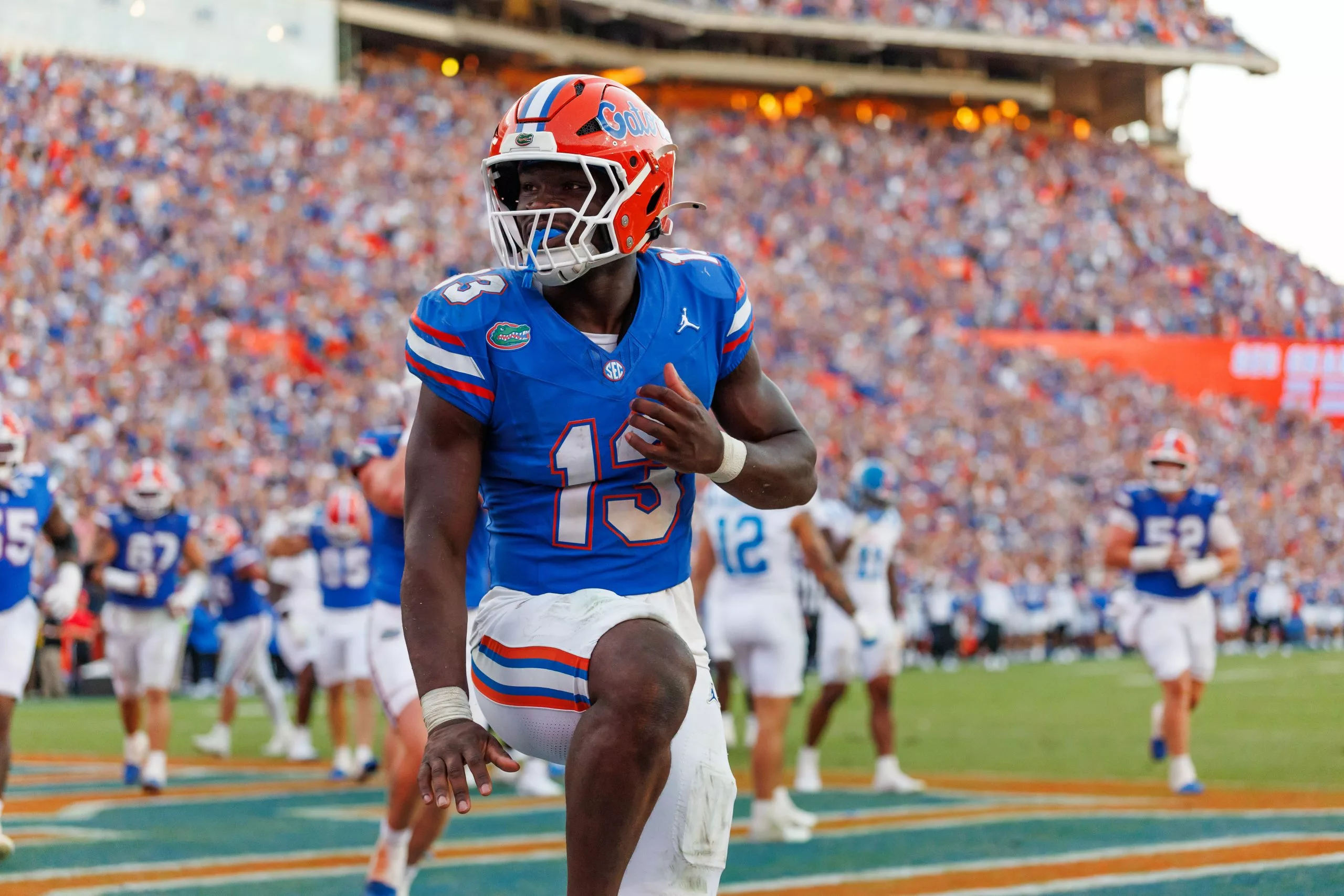
Sep 26, 2026; Gainesville, Florida, USA; Florida Gators running back Jadan Baugh (13) celebrates with a Heisman pose against the Mississippi Rebels during the second half at Ben Hill Griffin Stadium. Mandatory Credit: Matt Pendleton-Imagn Images
Florida entered the 2026 season as an intriguing team with a new head coach, a talented roster and enough unanswered questions to keep expectations under control.
Four games later, it is time to eliminate the qualifiers.
The Gators are not merely improving. They are not simply ahead of schedule. They are not a rebuilding program hoping to remain competitive in the SEC.
Florida is a legitimate national championship contender.
Jon Sumrall’s team delivered the clearest evidence yet Saturday afternoon, overwhelming No. 4 Ole Miss 52–28 at Ben Hill Griffin Stadium. The Gators improved to 4–0, earned their second consecutive victory over a ranked conference opponent and climbed 13 positions to No. 8 in the latest Associated Press poll.
Florida has already won a shootout at Auburn and dismantled a top-five opponent at home. The Gators can run the football, create explosive plays and respond when an opponent applies pressure.
Those are not the characteristics of a program waiting for the future.
They are the characteristics of a team capable of winning the SEC right now.
Florida Did Not Simply Beat Ole Miss
The most impressive part of Saturday’s victory was not that Florida won.
The Swamp, Florida’s physical running game and the uncertainty surrounding Ole Miss running back Kewan Lacy provided legitimate reasons to believe the Gators could beat the Rebels.
It was the way Florida controlled the game.
Ole Miss arrived in Gainesville ranked fourth nationally after defeating LSU 32–24. Quarterback Trinidad Chambliss had emerged as an early Heisman Trophy candidate, and the Rebels appeared to possess one of the country’s most dangerous offenses.
Florida made them look ordinary.
The Gators scored 10 points during the opening quarter, carried a 17–6 advantage into halftime and continued applying pressure after Ole Miss attempted to respond. Florida scored 21 points in the fourth quarter to turn a competitive conference game into a 24-point demolition.
That closing performance matters.
Good teams build leads. Championship teams finish opponents after they become vulnerable.
Florida could have become conservative after taking control. Instead, the Gators continued attacking and removed any opportunity for Ole Miss to produce a dramatic comeback.
The result was the kind of victory that changes the way an entire program is viewed.
Jon Sumrall Has Changed Florida’s Identity
Florida hired Sumrall because of his ability to build tough, disciplined and confident football teams.
Those qualities are already visible.
The Gators do not look like a team searching for an identity under a first-year head coach. They understand how they want to play, and more importantly, they believe that approach will work against anyone.
Florida has already demonstrated two distinctly different ways to win.
At Auburn, the Gators survived a 44–39 shootout in one of the SEC’s most difficult environments. The defense struggled, but Florida remained composed and continued answering every Auburn challenge.
Against Ole Miss, the Gators were more complete. They controlled the first half, forced the Rebels to chase the game and then delivered the decisive fourth-quarter surge.
Winning close on the road and winning comfortably at home require different qualities. Florida has now done both in consecutive weeks against ranked conference opponents.
Sumrall inherited a program that needed more than schematic adjustments. Florida needed confidence, discipline and a reason to believe it still belonged among the SEC’s elite.
He has supplied all three much faster than anticipated.
Jadan Baugh Gives Florida a Championship Foundation
Florida’s offensive success begins with its ability to run the football.
Jadan Baugh entered the Ole Miss game as one of the country’s most productive running backs. His combination of power, acceleration and balance gives Florida an offensive foundation that should translate against every opponent on the schedule.
That becomes especially important during conference play.
Explosive passing attacks can disappear when the weather changes, the competition improves or a hostile road environment disrupts communication. A physical running game travels.
Baugh allows Florida to control possession, protect its quarterback and punish defenses that commit too many resources to stopping explosive passes. If an opponent keeps additional defenders out of the box, Florida can repeatedly hand him the football. If safeties move forward, the Gators can attack the vacated space downfield.
The running game also helps Florida late in games.
Ole Miss needed the football to create a comeback, but Florida possessed the personnel to maintain control and wear down the Rebels. The Gators’ 21-point fourth quarter was not an accident. It was the result of an opponent being forced to defend Florida’s physical offense for an entire afternoon.
Every championship team needs something it can trust when the game becomes uncomfortable.
Florida can trust its running game.
The Offense Is More Dangerous Than Expected
The Gators are not simply a physical team attempting to win low-scoring games.
Florida has scored 96 points in its first two SEC contests. The Gators produced 44 points at Auburn and followed that performance by scoring 52 against Ole Miss.
That level of production changes Florida’s ceiling.
Sumrall does not need his defense to dominate every opponent. Florida can survive mistakes, recover from early deficits and win games that become offensive shootouts.
The Gators have also shown they can generate points against different defensive structures. Auburn attempted to match Florida’s pace and offensive aggression. Ole Miss arrived with enough athleticism to create pressure and defend the entire field.
Neither approach worked.
Florida’s balance makes the offense difficult to prepare for. Opponents cannot concentrate exclusively on Baugh without creating favorable passing situations. They also cannot sit in lighter defensive formations without risking another dominant rushing performance.
That balance separates Florida from teams that are dependent on a single quarterback, running back or offensive concept.
The Gators are becoming an offense without an obvious weakness.
Florida Has Already Built a Strong Playoff Résumé
The College Football Playoff conversation usually contains too much speculation during September. Many undefeated teams have accumulated perfect records against opponents that will not matter by November.
Florida’s résumé is different.
The Gators have already won at Auburn and defeated a top-five Ole Miss team by 24 points. Few programs possess two conference victories of that quality through four games.
Florida did not need favorable officiating, a late turnover or an improbable special-teams play to beat Ole Miss. The Gators were clearly the better team.
That distinction will matter to the selection committee if Florida eventually finishes with one or two losses.
The expanded playoff provides more room for error, but Florida should no longer view an at-large selection as its primary objective. The Gators have placed themselves in the
SEC championship race.
Reaching the conference title game would provide another opportunity to defeat an elite opponent. Winning it could give Florida one of the highest seeds in the playoff.
Those possibilities would have appeared overly optimistic before the season.
They now represent realistic objectives.
Is Florida the SEC’s Biggest Threat to Texas and Georgia?
Texas and Georgia remain the conference’s most established championship contenders.
Texas retained the No. 1 ranking after winning 20–17 at Tennessee. Georgia remained second after overpowering Oklahoma 41–13. Both teams are undefeated, experienced and loaded with future NFL players.
Florida has not yet earned the right to move ahead of either program.
The Gators have, however, entered the next group of contenders—and their ceiling may be higher than anyone expected.
Florida’s argument begins with balance. The Gators possess a powerful rushing attack, an increasingly explosive offense and a coaching staff that has demonstrated an ability to adjust during games.
They also appear mentally prepared for difficult situations. Florida did not panic when Auburn turned their meeting into a shootout, and it did not relax when Ole Miss attempted to generate second-half momentum.
That composure is essential in the SEC.
The Gators still need to prove their defense can consistently limit explosive plays. Auburn scored 39 points, and Ole Miss still reached 28 despite spending most of the afternoon playing from behind. Texas and Georgia would punish the same breakdowns even more severely.
Florida is not a finished product.
The frightening part for the rest of the conference is that the Gators are already winning while Sumrall continues correcting those problems.
Ole Miss Provided the Validation Florida Needed
Before Saturday, skeptics could dismiss Florida’s undefeated start.
The first two victories came before the Gators entered conference play. Auburn was a meaningful road win, but the Tigers were not considered one of the SEC’s leading championship contenders.
Ole Miss removed every remaining excuse.
The Rebels were ranked fourth. They had just defeated LSU. Chambliss was generating national Heisman attention, and Ole Miss entered Gainesville believing it belonged in the national championship discussion.
Florida did not merely survive the challenge.
The Gators ended it emphatically.
That victory gives Florida something every championship contender needs: proof that its formula works against elite competition.
Players no longer need to imagine what might happen against a top-five opponent. They have already experienced it. They know how the stadium feels, how the pressure builds and how to finish the game once the opportunity appears.
That experience becomes valuable later in the season when the stakes become even greater.
Sumrall Has Accelerated the Rebuild
Florida was not supposed to reach this point so quickly.
Coaching transitions normally require patience. Players must learn new terminology, understand different expectations and adjust to changes throughout the program. Even talented teams frequently experience inconsistency during the opening season of a new coaching staff.
Sumrall has largely avoided that process.
Florida looks prepared, connected and confident. The Gators have committed mistakes, particularly on defense, but they have not appeared confused or fragile.
That reflects coaching.
Sumrall has convinced his players that Florida can win immediately. He has also created a style that matches the roster’s strengths instead of forcing the players into a system that requires several recruiting classes to function.
The turnaround is not complete. Four victories do not erase every problem that developed during the program’s years outside the SEC’s top tier.
However, Sumrall has already changed the direction of Florida football.
The Gators are no longer attempting to recapture their national relevance. They have recaptured it.
The Remaining Concern Is the Defense
Florida’s offense is capable of winning a championship.
Whether its defense can do the same remains the central question.
Allowing 39 points to Auburn revealed problems with tackling, coverage discipline and preventing explosive plays. Ole Miss also produced four touchdowns despite falling behind early.
Florida can overcome those issues against most opponents because its offense creates so much pressure. The challenge will become greater against teams such as Texas and Georgia, which can control possession and punish defensive mistakes.
The Gators do not need to become the country’s best defense. They need to become more consistent.
Limiting busted coverages, tackling after the catch and producing third-down stops would be enough. Florida’s offense can handle the rest.
Sumrall’s teams have traditionally played with defensive toughness, giving the Gators reason to believe improvement will come as the season progresses.
If it does, Florida will not simply reach the playoff.
The Gators will be capable of winning it.
Florida Is Ahead of Schedule—but the Opportunity Is Now
It would be easy to describe Florida as a year away.
The roster can continue improving. Sumrall can recruit players specifically suited to his system. Another offseason would allow the coaching staff to build additional depth and correct the remaining defensive concerns.
Championship opportunities, however, cannot be postponed.
Florida is 4–0.
The Gators have defeated consecutive ranked SEC opponents. They possess an elite running back, a high-scoring offense and a coach whose players already believe in his message.
There is no reason to place artificial limits on this season.
Texas and Georgia remain the conference standards. Indiana is the defending national champion. Notre Dame and Miami also belong in the national discussion.
Florida now belongs there with them.
The Gators will face more difficult games, and they will eventually encounter adversity that cannot be solved by scoring 50 points. Their response will determine whether this season ends with a respectable playoff appearance or something much larger.
New Users – Get $350 in Bonus Bets when you wager $5 for 7 days
T&Cs apply
4.6/5
Gambling Problem? Call 1-800-GAMBLER or 1-800-MY-RESET. Call 1-888-789-7777 or visit ccpgg.org/chat (CT). Hope is here. GamblingHelpLineMA.org or call (800) 327-5050 for 24/7 support (MA). Visit www.mdgamblinghelp.org (MD). Call 1-877-8HOPE-NY or text HOPENY (NY). 21+ (18+ DC, WY) and present in select states (for KS, in affiliation with Kansas Star Casino). Find online real money wagering only. Min $5 wager required for 7 consecutive days. $5 free play credit. Bonus issued as non-withdrawable bonus with cash withdrawable bonus with cash withdrawable. Bonus bets which expire 7 days after receipt. Restrictions apply. See terms at sportsbook.fanduel.com. Call 1-877-770-7867 (LA).
Up To $1500 in Bonus Bets Paid Back if your First Bet Does Not Win
T&Cs apply
4.5/5
Gambling problem? Call 1-800-GAMBLER or 1-800-MY-RESET (Available in the US) 877-8-HOPENY or text HOPENY (467369) (NY) 1-800-327-5050 (MA), 1-800-BETS-OFF (IA), 1-800-981-0023 (PR). 21+ only. Please Gamble Responsibly. See BetMGM.com for Terms. First Bet Offer for new customers only (if applicable). Subject to eligibility requirements. Bonus bets are non-withdrawable. In partnership with Kansas Crossing Casino and Hotel. Promotional offers not available in Mississippi, Massachusetts, New York, Ontario, or Puerto Rico.
New DraftKings Customers: Bet $5, Get $200 + 3 Months of NBA League Pass!
T&Cs apply
4.5/5
GAMBLING PROBLEM? CALL 1-800-GAMBLER or 1-800-MY-RESET, (800) 327-5050 or visit gamblinghelplinema.org (MA). Please Gamble Responsibly. 888-789-7777/visit ccpg.org (CT), or visit www.mdgamblinghelp.org (MD), 1-800-981-0023 (PR). 21+ and present in most states. (18+ DC/NH/PR/WY). Void in CAN. Eligibility restrictions apply. On behalf of Boot Hill Casino (KS). Pass-thru of per wager tax may apply in IL. 1 per new Sportsbook customer. $5+ first-time bet req. Max. $200 issued as non-withdrawable Bonus Bets. Stake removed from payout. Reward issued as $50 in Bonus Bets every 7 days via click-to-claim for 21 days. Bonus Bets and click-to-claims expire 7 days (168hrs) after issuance. Terms: dkng.co/offer. Get 1 promo code to redeem a 3-month NBA League Pass subscription, complimentary of DraftKings. Subscription auto-renews monthly at then-current price (currently $16.99/mo); cancel anytime. Terms, restrictions, and eligibility requirements apply. Redeem League Pass by 12/19/26 at 11:59 PM ET. Addt’l terms: support.watch.nba.com/hc/en-us/articles/9165532876183-League-Pass-Terms-of-Use_. Ends 11/29/26 at 11:59 PM ET. Sponsored by DK.
Must be 21+. GAMBLING PROBLEM? CALL 1-800-GAMBLER OR CALL 1-800-MY-RESET, www.mdgamblinghelp.org (MD), (800)-327-5050 or gamblinghelplinema.org (MA), Call (877)8-HOPENY or text HOPENY (467369) (NY), (888) 789-7777 or ccpg.org (CT), morethanagame.nc.gov (NC), 1800gambler.net (WV)
Bet $1 and get double the winnings up to $25 for your next 10 bets
T&Cs apply
4.4/5
21+ New users only. Must register using eligible promo code. First bet after registration must qualify. Max. Bonus Bet: $1,000. Bonus Bet expires 14 days after receipt. Void where prohibited. See Caesars.com/promos for full terms. Gambling Problem? 1-800-GAMBLER (1-800-426-2537)
21+ and present in OH. Gambling Problem? Call 1-800-GAMBLER.
This site is using
Cloudflare
and adheres to the
Google Safe Browsing Program. We adapted
Google's Privacy Guidelines
to keep your data safe at all times.
Close
Ready to Win Big? Join the Elite with Our Sports Betting Deals!
FanDuel Promo
New Users – Get $350 in Bonus Bets when you wager $5 for 7 days
Our Favorite
T&Cs and 21+ apply
Gambling Problem? Call 1-800-GAMBLER or 1-800-MY-RESET. Call 1-888-789-7777 or visit ccpgg.org/chat (CT). Hope is here. GamblingHelpLineMA.org or call (800) 327-5050 for 24/7 support (MA). Visit www.mdgamblinghelp.org (MD). Call 1-877-8HOPE-NY or text HOPENY (NY). 21+ (18+ DC, WY) and present in select states (for KS, in affiliation with Kansas Star Casino). Find online real money wagering only. Min $5 wager required for 7 consecutive days. $5 free play credit. Bonus issued as non-withdrawable bonus with cash withdrawable bonus with cash withdrawable. Bonus bets which expire 7 days after receipt. Restrictions apply. See terms at sportsbook.fanduel.com. Call 1-877-770-7867 (LA).
Code:
Open FanDuel
Get Bonus
BetMGM Promo
Up To $1500 in Bonus Bets Paid Back if your First Bet Does Not Win
Best Slots
T&Cs and 21+ apply
Gambling problem? Call 1-800-GAMBLER or 1-800-MY-RESET (Available in the US) 877-8-HOPENY or text HOPENY (467369) (NY) 1-800-327-5050 (MA), 1-800-BETS-OFF (IA), 1-800-981-0023 (PR). 21+ only. Please Gamble Responsibly. See BetMGM.com for Terms. First Bet Offer for new customers only (if applicable). Subject to eligibility requirements. Bonus bets are non-withdrawable. In partnership with Kansas Crossing Casino and Hotel. Promotional offers not available in Mississippi, Massachusetts, New York, Ontario, or Puerto Rico.
Code:
Open BetMGM
Get Bonus
DraftKings Promo
New DraftKings Customers: Bet $5, Get $200 + 3 Months of NBA League Pass!
Newcomer
T&Cs and 21+ apply
GAMBLING PROBLEM? CALL 1-800-GAMBLER or 1-800-MY-RESET, (800) 327-5050 or visit gamblinghelplinema.org (MA). Please Gamble Responsibly. 888-789-7777/visit ccpg.org (CT), or visit www.mdgamblinghelp.org (MD), 1-800-981-0023 (PR). 21+ and present in most states. (18+ DC/NH/PR/WY). Void in CAN. Eligibility restrictions apply. On behalf of Boot Hill Casino (KS). Pass-thru of per wager tax may apply in IL. 1 per new Sportsbook customer. $5+ first-time bet req. Max. $200 issued as non-withdrawable Bonus Bets. Stake removed from payout. Reward issued as $50 in Bonus Bets every 7 days via click-to-claim for 21 days. Bonus Bets and click-to-claims expire 7 days (168hrs) after issuance. Terms: dkng.co/offer. Get 1 promo code to redeem a 3-month NBA League Pass subscription, complimentary of DraftKings. Subscription auto-renews monthly at then-current price (currently $16.99/mo); cancel anytime. Terms, restrictions, and eligibility requirements apply. Redeem League Pass by 12/19/26 at 11:59 PM ET. Addt’l terms: support.watch.nba.com/hc/en-us/articles/9165532876183-League-Pass-Terms-of-Use_. Ends 11/29/26 at 11:59 PM ET. Sponsored by DK.
Code:
Open DraftKings
Get Bonus
Find out what the legends have to say about sports this week....
New Users – Get $350 in Bonus Bets when you wager $5 for 7 days
Gambling Problem? Call 1-800-GAMBLER or 1-800-MY-RESET. Call 1-888-789-7777 or visit ccpgg.org/chat (CT). Hope is here. GamblingHelpLineMA.org or call (800) 327-5050 for 24/7 support (MA). Visit www.mdgamblinghelp.org (MD). Call 1-877-8HOPE-NY or text HOPENY (NY). 21+ (18+ DC, WY) and present in select states (for KS, in affiliation with Kansas Star Casino). Find online real money wagering only. Min $5 wager required for 7 consecutive days. $5 free play credit. Bonus issued as non-withdrawable bonus with cash withdrawable bonus with cash withdrawable. Bonus bets which expire 7 days after receipt. Restrictions apply. See terms at sportsbook.fanduel.com. Call 1-877-770-7867 (LA).