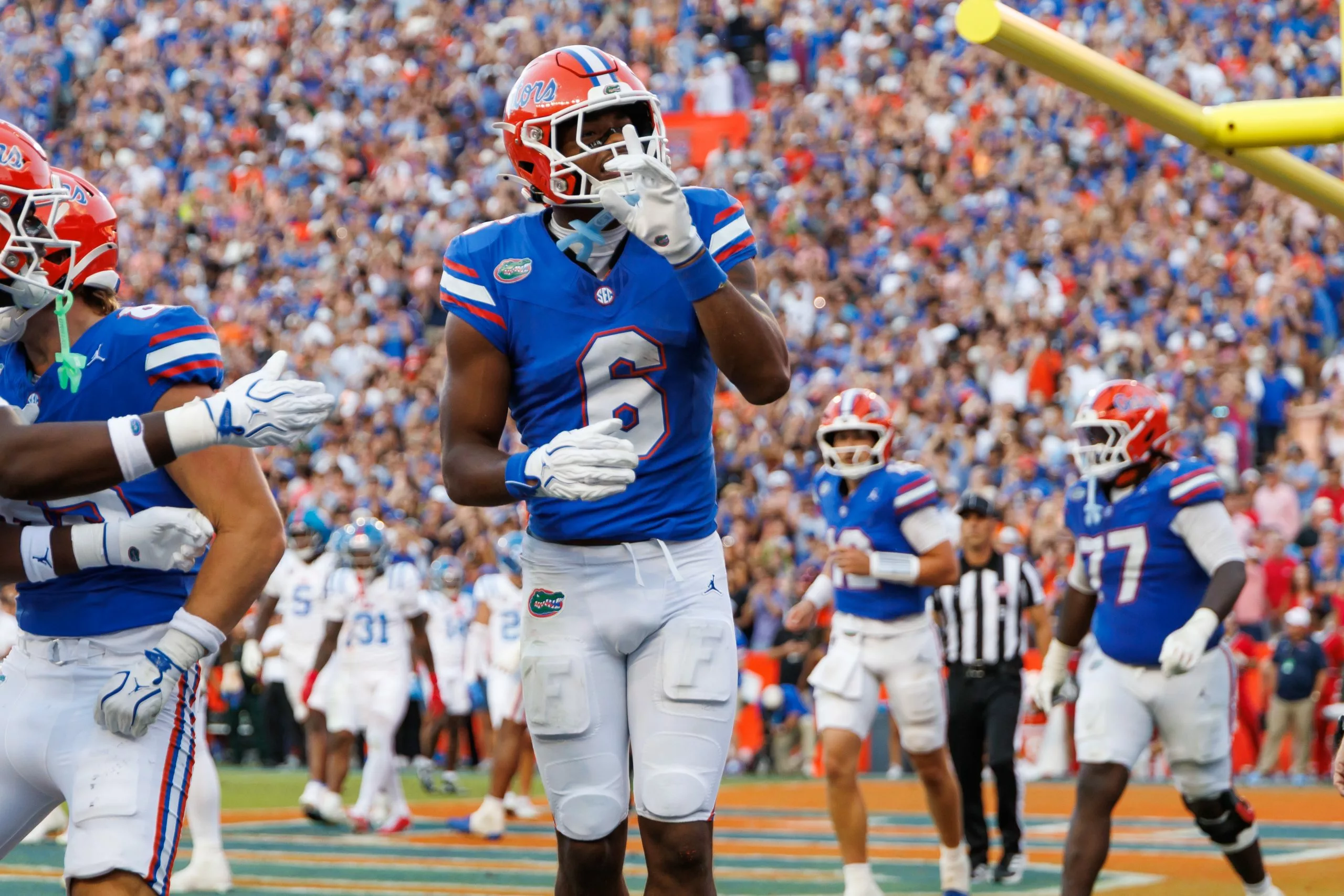
Sep 26, 2026; Gainesville, Florida, USA; Florida Gators wide receiver Dallas Wilson (6) gestures after scoring a touchdown against the Mississippi Rebels during the second half at Ben Hill Griffin Stadium. Mandatory Credit: Matt Pendleton-Imagn Images
Florida found a comfortable arrangement against Ole Miss. The Gators would keep handing off, and the Rebels would keep supplying reasons to do it again and again. Their 52-28 victory came with 302 rushing yards and six touchdowns on the ground in Gainesville, enough evidence to keep the passing menu short.
The interesting part is that the Rebels averaged more yards per play. And they still lost by 24 because their offense could get an answer without their defense preserving it. The Gators repeatedly took the ball back and returned to the same weakness.
Florida made familiar plays difficult to defend
Ole Miss coach Pete Golding acknowledged after the game in Gainesville that offensive coordinator Buster Faulkner had succeeded with concepts the Rebels already knew.
“Buster [Faulkner] did a great job, but it was nothing that we did not see on tape,”
Golding said.
His explanation makes the failure more specific. Golding described defenders losing the angles needed to contain runners, missing tackles, and diving at ankles. He also credited Faulkner with disguising familiar concepts through their presentation. Recognizing a play did little good when the defense could not finish the tackle.
Run fits, the assigned running lanes each defender must cover, only work when the next defender can trust the first one to handle his responsibility. Miss that assignment or tackle and the burden moves farther downfield, where help has less room for error.
Golding also accepted responsibility for calls that exposed his players while he chased a stop. Those gambles compounded the tackling problems. The Gators could threaten a long gain without asking quarterback Aaron Philo to hold the ball and wait for a receiver to separate.
Coach Jon Sumrall said injuries at receiver pushed the offense toward more two-tight-end formations, giving Philo selective opportunities downfield. Those formations put more potential blockers near the line while allowing either tight end to release for a pass, forcing defenders to respect both possibilities.
Changing running backs gave the Rebels little relief
Jadan Baugh scored three rushing touchdowns, but the defense could not treat his breaks as an intermission. Duke Clark ran for 126 yards on 12 carries, adding a different source of punishment to a game already slipping away at the line.
After Trinidad Chambliss pulled the Rebels within 17-14 early in the third quarter, Baugh gained seven yards on consecutive carries. Clark followed with a 45-yard touchdown run. The response required three rushing plays, with the starter creating progress and his replacement turning it into separation.
Clark credited his blockers in his postgame comments about the performance, directing attention toward the players who made the running room possible.
“I just got to give it all to my o-line, them blocking their ‘a’ off, man,”
Clark said.
His 44-yard run early in the fourth quarter helped set up another touchdown. A defense that already had trouble tackling Baugh also had to prevent Clark from turning an ordinary handoff into a field-position problem.
The substitution changed the runner without reducing the demand on the defense. Faulkner could give Baugh a breather and continue attacking the same weakness, rather than surrender a possession to rest his leading back.
Long possessions made the comeback harder to sustain
The Rebels’ offensive production supplies the strongest argument against calling this a complete mismatch. Chambliss generated scoring drives that twice cut the third-quarter deficit to three. The Gators’ defense needed help, and its offense supplied it through possession and repeated touchdowns.
Florida held the ball for 36:59 and converted six of 10 third downs. Those extended possessions forced the Rebels to recover momentum repeatedly instead of building on it. Head coach Jon Sumrall discussed that effect afterward when asked about a long second-quarter drive.
“And it kind of takes the air out of them a little bit when you’re able to sustain those long drives,”
Sumrall said.
The Gators ran 53 times and attempted 23 passes, keeping the game on terms their blockers and runners had established from the opening possession.
The loss exposed the defensive limit of
the continuity Pete Golding preserved. Keeping an offense capable of responding helped the Rebels stay close temporarily. It could not repair a defense that kept allowing the next touchdown.
The Gators scored touchdowns on their first five possessions after halftime. The Rebels answered the first-half deficit, then watched their defense allow 35 more points.
New Users – Get $350 in Bonus Bets when you wager $5 for 7 days
T&Cs apply
4.6/5
Gambling Problem? Call 1-800-GAMBLER or 1-800-MY-RESET. Call 1-888-789-7777 or visit ccpgg.org/chat (CT). Hope is here. GamblingHelpLineMA.org or call (800) 327-5050 for 24/7 support (MA). Visit www.mdgamblinghelp.org (MD). Call 1-877-8HOPE-NY or text HOPENY (NY). 21+ (18+ DC, WY) and present in select states (for KS, in affiliation with Kansas Star Casino). Find online real money wagering only. Min $5 wager required for 7 consecutive days. $5 free play credit. Bonus issued as non-withdrawable bonus with cash withdrawable bonus with cash withdrawable. Bonus bets which expire 7 days after receipt. Restrictions apply. See terms at sportsbook.fanduel.com. Call 1-877-770-7867 (LA).
Up To $1500 in Bonus Bets Paid Back if your First Bet Does Not Win
T&Cs apply
4.5/5
Gambling problem? Call 1-800-GAMBLER or 1-800-MY-RESET (Available in the US) 877-8-HOPENY or text HOPENY (467369) (NY) 1-800-327-5050 (MA), 1-800-BETS-OFF (IA), 1-800-981-0023 (PR). 21+ only. Please Gamble Responsibly. See BetMGM.com for Terms. First Bet Offer for new customers only (if applicable). Subject to eligibility requirements. Bonus bets are non-withdrawable. In partnership with Kansas Crossing Casino and Hotel. Promotional offers not available in Mississippi, Massachusetts, New York, Ontario, or Puerto Rico.
New DraftKings Customers: Bet $5, Get $200 + 3 Months of NBA League Pass!
T&Cs apply
4.5/5
GAMBLING PROBLEM? CALL 1-800-GAMBLER or 1-800-MY-RESET, (800) 327-5050 or visit gamblinghelplinema.org (MA). Please Gamble Responsibly. 888-789-7777/visit ccpg.org (CT), or visit www.mdgamblinghelp.org (MD), 1-800-981-0023 (PR). 21+ and present in most states. (18+ DC/NH/PR/WY). Void in CAN. Eligibility restrictions apply. On behalf of Boot Hill Casino (KS). Pass-thru of per wager tax may apply in IL. 1 per new Sportsbook customer. $5+ first-time bet req. Max. $200 issued as non-withdrawable Bonus Bets. Stake removed from payout. Reward issued as $50 in Bonus Bets every 7 days via click-to-claim for 21 days. Bonus Bets and click-to-claims expire 7 days (168hrs) after issuance. Terms: dkng.co/offer. Get 1 promo code to redeem a 3-month NBA League Pass subscription, complimentary of DraftKings. Subscription auto-renews monthly at then-current price (currently $16.99/mo); cancel anytime. Terms, restrictions, and eligibility requirements apply. Redeem League Pass by 12/19/26 at 11:59 PM ET. Addt’l terms: support.watch.nba.com/hc/en-us/articles/9165532876183-League-Pass-Terms-of-Use_. Ends 11/29/26 at 11:59 PM ET. Sponsored by DK.
Must be 21+. GAMBLING PROBLEM? CALL 1-800-GAMBLER OR CALL 1-800-MY-RESET, www.mdgamblinghelp.org (MD), (800)-327-5050 or gamblinghelplinema.org (MA), Call (877)8-HOPENY or text HOPENY (467369) (NY), (888) 789-7777 or ccpg.org (CT), morethanagame.nc.gov (NC), 1800gambler.net (WV)
Bet $1 and get double the winnings up to $25 for your next 10 bets
T&Cs apply
4.4/5
21+ New users only. Must register using eligible promo code. First bet after registration must qualify. Max. Bonus Bet: $1,000. Bonus Bet expires 14 days after receipt. Void where prohibited. See Caesars.com/promos for full terms. Gambling Problem? 1-800-GAMBLER (1-800-426-2537)
21+ and present in OH. Gambling Problem? Call 1-800-GAMBLER.
This site is using
Cloudflare
and adheres to the
Google Safe Browsing Program. We adapted
Google's Privacy Guidelines
to keep your data safe at all times.
Close
Ready to Win Big? Join the Elite with Our Sports Betting Deals!
FanDuel Promo
New Users – Get $350 in Bonus Bets when you wager $5 for 7 days
Our Favorite
T&Cs and 21+ apply
Gambling Problem? Call 1-800-GAMBLER or 1-800-MY-RESET. Call 1-888-789-7777 or visit ccpgg.org/chat (CT). Hope is here. GamblingHelpLineMA.org or call (800) 327-5050 for 24/7 support (MA). Visit www.mdgamblinghelp.org (MD). Call 1-877-8HOPE-NY or text HOPENY (NY). 21+ (18+ DC, WY) and present in select states (for KS, in affiliation with Kansas Star Casino). Find online real money wagering only. Min $5 wager required for 7 consecutive days. $5 free play credit. Bonus issued as non-withdrawable bonus with cash withdrawable bonus with cash withdrawable. Bonus bets which expire 7 days after receipt. Restrictions apply. See terms at sportsbook.fanduel.com. Call 1-877-770-7867 (LA).
Code:
Open FanDuel
Get Bonus
BetMGM Promo
Up To $1500 in Bonus Bets Paid Back if your First Bet Does Not Win
Best Slots
T&Cs and 21+ apply
Gambling problem? Call 1-800-GAMBLER or 1-800-MY-RESET (Available in the US) 877-8-HOPENY or text HOPENY (467369) (NY) 1-800-327-5050 (MA), 1-800-BETS-OFF (IA), 1-800-981-0023 (PR). 21+ only. Please Gamble Responsibly. See BetMGM.com for Terms. First Bet Offer for new customers only (if applicable). Subject to eligibility requirements. Bonus bets are non-withdrawable. In partnership with Kansas Crossing Casino and Hotel. Promotional offers not available in Mississippi, Massachusetts, New York, Ontario, or Puerto Rico.
Code:
Open BetMGM
Get Bonus
DraftKings Promo
New DraftKings Customers: Bet $5, Get $200 + 3 Months of NBA League Pass!
Newcomer
T&Cs and 21+ apply
GAMBLING PROBLEM? CALL 1-800-GAMBLER or 1-800-MY-RESET, (800) 327-5050 or visit gamblinghelplinema.org (MA). Please Gamble Responsibly. 888-789-7777/visit ccpg.org (CT), or visit www.mdgamblinghelp.org (MD), 1-800-981-0023 (PR). 21+ and present in most states. (18+ DC/NH/PR/WY). Void in CAN. Eligibility restrictions apply. On behalf of Boot Hill Casino (KS). Pass-thru of per wager tax may apply in IL. 1 per new Sportsbook customer. $5+ first-time bet req. Max. $200 issued as non-withdrawable Bonus Bets. Stake removed from payout. Reward issued as $50 in Bonus Bets every 7 days via click-to-claim for 21 days. Bonus Bets and click-to-claims expire 7 days (168hrs) after issuance. Terms: dkng.co/offer. Get 1 promo code to redeem a 3-month NBA League Pass subscription, complimentary of DraftKings. Subscription auto-renews monthly at then-current price (currently $16.99/mo); cancel anytime. Terms, restrictions, and eligibility requirements apply. Redeem League Pass by 12/19/26 at 11:59 PM ET. Addt’l terms: support.watch.nba.com/hc/en-us/articles/9165532876183-League-Pass-Terms-of-Use_. Ends 11/29/26 at 11:59 PM ET. Sponsored by DK.
Code:
Open DraftKings
Get Bonus
Find out what the legends have to say about sports this week....
New Users – Get $350 in Bonus Bets when you wager $5 for 7 days
Gambling Problem? Call 1-800-GAMBLER or 1-800-MY-RESET. Call 1-888-789-7777 or visit ccpgg.org/chat (CT). Hope is here. GamblingHelpLineMA.org or call (800) 327-5050 for 24/7 support (MA). Visit www.mdgamblinghelp.org (MD). Call 1-877-8HOPE-NY or text HOPENY (NY). 21+ (18+ DC, WY) and present in select states (for KS, in affiliation with Kansas Star Casino). Find online real money wagering only. Min $5 wager required for 7 consecutive days. $5 free play credit. Bonus issued as non-withdrawable bonus with cash withdrawable bonus with cash withdrawable. Bonus bets which expire 7 days after receipt. Restrictions apply. See terms at sportsbook.fanduel.com. Call 1-877-770-7867 (LA).