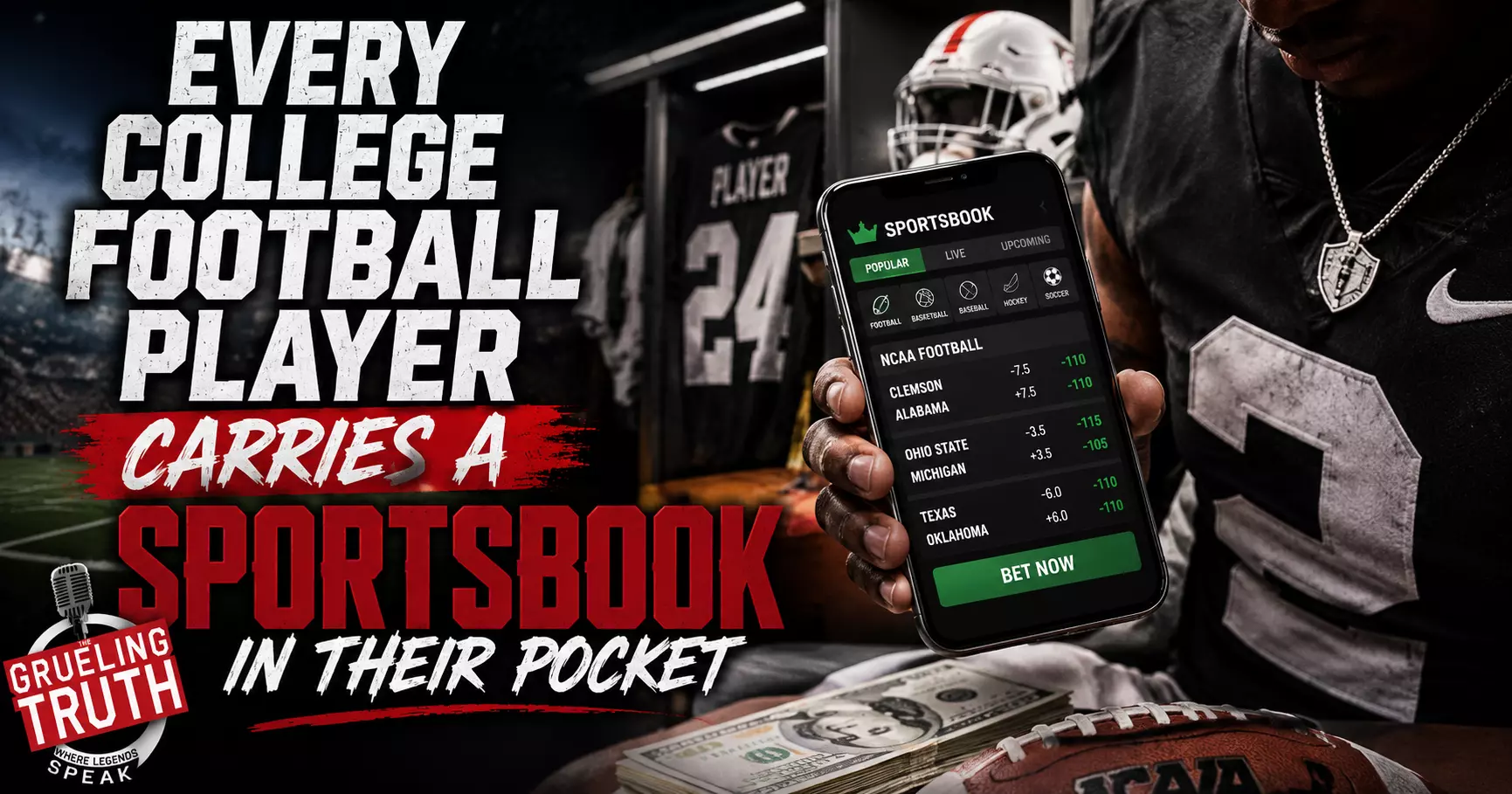
College football sports betting has become impossible to ignore as phones, and legal apps expose the NCAA's biggest challenge.
Not that long ago, betting on a football game meant knowing a bookie or making a trip to Las Vegas. Today, legal sports betting reaches most of the country, and every college football player walks around with a phone that doubles as a casino open round the clock. The temptation is no longer somewhere across town, because it now sits in his pocket during study hall, on the team bus, and in the locker room an hour before kickoff.
The people who run college football can see this problem coming, and they are quietly admitting they may not be able to stop it. The threat is not some outsider sneaking into the building anymore. It is already inside the locker room, and it fits in a teenager’s hand.
Brendan Sorsby’s case changed the conversation
The moment that rattled the sport this offseason involved a starting quarterback.
Brendan Sorsby admitted to years of heavy sports betting
that included 40 wagers on his own Indiana football games while he was a player there, and two of those bets were against his own team. Under NCAA rules, that should have ended his career for good on the spot.
Instead, a local judge granted him an injunction and let him keep playing for Texas Tech in 2026, and that ruling hit a hard rock. Several programs announced they would not schedule the Red Raiders in any sport, and one Big 12 coach vented to ESPN with a line dripping in dark sarcasm. He said that if this was the precedent, then he owed it to his players to bring in people from Las Vegas to teach them to gamble. He was not serious, but his frustration captured a sport that feels like it is losing control.
Sports betting is already part of campus life
The Sorsby story grabbed the headlines, but the quieter numbers tell you how deep this runs. An NCAA study found that 67 percent of college students on campus have bet on sports, that 41 percent have wagered on their own school’s team, and that 35 percent have used a student bookmaker. Betting is not some rare vice hiding in the shadows. It is woven into normal campus life, which is exactly what makes it extremely difficult to police.
You do not have to look for proof. A state sting in Iowa swept up dozens of football players for underage betting, and the same investigation caught five Iowa State football staffers who had placed more than 6,200 bets worth over $100,000, some of it on their own school’s teams. When staff members inside the program are betting six figures, the idea that schools have this under control starts to fall apart.
Why schools can’t keep up
The most dangerous bets of all are the small ones on a single player, often called prop bets, like how many yards a running back gains or how many passes a quarterback completes. A player can come up a few yards short on purpose, and it looks completely normal, which is why NCAA president Charlie Baker has spent years begging states to ban college prop bets. He warns that players face steady pressure from gamblers who want them to shave numbers so someone else can cash a ticket.
So the schools are stuck in a fight they mostly cannot win. They now monitor more than 22,000 competitions a year and have handed out bans and suspensions, yet the phones are everywhere, the money is legal, and the temptation refreshes every time a kid opens an app. The old enforcement system was built for a world of bookies and back rooms, and that world is gone. Until the sportsbooks stop offering bets on college kids, this is the new reality of college football, and everyone inside the building already knows it.
Up To $1500 in Bonus Bets Paid Back if your First Bet Does Not Win
T&Cs apply
4.5/5
Gambling problem? Call 1-800-GAMBLER or 1-800-MY-RESET (Available in the US) 877-8-HOPENY or text HOPENY (467369) (NY) 1-800-327-5050 (MA), 1-800-BETS-OFF (IA), 1-800-981-0023 (PR). 21+ only. Please Gamble Responsibly. See BetMGM.com for Terms. First Bet Offer for new customers only (if applicable). Subject to eligibility requirements. Bonus bets are non-withdrawable. In partnership with Kansas Crossing Casino and Hotel. Promotional offers not available in Mississippi, Massachusetts, New York, Ontario, or Puerto Rico.
New DraftKings Customers: Spend $5+ Get $150 in Bonuses
T&Cs apply
4.5/5
GAMBLING PROBLEM? CALL 1-800-GAMBLER or 1-800-MY-RESET, (800) 327-5050 or visit gamblinghelplinema.org (MA). Please Gamble Responsibly. 888-789-7777/visit ccpg.org (CT), or visit www.mdgamblinghelp.org (MD), 1-800-981-0023 (PR). 21+ and present in most states. (18+ DC/NH/PR/WY). Void in CAN. Eligibility restrictions apply. On behalf of Boot Hill Casino (KS). Pass-thru of per wager tax may apply in IL. 1 per new DraftKings customer. $5+ first-time bet req. Max. $150 issued as non-withdrawable Bonus Bets. Stake removed from payout. Reward issued as $50 in Bonus Bets every 7 days via click-to-claim for 14 days. Bonus Bets and click-to-claims expire 7 days (168hrs) after issuance. Terms: sportsbook.draftkings.com/promos. Ends 10/11/26 at 11:59 PM ET. Sponsored by DK.
Must be 21+. GAMBLING PROBLEM? CALL 1-800-GAMBLER OR CALL 1-800-MY-RESET, www.mdgamblinghelp.org (MD), (800)-327-5050 or gamblinghelplinema.org (MA), Call (877)8-HOPENY or text HOPENY (467369) (NY), (888) 789-7777 or ccpg.org (CT), morethanagame.nc.gov (NC), 1800gambler.net (WV)
Bet $1 and get double the winnings up to $25 for your next 10 bets
T&Cs apply
4.4/5
21+ New users only. Must register using eligible promo code. First bet after registration must qualify. Max. Bonus Bet: $1,000. Bonus Bet expires 14 days after receipt. Void where prohibited. See Caesars.com/promos for full terms. Gambling Problem? 1-800-GAMBLER (1-800-426-2537)
21+ and present in OH. Gambling Problem? Call 1-800-GAMBLER.
This site is using
Cloudflare
and adheres to the
Google Safe Browsing Program. We adapted
Google's Privacy Guidelines
to keep your data safe at all times.
Close
Ready to Win Big? Join the Elite with Our Sports Betting Deals!
FanDuel Promo
New Users – Get $250 in Bonus Bets when you wager $5 for 5 days
Up To $1500 in Bonus Bets Paid Back if your First Bet Does Not Win
Best Slots
T&Cs and 21+ apply
Gambling problem? Call 1-800-GAMBLER or 1-800-MY-RESET (Available in the US) 877-8-HOPENY or text HOPENY (467369) (NY) 1-800-327-5050 (MA), 1-800-BETS-OFF (IA), 1-800-981-0023 (PR). 21+ only. Please Gamble Responsibly. See BetMGM.com for Terms. First Bet Offer for new customers only (if applicable). Subject to eligibility requirements. Bonus bets are non-withdrawable. In partnership with Kansas Crossing Casino and Hotel. Promotional offers not available in Mississippi, Massachusetts, New York, Ontario, or Puerto Rico.
Code:
Open BetMGM
Get Bonus
DraftKings Promo
New DraftKings Customers: Spend $5+ Get $150 in Bonuses
Newcomer
T&Cs and 21+ apply
GAMBLING PROBLEM? CALL 1-800-GAMBLER or 1-800-MY-RESET, (800) 327-5050 or visit gamblinghelplinema.org (MA). Please Gamble Responsibly. 888-789-7777/visit ccpg.org (CT), or visit www.mdgamblinghelp.org (MD), 1-800-981-0023 (PR). 21+ and present in most states. (18+ DC/NH/PR/WY). Void in CAN. Eligibility restrictions apply. On behalf of Boot Hill Casino (KS). Pass-thru of per wager tax may apply in IL. 1 per new DraftKings customer. $5+ first-time bet req. Max. $150 issued as non-withdrawable Bonus Bets. Stake removed from payout. Reward issued as $50 in Bonus Bets every 7 days via click-to-claim for 14 days. Bonus Bets and click-to-claims expire 7 days (168hrs) after issuance. Terms: sportsbook.draftkings.com/promos. Ends 10/11/26 at 11:59 PM ET. Sponsored by DK.
Code:
Open DraftKings
Get Bonus
Find out what the legends have to say about sports this week....