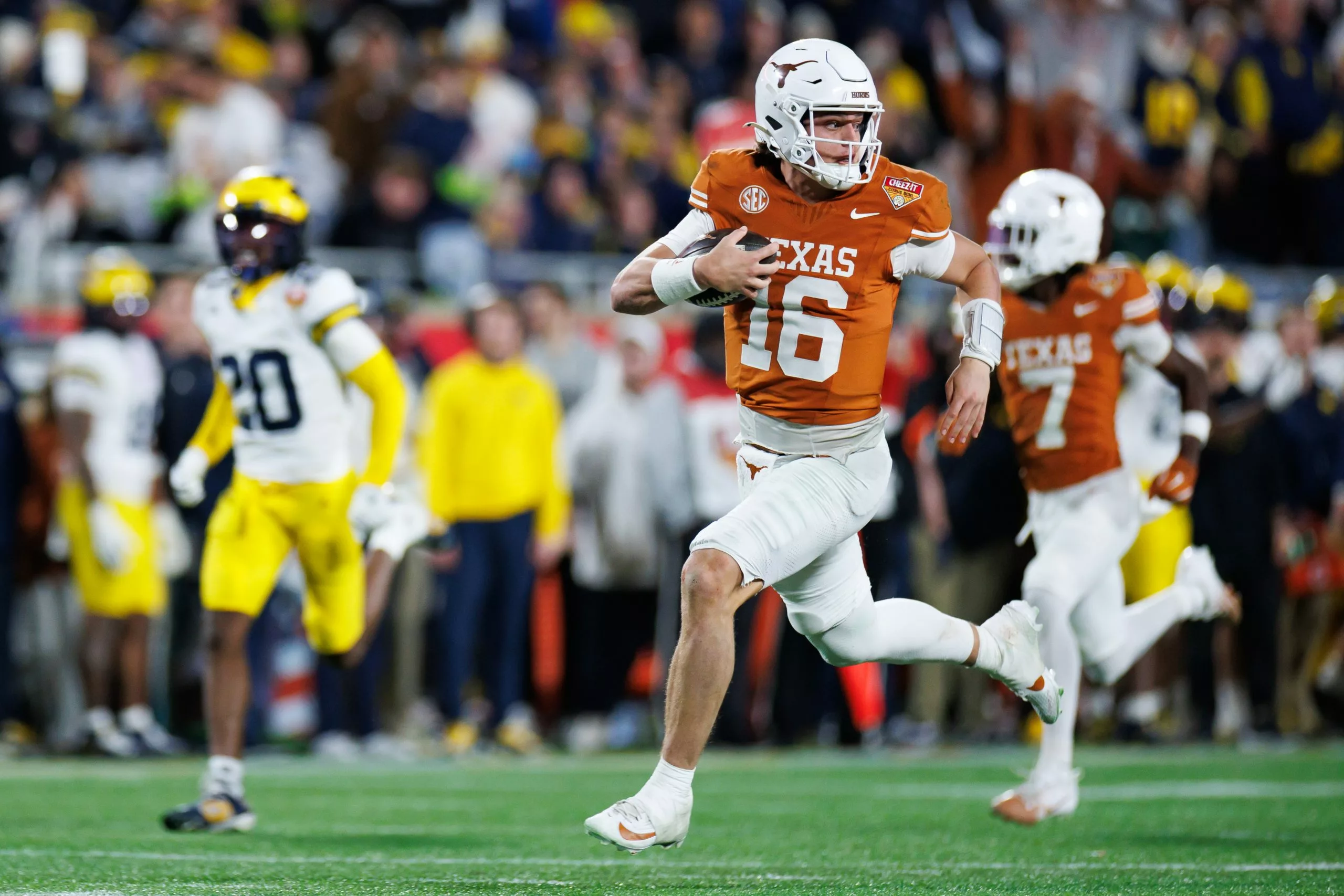
Dec 31, 2025; Orlando, FL, USA; Texas Longhorns quarterback Arch Manning (16) rushes with the ball for a touchdown against the Michigan Wolverines during the second half at Camping World Stadium. Mandatory Credit: Matt Pendleton-Imagn Images
Forty million dollars can give you a dream life and probably buy you a lot of things. But in college football, it now buys one roster, and Texas is writing the check. They want a national championship, and they are willing to spend more than any program in the sport’s history to get it. By multiple reports, Texas is building a roster valued at roughly $40 million, with some estimates pushing closer to $50 million once revenue sharing, collective checks, and outside NIL deals are factored in. For comparison, On3 reported the Longhorns spent around $28 million last season. The number keeps climbing, and that tells you everything about how this sport works now.
None of that money is being spent quietly. Texas loaded up in the portal with the
No.1 receiver in Cam Coleman, a top running back in Hollywood Smothers, and a top linebacker in Rasheem Biles, then added a top-ten class with three five-star freshmen. One On3 insider flatly called it the first $40 million roster in the sport’s history and an all-in season for Steve Sarkisian. None of that looks like a leak taken out of context, because it’s really the plan.
The money has to come from somewhere
Here is the part that doesn’t make the highlight reel. College football now runs on two stacked systems. The House settlement created a $20.5 million revenue-sharing cap that allows schools to pay players directly, but that cap does not affect collective money or outside NIL, so the real spending climbs well past it. The catch here is that the cap still forces hard choices. When a program hands seven figures to a flashy transfer, that money comes from somewhere, usually the depth chart. Players and agents have since figured this out, too. As one breakdown of the new economics puts it, when a Power Four program offers a recruit a little over $100,000, both sides understand he is being paid to be depth, not a starter. The cold math is simple. There is only so much money, and the stars get to feed first.
Even Arch Manning felt the squeeze
If you paid close attention, you will notice the squeeze at the very top of the roster. Arch Manning, the most marketable player in the sport and a possible No.1 pick, agreed to take a reduced share of Texas’s revenue-sharing money for 2026 so the program could fill holes elsewhere, particularly on the offensive line. Manning is not hurting for cash, since his deals with Red Bull, Panini, Uber, and others give him one of the highest valuations in the country. But the gesture says something real. When the quarterback named Manning trims his number to free up room for blockers, the budget has a ceiling, and even Texas lives under it.
How long can this last?
That brings up the question Texas would rather not answer out loud. How long can this list last? Even inside the building, the spending makes people nervous. Athletic director Chris Del Conte has called the current model unsustainable, with a source telling the Houston Chronicle the piece rate is simply too high to keep paying. Texas is betting 2026 is the year the investment finally pays off with a title, which is the whole reason it spent like this. Of course, if it works, nobody will care what it costs.
For now, the Longhorns are the clearest picture of where college football has landed: real money, stacked talent, and an enormous bill. Somewhere on that roster is a player who took a smaller check so a bigger name could be paid, and somewhere on the schedule is the game that decides if it was worth it. More than likely, Texas would do it again either way. When you are chasing a championship, the cold math always feels warm enough to justify.
Up To $1500 in Bonus Bets Paid Back if your First Bet Does Not Win
T&Cs apply
4.5/5
Gambling problem? Call 1-800-GAMBLER or 1-800-MY-RESET (Available in the US) 877-8-HOPENY or text HOPENY (467369) (NY) 1-800-327-5050 (MA), 1-800-BETS-OFF (IA), 1-800-981-0023 (PR). 21+ only. Please Gamble Responsibly. See BetMGM.com for Terms. First Bet Offer for new customers only (if applicable). Subject to eligibility requirements. Bonus bets are non-withdrawable. In partnership with Kansas Crossing Casino and Hotel. Promotional offers not available in Mississippi, Massachusetts, New York, Ontario, or Puerto Rico.
New DraftKings Customers: Spend $5+ Get $150 in Bonuses
T&Cs apply
4.5/5
GAMBLING PROBLEM? CALL 1-800-GAMBLER or 1-800-MY-RESET, (800) 327-5050 or visit gamblinghelplinema.org (MA). Please Gamble Responsibly. 888-789-7777/visit ccpg.org (CT), or visit www.mdgamblinghelp.org (MD), 1-800-981-0023 (PR). 21+ and present in most states. (18+ DC/NH/PR/WY). Void in CAN. Eligibility restrictions apply. On behalf of Boot Hill Casino (KS). Pass-thru of per wager tax may apply in IL. 1 per new DraftKings customer. $5+ first-time bet req. Max. $150 issued as non-withdrawable Bonus Bets. Stake removed from payout. Reward issued as $50 in Bonus Bets every 7 days via click-to-claim for 14 days. Bonus Bets and click-to-claims expire 7 days (168hrs) after issuance. Terms: sportsbook.draftkings.com/promos. Ends 10/11/26 at 11:59 PM ET. Sponsored by DK.
Must be 21+. GAMBLING PROBLEM? CALL 1-800-GAMBLER OR CALL 1-800-MY-RESET, www.mdgamblinghelp.org (MD), (800)-327-5050 or gamblinghelplinema.org (MA), Call (877)8-HOPENY or text HOPENY (467369) (NY), (888) 789-7777 or ccpg.org (CT), morethanagame.nc.gov (NC), 1800gambler.net (WV)
Bet $1 and get double the winnings up to $25 for your next 10 bets
T&Cs apply
4.4/5
21+ New users only. Must register using eligible promo code. First bet after registration must qualify. Max. Bonus Bet: $1,000. Bonus Bet expires 14 days after receipt. Void where prohibited. See Caesars.com/promos for full terms. Gambling Problem? 1-800-GAMBLER (1-800-426-2537)
21+ and present in OH. Gambling Problem? Call 1-800-GAMBLER.
This site is using
Cloudflare
and adheres to the
Google Safe Browsing Program. We adapted
Google's Privacy Guidelines
to keep your data safe at all times.
Close
Ready to Win Big? Join the Elite with Our Sports Betting Deals!
FanDuel Promo
New Users – Get $250 in Bonus Bets when you wager $5 for 5 days
Up To $1500 in Bonus Bets Paid Back if your First Bet Does Not Win
Best Slots
T&Cs and 21+ apply
Gambling problem? Call 1-800-GAMBLER or 1-800-MY-RESET (Available in the US) 877-8-HOPENY or text HOPENY (467369) (NY) 1-800-327-5050 (MA), 1-800-BETS-OFF (IA), 1-800-981-0023 (PR). 21+ only. Please Gamble Responsibly. See BetMGM.com for Terms. First Bet Offer for new customers only (if applicable). Subject to eligibility requirements. Bonus bets are non-withdrawable. In partnership with Kansas Crossing Casino and Hotel. Promotional offers not available in Mississippi, Massachusetts, New York, Ontario, or Puerto Rico.
Code:
Open BetMGM
Get Bonus
DraftKings Promo
New DraftKings Customers: Spend $5+ Get $150 in Bonuses
Newcomer
T&Cs and 21+ apply
GAMBLING PROBLEM? CALL 1-800-GAMBLER or 1-800-MY-RESET, (800) 327-5050 or visit gamblinghelplinema.org (MA). Please Gamble Responsibly. 888-789-7777/visit ccpg.org (CT), or visit www.mdgamblinghelp.org (MD), 1-800-981-0023 (PR). 21+ and present in most states. (18+ DC/NH/PR/WY). Void in CAN. Eligibility restrictions apply. On behalf of Boot Hill Casino (KS). Pass-thru of per wager tax may apply in IL. 1 per new DraftKings customer. $5+ first-time bet req. Max. $150 issued as non-withdrawable Bonus Bets. Stake removed from payout. Reward issued as $50 in Bonus Bets every 7 days via click-to-claim for 14 days. Bonus Bets and click-to-claims expire 7 days (168hrs) after issuance. Terms: sportsbook.draftkings.com/promos. Ends 10/11/26 at 11:59 PM ET. Sponsored by DK.
Code:
Open DraftKings
Get Bonus
Find out what the legends have to say about sports this week....